We arrived at ground zero at 4 pm — two hours before kickoff. I was deep in the FIFA World Cup fan zone and thinking to myself, why can’t every sports game feel like this? What did I mean? Well, for one thing, everyone was smiling.
The World Cup Mood
The match was between Norway and Iraq. Naturally, I wore a deep green Mexico jersey, which I hoped implied some degree of neutrality. Even so, I was getting nothing but smiles from everyone on the hike up to Boston Stadium. For some reason, the Norwegian fans didn’t care about my jersey one bit.
Part of their affable attitudes might have something to do with the new rules at this year’s World Cup. Instead of the usual 32 teams, FIFA has expanded its competition to include 48 nations. This means the early games will be tense but not the end-all, be-all for either camp. At this point, there’s marginally less pressure, and that means everyone just wants to have a good time.
We’ve already been seeing some truly beautiful scenes from across the country. Whether it’s Japanese fans bonding with their Dutch competitors over a mutual love for Dallas barbecue, or Scottish supporters literally outdrinking the city of Boston, it’s clear that the USA may have needed the World Cup more than it realized. For most Americans, these moments of intercultural connection feel refreshing, especially since they’ve become increasingly unfamiliar in the shadow of the Trump administration.
A Shadow Outside the Stadium
Before the match, I was seriously considering what the event would feel like under these circumstances. After all, the Iraqi team’s striker, Aymen Hussein, was detained for nearly 7 hours while entering America, and one Iraqi team photographer was banned from entering the country altogether. For reasons that amount to nothing short of outright bigotry, the Trump administration has been harassing certain teams, going so far as to demand that the Iranian national team not train inside the country.
Trump’s relationship with the World Cup’s governing body, FIFA, has already come under scrutiny in recent months. FIFA president Gianni Infantino’s year-long effort to win the favor of the 47th president culminated in awarding Trump a “FIFA Peace Prize Award.” There seems to be no escaping him. As we walked through the stadium gates, FIFA announced that it would break protocol and allow Trump to lift the World Cup trophy. To the outrage of many, FIFA is also considering letting Trump decide whether to stay on stage while the winning team celebrates.
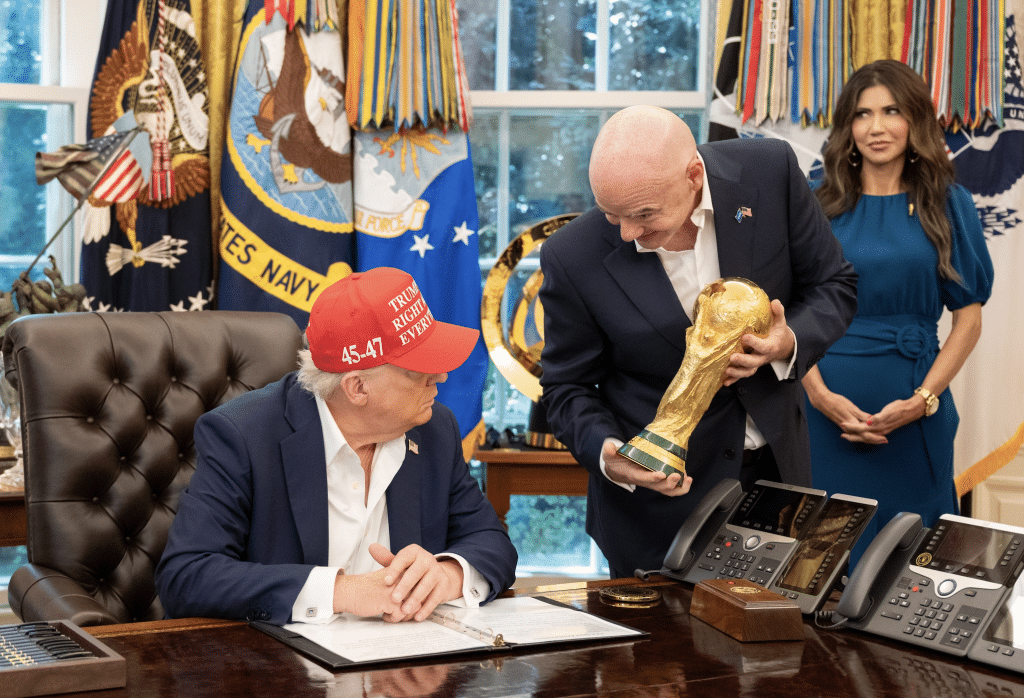
It’s a visual that makes real soccer fans shudder to imagine. Just think of it: The winning team is triumphant at last, its players suddenly skyrocketed into their nation’s history books, and there, right in the middle of all that happiness, is a man who has publicly claimed that certain teams shouldn’t have traveled to America “for their own safety.” It would be a fitting visual metaphor: A scene of celebration ruined by a big, divisive obstruction.
Apparently, I wasn’t the only one thinking about the obstructor in chief. I got talking with some young Scottish fans as we snaked our way through the massive line for drinks. These two were decked out in kilts, Glengarrys, Norwegian jerseys, and Argentina body paint: a regular cross-cultural collage. Their names were Ewan and Jacob, and they’d been thoroughly enjoying their first trip to the United States despite an undercurrent of hostility.

“Really, we know it’s just one guy… Everyone else has been so nice. It’s just old Donny boy ruining it.” Ewan said.
“Did you know he’s Scottish?” Jacob said. “Yeah, his mom is Scottish. But we don’t claim him, though. He’s not one of us.”
The Big Party
The grounds outside the stadium were teeming with excitement. Huge screens towered over the crowds, streaming the other matches of the day. Booths lined the fan zone, advertising everything from walking tacos to limited-edition World Cup plushies. I saw a trailer promoting a “Mobile Sensory Room,” but in the end, I chose to get my face painted instead.
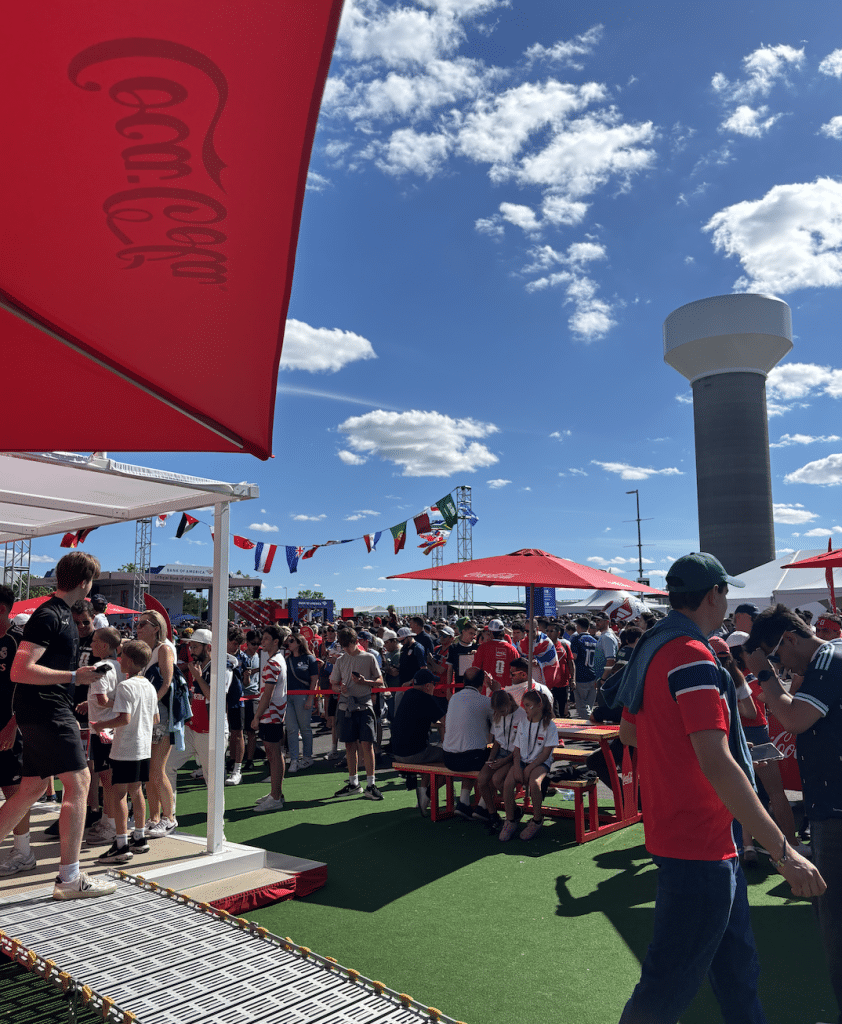
As an Official-Coca-Cola-Face-Paint-Booth-Representative slathered oily paint onto my cheeks, I caught two Iraqi fans staring at my jersey. I was worried that my attempts at impartiality were failing until one of them grinned and wagged his finger at me.
“You beat us last time,” he said. “What was it, like, 4 to 1?”
I realized he was talking about the last time Mexico and Iraq played each other in the World Cup. This had been a friendly match back in 2022, so the memory of this guy had to be insane to not only recall the game itself, but the score to boot. He wasn’t even mad about the loss.
“We support all the teams… but this… today… this is just the best experience,” he said.
That’s what they don’t tell you about World Cup matches, folks. Despite Trump’s best efforts to sow division, everyone who’s there is having an amazing time. There’s an energy at a World Cup match that the American mind cannot fully comprehend. It puts our best concerts to shame. It makes our most intense fanbases look tame by comparison. This is unlike anything you’ve seen before, and we’re not even in the elimination rounds yet.
Enter the Nordic Cyborg
I was sitting squarely in the Norwegian camp, looking out over a sea of red jerseys and Viking helmets. The Norwegian fans have adopted a truly fierce chant in which they all pretend to row a Viking longship. I have to say, watching thousands of synchronized Scandinavians grunting, “Hu!” really gives you a sense that the relatively primitive, “Lets go ____” format desperately needs an update.
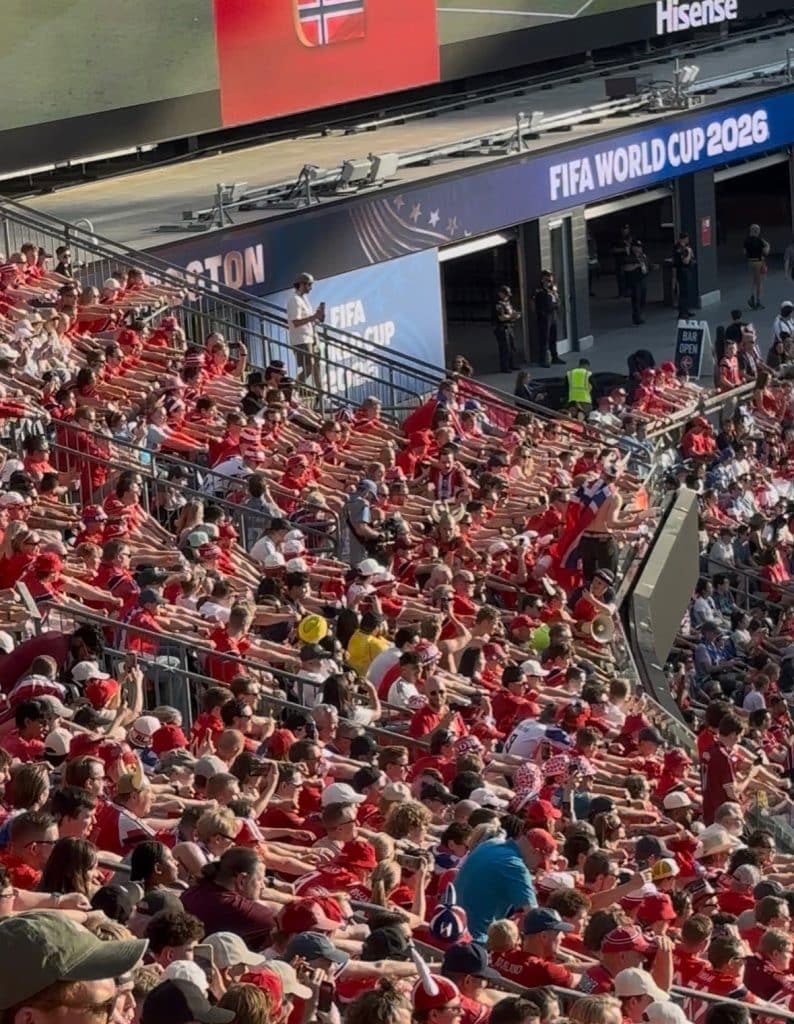
On the other end of the stadium, a mass of white jerseys and Iraqi flags mounted a valiant defense. They were outnumbered — the definite underdogs. But when it came time for kickoff, the Iraqi side erupted in a cheer that nearly rivaled the best Norwegian “Hu!”
Regardless of fanbase, everyone in attendance seemed to automatically know that there would be one man at the center of attention. They call him the Nordic Cyborg. Some have dubbed him the blond behemoth. In most circles, he is simply known as The Terminator. This year, all eyes are on the 25-year-old Erling Haaland, who is making his World Cup debut for the Norwegian national team.
There’d been much talk about the Norwegian sensation leading up to this game, and to his credit, Haaland put on a top-notch performance. His first goal came before the 30th minute, a commanding opening that he solidified by scoring again, not 14 minutes later.
At some point in the match, I was coming back from the restroom and accidentally knocked over a Norwegian fan’s beer, which did not go over well. He had every right to be sulky, considering a “Boston Stadium” World Cup beer was running you just under 15 dollars, but after I insisted that he take my unopened bottle as compensation, everything was water under the bridge. In fact, after Haaland’s second goal, one of them reached over and stuck a Viking helmet on my head — complete with two blond braids.
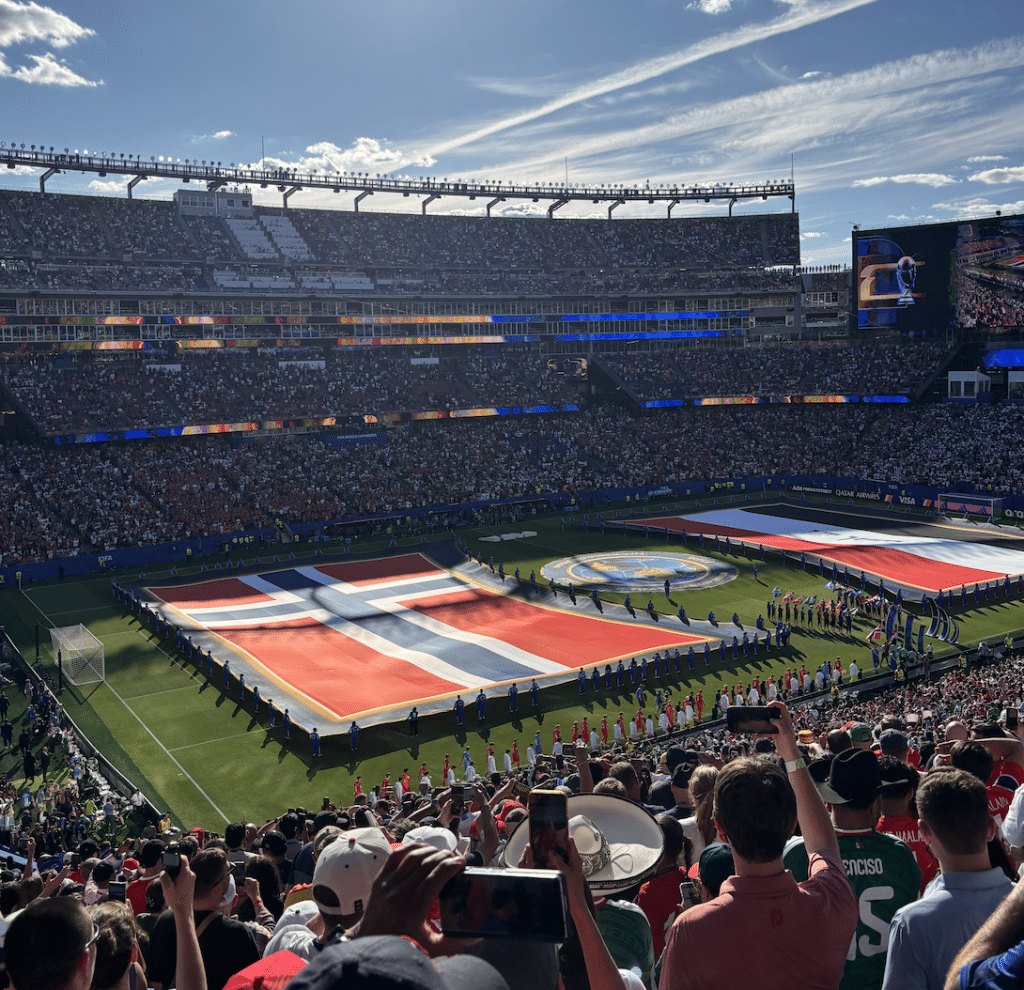
When the half-time whistle sounded, it struck me that I had never been to a single sporting event where I’d ever thought the game was passing too fast. Yet, there was an electricity in the World Cup crowd that made you honestly wish that triple overtime could be a possibility. It’s one big party, and you don’t want it to end. You want to keep chanting with the Norwegians. You want to keep dancing to Husam Al Rassam.
A fan next to me said, “I get it now… I think if I really liked baseball, I wouldn’t care about it lasting five hours.”
Why America Needs the World Cup
After the match, there was a mad scrum to get to the exits. I decided to let that all blow over and hang around with the fans idling in the parking lot. A Norwegian named Jan took a liking to me, and I imagine the absurdly large Viking helmet and braids might have had something to do with it.
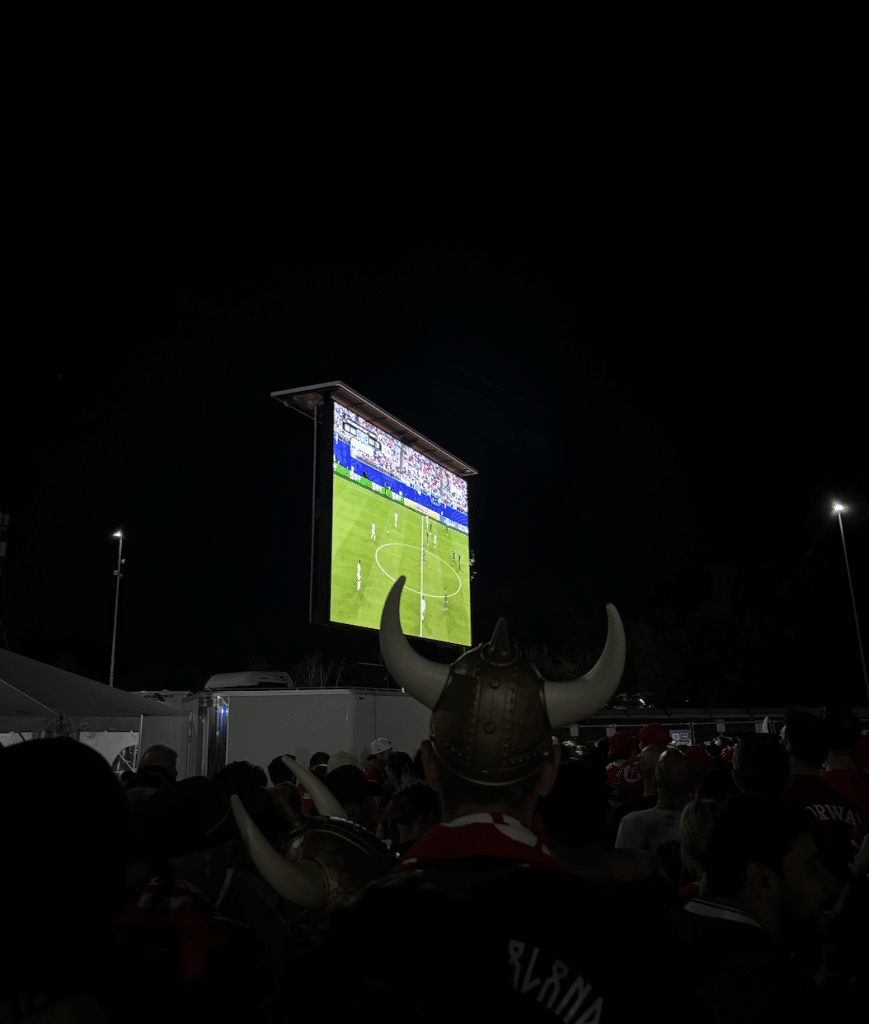
“I love this!” said Jan. “This is what Norwegian is all about. It’s perfect. The whole thing is just perfect.”
Was he only saying this because the final score came out 4 to 1? Then again, I was still seeing nothing but smiles from everyone flooding out of the stadium. Even the Iraqi fans seemed thrilled because Aymen Hussein had scored their first 2026 World Cup goal. There was nothing but love from the respective countries. Nothing but a swelling sense of camaraderie among everyone.
You have to think that this is what makes the World Cup so important. The writer Hunter S. Thompson once wrote, “Big-time Sports and big-time Politics are not so far apart in America. They are both a means to the same end, which is victory.” I don’t know that this is entirely true anymore.
We live in a nation that has turned winning into a dirty grudge match. These days, victory usually comes at someone else’s expense, or, worse, those in power leverage it to justify further abuses. So maybe it’s time Big-time Sports and big-time Politics part ways.
The United States needs the World Cup because the culture of the sport is inherently connective. In recent years, it’s become easy to sink into isolation and infighting. It’s only when you’re arm-in-arm with a Norwegian and an Iraqi, belting out the lyrics to “Don’t Stop Believin’,” that you start to really believe that a better world is possible. That’s the real magic of the World Cup. It’s the antithesis of Trumpian politics, the promise of a global community. It’s a shame the World Cup only comes around every 4 years. I like people better this way.