

The last time I was in a debate with one of my friends, I lost.
We disagreed on the fastest route between two rooms in my old school. Rather than racing it out, trusting the other person not to speed walk, we used geometric analysis and a piece of paper. To my surprise, she was right, and the math nerd in me still genuinely enjoyed the conversation even if I was wrong.
If only all of my arguments went like this.
Yes, this was a very light topic for a debate. However, the more arguments I participate in, the more I notice one of two things. The other person is only trying to either prove me wrong or prove that they are right. We aren’t arguing to agree, we’re arguing to accentuate our differences.
Changing their mind was never even on the table.
Think about the last time you debated someone about something. Did you gain something out of the conversation? Or did you leave more flustered than anything else?
Is the satisfaction of being right even worth a dispute?
Why is it becoming more difficult to have an open discourse about something and change our minds? Are we becoming less impressionable, or more stubborn?

What is debate?

It’s important to understand why we argue in the first place. If you asked Aristotle, he would have told you that rhetoric is the art of persuasion. People debate to communicate clearly and reach a consensus.
Consensus, after all, is what makes an argument productive.
However, this is only possible when both parties are open-minded and allow themselves to be persuaded.
“You just don’t get it.”
You’ve probably heard this line (or something similar) a few times. Maybe you’ve even used it yourself.
This is an attempt to shut the conversation down. Sometimes, we’d rather be wrong than let ourselves be convinced.
Why do we do this?
Social media influence
It’s no secret that the sea of content on social media is a recipe for overstimulation. Your friend’s vacation pictures, product ads, a funny clip, and some terrible local news, all in one scroll.
One way we tend to navigate social media is by blocking out all the extra noise. This is part of the reason why it’s becoming increasingly more difficult to hold people’s attention online. If we don’t like something immediately, we won’t interact with it. We’ll just keep scrolling.
This culture carries over to our beliefs as well. When something challenges our opinion, we steer clear of it.
You can really think of it as a fight-or-flight response. Some people completely avoid the conversation. Others will rush to tirelessly defend their stance until the other person either walks away or changes their mind, and we already know how unlikely that is.
Algorithms feed into this as well. Social media shows us posts based on what we interact with, which is content that aligns with our beliefs. This creates an echo chamber effect.
When we only consume content that affirms our beliefs, we never have to consider another perspective.
The longer we believe that our way of thinking is the only way, the more we begin to see our beliefs as the objective truth. They become more rigid, and we become less willing to change them.
The lengths we will go to avoid these types of interactions can be quite surprising. A 2025 Pew Research study found that the percentage of users of each political party shifted on each platform around the 2024 presidential election. In nearly all cases, when the percentage of one party increased, the percentage of the other decreased.
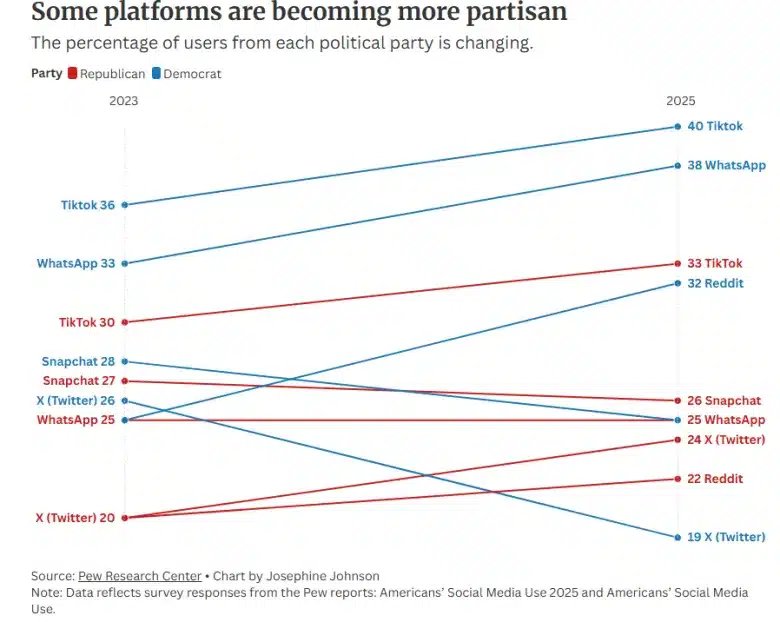
No, this does not necessarily mean that users left these platforms due to the higher volume of the opposing political party. Although it does suggest that people prefer to surround themselves with people who share similar beliefs.
Regardless of the reason behind it, this trend shows that social media platforms are quickly becoming more partisan, feeding into polarization.
Political influence
Speaking of politics, how did we get to a point where even bringing it up is considered risky?
I’ve noticed a subtle shift in the focus of political campaigns. There seems to be a bigger push for vilifying the opposing candidate. I found that this was especially prevalent in 2024.
Take note of the fact that neither candidate mentioned themself in these posts.
Self-centered campaigning leaves room for discussion about each candidate’s goals and methodology. Contrarily, these types of campaigns discourage this by framing the other side as beyond reason.
This framing makes it impossible to agree with anything an opposing candidate says. Changing our political stance on something doesn’t have to feel like a betrayal, but today, it does.
This is how the political landscape became so polarized.
Cultural influence
I have an iPhone.
Did that elicit a reaction out of you?
On paper, the type of phone you have is about as relevant as the brand of pencil you use. I couldn’t even tell you the brand of the last pencil I used earlier today. Collectively, we don’t place any weight on pencil brands.
Yet, the iPhone vs. Android discourse has been going on for years.
At one point, it may have been about the features themselves. Now, it’s more about staying loyal to your group. This “us vs. them” mindset has become part of the dominant culture, throwing blows at the other side without a proper discussion.
In a way, the phone debate reflects our current political landscape.
It also shares similarities with sports culture, which can be equally as divisive. My home city of Philadelphia is known for its intense sports culture, and I can’t say I disagree.
Sure, it isn’t normal for fans to set their own city on fire during a victory celebration.
What non-Philadelphians don’t talk about is the connection you can have with almost anyone in the city just by wearing an Eagles hat.
On the other hand, you’ll probably catch a few unpleasant looks wearing gear for another team during football season. If that team is from Dallas, the number of looks will double.
Not all cities have a sports culture as extreme as Philly. However, when this type of culture is normalized, it further enforces the stubborn way of thinking we’ve discussed.
You might not expect phone brands or sports teams to play a role in polarization, but they do. We are surrounded by this type of culture, and that’s making it harder for us to change our minds.
The impacts of polarization
In a social or cultural context, the consequences of polarization are relatively minor. Your co-worker might make a snarky comment about your phone brand. Maybe you’ll find yourself in a heated debate with someone about which side of a Twix bar tastes better. These are mostly healthy disagreements that do not largely affect interpersonal relationships.
Political polarization is a whole different story.
The longest government shutdown in U.S. history (October 1 – November 12, 2025) was a product of political gridlock.
Many families never fully recover from one fiery argument at the Thanksgiving table. After all, continuing to be around that side of the family would be a breach of contract to their political party.
But let’s not jump to too many conclusions.
Statistically, most Americans fall closer to the center of the political spectrum. Even if they consistently vote one way, they may not hold the same beliefs as the extremists of their party.
Centrists tend to have mixed stances on political issues. This means that they will agree and disagree with both sides about different topics.
In short, maybe that cousin isn’t as crazy as you think.
Listen to others.

I want to be crystal clear about one thing. You don’t have to agree with anyone about anything.
You should still listen to them. Like, actually listen.
As you can tell from the story I told in the beginning, I enjoy a healthy debate. Even if it doesn’t change my mind, I’ll probably learn something new. At the very least, I’ll have taught someone else something new.
Now, I’m making a conscious effort to be less stubborn in my beliefs. I’m open to changing my mind, and I debate to gain understanding, not validation.
I encourage you to do the same.