Homelessness is a visible reality in many Western and non-Western cities; yet public reactions to it vary widely. Some people offer help, while others avoid interaction altogether. Beyond these everyday encounters lies a broader issue: how governments, citizens, and social media shape society’s perception and treatment of homeless individuals.
Online, there seems to be a growing trend of vloggers and so-called influencers offering money and food to homeless people. Walk down any high street in the UK, and there’s a good chance you’ll see someone filming rough sleepers. In the US, a similar pattern has appeared. Content creators are filming themselves ordering large amounts of food in restaurants. They’ll then stage tests to see if staff will feed nearby homeless people.
Maybe I’m cynical, but it’s hard not to see through this. Digestible, quick videos reflect superficial attitudes toward the homeless: compassion in short, forgettable doses. This brand of performative altruism reflects the wider issue of how homelessness is conceptualized in the West: Attention and empathy are predicated on visibility. When the cameras are off, so too is the concern.
Homelessness exists in every society, but the views of homeless people vary dramatically. Across much of the West, many people deem homelessness to be the consequence of poor choices or personal shortcomings. Elsewhere, societies are more likely to link it to economic inequality, housing shortages, or social instability. These perceptions carry weight.
The question is not only how homeless people will survive, but how the rest of society will engage with them.
Homelessness: an unthinkable fate?
In the West, myriad people see homelessness as a worst-case scenario; a fate so frightening that they can’t imagine it happening to them. Politicians, commentators, and activists often turn homelessness into a talking point, overshadowing the human experiences behind it.
In recent years, homelessness has become intertwined with debates over immigration, public spending, and national identity. Governments are seemingly willing to invest resources elsewhere, while failing to support the citizens sleeping rough on their own streets. Whether these claims are justified or not, such arguments frequently overshadow the people at the center of the issue.
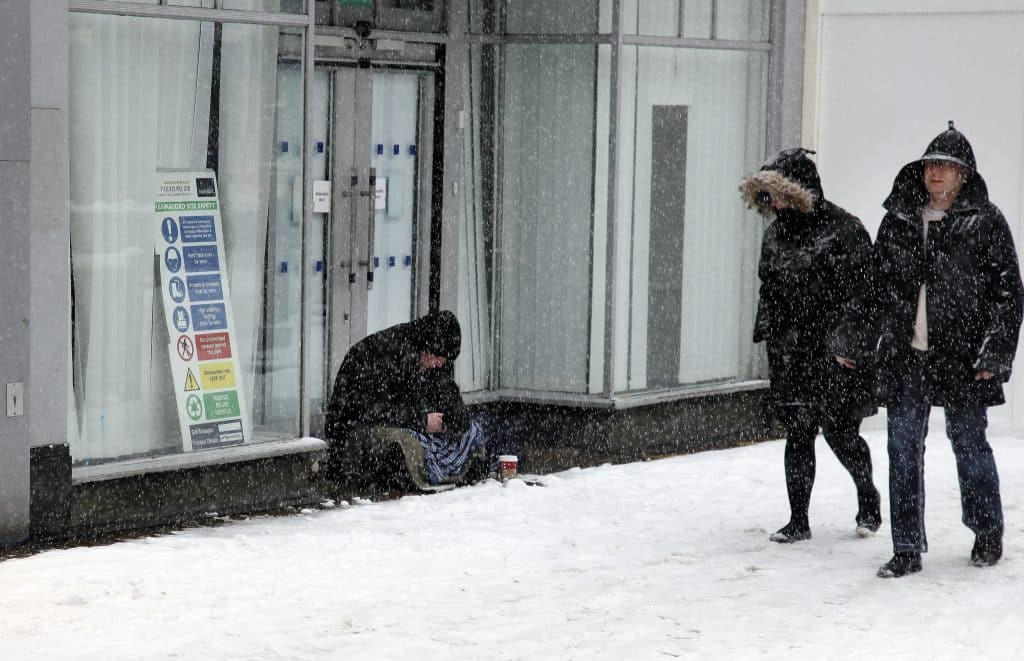
Lost amid political debates is a more important question: How does society actually perceive homeless people? Do people perceive them as victims of circumstances beyond their control, or as symbols of personal failure? Perceptions vary across countries and individuals, but they directly shape how homeless people are treated. If they are classified as victims, they receive support. However, if they are believed to be at fault, they face stigma.

Bigger than a mere symbol or talking point, homelessness remains one of the most pertinent problems in both America and the United Kingdom.
Transatlantic treatment
The two countries recognize homelessness as a social issue that deserves support; yet authorities still tend to treat homeless people as a problem to be managed.
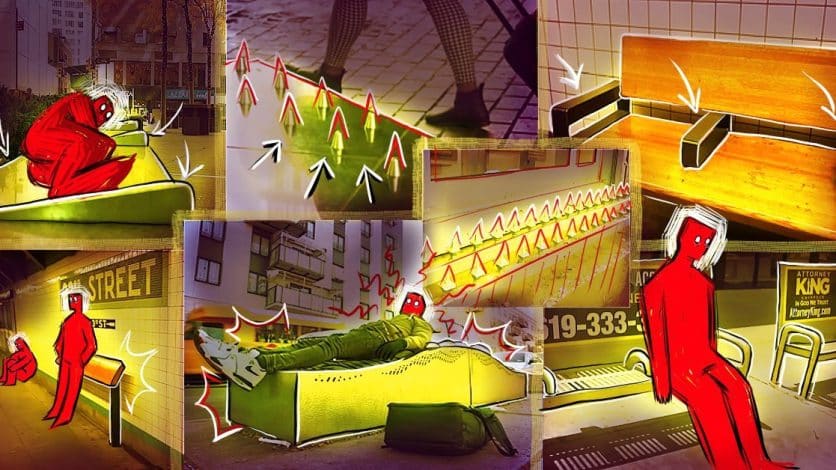
Nowhere is this contradiction more visible than in the rise of anti-homeless architecture: benches designed to prevent sleeping, spikes placed in sheltered areas, and urban spaces that deliberately discourage loitering. While often justified as measures to improve safety or public order, critics argue that such designs send a clear message about who is welcome in public spaces and who is not.

Government responses reveal a similar tension. Both nations’ governments invest in shelters, charities, and support programs, but policies aimed at restricting rough sleeping or removing homeless encampments continue to generate controversy.
In Britain, a culture of suspicion has developed around homelessness. Stories of “fake beggars” are circulating widely online and in tabloid headlines, creating an atmosphere in which genuine hardship is met with doubt. Even when homelessness is acknowledged as real, many people have become accustomed to looking away.
This attitude is reinforced by architecture. In the UK, hostile architecture has become more common in the past decade. This phrase refers to any public space intentionally constructed to restrict the movement or comfort of anyone who is sleeping rough. It can be as slight as a curved bench or a jagged surface beneath a makeshift roof.
Eva Wiseman for The Guardian expands on this phenomenon: “As if it isn’t dangerous, traumatic, or humiliating enough to sleep on the street, you not only face punishment for doing so, but the architecture (in Britain) itself is also designed to move you on. A steel and concrete reminder that you are unwelcome here, a project in erasure.“
Suffice to say, there is a shared transatlantic dilemma: Should homelessness be addressed primarily through welfare and housing support, or through measures that reduce its visibility? The answer speaks to broader societal attitudes.
Though homelessness in America is tied to the recent fentanyl epidemic, its metropolitan cities likewise contain hostile architecture.
How people are using the homeless
For me, any growing social consensus depicted online feels somewhat facetious. While altruistic acts can undoubtedly help those in need, it appears that many content creators who help homeless people are doing so as much for their own image as for the people they are supporting. In numerous cases, the underlying motivation is less about addressing homelessness and more about projecting a personal brand or boosting one’s ego.
This type of content keeps popping up across my social media. What might seem like an innocent attempt to assist those in need is, in fact, a grossly misplaced use of power. There is a sad irony in how social media engagement has fostered a culture of falsified empathy.
You can witness this for yourself in the comment sections, in the shameless hashtags, and in the aforementioned millennial pause (seriously, look out for it). But offering your money, time, and patience to improve your local community is just as beneficial, if not more, with the cameras off.
Beyond the West
Many other nations around the world have much lower rates of homelessness than the UK and the US. I would estimate that culture plays one of the biggest parts in this discrepancy.
Japan, for instance, celebrates a kind of collectivism. Inherent in their culture is the ethos that working together breeds a harmonious life.
BBC journalist Miriam Frankel has observed that “non-westerners are more likely to experience ‘other-focused’ emotions that promote social harmony.” It’s not that the West lacks these values entirely; it’s that they are more apparent in non-Western cultures.
Japan has kept homelessness at remarkably low levels compared with many Western nations. Japanese employers, communities, and public authorities prioritize work and self-sufficiency, and this cultural emphasis limits visible homelessness to a small fraction of the population—around 0.02%. However, this expectation also dictates how people respond to visible poverty, with countless Japanese citizens associating homelessness with personal shame.
A counterargument could be that one of the reasons Japan appears to have relatively low visible homelessness rates is the strong social stigma attached to it. Like other taboo aspects of culture, Japan’s focus on social conformity and avoiding public shame may discourage people from being openly identified as homeless, pushing some individuals into less visible forms of homelessness instead.
Japan also actively hides its homeless. The video below highlights how, in combination with police enforcement and hostile architecture, homeless people are quietly shunned.
Even in places where the levels of poverty are starkly lower, we still see a type of social rejection. In Japan, this manifests in the government. The video above shows that there isn’t room for homelessness in Eastern society. When it occurs, these people are obscured from the bustling communities and forced into segregated communities.
Yet it is crucial to remember that looking at other cultures can reveal what is lacking in our own.
New era of compassion
Nobody has a concrete solution for homelessness, as bleak as that sounds.
Short, attention-grabbing videos may feel like a good way to represent the modern take on homelessness. However, this content further marginalizes rough sleepers by using their circumstances as a way to earn additional revenue.
I believe that a new type of compassion will better serve us in the West. We can all cultivate deeper compassion by being citizens of the world. We are connected to everyone, not just people of our nationality or the people we interact with daily. Humanity’s origins can be clearly traced back to one place.
So don’t film the homeless, and don’t trade compassion for performative altruism. Instead, take a few deep breaths and try your best.