

At the European Rhythmic Gymnastics Championships, Ukrainian athletes protested during the medal ceremony through a silent but visible act.
What happened and why
On May 28, 2026, an act of political protest took place during the awards ceremony at the European Rhythmic Gymnastics Championships. Ukrainian athletes protested during the Russian anthem following the participation of Russian and Belarusian gymnasts at the competition. Their protest was not violent nor with any dramatic gesture or confrontations, but rather silent and highly visual, which made it stand out even more.
Instead of focusing on whether the protest was right or wrong, this article uses the moment to explore a broader question: can sports ever truly remain separate from politics? International competitions involve national teams, flags, anthems, and representation, which means political meaning is often already present. The actions of the Ukrainian gymnasts highlighted this tension and turned a quiet moment into a wider conversation about identity, conflict, and the role of athletes in expressing political positions.
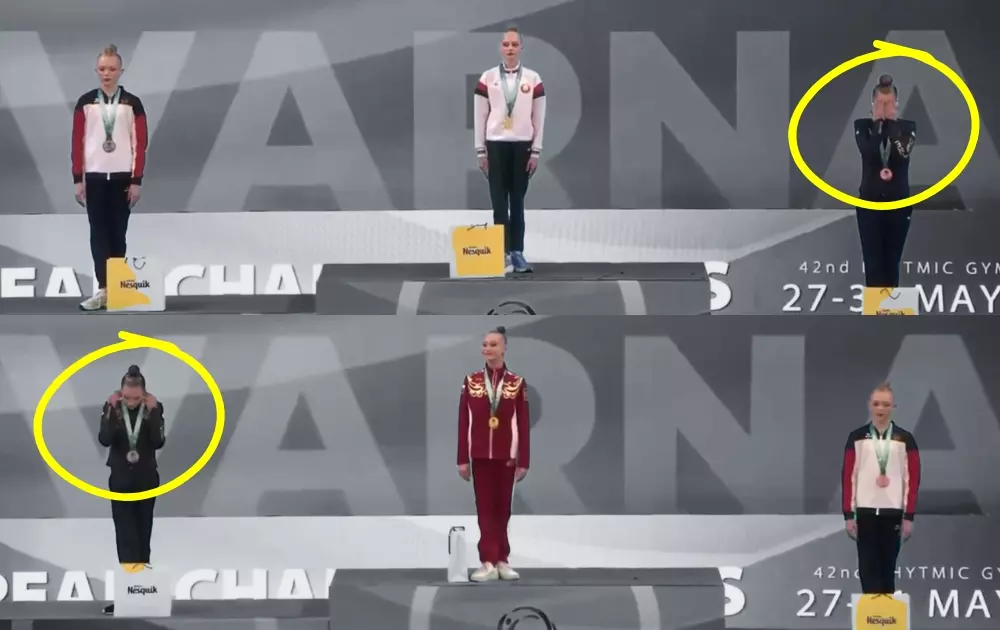
Russian gymnast Yana Zaikina (ribbon event) and Belarusian athlete Kira Babkevich (ball event) won gold medals at the European Rhythmic Gymnastics Championships. Ukrainian gymnasts Sofiia Krainska, who won silver in the ribbon event, and Varvara Chubarova, who took bronze at the ball event, boycotted the national anthems of Russia and Belarus. During the award ceremonies, Krainska and Chubarova protested by putting on headphones and covering their faces with their hands while the Russian and Belarusian anthems played.
The context for this action is the ongoing war in Ukraine. Following Russia’s invasion of Ukraine on the 24, of Febuary 2022, international sports organisations have faced pressure and criticism over whether Russian and Belarusian athletes should be allowed to compete internationally and under what conditions.
The International Olympic Committee (IOC) has repeatedly argued that athletes should not be treated as political tools and that sport should not become a weapon in political conflict. However, moments like this show how difficult it can be to separate athletes from the political realities of the countries they represent. According to Ukrainian media, some athletes are considered participants of the war as they have military or political connections. While the allegations are properly investigated, it shows how close some of the Russian and Belarusian athletes are associated with the war by Ukrainians, since the majority of these athletes didn’t publicly condemn the invasion and war in Ukraine.
Many Ukrainian athletes have spoken publicly about the challenges and hardships they face as the war has affected their training, careers, families, and everyday lives. In this context, competing alongside Russian athletes can become emotionally and politically difficult. Flags and national anthems represent countries rather than individual athletes. However, at international competitions, athletes often become closely associated with the actions and political situation of the country they represent. As a result, audiences may generalise their political position based on their nationality, even if the athlete has not expressed any personal political views.
In the case of Russian and Belarusian athletes, the display of national flags and anthems raises questions about neutrality. For some Ukrainian athletes and spectators, these national symbols make it difficult to separate individual competitors from the governments and conflicts they represent

Why the Ukrainians’ protest was powerful
Rhythmic gymnastics is often associated with elegance, discipline, and quiet performance rather than loud gestures with political involvement. Medal ceremonies are usually moments of celebration, recognition, and joy. Instead, this ceremony became a space where politics became visible and impossible to ignore.
The protest itself relied on silence rather than words. There were no prepared emotional speeches or banners, yet the message reached audiences worldwide. This shows how modern protests in sport do not always need direct statements to become influential. During the medal ceremony, the Ukrainian athletes used body language and visual actions to express their position, showing that silence can sometimes communicate more strongly than a spoken protest.
Other political statements made in the sports arena
However, this is not the first time that sports have become a stage for political expression. Similar moments have happened across different sports and competitions.
During the 2022 FIFA World Cup, members of the Iranian national team became part of international political discussion when they did not sing their national anthem before their opening match, following the death of Mahsa Amini and the wider demonstrations for women’s rights against the Iranian government.
The protest extended beyond the players. Iranian fans in the stadium carried protest symbols, used slogans connected to the “Woman, Life, Freedom” movement, and showed support for protesters at home, while some reports described tensions around political expression inside the stadium.
Similar to the protest at the European Rhythmic Gymnastics Championships, this moment did not rely on loud speeches or disruption. Instead, silence and visual symbolism turned an international sporting event into a political statement. These examples show that sport is often seen as neutral, but because it represents countries, identities, and millions of spectators, political messages can become impossible to separate from competition.
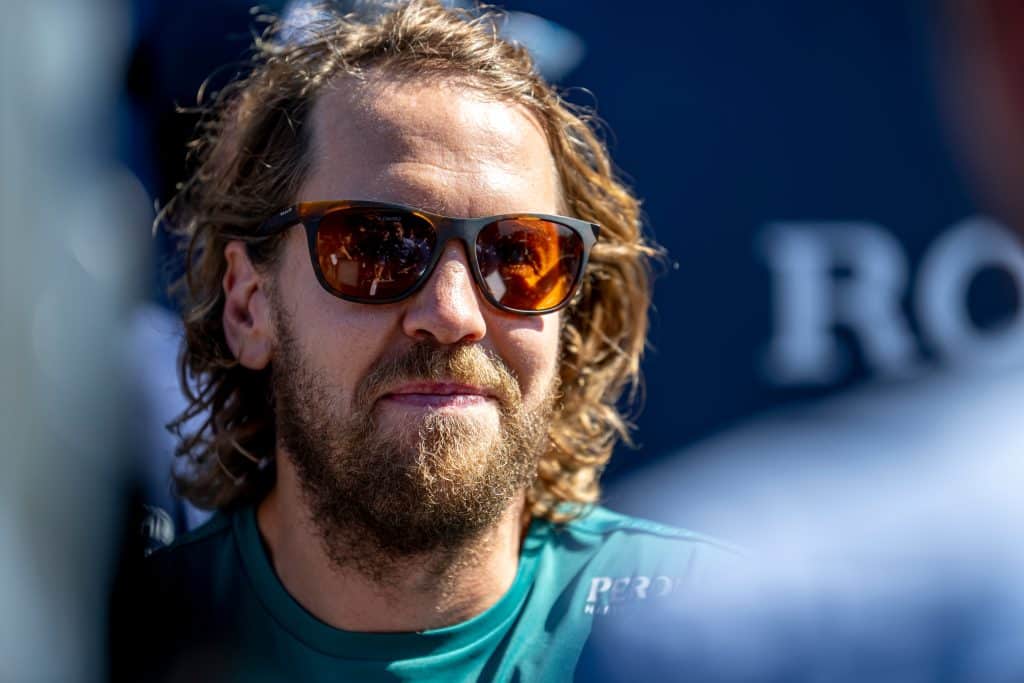
Political messages have also appeared in motorsport. Former Formula 1 driver Sebastian Vettel repeatedly used his platform to speak about social and political issues, including human rights, environmental concerns, and LGBTQ+ rights. By wearing symbolic clothing and making public statements during race weekends, he showed how athletes and public figures can use international sporting events to raise awareness beyond competition.
These examples show that the protest at the European Rhythmic Gymnastics Championships is not an isolated event. Sports are often viewed as neutral spaces, but because they attract global attention and represent numerous countries and their identities, sports continue to become places where political ideas and personal values are expressed.
Can sports ever be a
Sports are often seen as a celebration of athletes coming together from different countries and backgrounds. They are meant to create connection, competition, and shared moments beyond national differences. However, in times of war, this idea becomes more complicated.
While sport is often described as something that unites people and creates a space separate from conflict, it still reflects what is happening outside the arena. Sports can never be completely apolitical because international competitions are built around countries, national identity, and representation.
The moment with Ukrainian gymnasts did not directly change the viewers’ opinion on the war, lead to new online movements, or influence critical international decisions. Views on the war have long been established in the people’s minds. However, it highlighted that the protest’s importance lies elsewhere.
A team that usually competes together for the same goal decided to make a political statement. Quiet but powerful. The two Ukrainian medal winners used the moment they were given the stage, the attention, and the visibility to express something beyond sport. Sebastian Vettel knew that speaking up could have consequences, but he still chose the public stage of Formula 1 to show his support for political and social issues. The Iranian team also knew that the world was watching them during the World Cup. By using that moment, they drew attention to the problems and challenges in their country, making them visible to an international audience.
All the above instances show that athletes often understand the power of the stage they are given. Sporting events are watched by millions of people, so political actions in these spaces can create awareness, public discussion, and international pressure.
For a brief moment, they were not untouchable athletes standing on a podium. They became human. Ukrainians showed their identity, their experiences, and the reality of representing a country where war continues to shape everyday life. Their protest did not try to change political decisions directly, but it reminded audiences that athletes do not leave their personal realities outside the competition hall.
That is what made the moment powerful: not because it changed the war, but because it made people realise that sport is never completely separated from the world around it.
As long as there are political tensions, wars, or global conflicts, sports will continue to become a stage for political views and statements.
This does not mean every sporting event is political by intention. But when athletes from countries in conflict stand next to each other, the political context often becomes impossible to ignore. However, because sports attract large national and international audiences, they often become spaces where political messages are expressed intentionally or interpreted politically. Athletes, organisations, and even governments understand the visibility and influence that sporting events can create.
When athletes from countries in conflict stand next to each other, the political context often becomes impossible to ignore. In this case, the moment did not appear to be a planned political campaign but rather an emotional reaction to frustration, grief, and helplessness experienced by the Ukrainian athletes.
After years of war affecting their country, emotions were naturally high. Standing on the podium while Russian and Belarusian athletes were being celebrated created a moment that, from the perspective of the protesting athletes, may have felt difficult to separate from the reality of what is happening at home.
This is what made the protest powerful. It was not a prepared speech or organised demonstration but a human reaction shown on an international stage.