


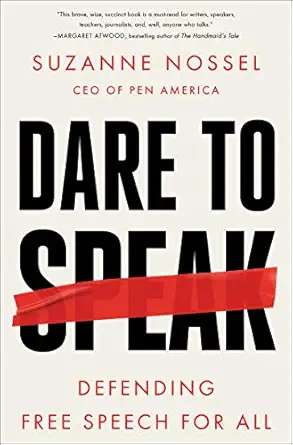
In the midst of a confused and chaotic world, understanding and navigating free speech is more important than ever. For example, the autonomy and power of our voices are important in shaping a sound society. In Suzanne Nossel’s book, Dare to Speak, she lays out four principles to help readers understand how to exercise the freedom of speech.
These principles include: speaking, listening, debating free speech questions, and considering speech-related policies. The duty to carefully and respectfully use your voice comes along with each principle, promoting active communication. Through this, Nossel both informs us about our rights while persuading us to be more considerate about them as well.
As the book progresses, Nossel equips readers to maintain accountability, while also reminding us about the power language holds. Most importantly, Dare to Speak prepares us to interact with speech and ideas that we do not agree with.
The Importance of Free Speech
As the previous CEO of PEN America, Nossel knows all too well the importance of protecting free speech and expression. PEN America is a nonprofit organization that advocates for these things, both through the power of speaking and writing. In her book, she demonstrates how speech has the power to transform the world. Not only does it allow us to express what we believe, but it also goes much further.
At the end of her book, Nossel lists five different points on why free speech is so significant in the first place (Nossel 259).
- Free speech enables society to uncover truth
- Free speech promotes tolerance and lessens violence
- Free speech is essential to individual autonomy, identity, and self-actualization
- Protections for free speech foster economic prosperity, scientific progress, and creative achievement
- Safeguards for free speech have been essential to virtually every form of social progress attained by democracies
Free speech doesn’t stand alone; it is connected to a myriad of rights. The First Amendment also protects the freedom of religion, the press, assembly, and petition. What’s important to know is that without these other rights, free speech would be weak. Every single right listed in The First Amendment connects, and each is significant in maintaining stable communication.
Speech Holds Power: Connection or Destruction
Speech holds tremendous power, both for the sender and receiver. We can either form lasting connections or destroy each other with our words. Between the two choices, the first almost always sounds nicer. But it is harder than it looks. The human tendency to impulsively speak or act is so much easier and so much more comfortable. And with this impulsivity, we often say things that we do not mean. Although we may not mean everything we say, our speech still greatly impacts those around us.
It is our duty to step outside of our comfort zones and use our speech carefully. When we use our speech to inform, criticize, persuade, or entertain, we should be doing so in a mindful manner. When we respectfully use our voices to share something, we should demonstrate patience and humility. Reckless speech only ends in chaos, while deliberate speech makes a difference.

This isn’t to say that speech should be passive and positive at all times, but rather that it should be well thought out. After all, we have earned five freedoms in the First Amendment. This is a huge privilege, and it should not be taken for granted. Instead of using these rights as a path to destruction, let us come together amidst our differences and connect.
Avoid Politicizing Free Speech
In relation, when we gatekeep free speech for a political party, we cause more upheaval. In Chapter 13 of Dare to Speak, titled “Don’t Politicize Free Speech”, Nossel urges readers to defend free speech for all political parties. While you don’t have to agree with what others are saying, it is still important to recognize their rights.
We often see conservatives and liberals protecting their own speech, whilst at the same time limiting the speech of their opposition. While this feels justified to many, it is hypocritical to say the least. It is dangerous to safeguard free speech for your own purposes while trying to silence and suppress the other side.
“Those on the left accuse their political opponents of using free speech as a cover to excuse expressions of bigotry and intimidation. But free speech shouldn’t be condemned on the basis of the worst ideas that can claim its protection. Those on the right invoke free speech as a cudgel, calling out their opponents as cowering and unprincipled. In howling over infringements on their right to free speech, they drown out the genuine articulations of discomfort, pain, or outrage that denigrating expression can provoke” (Nossel 7).
We live in an age where political parties are almost battling for ownership over free speech. According to Nossel, this causes a ‘chilling effect,’ where self-censorship occurs in fear of social disapproval and retaliation. While political parties believe that claiming free speech as their own is beneficial to the country, it completely ignores those who do not abide by their ideologies.
Free speech was not earned for a specific political party, nor was it earned for specific beliefs. Treating this freedom in such a way completely strips it of its power and purpose. The freedom of speech belongs to all, so stop shoving it into a box that it will never fit into.
Defending the Right to Unpopular Speech
Furthermore, Nossel urges her readers to defend speech that they do not agree with. This does not mean sympathizing with it, but it does mean resisting the temptation to silence or shut it out. If we police free speech and put more governmental control over it, we will be stripped of our individual autonomy.
All humans tend to easily defend ideas they agree with, while ignoring or finding fault in ideas they disagree with. It is easy to try to censor ideas you disagree with while promoting beliefs that you abide by. However, with speech, it is almost impossible to please everyone. There will always be someone who disagrees with you or is even offended by your words. But Nossel makes a great point in the midst of these occurrences, bringing up the words of Nani Jansen Reventlow (Nossel 50):
- Views on what is offensive will inevitably change according to who is judging
- Allowing offensive ideas to be spoken and written serves as an important safety valve against the expression of such ideas by physical violence
- In order to move forward as a society, we need dissenting voices, even ones that express their views in a way that may be offensive or shocking to others
Allowing society to respect dissent not only makes room for individual freedoms but also allows spaces of learning through debate. By exchanging opposing and unpopular ideas, we learn to step out of our own worldviews and become familiar with the unknown. Through this, we can help both ourselves and others become less ignorant. After all, free speech is not only available for majorities, but also for the most unpopular ideologies.
Responding to Hate & Offensive Speech With Accountability
While Nossel encourages readers to expand their worldviews on unpopular speech, she also states that we don’t have to be passive towards offensive speech. While people do have a right to offend, they also have a right to speak up against those offenses.
“To be clear, the right to offend does not imply an obligation to offend or to celebrate offensive speech. It doesn’t mean that willful offense is acceptable, much less desirable. Rather, it interlaces with other principles, including the need to use our language conscientiously, to exercise a duty of care, and to be cognizant of the harms that speech can inflict” (Nossel 52).
As explained above, speech should not be met with silencing and suppression, but rather, it should be held accountable. She also makes a clear distinction: not all offensive speech is hate speech. In the book, Nossel provides ethical solutions to navigating through hateful or unpopular speech. For example, she urges readers to avoid shutting down speakers but instead listen and ask questions. These questions allow you to share your own thoughts on the matter, while also holding the speaker accountable by showing them that you will not accept hatred. Rather than preventing them from speaking, you can allow them to do so and then hold them accountable.
With this idea, Nossel provides an example of Barack Obama criticizing Rutgers University for cancelling a planned graduation speech by Condoleezza Rice due to student protestors.
“The notion that this community or the country would be better served by not hearing from a former secretary of state, or shutting out what she had to say– I believe that’s misguided… If you disagree with somebody, bring them in and ask them tough questions. Hold their feet to the fire. Make them defend their positions. If somebody has a bad or offensive idea, prove it wrong. Engage it. Debate it. Stand up for what you believe in. Don’t be scared to take somebody on. Don’t feel like you got to shut your ears off” (Nossel 156).
Don’t fight hate or offensive speech with more hatred, silencing, and suppression. We clearly have enough of that already. Rather, engage in real discussion with those you disagree with. Through this, both you and the other person grow tremendously.
Most importantly, don’t be afraid to speak about what you think is right. After all, laws and decisions are made when brave people challenge ideas. Words have power: you can either cause more division with your speech, or you can change the world one word at a time. So while not all speech is agreeable or likeable, let us uphold our right to the freedom of speech by advocating it for all.












Debra Lewis
June 22, 2026 at 8:13 pm
Words do have power! Thanks for bringing more power to them as well.