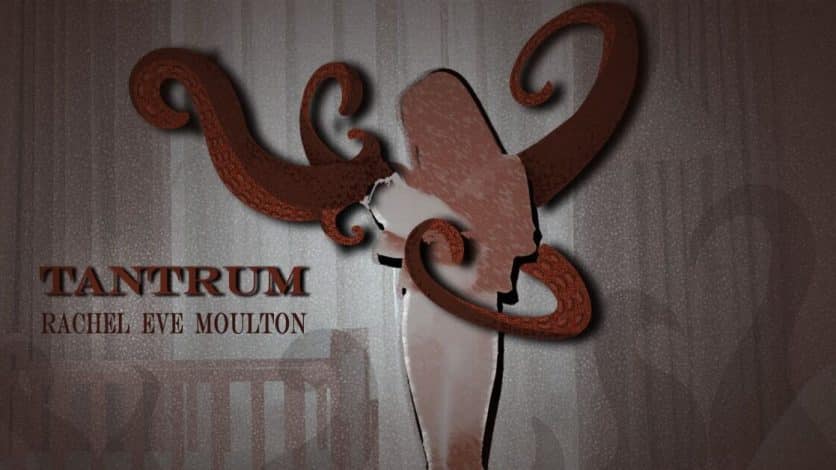
“In this electric horror novel … an exhausted mother thinks her newborn might be a monster. She’s right.”
~Tantrum (book blurb)
Tantrum, by Rachel Eve Moulton is a short 192 page story that packs a strong punch! It focuses on breaking cycles of abuse, as enacted or allowed by a mother to their daughter, with a surreal supernatural twist. In the end, is the idea of being a monster really so bad?
What is Tantrum?
Tantrum is a “feminist-horror” genre book about female trauma told through a lens of magical realism. It uses a non-sequential timeline to follow the life of a middle-aged mother of three, Thea, and her relationships with the women in her life. Specifically, it focuses on her relationship with her newborn daughter of three months, Lucia, and her controlling and neglectful mother. As Thea tackles new challenges with parenting Lucia, she is drawn back into memories of her childhood that she has spent her adult life running from. Ultimately, the only way to move forward may be to confront those monsters from her childhood before they have the chance to consume her completely.
The premise
A mother’s love knows no bounds, but Lucia is a strange child. She has not breastfed in weeks, she devours raw meat, and she is speaking and walking at only three months old. Lucia also has too many, too sharp teeth. One morning, Lucia even ripped the head off of one of their chickens. Thea has told no one this, because she is afraid of what Lucia might do to her and the rest of their family—and that it might be her fault. Lucia is hungry, and Thea must make a choice before it is too late.
The stakes
If Thea cannot come to terms with a past she can no longer—and does not want to—remember, than her story will culminate in tragedy. Lucia will finish what she started and devour her brothers before going after her parents. Thea must confront the choices that her mother made all those years ago or die trying if she wants any chance of saving her family from a dark legacy.
Temper, wean, latch
Tantrum is split into three parts, Temper, Wean, and Latch—each reflecting a phase in Thea’s journey of self-discovery. Temper focuses on Thea’s emotional and literal isolation from everyone in her life, save perhaps Lucia. It unpacks how she lashes out at the people around her because she believes that Lucia is the sort of monster she sees in herself. In Wean, Thea resolves to love and protect Lucia before they journey through Thea’s memories together to confront the people who hurt her in her childhood.
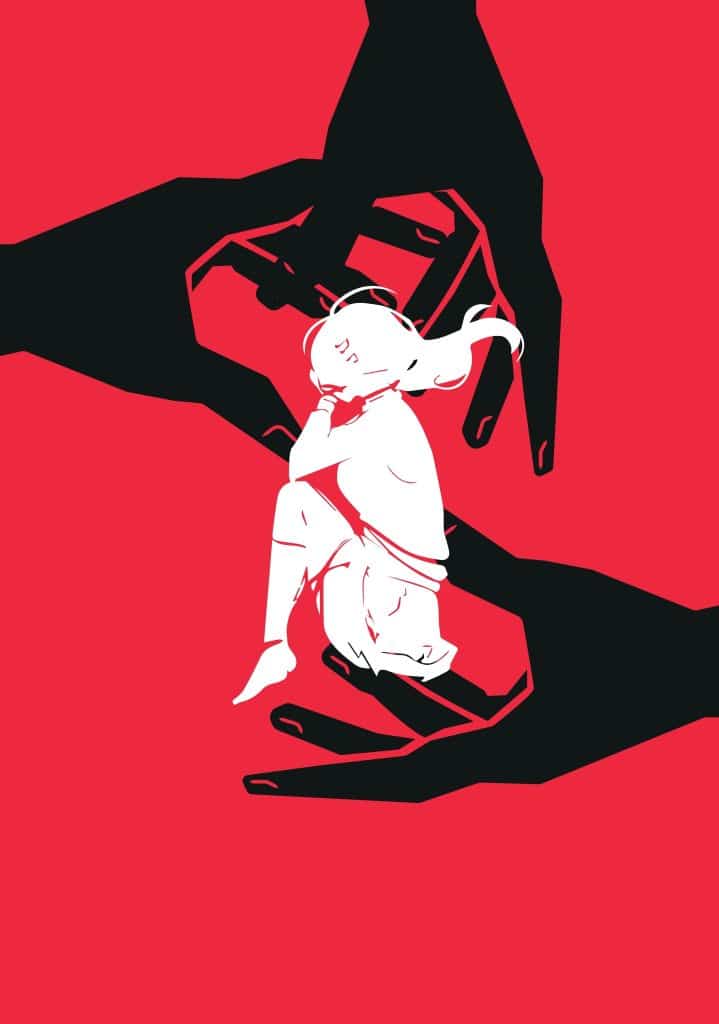
Eventually, Thea realizes that allowing her daughter to consume everything that hurt her in order to help herself would only pass on the trauma. She wants to be better than her mother and to do better for her daughter. So she tells Lucia to devour her. And she does. In Latch, the trauma within Lucia’s body is worked out. Thea is reborn and climbs forth from her daughter’s mouth, determined to face her own mother, claws and fangs and all. Determined to stand up for herself against the lies her mother has spouted about her childhood all her life. She wants to know the truth, and she gets it, for better or for worse.
As a result, Thea must face the reality that:
“[She] was devoured long ago and that [her] spite has been hungrier than [she] thought. [She chose to make] more little people to feed the world. Producing boys that will become men and step into a world that will offer them too much, while telling them they are welcome to take the rest by force.”
~Tantrum
But Thea decides to do something about it. She will save her little girl from the dark realities of her own childhood, or she will be devoured while trying.

The author
Rachel Eve Moulton is a thrice published horror novelist who centers feminist-driven horror in her work. She delves into the emotional relationships between characters, against a backdrop of a fabulistic world. The line between magic and delusion is vague here, cultivating a sense of magic realism. Today, she lives with her husband and two teen daughters, up in the mountains east of Albuquerque.
Tantrum is based on her personal experience of pregnancy and childbirth, in which the body is essentially taken over by something unknown and foreign. Moulton does an excellent job of tapping into the inherent body horror aspect of growing another living thing and bringing it, alive and screaming, into the world.
If you are interested in learning more about the author and her inspiration for Tantrum, check out this interview with her!
Other Works
Moulton is also the author of two other books. Prior to Tantrum, she wrote the Tinfoil Butterfly: A Novel and The Insatiable Volt Sisters: A Novel. Both books have found great success. And perhaps unsurprisingly, they share Tantrum‘s focus on interpersonal relationships and supernatural elements with a feminist horror spin. I would highly recommend, especially if Tantrum‘s subject matter is too dark for you. Tantrum features the most disturbing subject matter by far, and Moulton’s other books may be pleasant alternatives.
Intergenerational trauma
Tantrum is predicated upon the idea of intergenerational trauma. Thea’s mother was abused as a child, and she went on to abuse Thea. Thea, more than anything, wants to break this cycle with her daughter. Even if it is impossible to sever Lucia’s connection, Thea can at least make sure that she heals any inherited damage. Lucia will be loved, because she is Thea’s daughter, and a child, before she is anything else. And even monsters deserve love.
Alienation, vulnerability, and diaspora
The isolation that comes from intergenerational abuse can leave people feeling unmoored and disconnected. When home is not a safe place, you look for comfort elsewhere. There is also a poignant disconnect between Thea and her maternal heritage. She knows so little of what she inherited from her mother and passed down to Lucia. She has no concept of her ancestors’ culture or their way of life, only that their ancestral home is no more. She does not know what she is, so she is forced to carve out a path of her own. This is worsened by her mother’s refusal to address their past. When presented with photos she took and treasured as a child, she thinks:
“Here are the photographs, to go with each and every open house and estate sale my mother my mother and I ever visited. Usually they were on Sundays, so they became a sort of church for us. I worshiped at the alter of these dreamy spaces. … My mother encouraged my longing. … We talked to the house as we went through, or, at least, that’s what I thought we were doing. I was fifteen when she told me we stole from the houses we saw. … ‘What did you think we were doing here?’ she asked. I thought we were there for the same reason, my mother and I, for the love of the space, the dream of belonging. I always took my camera for an exterior shot of the front of each house, just like I had taken a picture of of every apartment entrance where we’d ever lived. I was always trying to find a home. … I was collecting futures, while my mother robbed them.”
~Tantrum
This status as a foreigner in a foreign land made Thea a vulnerable child for the exact same reasons that real-life minorities face higher rates of violent and sexual crimes. For the entirety of her childhood, Thea lacks an effective support network. This is how she ends up victimized by the people in her mother’s life. In fact, what she does know about people like her is awful and terrifying. This difference, this deviation from other people, is, in her mind, the source as much as the result of her familial (intergenerational) trauma. The only way for her to overcome this trauma is to cultivate a sense of belonging. She must find and recognize the people who will stand by her, despite her differences.
The cycle of abuse
Of course, this will not be easy for Thea, especially and as long as her mother remains a permanent fixture in her and her chosen and created family’s lives. Her mother is self-centered and emotionally juvenile. She does not care for Thea in the ways that she needs. She has neglected and outright abused her. What’s more, Thea’s mother believes that because she was not abusive in the same ways that she herself was abused, she did not abuse Thea at all. She thinks Thea should be grateful that she tried to supply the bare minimum.
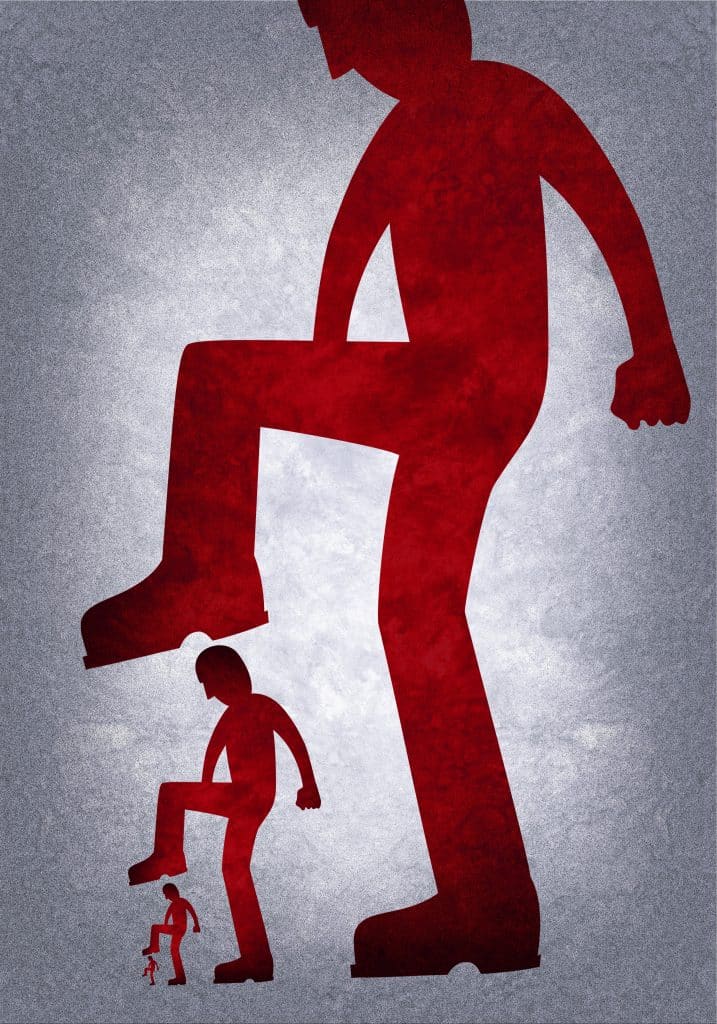
Thea’s mother believes that Thea’s sexual abuse was preferable to getting beaten; that because she filed her daughter’s teeth down instead of sewing her mouth shut nighty like hers was as a child, that she was a good mother. She claims that Thea should be thankful for what she had, that she “had it easy.” Thea’s mother has ruined her daughter’s life in so many ways but is unable to see the damage she has done.
Female rage; mother to daughter
A great part of the violence that Thea and her mother suffer stems from their girlhood. And later, their womanhood. The inhumanity of both women represents the vilification of female rage. A woman’s anger can seem monstrous and alien, especially in a society that does not want to accept that such anger is warranted.
“The anger is stretching to its full height. My jaw hurts, my teeth suddenly feel too big for my mouth. Anger may split my face in half.
‘Your daughter, is just like you.’ my mother says with a tone that makes it clear this is not desirable. ‘Nothing like me.’
‘You’re right. Lucia is nothing like you.’ I say.
‘That’s because I keep myself under control. I don’t let people see my nasty. You need to wake up and start training her to be a lady.’
‘And what exactly is a lady?’ I ask.
‘Well if you don’t know then I’ve certainly failed. I worked my whole life to keep myself managed. Then I spent another two decades teaching you to keep yourself right. … You need to curb it.'”
~Tantrum
In her final confrontation with her mother, Thea’s own rage takes on a decidedly inhuman aspect. This grants her the opportunity to exercise retribution and experience a cathartic release of her emotional turmoil. It is a joy to live vicariously through her. Once Thea comes into herself, the people who hurt her will have to be afraid. But, maybe, Thea will be better than those people.
The monstrosity of the female body
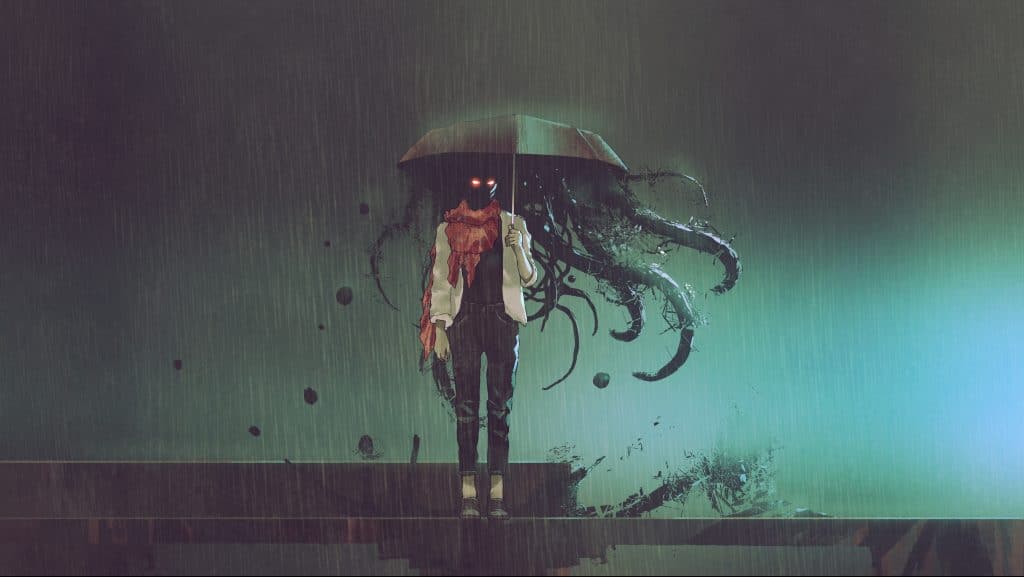
Over the millennia, women and their bodies have been cast as monstrous, from Homer’s sirens and harpies to the demonic transformation in the cult classic, Jennifer’s Body. It’s hardly surprising. Women have the power to create whole new people from their body. They can bleed for days and never die. Few things are more horrifying than these basic aspects of female anatomy, as demonstrated by movies like Alien, where something that is not you rips its way out from the inside of your body.
This is perfectly depicted in Tantrum. As Thea’s mother so eloquently puts it:
“‘And here you are, messing up just like I did. Only far worse, raising a demon baby just like I had to. … Are you so fucking naive that you think somehow she won’t eat all of you alive the first chance she gets?'”
~Tantrum
There is a horror inherent in creating and being responsible for a new life, especially one that is everything and nothing like you. The sacrifices you must make and the inherent costs of child rearing can become a horror unto themselves.
Sub-human and super-human
At the same time, that horror of living as a woman positions women as “other” to men: sub-human and super-human in turn, depending on who is crafting the narrative. This is certainly true for Thea and her maternal family, who are more than human. In the words of Thea’s mother to her:
“‘You know exactly what we are. Freaks. Monsters. Me telling you that we are hideous isn’t going to change anything.'”
~Tantrum
Her mother believes that because they are different, they must hide who and what they are, that they are somehow wrong or deformed. In their final mother-daughter confrontation, Thea refuses to accept this attitude.
Is it worth the read?
I thoroughly enjoyed this book and would absolutely recommend it. By the end, I was completely enamored with little Lucia, and I was hoping for Thea to grow into the person she always had the potential to be. Seeing Thea standing up to her mother made for a fantastic payoff. And I didn’t know how the climax would play out until it had already happened. It was both engaging and unpredictable enough to sustain my interest. It kept me on my toes the whole way through!
That said, lets look at some of my favorite aspects of Tantrum!
Messaging
One strength of the book was its message and delivery. There is a surreal unreality to the horror of the book that spans its fantastical and realistic aspects. This horror is deployed very effectively in the advocacy for woman’s rights. The characters’ journey of literally and figuratively breaking the cycle of trauma really hit home.
Writing and format
Another thing I love about this story is how the writing effectively conveys emotion and setting in simple but fresh language:
“I squeeze my eyes shut, and make the dark darker and remember what I haven’t remembered in a long time. Is it a good memory? A bad one? Perhaps there is no such thing. No distinction, just a jabberwocky of garbage and grace.”
~Tantrum
This is especially true of the official audiobook of Tantrum, which I listened to as I read. It does a great job of enhancing the tone of the book, bringing a sense of vibrancy and life to the characters that I wouldn’t have managed on my own.
Mystery and characterization
While Moulton crafts well-defined voices for each of the central characters of Tantrum, I think the bigger highlight is the characters’ deep entanglement with the mysteries woven throughout the plot. What is Lucia? Is she truly something more than human? Is she evil? Why does Thea resent and distrust her mother? What really happened to Thea as a child, and how reliable of a narrator is she? Is the idea of being a monster really so bad?
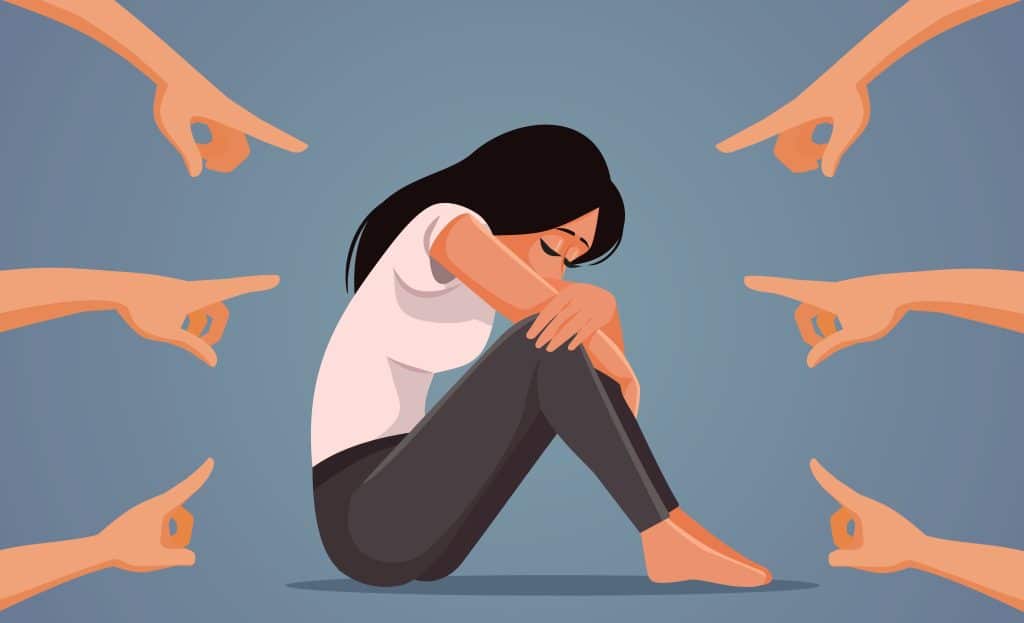
As the story dissects these questions one by one, it reveals more about each character, showing rather than telling their backgrounds. Its structure serves to underscore Lucia’s literal development and Thea’s character arc. Of course, the book simultaneously leaves its reader with more questions. What are Thea, her mother, and Lucia? Will Thea be able to protect Lucia and the rest of her family?
Tantrum does make sure to end the story on a hopeful note. Maybe everything isn’t fixed, but they will all work together to carve a better future for their family.
Timeline
The timeline of Tantrum is non-linear. It is directed by Thea’s character arc instead of a strict sequence of subsequent events. This is aided by the dream-like quality layered over much of the story, where reality, memory, and nightmare blur together. It personally bothers me a bit that the passage of time and presence or absence of characters is not always clear to the reader. I do feel that it reflects Thea’s own disconnect with reality and the people in her life, though. The timeline thereby reinforces the thematic and emotional setting of the story. It won’t be everyone’s cup of tea, but it can be worth pushing through.
A matter of taste
I understand that not everyone shares my appreciation for the disturbing, but I think that anyone looking for a good fiction read should try Tantrum, as long as they can handle dark subject matter.
Dark subject matter
That said, here are some things to look out for in Tantrum.
Tantrum incorporates myriad elements of body horror, including physical transformation and metamorphosis, physical mutilation, violent acts of consumption and of being consumed, bodily invasion, murder via cannibalism, animal killing, and death.

It probes the long-term effects of physical and mental and sexual abuse and addresses violent responses by children to abuse. Additionally, it touches on the impact of mental strain and instability, unreality, and gaslighting and emotional manipulation, as well as the physical mutilation of children’s bodies.
Unlike the other elements, the sexual abuse is not described, though the novel makes it very clear that one of the characters was subjected to it as a child. If these are triggers for you, please do not read.
What to look forward to
If not, I would strongly recommend soldiering on. Buy yourself a copy of this surprisingly sweet and heartfelt story in whatever format works best for you!