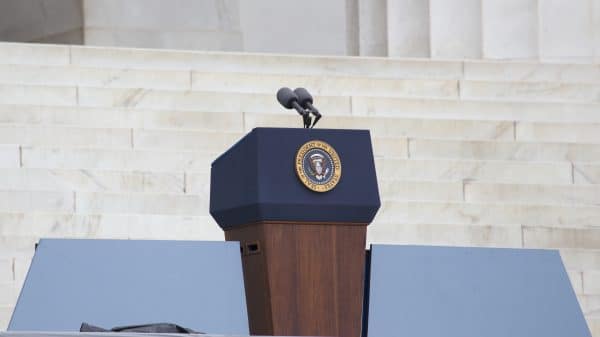
An American president stands before his country, trying to defend a war in the Middle East that in most circles is unpopular, confusing, and unnecessary. To win their support, he tells them, “As we struggle to defeat the forces of evil, the God of the universe struggles with us.”
This isn’t our current president. This isn’t the war in Iran. This is a quote from George W. Bush, attempting to justify the Iraq War. Although most Americans had supported retribution against al-Qaeda, the Islamist terrorist network responsible for the September 11th terrorist attacks, the Iraq War was more difficult to sell. Lacking a genuine threat, top officials made dubious claims that Iraq had weapons of mass destruction. The president also occasionally invoked religious messages in what was supposed to be a secular war against terrorism.
Roughly 4,500 American service members were killed, and 32,000 more were wounded. Yet, not even twenty years later, America is again at war in the Middle East, and again for vague reasons.
How did we get here? And what consequences will this conflict have, not just outside our borders, but within?
A war no one asked for

Most polls suggest the percentage of Americans who oppose the war outweighs supporters by double digits. There are many reasons for this lack of support. For one, a recent poll found that 55% of Americans see Iran as a minor or non threat. And the Trump administration’s stated reasons for invading have changed a lot in the short time we’ve been at war. There’s no solid story for Americans to stand behind.
Moreover, the fighting has killed at least thirteen soldiers, and, because Iran supplies much of the world’s oil, oil prices are surging past $100 per barrel.
President Trump has claimed that the war will be over “soon,” probably because of its unpopularity. On March 13th, Pete Hegseth, Secretary for the U.S. Department of War, similarly stated that Iranian soldiers were “cowering” like “rats” and that their new Supreme Leader, Mojtaba Khamenei, was “likely disfigured.”
This clip raises two questions. First, does anyone in an actual position of strength need to emphasize how “weak” their enemy is this much? Second, why does this have the imagery one would expect from a thriller novel, rather than a security briefing? It makes no difference to American national security whether the leader waging war with us is disfigured or not. Yet Hegseth seems unusually fixated on this image.

Who is the enemy?
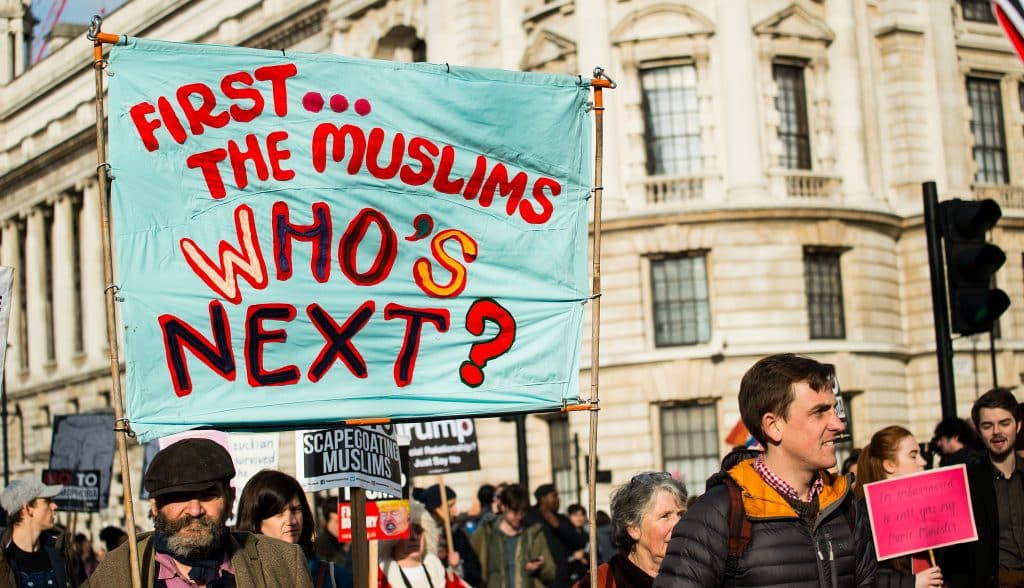
In President Trump’s first campaign, Islamophobia – which refers to unfounded fears of all Muslim people, such as the association of all Muslims with terrorists – was a key rallying point. According to a Bloomberg poll in late 2015, 2/3rds of voting Republicans supported his proposed “Muslim Ban,“ which would block people from certain Muslim-majority countries from entering the United States.
Trump implemented the ban in 2017, banning all entry into the United States for immigrants from Iraq, Syria, Iran, Libya, Somalia, Sudan, and Yemen. Although he claimed that it banned “terror,” not religion, he also described it as a “Muslim Ban” a dozen times.
Support for the ban was evenly split. A notable exception came from white evangelicals, who had a support rate of 75%. He also sent out a tweet claiming that Congresswoman Ilhan Omar, a Muslim, Somali-born U.S. citizen, should “go back” to her country of origin. Three days later, he criticized her at a public rally while his supporters chanted, “Send her back!”
Today, the intolerance continues to grow. Last January, a man attacked Ilhan Omar with a substance in a town hall meeting. It’s true that this would best be described as a political attack and not a hate crime per se. However, it’s impossible to ignore that, hours before the attack, Trump claimed that immigrants must “show they love our country”, and Omar did not. Or that her attacker has a history of racist tweets, including one that said, “Stop other countries from stealing from us.”
Zohran Mamdani, New York City’s first Asian American and Muslim mayor, faced blatant racism and Islamophobia in his campaign. Trump claimed he should be deported, and his Democratic opponent, Andrew Cuomo, seemed to agree with a radio host who said Mamdani would “be cheering” another 9/11.
In early March, former January 6th rioter Jake Lang organized a protest in front of Mamdani’s home called “Stop the Islamic Takeover of New York City.” Two ISIS supporters showed up at a counterprotest with improvised explosive devices that failed to detonate. Mamdani condemned both the hateful protest and the attempted terror attack.
Seemingly in response, Republican representative Andy Ogles (who represents a large Muslim-American district) posted, “Muslims don’t belong in American society. Pluralism is a lie.”
Other Republican representatives made curiously similar statements that same week. Alabama Senator Tommy Tuberville suggested that, because of Mamdani, “the enemy is at the gates.” Speaker Mike Johnson also told Republicans at a GOP retreat that “[regarding] our tone and our messaging … there’s a lot of popular sentiment that the demand to impose Sharia Law in America is a serious problem.”
It means something that many Republicans are invoking Islamophobia right now, while Americans fear the war ahead. It paints a picture of who is to blame: not the administration that started the war, but Muslims. Hegseth’s comments paint this picture, too. His comparison of Iranian soldiers to “rats” suggests they are not only cowardly but vermin-like and potentially less than human. And when he talks about a disfigured villain, note that this is a very common movie trope, meant to associate “abnormality” with “evil.”
Arguably, GOP rhetoric about the Iran War is not just about the Iran War. It’s about who is an American, and who is the “other.”
Myths, Messiahs, and monster-making
As previously stated, one of the ways George Bush justified the Iraq War was through religious rhetoric. Although he claimed Islam is not a “religion of terror,” he was simultaneously convinced that God told him to “end the tyranny in Iraq.” In this story, there were fundamentalist villains, but also victims who had to be saved by a different God and a different nation, detached from their own culture and lives. It’s a story that, though more sympathetic than blatant Islamophobia, didn’t allow for moral ambiguity or self-determination.
The reality that followed had some of the worst human rights abuses of this century.
As early as November 2003, the Associated Press interviewed former Iraqi prisoners of war who claimed American soldiers had abused them while they were captive. Today, two Iraq War prisons have earned particular notoriety: the Abu Ghraib prison and Guantánamo Bay Detention Camp. The first was an army prison, originally built by Saddam Hussein to hold political prisoners. The U.S. Army seized control of the prison and used it to hold Iraqi POWs, whom they subjected to horrific acts of torture, including electrical shocks, sexual abuse, and attacks from trained military dogs. Guantánamo Bay, a Cuban military base, was “an island outside the law” where soldiers conducted similar brutal acts without oversight.
Will history repeat itself? In one way, it has. The nonprofit advocacy group Military Religious Freedom Foundation (MRFF) has already received 200 complaints from soldiers who say their superiors are using religious language to justify the Iran War.
“[My commander] said that ‘President Trump has been anointed by Jesus to light the signal fire in Iran to cause Armageddon and mark his return to Earth.'” – Anonymous non-commissioned officer
Similarly, Trump recently suggested that the ISIS attack on Mamdani, and two other recent Islamist terror attacks on a synagogue and a university, were due to “bad genetics.” It’s the language of science, not the language of religion, but both say the same thing. They say there is something evil in the nature of these people. Something that, in theory, could be present in people similar to them.
These ideas covertly enable Islamophobia. Nothing justifies terrorism, ever. But the man who attacked the synagogue had lost four family members to Israeli drone strikes a week before, which illustrates that political violence like this rarely emerges in a vacuum or some intrinsic malice. It comes from personal grief, political conflict, and extremist propaganda. Trump, in his statements about genetics, ignores this nuance.
Multiple writers have pointed out how Trump promised to be a “President of Peace” in his campaign, yet started many international conflicts while in office. To just describe this as hypocrisy fails to recognize that “peace” means different things to different people. From a liberal, pluralist, isolationist perspective, this war is unnecessary, and therefore, starting it was not a peaceful act. But to those who have been taught to believe in Islamophobia – that Muslims are an inherent threat – neutralizing the enemy first is the only path to peace.
Islamophobia is not the answer. If history teaches us anything from the Iraq War, it is that the stories leaders tell about enemies matter. When those stories rely on religion, fear, or dehumanization, the consequences rarely stay overseas. They will shape how Americans see each other at home. When a person is inherently wrong, any cruel thing done to that person becomes right.