
For years, experts predicted young people would leave religion behind. New data suggests the story may be more complicated. Here’s why.
Experts, for years, assumed that young people in Western countries would become less religious than generations before them. Raised in increasingly secular societies with opportunities, identity decisions, freedom, and information than ever before, Gen Z seemed likely to continue the trend away from organised religion. But recent data suggests the picture may be changing.
Interests are particularly visible among young Americans. According to Gallup, 28% of men under 30 stated that religion was ‘very important’ to them in 2023, increasing to 42% in 2025. Similar patterns have appeared in parts of Western Europe. Survey suggests that Gen Z is attending church at higher rates compared to their grandparents, with over 20% increase in countries such as Sweden, Germany, and the UK.
But why is it especially Gen Z sticking to faith again?
God got a Glow-up
Scrolling through Instagram or TikTok, you may have noticed more young influencers sharing faith with their followers through inspirational bible quotes, advice, and aesthetically appealing everyday lives with god.
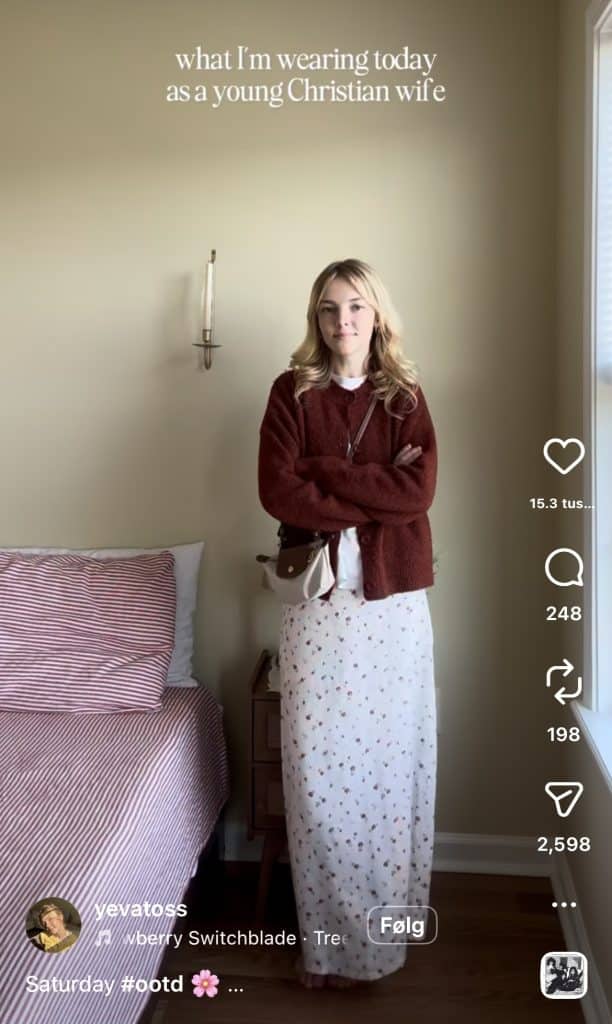

Search hashtags on Instagram like #ChristianLife, most of what you’ll find is a version of Christianity tailored to social media and Gen Z: soft colours, cute visuals, communal bonfires, and young faces. Christianity online has become Gen Z-styled.
Some experts point to the Covid-19 pandemic as a turning point. The churches closed their doors and opened online instead, branding the church in a medium different than before.
Researcher Dr. Edward A. David argues that while every generation searches for meaning, the way Gen Z does so has changed. Both religion and algorithms are built around a similar dynamic: people search for answers, and both provide them. Religion offers meaning, belonging, and direction, while algorithms continuously deliver content that resonates with users’ interests and uncertainties. As media becomes increasingly personalised, David argues, it is not surprising that religion is thriving online.
The idea is supported by the study The Impact of Social Media Algorithms on Religious Belief Formation and Community Engagement. Surveying 400 active social media users, researchers found that personalised algorithms significantly influence exposure to religious ideas by repeatedly reinforcing familiar themes.

Podcast host Andrew Gill has also noticed the role algorithms play.
I believe that many evangelical leaders became more savvy with social media in this time frame and worked to create the image of more young people turning to evangelical Christianity by employing influencer aesthetics and posting techniques – Andrew Gill

However, experts caution against overstating a sudden Gen Z religious boom. Churches are not suddenly overflowing with young worshippers. Instead, that religious decline may simply be slowing, and that social media and news coverage can sometimes make the changes appear larger than they are.
Gen Z Doesn’t Want More Options. It Wants Answers
In societies shaped by individualism and economic uncertainty, Richard Reeves points to a growing yearning for purpose and structure. In a CNN interview, he says that many young men are no longer asking “What should I feel?” but rather, “What should I do?”.
This shift is particularly visible in secular Western countries, where success is often framed around individual effort, hard work, and personal responsibility. At the same time, daily life has become increasingly efficient and individualised: people work from home, shop online, and turn to AI for advice. As freedom, choice, and opportunity expand, so does the burden navigating them, which can feel like a paradox of infinite choices.
A counterreaction to such can be the search for expectations that are clearly framed within structure, discipline, and meaning. Reeves points to the appeal of long-established traditions such as Roman Catholicism or Eastern Orthodoxy, where stability and consistency can feel reassuring in a rapidly changing cultural norms.
Author to God Is Personal: Finding the Father in a Crowded World and pastor, Justin McLane, who himself became religious later in life, believes that young people are attracted to religion, because they, for once, are told that they do not have to change themselves to be loved, specifically in this period of their lives, where getting into the right universities, creating social circles, and forming identity can feel like a never-ending race for recognition.
Community Beyond Screens
Gen Z is one of the loneliest generations. A 2025 Cigna Group report of “Loneliness in America” found that 67% of Gen Zers reported being lonely.
Gen Z is constantly watching other people’s lives unfold through a screen, their friendships, parties, achievements, and social circles. For someone without a close friend group or a strong sense of community, it can feel like everyone else has found belonging that they are not a part of.
Experts point to the importance of unconditional belonging, spaces where people are welcomed without needing to prove themselves first. The church is stable, and one of the few places left that offers a space where you don’t need to be good at a sport, know the right people, or pay to be there. The online community suddenly translates to being tangible – you just show up. Gill supports this idea, saying:
I think that with the loss of social capital, religious spaces are one of the few public places that are not obviously transactional. People need a framework to make meaning of the world, which religion provides in ways that technology cannot. – Andrew Gill
Furthermore, Dr. Edward A. David also argues that as different forms of religious practice become more visible online, religious communities appear larger and more diverse. This allows young people to approach religion and spirituality on their own terms, less tied to traditional institutions and with fewer preconceptions than previous generations, while still feeling part of a wider community. A young woman who joined religion at 18 complements the idea, she said, “On social media, I was exposed to so many different ways of practising Christianity, which made me feel part of a larger community, while still allowing me to practise it in my own way.
An Overnight Trend, or a Generational Commitment to God?
So what happens next?
More than anyone, Gen Z understands how quickly trends can emerge and disappear online. It is still too early to say whether the renewed interest among some young people represents a lasting shift or a temporary cultural moment.
What makes this trend notable, however, is that it appears to be driven by needs that are unlikely to disappear anytime soon. Young people are searching for a community in an age of loneliness, direction in a culture of endless choices, and purpose in an increasingly uncertain world.
Whether religion’s resurgence proves temporary or enduring, those needs are likely to remain.