One weekend, during my designated phone time, Zara Larsson pops up on my timeline. She’s wearing bright colors, she’s having fun, she looks beautiful. And if you are online, then you know all about her Midnight Sun era—a defining album and moment not just for the singer’s career, but for modern pop music.
I scroll through Larsson’s Instagram, and I notice that she has that aesthetic all over her page. Bedazzled tops, pink and blue eye makeup, dolphins, rainbows—anything that represents the summer. She became summer personified, and it made her stand out.
And I realized: It’s not just that she looks good. It’s that she feels specific. Now, you can’t see a beach picture or a Lisa Frank drawing without thinking of her.
And that kind of specificity feels rare in this digital age.
The It Girl once defined the culture instead of reflecting it.
According to Classic Six, the term “It Girl” has been thrown around for ages. An “It Girl” is defined as a young, attractive woman who exudes a sense of magnetism. The phrase was popularized through Clara Bow, where “It” meant something close to sex appeal—something you couldn’t quite explain, but couldn’t ignore.
Every era had its own. The 50s had Marilyn Monroe. The 70s had Cher. The 90s had Chloë Sevigny.
What made them “it” wasn’t that they fit in. They introduced something new. They weren’t pulling from a reference—they became one.

The Internet made “It” replicable.
But something has shifted.

The women we once called It Girls stood out because they disrupted. Now, we are saturated with a constant stream of “It Girls” and “It-Girls-to-be.” Social media has widened the pool. We’re no longer just looking at actresses, models, and musicians. We’re looking at girls who make TikToks, who build followings, who turn aesthetics into brands.
And while that expansion is interesting, it reveals something else.
Because while there are more “It Girls” than ever, many of them don’t really have… it.
Content creation has become oversaturated. The same products, the same lifestyles, the same aesthetics circulate over and over again. Audiences consume it, then aspire to become it. The It Girl is no longer just a person—it’s a goal, a lifestyle, even a career path.
But when everyone is dressing the same, acting the same, curating the same life, there’s nothing left to differentiate.
It’s less about becoming an It Girl and more about trying on the “It Girl wig”— pulling from what they see, applying it to themselves, and hoping they might gain recognition too.
What’s happening here isn’t just cultural—it’s psychological.
Psychology defines the validation cycle as a process in which people rely on external feedback to determine their sense of worth instead of internal grounding, and early experiences—family, school, and environment—often shape that pattern.
But in the digital age, that cycle has been amplified and accelerated.
Recent research claims that almost 50% of adolescents today suffer from low self-esteem. A key cause? Social media comparison. Growing up online means constantly encountering curated versions of other people’s lives—their beauty, their lifestyle, their desirability—and learning exactly what gets rewarded.
You don’t just see someone being admired—you see why they’re admired. The outfit, the pose, the lighting, the routine all start to signal what works, and over time, it becomes clear that validation follows patterns. And once those patterns are recognized, they can be replicated.
So people begin to model themselves after what they see working.
A post that performs well creates an emotional high. It feels like confirmation—this works, this is good, this is me at my most acceptable. But that feeling doesn’t last. It turns into a need to recreate it. And when a post doesn’t perform, the opposite happens. There’s a moment of doubt—what did I do wrong? What should I change?
Over time, those adjustments stack. Identity becomes less about expression and more about optimization.
And when the most visible “It Girls” are not distant celebrities, but girls who feel accessible—girls who seem like they simply figured out what works—it makes one’s own transformation feel possible.
Not only can you admire them. You can become them.
But in that process, something gets lost. Because when validation becomes the goal, identity becomes flexible. And when identity becomes flexible, it becomes interchangeable.
When sameness becomes the standard, distinction disappears.
The result is visible everywhere.
Everyone begins to look the same—not because originality disappeared, but because originality stopped feeling safe. When validation is tied to familiarity, experimentation becomes a risk rather than a reward.
“If it ain’t broke, don’t fix it.” If the algorithm rewards a certain look, a certain pose, a certain lifestyle, then stepping outside of that becomes a gamble. So people stay within the lines.
And that comfort is exactly what waters down “it.”
The It Girl has become an aesthetic with rules when it was never supposed to be one. You can’t condense “it” into a Pinterest board. The real It Girl exists outside of instruction.
Think of Jane Birkin—her style wasn’t curated for replication. It was lived in, instinctive, hers. It’s replicated now because it has already been validated as “it.”
Validation has quietly replaced identity.
The It Girls who still feel like themselves
But fear not! The It Girl still exists. There are women today who have stepped out of the mold of what is expected of them and moved with authenticity, positioning themselves at the front of cultural conversation:
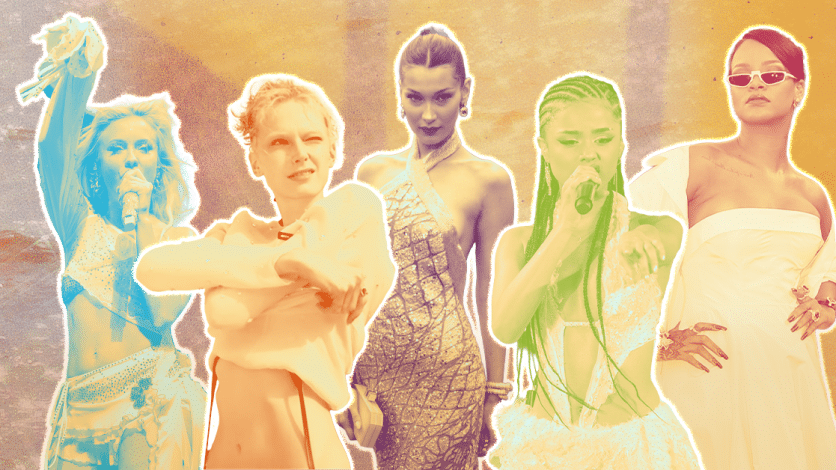
Alex Consani
Alex Consani refuses the traditional model script. Where models are expected to be silent, polished, and distant, she’s loud, unserious, and deeply online in a way that feels intentional—not try-hard. Her presence doesn’t dilute her image; it builds it. She reminds people that personality is not a liability in fashion—it’s an advantage.
Tyla
Tyla doesn’t feel like a product of the internet—she feels rooted. Her sound, her movement, her visuals all pull from a specific cultural lineage that isn’t being watered down for mass appeal. That specificity is exactly why she translates globally. She didn’t chase a trend—she arrived with one.
Bella Hadid
Bella Hadid represents a turning point. Her aesthetic—off-duty, minimal, slightly undone—became so influential that it’s now everywhere. She didn’t follow a formula; she became one. If anything, the oversaturation of “it girls” who look alike proves her impact. The copies only exist because the original hit that hard.
Rihanna
Rihanna is the blueprint. Before the algorithm, before the hyper-curated feed, she moved off instinct. Every era, every look, every shift felt self-defined and ahead of its time. She wasn’t asking what worked—she decided what would. That’s why her influence doesn’t fade. It regenerates.
Katya Bratwaite
Katya Bratwaite feels like someone you discover, not someone pushed to you. Her style is layered, referential, and personal in a way that resists easy replication. She doesn’t look like a trend cycle—she looks like her own archive. That’s what makes people pay attention.
Quenlin Blackwell
Quenlin Blackwell doesn’t separate her personality from her image—and that’s exactly why she stands out. She’s chaotic, funny, self-aware, and emotionally transparent in a way that feels human, not curated. You’re not just looking at her, you’re experiencing her. That kind of presence can’t be duplicated.
What separates these It Girls isn’t perfection; it’s authorship. They’re not assembling themselves from what already exists. They are writing themselves authentically and originally, becoming the reference.
The system isn’t neutral—but you still have a choice
It’s worth noting: the desire to be seen isn’t the problem. It’s what we give up to be seen.
Social platforms do not operate as neutral spaces. They amplify specific aesthetics, reward certain behaviors, and create feedback loops that encourage repetition. Users respond to those signals by adjusting how they present themselves, often without fully recognizing the extent of that influence. And by engaging with those same patterns, we reinforce them too.
At the same time, individuals still make choices within that system. Even something as simple as a spring break dump or a casual post on Instagram can either reflect something personal or fall into what already feels familiar.
The desire to be seen remains natural. Problems arise when that desire overrides the need to develop a stable sense of self. When people prioritize validation above identity, they become more adaptable but less distinct.
Personal style and aesthetic become a risk factor, and people are making themselves more malleable.
But as shown in the It Girls we know and love, they dared to be different. They dared to be themselves, and the world had no choice but to tune in.
So what do you actually want?
I was pulled in by Zara’s page because she gave me something to be pulled by. A visual identity that felt entirely her own.
That clarity feels increasingly uncommon.
We have to learn to be comfortable with our identities, even if they differ from what is “popular” at the moment. And that doesn’t just apply to what you post—it applies to what you engage with. Because the more we reward sameness with our attention, the more sameness becomes the standard.
Because at some point, you have to decide: Do you want to be recognized? Or do you want to be distinct?
The It Girl doesn’t follow the algorithm.
The algorithm follows her.