

Budget travel promises a more intimate and unique experience than regular tourism does. But the more I’ve traveled this way, the more I’ve had to think about what it actually means to show up somewhere as an ethical budget traveler—how to spend your money, what your presence costs, and what your place really is in your destination.
Budget traveling is one of the most rewarding experiences I’ve had. It puts you out of your comfort zone just enough that you are constantly in this unguarded and present headspace. It makes you so receptive to connecting with the local culture, more so than regular tourism or vacationing ever could. Living more humbly somehow makes you live more bravely when you are traveling. I think that’s why it’s become so popular with Gen Z: we can often feel that our lives, especially filtered through social media, can feel performative and safe. In reaction, we have this deep urge to seek out more unique and exciting experiences. We are looking for something that actually feels different from our normal lives. Budget travel is a great place to turn, because of course, you can do it on a budget.
So we take off, we pick a location that’s cheaper than home, and we prepare to pinch every penny. But this sets us up for a potentially problematic perspective. It’s important to remember that for most of us, if we are able to travel, we are already in a position of privilege. And the first problematic thing is the choice itself. Picking a country because your dollar goes further there is already an act of privilege. I think that sometimes when we are budget traveling, we forget that we are still at an advantage, and that we likely have more money than many of the people around us. Because of this privilege, we have to be extra aware of where we spend our money. It is one of the most important powers we have while we are in a new country.
I’m someone who spends a lot of time thinking about how I can minimize my spending when I’m traveling. I do all the typical, ridiculous, budget traveler hacks to save money. I book the overnight bus so I can pay one less night in a hostel, I pick the cheaper cities, and I eat absurd amounts of peanut butter and jelly sandwiches. On a recent trip I started drinking instant coffee out of a plastic water bottle to avoid getting an overpriced latte while I was out.
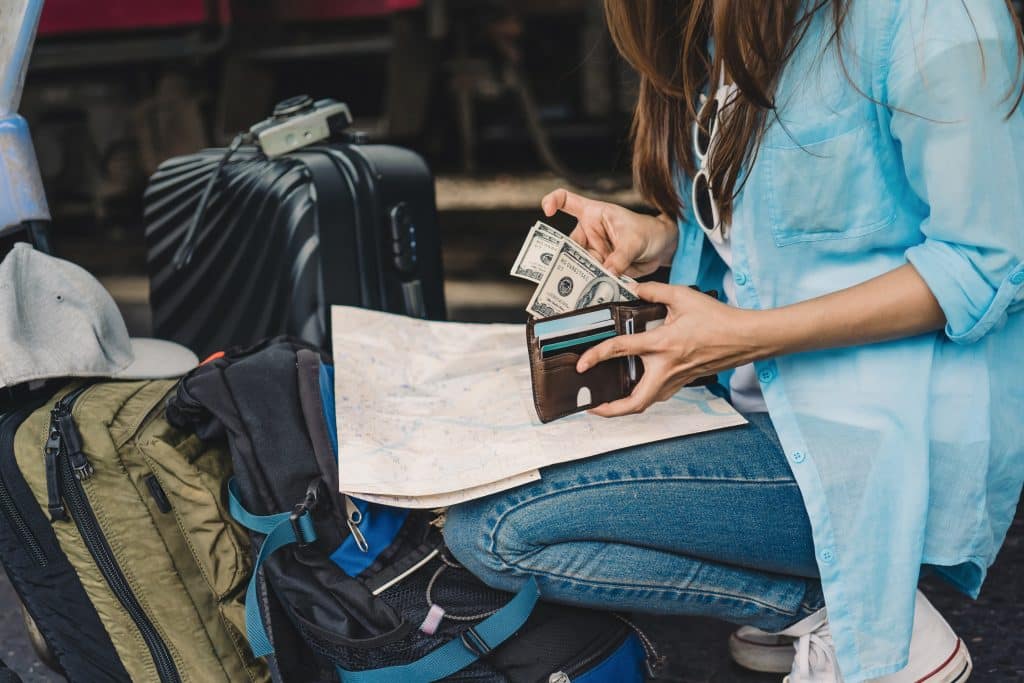
Anywho, with my credentials laid out, I can say that I find it quite easy to slip into a sort of scarcity mindset around money. A scarcity mindset is when your brain shifts into a mode of protecting what little you have, or what little you believe you have. It can make every small expense feel like a huge ordeal. When you’re in this scarcity mindset, it can be easier to forget that you’re still in a position of privilege. You can be low on cash and still know that you are privileged in the grand scheme of things. The two aren’t mutually exclusive, and this scarcity mindset makes it easy to lose sight of the latter.
Doing a bit of background research is the simplest way to counter this mindset and become a more ethical traveler. Having an idea of the economic and political circumstances of your destination is a great place to start building mindfulness. If you can connect the things you are seeing on a more personal scale to the larger happenings of the country, it really changes your perspective. It makes you so much more aware of your actions and impact. Knowing more changes how you spend, and spending is where your real impact is.
Research also gives you a truer understanding of the place. You leave knowing it in so much more depth than you otherwise would. You get to see the cause and effect of bigger things and you just make such interesting connections. It allows you to connect with locals more genuinely, and your conversations will go far deeper. You aren’t just a completely mindless tourist, you are actually there to learn. A little bit of context goes a long way when you’re trying to connect with a place.
Your research doesn’t need to be a whole deep dive. For me, it’s often just a podcast on the bus ride to my destination, but still, I think it makes a difference. Being from the United States, whenever I travel somewhere, there’s a good chance that the US has had its hand in something it likely shouldn’t have. I love to speak with locals about their perspectives on the US, and it’s essential to know the United States’ relationship if I’m going to engage in those conversations. That being said, my mindset is always “do your research, then forget you did it.” Remember what you learned, but don’t assume you know very much. There’s nothing worse than a pretentious traveler who reads one article and then acts like they know everything about a country.

Once you have some knowledge on your destination, you move with far more awareness. It stays in the back of your mind, and it helps you spend your money with more mindfulness.
If you’re picking a “budget friendly” destination for your travels, this awareness becomes even more vital. Many budget travelers head towards the global south, because that’s where many of the affordable locations are. But that affordability is a result of the economic inequality that makes those places more vulnerable to touristic exploitation. That’s not me saying you shouldn’t go, it’s just me saying you should go more mindfully.
You have probably heard the argument that traveling is good for local economies. People say that it supports communities, creates jobs, and drives growth. This does have a lot of truth to it. In 2025, the travel and tourism sector contributed $11.6 trillion to the global GDP, and it supported 366 million jobs (wttc.org). But this argument doesn’t show you where money actually lands. This is where something called tourism leakage comes into play.
Tourism leakage is when the money spent while traveling doesn’t actually end up going towards the locals. Instead, that money goes towards other economies, like foreign-owned airlines, hotels, and suppliers. The locals who welcomed you into their home often see very little of your money. To put it in context: tourism leakage is “up to 40% in India, 70% in Thailand and 80% in Caribbean countries due to factors such as foreign-owned operators, airlines, hotels and imported food and products.” (Stuart Kenny)
Tourism leakage tends to be worse in the global south. This is because oftentimes global capital arrived before tourism infrastructure could be put in place. Locals may have lacked the resources and money to build their own infrastructure, so corporate giants moved in first. They set up infrastructure that favors recognizable big name goods. They built it, and they’re the ones who benefit from it. This makes it difficult for local entrepreneurs to access local tourism. Smaller businesses simply cannot compete. So, the affordable destinations for budget travelers are often the places where your money is least likely to reach the people who live there, unless you are paying attention to where it goes.
Tourism leakage is systemic, and mindfulness can’t dismantle that, but you do have more agency than you might think. The simplest framework I’ve found is just thinking like a guest rather than a tourist. When you are a guest in someone’s house, you are there to learn about them. You make a real personal connection, and you treat them with respect. Once you’re in that headspace, and you have some research to back you up, it all becomes more instinctive. You gravitate toward locally owned places, you stop haggling over a dollar with someone who needs it more than you do, and you think about where your money actually lands.
If you want some more practical guidance on how to be a good guest, Grassroots Volunteering is a great place to start. If you want advice on how to spend your money, I really enjoyed this article. None of this actually fixes the systemic problem, but it does mean your money is more likely to reach the people you actually interacted with on your trip.
All of these things are a bit heavy, but that doesn’t discredit the fact that travel, especially budget travel, is one of the most enriching things you can do in your life. The point is that being aware of these things doesn’t make travel worse, it makes it better. When you travel knowing where your money goes, you are having a richer experience, not a more restricted one. If you have the opportunity to travel, do it. Travel is one of the coolest things a person can do. It expands your mind in a way that not many other things can, and if you have the opportunity to make it happen for yourself, you should most certainly go for it.