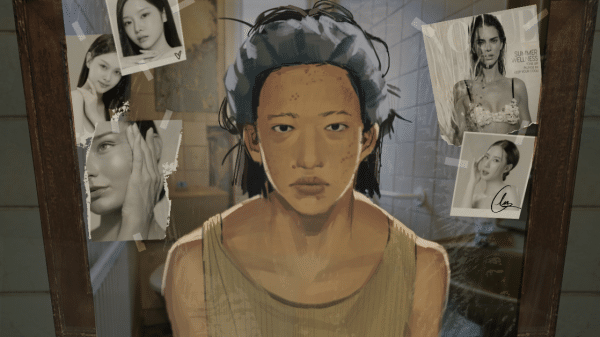
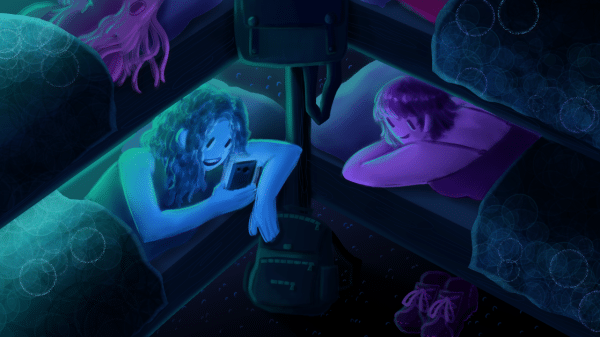
Hey. Yeah, you. I’m talking to you—the one trying to decide whether to follow your dreams or do what you (think you) know will make you successful. I get it. I’ve been there; I’ve felt the pressure too.
I’ve sat in the classroom and heard the teacher list the careers that are most successful; I’ve heard the stereotyping of writers and history majors, and the negative opinions on people who study anything except for STEM, law, or education.
As well as this, I’ve worked at a camp where my boss said, “I need to talk with the smart people,” and then pulled the engineering and computer science majors aside, leaving the English, social work, and music majors behind to do physical labor. That moment sticks with you. It tells you exactly where you stand without ever saying it outright.
So if you’ve ever felt small for what you love, if you’ve ever second-guessed your major because of how other people reacted, if you’re still working on figuring it out, you’re not alone. I promise.
But I have something important to tell you—and I really think you should listen.
The familiar scene
You’re sitting at the dinner table during one of those family meals. Everything is going great: your dad and grandpa are talking about some car or house, your mom is bustling around the kitchen, and everyone is enjoying the food.
Then your grandma turns to you.
“So, honey, what are you studying in college?”

BAM. Suddenly, you realize you have three options.
Option One: Tell the truth.
“Well, I’m currently pursuing a B.A. in English (or history, communications, etc.).”
Grandma smiles a little, but she looks confused.
“And what are you planning to do with that?”
This is where you freeze, because—wonder of wonders—you haven’t planned out your entire life yet. You’re still figuring things out.
Option Two: Hedge.
“Well, I haven’t exactly decided yet. I’m trying out a few things, studying English, probably going into law.”
Law is the magic word. Suddenly, Grandma has a full vision in her head.
“Aww,” she says. “My little lawyer.”
Do you actually want to go into law? Maybe. Maybe not. You were hoping to discover your passions in college—almost like that’s what college is for.
Option Three: Pretend to faint.
I don’t recommend this one. It usually ends with a head injury and/or a trip to the ER.
What this moment shows isn’t that studying the humanities is irresponsible or naïve. It’s that we’re uncomfortable with paths that aren’t clearly mapped out. Humanities don’t come with a single, recognizable script—and in a culture that craves certainty, that can look like failure. Studying the humanities isn’t the problem. The problem is that not everything valuable can be explained in one sentence at the dinner table.

The things I learned not to say out loud
In seventh grade, I started writing creatively. I’d been reading fantasy, sci-fi, anything I could get my hands on. Books became my world. I’d curl up on my favorite couch with a blanket and a snack and be immersed in a story for hours. Writing followed naturally—I could lose myself in those worlds, so of course I started creating my own.
I made up stories for my younger sister as we lay in bed together, telling her about people who lived underground and all the adventures they had. I also recited stories and songs—some memorized, some made up. Writing wasn’t just something I did; it felt like part of who I was.
At first, I wanted everyone to read my work. I sent stories as gifts. But sometimes they were ignored or treated as unimportant. I wasn’t looking for praise—I just wanted someone to care about what I had made.
As I got older, my parents praised my success in math, sports, and my enjoyment in teaching younger kids. They encouraged nonfiction and “real-world” reading. This didn’t mean writing wasn’t discouraged; rather, certain types of writing were encouraged. For example, essays, news articles, and even an autobiography were suggested to me whenever I wanted to write. Never fiction. Since I didn’t want to write those things, I allowed my writing to quietly fade into the background.
To do this, I adjusted the things I would discuss with others. I emphasized the achievements that everyone saw as impressive—STEM classes, grades, sports—while allowing my study of the humanities to become a quiet hobby.

When praise turns into pressure
In high school, I was the “teacher’s pet.” You know the type. I sat near the front, knew the answers, got good grades, and stayed busy with extracurriculars. Teachers loved me. I liked the praise. I liked being good at school.
By senior year, that praise started to feel heavy.
Teachers, parents, and others kept asking about my plans. They expected something impressive—biology, chemistry, engineering, maybe law school. Something practical, something that fits my grades and achievements. So when I told them I was going to a small private college to study English, the reactions were… confused. Lots of “why” questions. When they asked me what I would do with it, I would explain that I was figuring it out, but probably something in writing. One day, my best friend told me her mom thought I was wasting my life.
That comment stuck with me. I realized something: some paths are celebrated automatically, while others need justification. Doctors and lawyers? Admired. Writers? Apparently, not so much.
And yet, when it came time to choose my major, I knew it would be English. Not because I had it all figured out, but because I knew I would enjoy the writing classes. Writing had stayed with me, whether I shared it or not.
I’m very grateful for the choice I made, because many people who focus so hard on being the perfect student and continuing down the path I had begun would end up burning out. If you’re experiencing this feeling, you’re not alone.
I also realized something important: you don’t need to have everything decided when you apply to college. And it’s never too late to change your mind.
The myth that your major defines your entire life
I had to learn this one fast: your major doesn’t define your entire life. You probably notice it too—engineering? You picture an engineer. Elementary education? Teacher. Biology or health sciences? Doctor, nurse, or physical therapist.
Then there’s the humanities.
When I tell people I study English, with a writing concentration, I get the inevitable follow-up:
“And what are you going to do with that?”
I used to hate that question. Sometimes I soften it—“with a writing concentration”—hoping you’ll understand. Other times, I throw in a “maybe law school” just to make people comfortable. I used to say that I was still working to figure it out, but unfortunately, a lot of people don’t react well to that response.
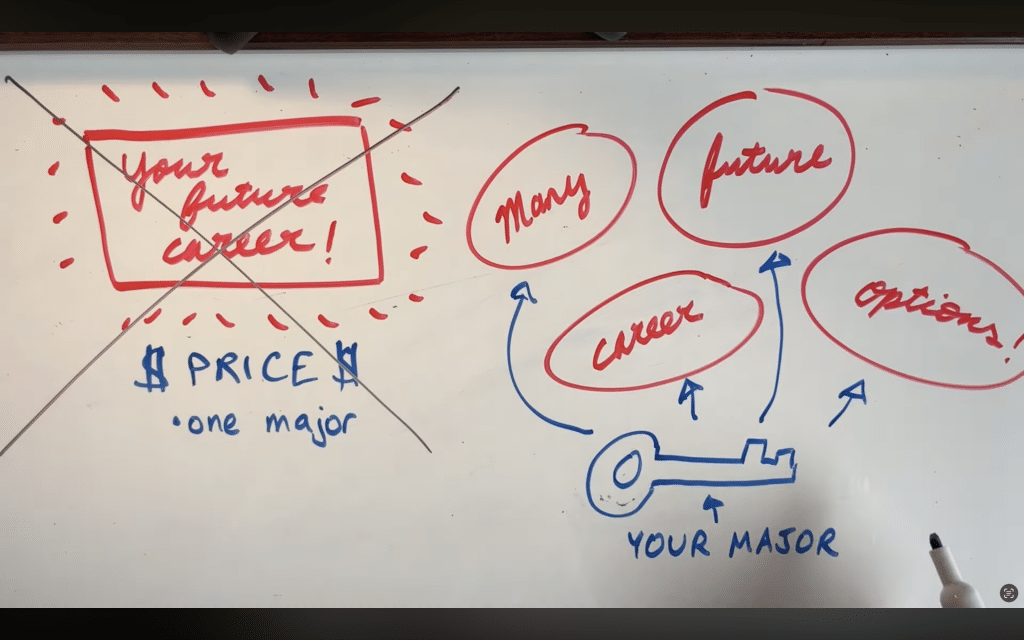
Here’s the truth: there’s no single career path for any major. Engineers end up in tech, business, or even sales. Education majors pivot. Biology majors become researchers, zookeepers, archaeologists, or doctors. Your major doesn’t lock you in. The pressure to choose a practical major comes from our need for certainty, not from any actual rule about how careers work.
Humanities just make it obvious. Flexibility is one of the best skills you can have in a world that’s always changing. And honestly? You might not even work in your major. Most people don’t. Often, all you really need is the degree itself.
Who says you have to have it all figured out?
Right now, you’re probably facing a lot of questions and expectations. College is a huge investment of time, money, and effort, and it makes sense that people expect you to have a plan. But that plan doesn’t need to be elaborate and complete; it can have parts that haven’t been fully figured out. It can be simple.
For me, I always knew I wanted to go to college. I had a deep love of learning that high school never fully satisfied—and, if I’m being honest, I didn’t learn much in my last few years there. Those final years often feel like a waiting period. The basics have been taught; what’s left is exploration. You choose classes based on interest, not necessity. You start imagining your future. That time isn’t wasted—it’s preparation.
I have a friend who attended a very STEM-focused high school. For most of his life, he assumed he would become an engineer. He even took an advanced engineering prep course in his senior year. That class is where he realized engineering wasn’t for him. Now he’s happily an English major, considering journalism, and volunteering as a firefighter on the side. Who decided English majors had to look one way? We’re completely different people, connected by a shared love of literature and writing.
In college, there are also what students call “weed-out” classes—courses that force you to confront what a field actually looks like. Sometimes they’re difficult; other times, they’re revealing. They show you what you’re really signing up for. Some people resent them. I don’t. They exist to remind us of something important: you don’t need to have everything figured out. Changing your mind isn’t failure. More often than not, it’s growth.
Success according to whom?
I know you’ve heard all of this before. You’ll skim through this article and think this is just another person giving the same advice everyone else gives. You expect it to end with “If you follow your dreams, you’ll automatically be happy and successful!”
I’m not going to lie to you—nothing happens automatically. Hard work and perseverance will get you far, but nothing guarantees your future will work out perfectly. Those studying engineering and other STEM fields are just as likely to fall short of their goals as anyone else. No path guarantees success.
This may sound scary, but that’s not the right reaction. Instead of chasing money or power, pursue what you love wholeheartedly. As Mark Twain said, “Find a job you enjoy doing, and you will never have to work a day in your life.”
Our world is obsessed with success—but we don’t even agree on what that word means. Some define it as happiness, finding love, or having enough money to support yourself. So what is success?
To be honest, I am still figuring it out. I’m still trying to understand what success looks like in my own life. All I know is that I would rather pursue the gifts I’ve been given and work to grow them than mold myself into something that just looks impressive on paper.
We weren’t made to fit into one specific position. We’re allowed to change, adapt, and choose paths that don’t immediately make sense to everyone around us. Sometimes they don’t even make sense to us—and that’s okay.
You’re still young. You have so many years left. And honestly, life would be awfully boring if you already knew how the story was going to end.