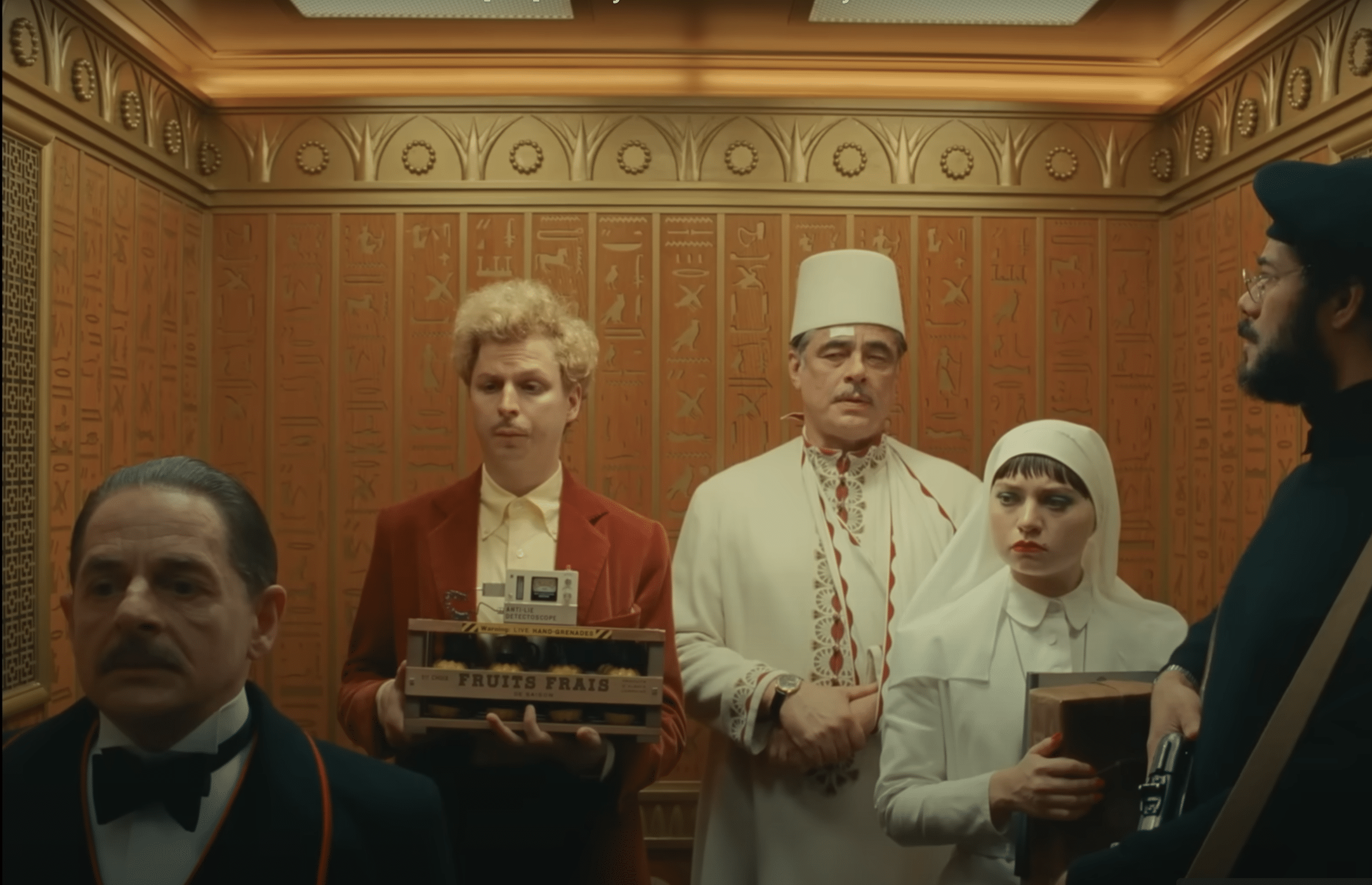
Wake up cinephiles because Wes Anderson has cooked up another kooky film. Known for his whimsical, perfectly symmetrical world of strange characters, Anderson has been a fan favorite in the film world. This time, he reimagines the Middle East as a parallel universe in the 1950s in The Phoenician Scheme.
The world building of the film is far-fetched from real life with its lack of historical events and absence of places. Yet everything in this espionage film is unmistakably Wes Anderson from the film’s colorful palette to the humor. Benicio Del Toro plays Anatole “Zsa-Zsa” Korda, an arms dealer who tries to mend his relationship with his daughter amidst a world of other scheming characters.
Filled with a complex plot and complex characters, The Phoenician Scheme alters American history with its fictitious world. Anderson romanticizes a different time period yet again minus the conflict happening at the time. The hidden, dark themes are present throughout the film, however, despite the re-written past.
The morally ambiguous businessman
It’s 1950 and arms dealer Anatole “Zsa-Zsa” Korda (Benicio Del Toro) enters the afterlife after narrowly escaping death. While the divine court discuss his fate, Zorda decides to mend his relationship with his estranged daughter Sister Liesl (Mia Threapleton). Korda’s character is your typical Wes Anderson personality: brilliant and multi-layered. He is also based on Anderson’s father-in-law.
“The father/daughter aspects also reflect the father of my wife Juman, Fouad Malouf, a Lebanese businessman, and her experiences with him, and my experiences, too. In a way, he’s the first inspiration for the movie. Something in Zsa-zsa is just totally rooted in Fouad,” Anderson says about the character.
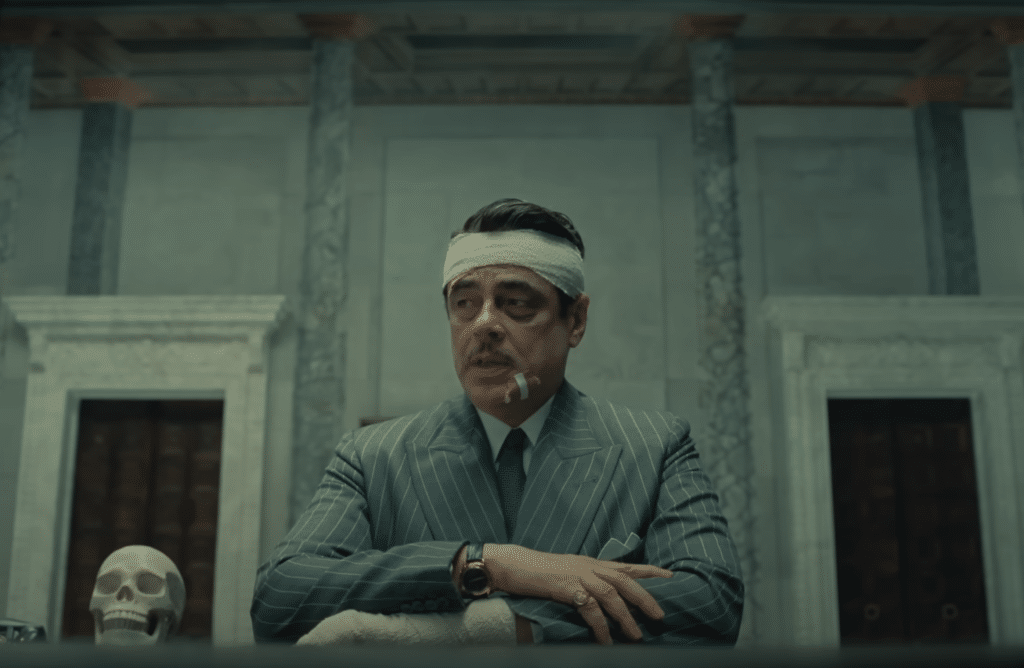
Korda isn’t just any kind of businessman. He is a morally ambiguous man and your typical tycoon, willing to exploit others for his personal gain. Though, he’s not necessarily a villain. Granted, his paternal decisions aren’t the best as he sent his daughter away to a convent at just five years old. But throughout the film, it’s clear he has a soft spot for Liesl. Despite his seemingly cold demeanor, he expresses moments of vulnerability.
Korda is relentless and stops at nothing to leave a lasting impact on his legacy aka The Phoenician Scheme. But Liesl is his anchor and the voice of reason. Being his daughter, she is naturally Korda’s soft spot, making his character all the more likable. Similar to other father-daughter tropes in media, Korda and Liesl’s relationship is enough to make the viewer think twice about Korda’s character.
Assassins and mayhem
On his journey, Korda is targeted by assassins and governments that want to take down Korda’s business. With fictional places and dream-like fantasy depictions of the afterlife, it’s safe to describe the film as a dystopia. From the symmetrical shots to the yellow-tinted deserts of the Middle East– as depicted in the film– the actors are Anderson’s personal puppets for his whimsical imagination.

Like The Phoenician Scheme, other Anderson films have not only a memorable color palette but are always set in an abstract, retro time period, making it nostalgic. There is a romanticization that comes with it, explicitly shown in the costume choices and set design. The eccentric characters are an additional layer to Anderson’s world. In The Phoenician Scheme, Scarlett Johanson and Bryan Cranston– who have both featured on other Anderson films– join the cast of strange characters along with Michael Cera and Tom Hanks. Amidst the assassins and mayhem, Del Toro’s character shines in this quirky adventure.
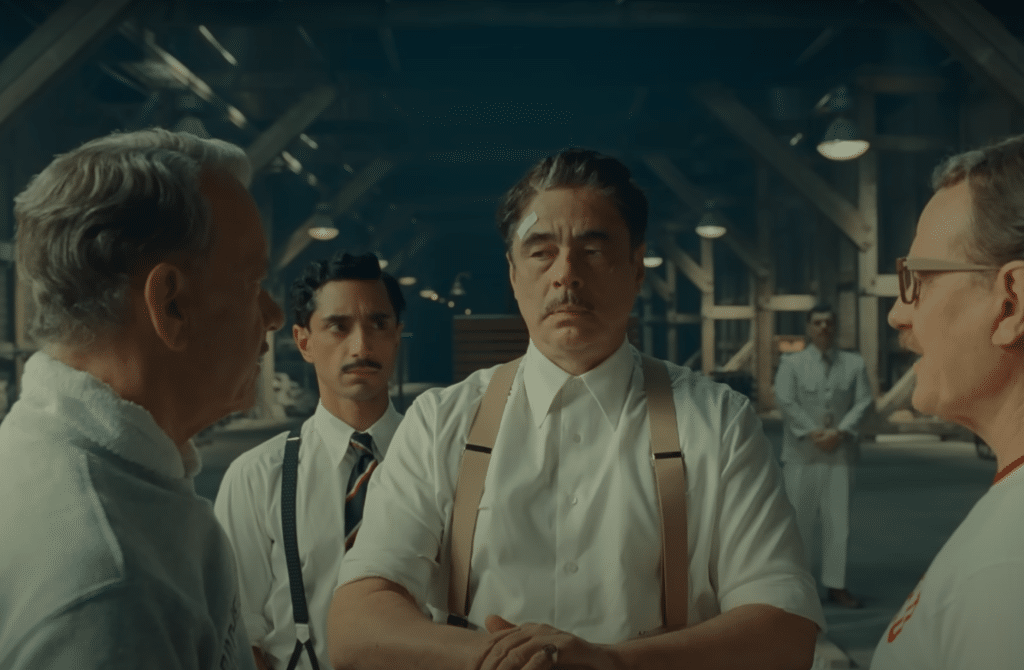
But aside from the all the craziness and slapstick humor, there are hidden themes that might take a second viewing to spot. In the end, Zorda has his redemption despite being a morally ambiguous character. So why is it that power-hungry, flawed men such as him have hope for change? And more so, why is he this way? Liesal asks her father this and he hints at some childhood trauma. Even the scene with Zorda and Uncle Nubar arguing, the both admit that their motives are rooted in pride and competition. It makes you wonder if these characters are supposed to be a reflection of our society’s power-hungry men in office.
Amongst its absurdity, family drama, and pretty visuals, the film offers emotional depth. In the end, Zorda becomes a redeemable person, showing that morally gray characters like him can change for the better. There’s some emotional weight here among the assassins and tycoons of the story, about redemption. As well as life and death themes with the fantasy-like scenes in which Zorda enters the afterlife.
Altered american history
Like in every other Anderson film, there is a lot going on in terms of plot. The world building in this one is more complex however. It’s 1950 except the Holocaust or any world war hasn’t happened. It’s a parallel universe of the Middle East, showing the Levant as one independent territory called ‘Modern Greater Independent Phoenicia’, named after the ancient Phoenician civilization in what is now Lebanon, Palestine, and Israel. The entire region lacks national borders and is depicted as one big, peaceful place.

Critics have referred to the film’s world as “a cosmopolitan world that is, for all its lying and cheating and double-dealing, completely free of racism.” In retrospect of the current state of the world– specifically in Gaza–, The Phoenician Scheme is almost a “sweet fantasy of a much-promised land, and the bitter, bloody reality of how it’s turning out.”
It’s a stylized, nostalgic take on empire and the Middle East. The main character Korda is inspired by historical figures such as Cecil Rhodes and Ferdinand De Lesseps– ambitious men who reshaped regions through massive projects. The film meshes different cultures– Arabs, Jews, Armanians, and French– which coexist peacefully.
In Anderson’s reimagined Middle East, nationalism and racism are absent. The whimsical, dreamy world is a stark contrast to our harsh reality, making the film feel a bit morally troubling. Despite being visually rich and full of historical references, its creative direction can risk being insensitive.