For years, film marketing has followed a simple rule: visibility creates momentum. Trailers premiered during major television and sports events. Posters appeared everywhere as far as the eye could see. Press tours were hosted across the late-night shows, conventions, and magazine covers. Even if many were not interested in a particular film, they would at least know it existed. But this shared cultural awareness is no longer guaranteed in today’s world.
Today, many films struggle. Not because they are lacking in quality, don’t elicit strong positive reviews, or lack creativity in their marketing campaigns. Instead, audiences just never encounter them “in the wild” in the first place. Movie marketing has become increasingly fragmented; the space is now shaped by algorithms that target content to specific online communities rather than audiences as a whole. As a result, one group may feel flooded with trailers and promotional clips, while another remains completely unaware that a movie has even been released.
This widening visibility gap has been quietly reshaping current box-office outcomes and shaping our collective cultural impact. It begins to raise a few uncomfortable questions, the main one being, what happens when marketing perfectly reaches and influences select viewers but falls flat for everyone else? Has the film industry fallen prey to technological evolution?
The shift from shared culture to fragmented audiences
Throughout the past decade, studios have done their best to embrace digital advertising as the current leading film marketing strategy. Algorithms promise efficiency and personalization. The ads reach and intentionally target viewers most likely to engage. Funds are allocated to fund large marketing budgets and strategically spent to stretch further. In theory, this technological precision should be helping films succeed and have further reach than ever before.
In practice, it often misses the mark.
Unlike more traditional mass advertising, algorithm-driven marketing does not foster a shared media movement. Two people scrolling on the same platform are more likely to see entirely different trailers, banners, genres, and promotional interviews based on their viewing habits, demographics, and engagement history. A film can overwhelm one corner of the internet while remaining completely invisible to most of the general public.
This steady shift has fundamentally changed how movies build momentum. Cultural conversation no longer spreads evenly throughout the demographics. Instead, it circulates within closed-off niche groups, making it difficult for films to cross from select insiders’ enthusiasm into mainstream awareness.
When buzz dissolves into fizzling out

We can see this phenomenon with numerous recent releases that clearly demonstrate this divide.
There are many films that generate intense discussion within specific online communities while failing to reach a wider audience. Festival buzz, positive critical feedback, or viral moments may convince select viewers that a movie is unavoidable and everywhere. All of this while others never come across a single ad of any kind, a group that I have been in very often recently.

This phenomenon has become especially apparent with indie or genre-driven films. Horror crowds, cinephile cliques, and awards-focused audiences may engage deeply with niche releases. Nonetheless, this just gives off the impression of widespread interest that doesn’t actually match the numbers and statistics. Outside those spaces, however, awareness often does not reflect the positive feedback from dedicated groups.
The result is a jarring disconnect between demographics. Viewers discover films weeks or months later, wondering how these great films slipped through the cracks. Many wonder how they missed a theatrical release entirely. By the time the average Joe realizes what has happened, the box office window has closed, the opportunity for synergetic cultural conversation has passed, and the vibe is no longer there to be shared.
Where evil stayed within: Late Night with the Devil
A clear example of this divide can be seen with Late Night with the Devil. As a low-budget Shudder release aimed at a niche audience, the film was extremely well received within horror communities, generating strong word of mouth, critical praise, and sustained online discussion (including a few controversies). Within those spaces, it felt inescapable. However, that visibility rarely extended beyond dedicated horror fans. Despite its originality and reception, the film failed to break into mainstream awareness in the way larger horror franchises like Scream have, even when those franchises rely on more familiar formulas. Late Night with the Devil demonstrates how a movie can succeed within its intended niche while remaining largely invisible to general audiences, reinforcing the idea that fragmented marketing limits a film’s cultural reach rather than reflecting a lack of interest or quality.
When visibility wasn’t enough: Marty Supreme
A recent example that further illustrates this fragmentation is Marty Supreme. Despite a comparatively larger marketing budget and a recent Golden Globe win, the film still slipped under the radar for many viewers. Among my peers, several hadn’t heard of the movie through conversation or awards coverage and hadn’t encountered a single advertisement for it on their social media platforms. While the campaign included creative, high-visibility stunts such as the Marty blimp spotted over California and a Marty Supreme streetwear pop-up that generated buzz in select areas, these efforts were geographically concentrated in major cultural cities like New York and Hollywood. This meant that even my peers living in California remained unaware of the movie’s campaign.
The case of Marty Supreme shows that even ambitious and competitive movie marketing strategies can fall short when visibility is uneven. Unlike Barbie, which achieved saturation across both digital and physical spaces, Marty Supreme demonstrates how algorithm-driven targeting and limited geographic reach can prevent a film from achieving broader cultural awareness, even when resources and creativity are working overtime.
Why do some films break through?
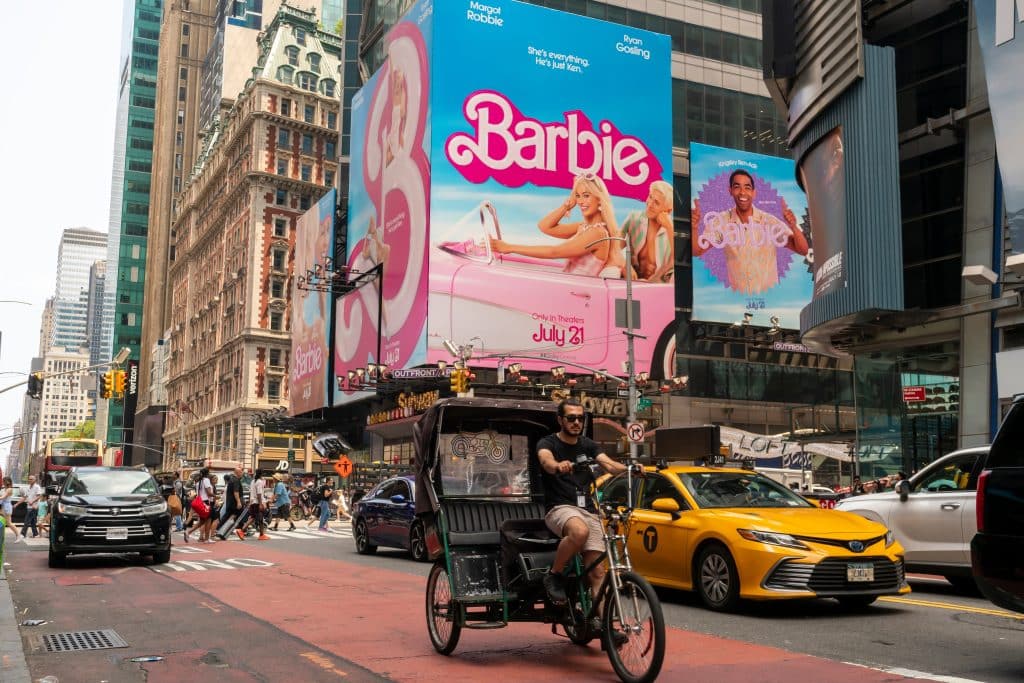
In contrast, a number of recent films demonstrate that unified marketing can still create cultural moments.
Large-scale campaigns that prioritize saturation over precision continue to dominate the public consciousness. These films appear everywhere at once, across platforms and demographics. Alongside a strong focus on offline spaces. Banners pop up repeatedly, and press coverage overlaps. Merchandising, memes, and mainstream media reinforce one another.
This kind of marketing does not rely solely on algorithms. It dominates them.
The difference between films that feel omnipresent and those that feel invisible often has less to do with creativity than with consistency. When everyone sees the same promotional materials, conversation builds naturally. Whereas when movie marketing fragments, that conversation stalls before it begins.
When saturation still works: Barbie
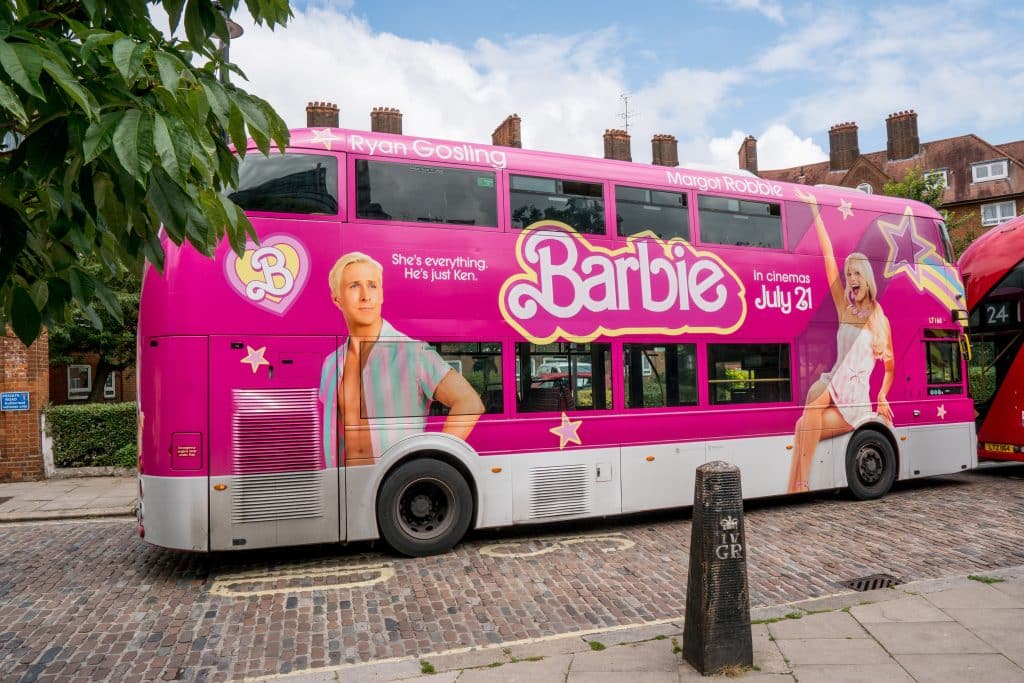
A recent counterexample to this fragmentation is the Barbie marketing campaign. With a massive promotional budget, the film’s visibility extended far beyond algorithm-driven online spaces. Billboards, themed brand collaborations, and immersive physical advertisements saturated cities and public spaces. Red carpet appearances doubled as marketing moments, with cast members dressed in eye-catching, themed looks that circulated across social media.
In this case, visibility was not left to chance or confined to digital spaces. The campaign reintroduced a form of shared cultural advertising that audiences felt included in, regardless of their online habits, demonstrating how physical media and real-world presence can cut through the fragmentation created by digital algorithms. In an era of sporadic online visibility, Barbie suggests that movie marketing beyond the screen may once again be essential to creating connection.
The pitfalls of fragmentation
Fragmented marketing has consequences beyond opening weekend numbers.
When audiences lack shared awareness, word of mouth becomes harder to develop. Viewers cannot recommend films their friends have never heard of. Cultural references fail to land. Films that never achieve broad visibility struggle to enter communal remembrance, regardless of their high quality. They are remembered as niche successes rather than cultural touchstones. Studios interpret underperformance as a lack of interest rather than a lack of awareness, supporting cautious marketing strategies that further fragment exposure.
Winning over critics first: Anora
One of the most striking recent examples of fragmented marketing is Anora. The film grossed roughly $41 million worldwide, making it one of the lowest-grossing Best Picture Oscar winners in history despite winning five Academy Awards. Anora was not a typical wide-release blockbuster. It was an indie film with a comparatively modest budget, and its distributor, Neon, chose to invest heavily in awards-season marketing rather than traditional mass-market promotion. According to industry reporting, the company spent about $18 million on marketing, distribution, and its awards campaign, roughly three times the film’s production budget.
Neon’s strategy was a calculated gamble: focus on the awards circuit, cultivate buzz among critics and voting bodies, and then let that momentum trickle outward. The result was a rare case in which a film’s commercial visibility spiked after its Oscar success rather than before (The Whale being another side of this coin). Many audience members reported discovering Anora only after it earned nominations or won. Traditional awards-focused campaigns may create enthusiasm among industry insiders and niche communities, but they can leave the general public unaware of the film until its commercial run is already over. This case stands as a recent anomaly and a kind of guerrilla warfare success story.
What movie marketing needs to rethink
The problem is not that modern movie marketing is ineffective. It is uneven.
Algorithm-driven advertising excels at reaching the already interested. It struggles to create discovery. If theatrical films are to regain shared cultural relevance, studios may need to rethink their dependence on hyper-targeted visibility.
That does not mean abandoning digital tools. It means supplementing them with strategies that prioritize collective exposure, even at the risk of inefficiency. Shared trailers. Overlapping press. Cultural saturation. Because a movie cannot succeed if audiences never have the chance to see it.
Increasingly, the biggest question surrounding new releases is no longer whether people liked them, but whether they ever knew they existed at all. Unless a film has an exceptionally high budget and the ability to blanket every space at once, as Barbie did, digital marketing alone is no longer enough. Physical advertisements must now work in tandem with online strategies to counteract fragmentation.
Post-pandemic audiences have shown a renewed receptiveness to spectacle, stunts, campy and theatrical campaigns, even when they are intentionally gimmicky. Blimps, pop-ups, themed installations, and unconventional real-world promotions are no longer distractions but necessary tools for film marketing. Creativity has become as important as reach, and unconventional marketing methods are increasingly being tested as studios search for ways to cut through algorithmic isolation and foster collective awareness.