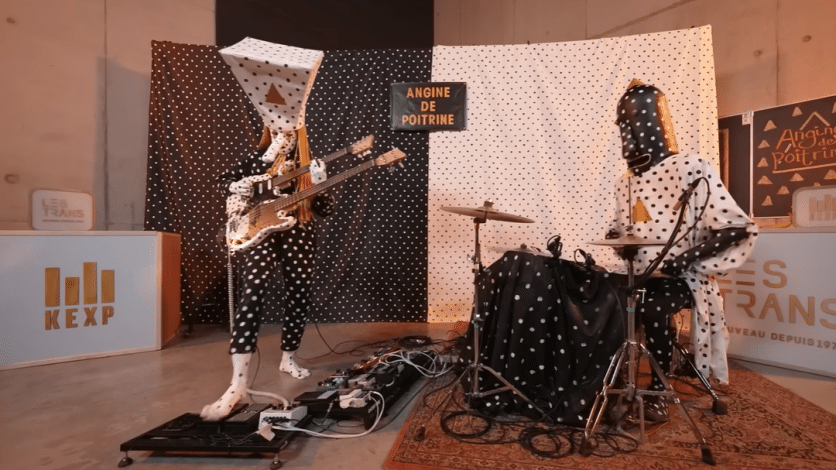
Angine de Poitrine looks like anything but the next faces of popular rock music. In fact, you can’t see their faces at all. Hidden behind peculiar papier-mâché masks and shouting alien noises over microtonal instrumentation, the duo seems like the perfect example of music that appeals to a very niche audience.
The only issue with that statement? Angine de Poitrine has nearly three million monthly Spotify listeners. That’s more than legendary alternative rock bands popular with Gen Z, like Pavement, as well as trending rock groups such as Geese. How did they get here, and what does that mean for popular rock music going forward?
Who are Angine de Poitrine?
The official Angine de Poitrine website states that “Angine de Poitrine est un projet artistique anonyme (Angine de Poitrine is an anonymous art project).” While that may be true, there is some information about the duo out there. They first began performing as Angine de Poitrine in Saguenay, Quebec, around 2019. Picking up the pseudonyms Khn de Poitrine and Klek de Poitrine along the way, they immediately established themselves as a project rooted in the avant-garde.
They released their debut album, Vol. I, in 2024. It didn’t take long before their minimalistic yet strange live shows started to gain traction. With a simple combination of drums and a custom double-neck instrument that fuses a guitar and bass, their outlandish looks and surprisingly filled-out sound began to nurture a fanbase.
February of 2026 is when they truly started to become internet culture darlings. Legendary arts-supporting non-profit KEXP gave them the limelight. KEXP, whose long history has seen them give early platforms to artists like Nirvana and Built to Spill, uploaded a live performance from Angine de Poitrine. It has since accumulated nearly thirteen million views, as of April 2026.
They soon followed up their newfound virality with their sophomore studio album. Vol. II was released a mere couple weeks later on April 3rd, 2026. Naturally, a new album took advantage of this sudden rise in popularity. Vol. II debuted at #11 on the Canadian Billboard charts. Somehow, these math rock weirdos found themselves right next to the likes of Drake and Bruno Mars.
What makes them so strange?
From the second that their KEXP performance begins, it is clear that Angine de Poitrine is not just another rock band being hyped up by music media. The throat-singing-adjacent intro is nearly as off-putting as their general appearance.
It should be said that Angine de Poitrine are far from the first band to have a deliberately odd visual aesthetic. Bands like GWAR and The Residents have spent decades establishing themselves as visual artists as well as musicians. The difference comes in how those visual aspects are incorporated into their music. Those aforementioned acts incorporate visuality into their music by creating lore that connects those aspects of their art for the sake of creating a multi-medium art project.

It would be ignorant to say that Angine de Poitrine are not artistic in their physical presentation (they certainly are). With that being said, it is bizarre and fascinating how their visual aesthetic is used as a means to obscure any potential understanding of them rather than building upon their already experimental music.
Their music is strange in its own right. As time signatures constantly shift, the duo seems oddly spontaneous despite clearly playing well-practiced music. Various avant-garde genres of music are where Angine de Poitrine find their roots. The angular guitar performances and jittery yet precise rhythmic instrumentation are obviously rooted in math rock.
Angine de Poitrine’s microtonality
What really makes Angine de Poitrine stand out is their usage of microtonality. Artists create microtonal music when they utilize intervals smaller than the standard half-step of the Western semi-tone. The usage of microtonality in popular rock music has been historically rare. Nonetheless, a couple of bands have been utilizing it semi-frequently within the last few years. Perhaps the most obvious example is King Gizzard & the Lizard Wizard. The Australian genre-blending giants popularized microtonality amongst certain sects of rock fans with 2017’s Flying Microtonal Banana.
Due to the fact that performing this way requires one to deconstruct the building blocks of Western music composition (microtonality is much more common in music from the Eastern hemisphere), Khn de Poitrine’s custom guitar-bass is also designed specifically to allow for the performance of microtonal music.
Why are they getting so popular?
While it goes without saying that it is a cop-out answer, it is genuinely difficult to say why Angine de Poitrine is getting so popular.
At first glance, it would seem that people gravitate towards them just because of how strange their appearance is. Almost every top comment on their KEXP performance is some variant of a joke on their general strangeness. That doesn’t account for their millions of monthly listeners, though.
Plenty of artists become briefly popular due to a joke or viral clip before falling off the radar once again. Even if it has only been a couple months, that is still more than enough time for a running joke to come and go on the internet.
Another reason could be that Angine de Poitrine simply feel unique compared to the usual “saviors of rock” that the music industry pushes. In the past decade, the music industry has pushed groups like Greta Van Fleet and The Struts as bands destined to bring rock back to the mainstream.
While these bands have done well commercially, critics have not received them the same way. No matter what you think of them, there’s no denying that they are willingly derivative of various classic rock bands. On the other hand, Angine de Poitrine feels wildly unique by comparison.
That isn’t to say that Angine de Poitrine doesn’t have their influences. Quebec has a history of avant-garde music thanks to experimentalists like thrash metal legends Voivod. They aren’t even the first band to play complex music with alien-like noises. Christian Vander’s progressive rock band Magma has been making music with the self-created Kobaïan language since the early 70s.
Angine de Poitrine vs. trending rock
It becomes easier to notice what really makes them so appealing when you take a look at Angine de Poitrine’s competition amongst trending rock bands: Dexter and The Moonrocks’ post-grunge throwback “Freakin’ Out,” mgk and Fred Durst’s (of Limp Bizkit) rap rock collaboration “FIX UR FACE,” a new album from Dave Grohl’s long-running Foo Fighters, etc. All of these artists have either been around for decades or are making music meant to elicit popular rock music that people have grown nostalgic for in the last few years.
No matter how maligned artists like Creed, Limp Bizkit, and Three Days Grace were in their heyday, they are now becoming legacy acts whose increasing age is causing them to become retroactively beloved by those who are susceptible to nostalgia.
Being influenced by those artists isn’t inherently bad. However, Angine de Poitrine are not. Their influences are niche, varied, and mostly difficult to directly connect to them. It isn’t hard to see why people disillusioned with the state of popular rock music may be drawn to such a comparatively unconventional group.
What do Angine de Poitrine mean for the future of music?
As it stands, Angine de Poitrine’s popularity means nothing for popular music. After all, it has only been a couple months since they started to blow up on a wider scale. Even still, they have extended their presence much farther than anyone could have anticipated.
Perhaps this is all the beginning of some sort of change in popular rock music. Genres and movements change just as quickly as they begin and end. Maybe the next ten years will see a massive boom in complex, instrumental math rock in the mainstream. Considering the subgenre has always been underground since its inception in the late 80s/early 90s, that seems unlikely. The Weeknd having to compete with two French-Canadians playing in a 12/8 time signature doesn’t seem like the future of pop music.
Why do they attract Gen Z?
Nonetheless, Angine de Poitrine’s relevance amongst a younger crowd does show one thing to be true: people need rock music to sound exciting again. There’s a reason that the biggest rock artists of the last few years have been the likes of Turnstile, Geese, Viagra Boys, Black Country New Road, Wet Leg, Fontaines D.C., Geordie Greep, etc. Even if they aren’t breaking sales records, they’re some of the first names you’ll see if you explore the alternative music side of Instagram Reels, TikTok, or music-based websites like RateYourMusic.
Angine de Poitrine, despite sounding like none of those bands, is similar in one way. They represent a side of rock that isn’t rooted in nostalgia or any sort of traditionalism. After decades out of the mainstream spotlight, it feels like the rock side of the music industry is clinging to old trends in a desperate attempt to achieve mainstream relevance once again (no matter how fleeting).
Younger listeners want something fresh and new. That has surely caused certain Gen Z listeners to gravitate towards bands that they would never stumble across otherwise. Angine de Poitrine is one of those bands.
Angine de Poitrine probably won’t change the world on their own. Still, they feel like a part of something much larger happening within the Western hemisphere at the moment.
Are they more than a peculiar blip?
Angine de Poitrine’s rise to virality is just as unlikely today as it would have been thirty years ago. A fresh math rock band with a whimsical yet somewhat unsettling appearance and tunes that sound like no other popular rock music is the last thing that you’d expect on a list of “Biggest Up-and-Coming Names in Music” in 2026.
Maybe Angine de Poitrine are outside your wheelhouse and come off as a bit strange to you. Maybe you love weirdo rock like this and are excited to see how long they ride this wave of popularity. Either way, it seems likely that Angine de Poitrine’s impact is more than a peculiar blip.