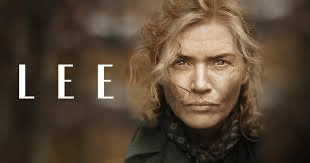
In today’s article I want to talk about a World War 2 war correspondent by the name of Elizabeth “Lee” Miller, who is the focal point of the war movie “Lee.” I thought that this is an important part of history in terms of photography and that she was one of the first people to document what happened during World War 2.
Who was Lee Milller
Elizabeth “Lee” Miller used to be a model. That was before she became a part of the staff for Vogue magazine as a photojournalist. She states, in the movie, “I was only good at three things: drinking, having sex, and taking pictures.” I did them all as much as I could.” The movie starts out on an outing with friends. Lee meets her future husband Robert, an artist, and he looks at her work and approves of it.
One of her friends asks Lee to return to Paris with them as they miss her over there. She says that she does not know who she is when she is over there. This saves her from many hardships that these same friends will experience while they are hiding in occupied France. We know now that Lee Milller didn’t really enjoy her time as a model. That could have influenced her decision to not go back to Paris.
Instead, Miller decides to go with Robert to London where she heads directly for the British Vogue headquarters. She then asks for a job to an older woman by the name of Audrey who is in charge. Audrey quite taken with Lee’s work accepts rather quickly.
What is memorable
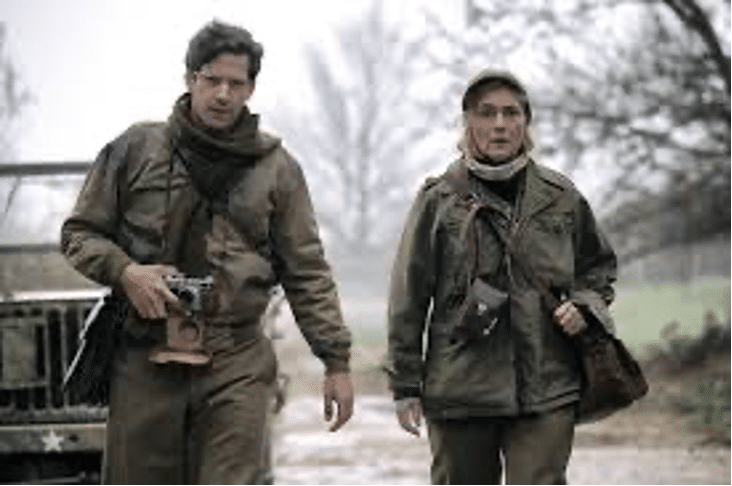
What is memorable about the film if you ask me to come from the portrayal of Lee herself. Right from the outset you know she is a no–nonsense–kind of person. She will do what she needs to do to get things done. You could say from the very beginning that she is quite patriotic. She states more than once that she “has to do her part,” which is a very common saying among the populace. Especially it seems among the women.
The things that Lee decides to capture in her work,. For example, the one soldier named Kurt who is in the medical tent, recovering from his injuries. This I think is something noteworthy. It serves to add a sense of humanity amidst senseless violence. Perhaps it even restores a bit of the dignity to the dead.
In one part of the movie Lee asks her partner Davy to give her a boost into a train car filled with dead Jews. This struck me as something that was heartfelt, because instead of turning away, she gets closer. She understands the need to capture these moments. This is what sets her apart from the glory hounds, like when her interviewer Tony asked if she went to war so people would know her name.
The Shock
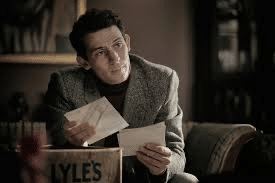
The shocking part of the movie, the one part you couldn’t see coming has to do with the interviewer, Tony, and Lee. You don’t appreciate this twist for what it is unless you read the text at the end of the film. But it was a subtle way to put a cap on the life of Lee.

So don’t worry if you’re a little confused right when it happens. Just stick around for the credits and all will be revealed. I think this movie is a very well done tribute to Lee. I know that the part where Lee’s pictures not getting published by the British Vogue is history but it still gets under my skin. Primarily because a lot of the pictures she took weren’t known about until after her death.
Not to mention that she destroyed some of them in outrage. I think that there should have been better ways to handle such things. But Audrey, the editor of the British Vogue, at the time did try to get them published through there American branch. I can still understand why Lee would be outraged. People should have taken every chance they could to preserve the truth of what happened. Even if the truth is a hard one to face.
What could have been different
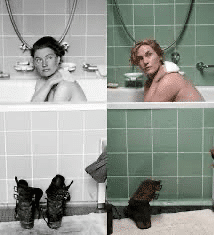
I personally think that this picture taken at the home of the Fuhrer before anyone knew that they were dead, is by far the most controversial. I can understand why this would be a famous photo given the circumstances and the shock factor. But it does take a certain kind of daring to attempt such a photo.
Tony even goes on to comment that most people would have been worried about “appearances.” Lee replies, “What do I have to care about appearances.” I think in a sea of staggering photos this is perhaps the one that bothers me a bit. But I can see the significance.
The photo certainly is shocking and sort of mocks Hitler. It states that American soldiers can manage to be in the Fuhrer’s home despite his power. I think the power that this picture has, is best shown by the fact that after it is taken. When Davy and Lee are back in the living area of the apartment, Davy begins to cry and says, “all those people, my people.” Then he is embraced by Lee who comforts him.
Lee Miller exhibition (Photo Credit: Renato Murolo/ Shutterstock)
The overall work of Lee Miller
The work that Miller produced I like for the same reason that I didn’t like the photo in the Fuhrer’s bathroom. They are quite daring, especially during her World War 2 era. The soldier all wrapped up in gauze hits differently when you see the original photo in the Lee Miller Archives. The lingerie left by the window of the woman’s barracks doesn’t seem as important when you look at the original in the archives.
Sometimes it is the story behind it that makes a photo worthwhile. For someone interested in photography, I find that the photos that inspire me most are the ones that tell a story. Her other work outside of the war seems to be photos of people going about just going about their day. Some are more posed for than others.
In her 1920’s work there are a couple of nudes of women, but not many, I would say that the ones she did during the war is my favorite period for her work. In the 1950’s she went back to a similar style that she had in the 1920’s. If you ask me she had a knack for setting up a shot to look as natural as you could get it, without it being a true candid photo.
How the movie did
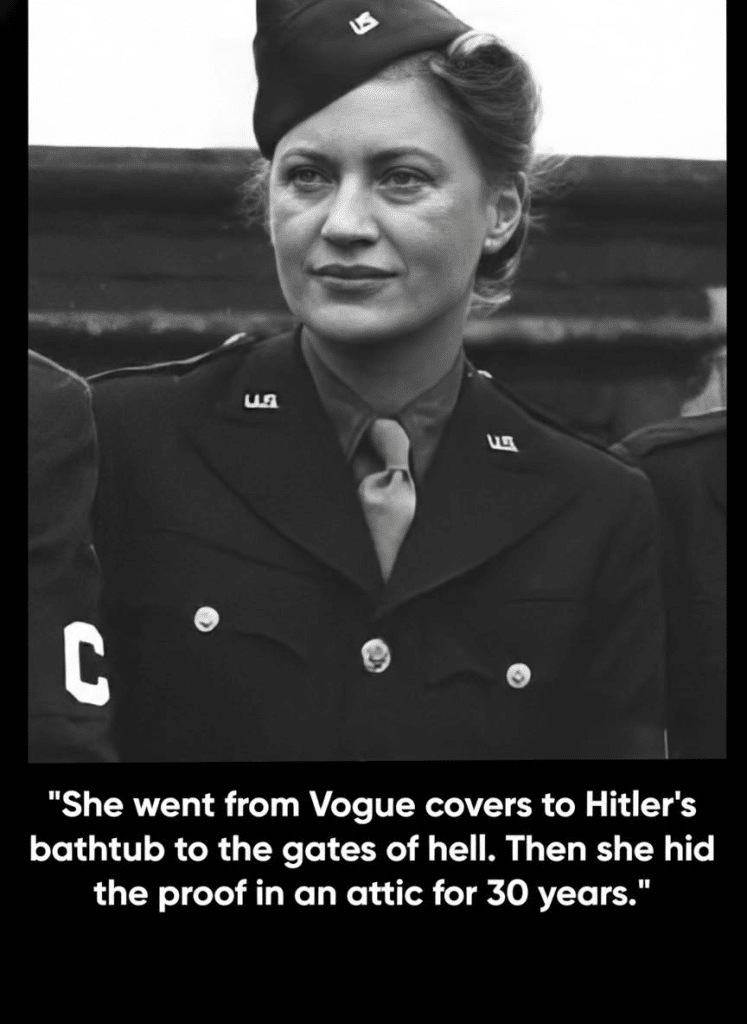
Now that we have talked about the various aspects of this biopic, I would recommend it and I think you readers will enjoy this film. I don’t think there are any unnecessary parts or that the movie is a slow burn. I think it hits all the right points and does it in a way that is respectable toward the history that it is trying to portray.
There wasn’t much of anything about this film that I wish that they would have added or changed. I half expected Lee to find Jean’s body somewhere in the camps, but that never happened. This s historically accurate for a lot of victims of the Holocaust. I was surprised that one of Lee’s friends, called Solange, is left out of the information from when the credits roll. My assumption is that she survived, but just never found Jean.
This film is very well put together and I think it had the right people for the job. I feel this is movie is just right for those who don’t want something too overwhelmng as far as content. The scenes aren’t graphic, but it is just enough to get the point across that what happened during this time.
How the Photographer did
I agree, with one criticism of the movie, that Lee Miller’s life had so much more to show then the two hours and change that the movie gave us. This criticism is true since out of the sheer volume of photos that Lee Miller took in her lifetime, very little was covered by comparison. There are about 4,220 photos attributed to her. Some might not think so, but to me it is an extraordinary number.
However, having looked at some of the work before and after the 1940’s I can’t say that either set of photos was as powerful as that of the holocaust photos. I am, but one person with this opinion, and I am still glad that all the other photos were preserved. Even though there was more material to work with that the movie didn’t use, I think that it is the right choice because they worked with the best that she had.
I’m glad that we have any of her photos at all as she had hidden them away. It was only because of her son, Anthony Penrose, discovering them that we have them at all. I wish that she had been more prolific in her later years, like she was during the 1940’s. The photos that wer e taken after that were rather scant in terms of amount. But as I said I think the film worked with the best that Lee Miller had to offer. You can view her photos in the archive linked here.
In conclusion
After watching this film I now have yet another great figure in the history of photography in my mind. Not just the photographer controversy that propelled me to write The Stringer article. I find myself fascinated with the history of photography, and all the memorable images that have come through the medium. It is a unique thing to be able to actually see what one saw in the past. Then have it marked down forever in history.
The fact that these photos were taken by a woman makes it all the more extraordinary. The army had initially refused to let Miller cover the story. But then she went through the United States rather than the British Army. I like to think of this as one of those times where the U.S.A was actually progressive in its history. Miller exemplifies what happens when you chase something with everything you have. She knew this event would make history, and that it had to be covered.
She did not come to photography initially, she had been a model first. However, she no doubt gave the profession of photography every ounce of energy that she did for her modeling. She is an example for women everywhere. I hope that this inspires some of you to take a harder look at history. I love biopics and so should a lot of other people because they are allowing us to keep important moments in history alive.