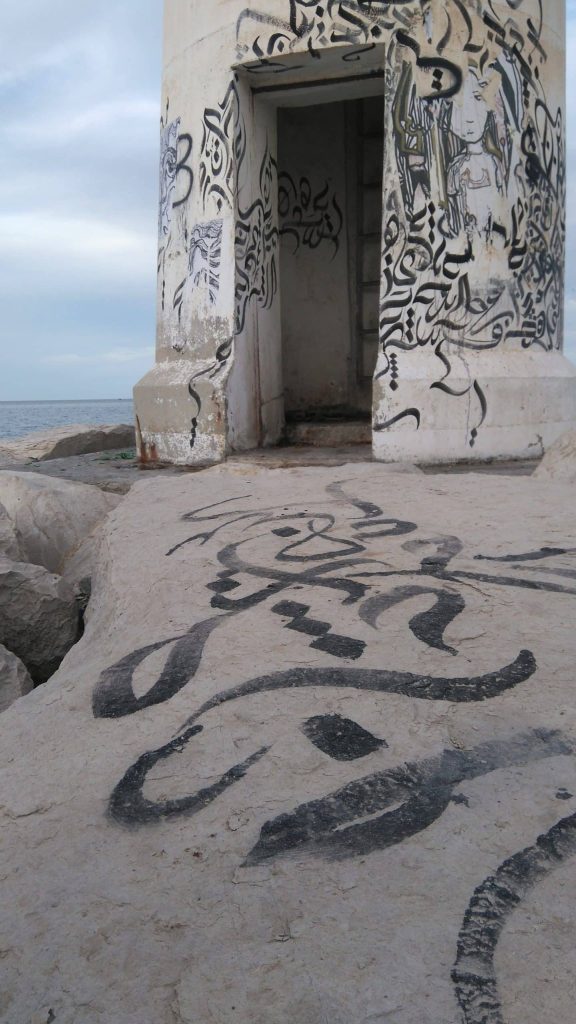
While digital technologies gave artists new tools to enhance their works and reach their audiences, the art scene is ever-changing. Modern calligraffiti, an art form that emerged as a combination of tagging and calligraphy, is not an exception.
Calligraffiti is quite different from calligraphy, which has rigid guidelines. In contrast with calligraphy, calligraffiti gives artists more freedom to experiment.
Street Art Statistics
According to Zipdo,
- 25% of young adults viewed graffiti as legitimate art in 2022;
- Graffiti murals cover 5 km² as public art in global cities;
- 40% of global museums recognized graffiti as a form of art by 2023.
The Love for Calligraffiti
Richard Wideman, owner of the global project Calligrascape, says his favorite part of calligraffiti is “the beauty of the unreadable.” He is captivated by examining a script he does not understand:
With calligraffiti, there are shapes and strokes that resemble letters and my brain is just tickled looking at it. Maybe our curious brains can tell there is information to be discovered there, or maybe it’s just the strokes are aesthetically pleasing. Who knows?
Burnzy is a UK-based calligraffiti artist who has long been part of the art world. His interest in Chicano culture sparked his passion for lettering, eventually leading him to begin a tattoo apprenticeship.
Burnzy approaches conveying messages differently depending on whether he is doing his work for himself or his clients. Sometimes, they ask him to add a certain message to the piece.
“You can hide certain stuff so only that people that know, know that there’s something written in there“.
The artist also adapts the visual style he chooses to the message. If he is conveying a sinister, dark message, he can adapt the calligraffiti to a darker Gothic style. A lighter and friendlier message will be visually different, too. Burnzy got this practice from tattooing, where he would match the words clients wanted to specific styles.

“And then, a lot of messages that I put out in my work is all dependent on what I’m going through, what’s going through my head”.
He also explained that some of his pieces had meaning and some didn’t.
Sometimes, I won’t put any message [into the artwork], just an impactful piece that people see and they’re like, ‘Oh, whoa! What is that?’
Wideman also mentioned being in the know:
Calligraffiti by design is generally hard to read for the average person (not unlike graffiti), therefore I don’t think this medium or style is good for sending general messages except to other curious letterers (or people in the know). Although with any “cool” art, comes with people that want to be in the know.
He also said that Arabic calligraffiti is particularly beautiful and flowing.
Arabic Calligraffiti: a Dream of Acceptance
Hela Zahar, a cultural sociologist with one PhD in cinema and another in urban studies, researched the tensions in the world of Arabic calligraffiti.
In the countries where calligraphy belongs to mosques and places of worship, bringing it out onto the streets might become a source of tension. Moreover, traditional Arabic calligraphy cannot be illegible. The letter proportions should be respected, and it should be written from right to left. This conflicts with the modernity of Arabic calligraffiti.
Most artists, if not all, didn’t see calligraffiti as something that had to be legible. On the contrary, it had to be elevated to a much more aesthetic form, one that spoke more to people’s emotions — the beauty of the style — rather than conveying a more legible message.
An Art for the People
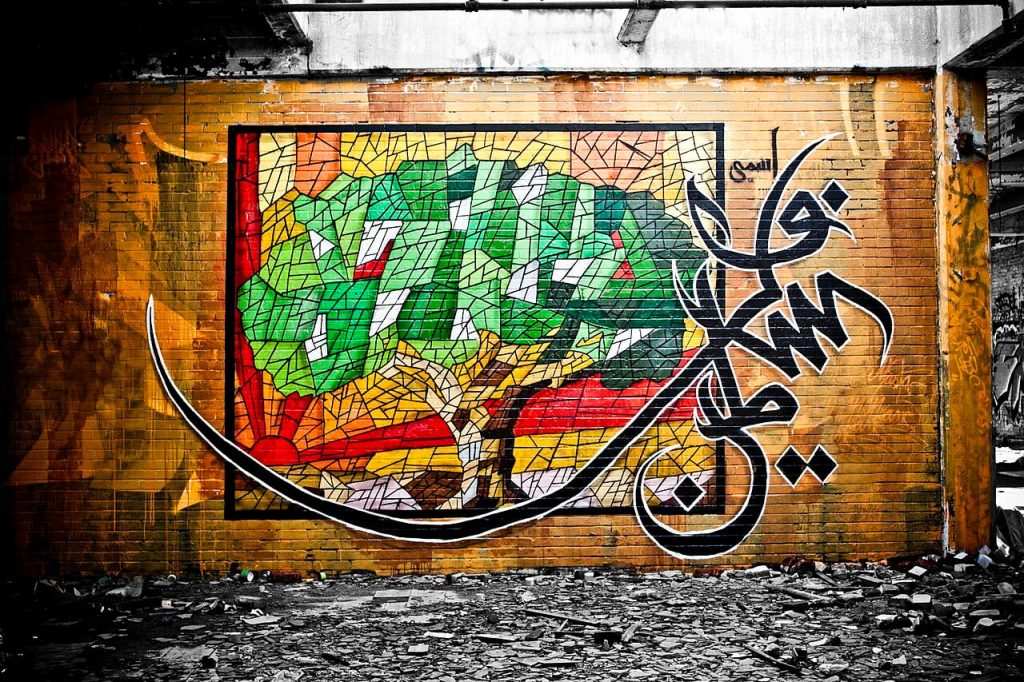
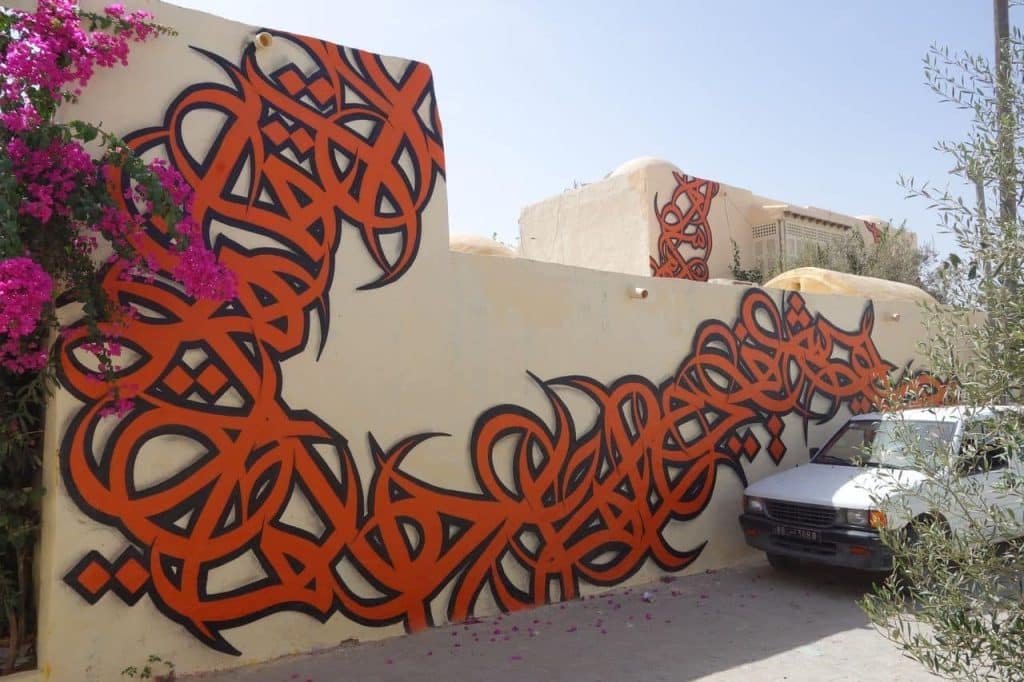
Zahar also emphasized that Arabic calligraffitists did not just make art for themselves or for others, but for the streets and the locals.
“It is on the people’s walls, it is on the residents’ doors … so that they can take ownership of it and find a way to come to terms with the tensions surrounding Arab identity, especially in the aftermath of everything that happened with the 2001 attacks”.
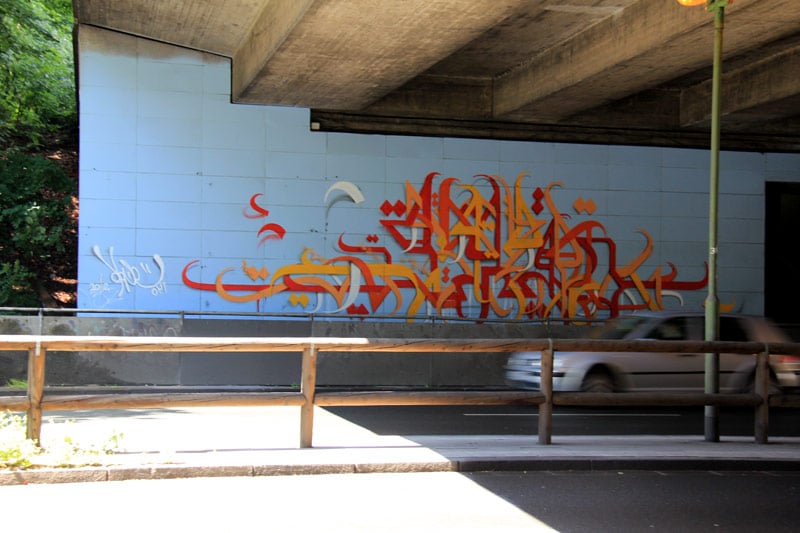
In Western countries, Arabic calligraffiti can also create tensions because of illegibility. While Westerners recognized the Arabness of the art, their inability to read it became a barrier. Every person, however, can interpret it in their own way.
“It opens up the interpretation to people who don’t read Arabic, and therefore the idea of building bridges. Because if we leave the calligraphy in a legible form, it also creates tension, since those who can’t read Arabic won’t be able to connect with the calligraffiti. So, ElSeed and all the other artists have stopped saying what they’ve written or providing a translation, because, on the contrary, they want to open up the interpretation to people who don’t read Arabic. And so, this actually creates a form, so to speak, of visual, cultural, and social inclusion. And that’s the goal of calligraffiti—it’s really about creating social inclusion”.
The Utopianism of Arabic Calligraffiti
In addition, Zahar explained the utopianism of Arabic calligraffiti:
“At the core, the artists are, first and foremost, nomads. They travel a lot, they move a lot, from one wall to another, from one artwork to another, across all five continents. The idea that calligraffiti can bring different cultures together in an urban space — when we see, for example, Arabic calligraphy on walls in Europe or North America — it makes us think of a form of symbolic encounter, that is, of unity. That’s why I say it’s utopian — because we imagine that all cultures will coexist together, with no tensions. Yet the tensions were there“.
“It’s a bit utopian to think that it really built cultural bridges or eased tensions. The tensions were still there. Except that I think the social fabric was called into question, in the sense that it’s true we might need to rethink our stereotypes about Arab identity a bit. ‘Look, this is really good stuff; art is beautiful. ‘ So it did spark some social reflection, and that sometimes eased tensions, but at other times, on the contrary, it also exacerbated them“.
Arabic Calligraffiti and Social Media
As street art becomes more accepted in the world, calligraffiti is gaining popularity on social media. The #calligraffiti tag has 21.4K publications on TikTok. The Reddit community dedicated to this art style had 12k members as of 2023.
On the other hand, social media platforms could be alien to the world of calligraffiti. Zahar noted that social media results in a commercialization of the field. “It leads us toward centralization, it leads us toward capitalism, it leads us toward a form of recuperation, in a way.”
The artworks that belong to the streets are now commissioned by institutions or organizations for specific events or for charitable purposes.
“So, what I see right now is less of a social aspect, whereas the original intent was, on the contrary, to ease social tensions, to assert a modern Arab identity, to build cultural bridges, to accept one another… And we see less of that these days.”
– Hela Zahar
Western Calligraffiti and Social Media
It is safe to say that Western calligraffiti is facing some challenges from social media, as well. Burnzy expressed that it was helpful in making connections internationally, but daunting in other senses. He said it could become a full-time job in itself.
“When you’re a creative person, trying to force creativity all the time can actually kill your creativity. […] I find that algorithms of social media do this to not just me, but to a lot of artists. Nowadays, you can create the most amazing piece in the world, [but] if you’re not uploading regularly on social media, and the algorithm isn’t supporting you […], no one’s going to see it”.
The artist added that younger generations could also be negatively affected by likes and view numbers.
“If they put a lot of time and effort into a piece […], and it doesn’t get the likes and the comments that they think it deserves, they judge their own work based upon that when it really not the case — it’s just not being shown to the right people. I always say, it’s important not to get caught up on likes and views and that kind of business on social media.“
Artificial Intelligence and Calligraffiti
Burnzy, whose favorite tool is a brush, finds that iPads can make artists lose certain skills. He also avoids using AI. He believes that when AI eventually evolves, the art created by humans will become more niche and more pricey. “I know that people are worried about AI. I’m not, because maybe it could mimic what I do, but it doesn’t know the meanings or anything that makes the artwork what it is.”
Wideman shares a similar view on AI. “I still think that there is nothing more human than the written word, calligraphy, and calligraffiti. It is how we communicate, how we write beautifully, and how we abstractly express ourselves”.
“For the time being, AI has not figured out how to write calligraffiti, and even if it does, I will still be making it”.
– Richard Wideman
Burnzy believes that the calligraffiti movement is going to grow in the near future, and would like people to start paying more attention to it. ‘‘In my opinion, it’s the best style”, he added.