In the trying times of intense political polarization, big, unethical corporate mergers happening all around, and the dumbing of society through algorithms, it is very difficult to answer the question: How can we send a message of optimism? It takes a bolder, edgier artist like filmmaker Boots Riley to lead us into our response.
In “I Love Boosters,” he takes the incendiary sentiment of revolt to the stratosphere, masking it as a cartoonish, comical film about fashion, a tyrannical Demi Moore, and communism.
When Robin Hood becomes sci-fi
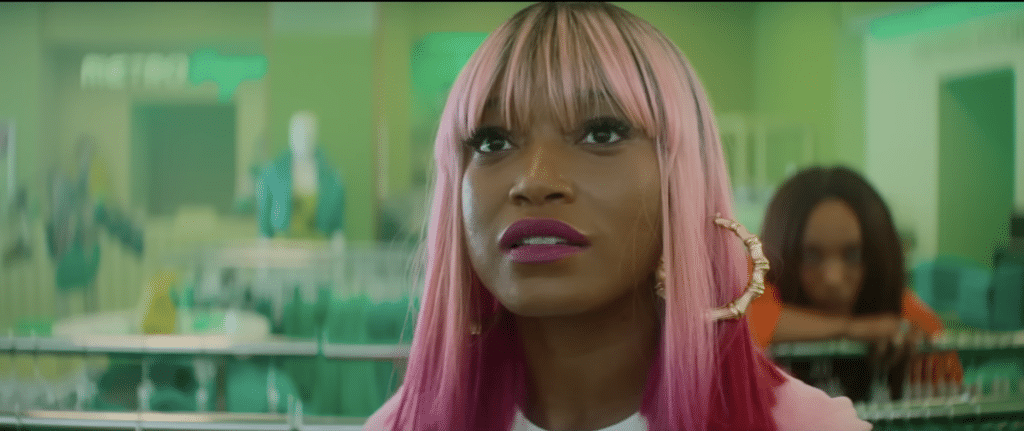
Corvette (Keke Palmer) is an aspiring designer who spends a good chunk of her time stealing haute couture pieces. Not for the glamour exactly, but for redistribution. She leads the Velvet Gang, a group of boosters who resell luxury pieces at more accessible prices to Oakland’s community. On the other side stands Christie Smith, the tyrant of Metro Design played by Demi Moore, a kind of Cruella from some neoliberal laboratory.
The protagonist has one target and one target only: Metro Design, run by Christie, her greatest reference in the fashion world. But Corvette is far from being a revolutionary. She’s more of an entrepreneur, trying to make money reselling the pieces. For a successful CEO, stolen pieces shouldn’t even tickle. However, the problem is that for Christie, this small market distortion is already an existential threat. The Velvet Gang doesn’t want to bring down capitalism, at least not yet. But capitalism, for Riley, makes everything personal.
The gang and the scale shift
Her best friend Sade, played by the always great Naomi Ackie, is the one who keeps Corvette grounded, even when she doesn’t realize it. The gang is completed by Mariah (Taylour Paige) and Jianhu (Poppy Liu), a mysterious Chinese activist whose arrival shifts the film’s entire scale. It’s when Jianhu shows up that “I Love Boosters” stops being just a heist movie about stolen clothes. Instead, it plunges headfirst into sci-fi territory, body horror, and revolutionary conspiracy.
There’s something delicious about seeing Moore, fresh from her career renaissance in “The Substance,” playing such a blatant satire of a Silicon Valley tech-magnate liberal. Palmer, for her part, has been refining her work as a lead since Jordan Peele’s “Nope.” Even hunted by Christie, what really terrifies Corvette is a literal ball made from her financial and emotional fears. It’s a ridiculous image, but also one of the film’s most accurate ones. It shows that the real monster isn’t just the CEO, but the accumulation of debt, desire, ambition, and anxiety that turns survival into body horror.
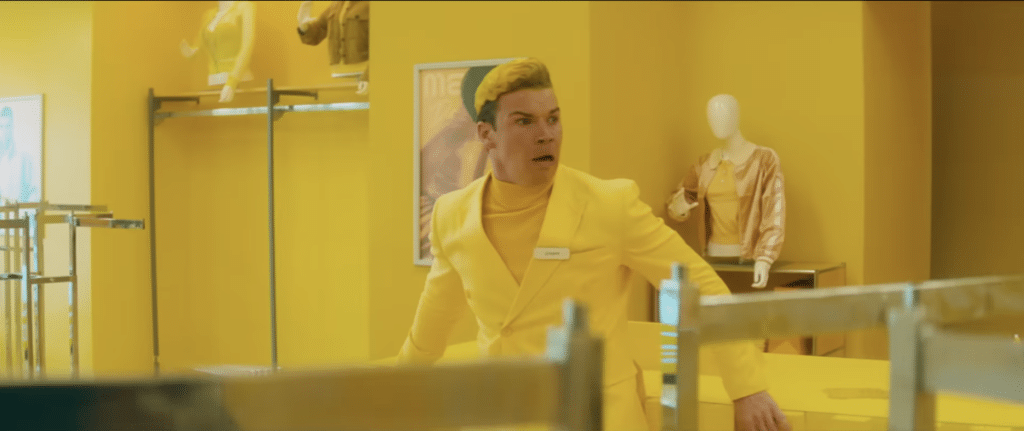
It’s easy to want to draw parallels between “I Love Boosters” and other films that also abuse maximalism, like “Everything Everywhere All At Once,” directed by Daniel Kwan and Daniel Scheinert (The Daniels). Many things stand out in “I Love Boosters,” like the vibrant color schemes of the Metro Design stores that only sell one color each month, the cartoonish humor, and the use of California as the backdrop of the movie. While The Daniels use a familiar trauma inheritance as the center of their movie, Riley has a message that feels more urgent than that of their peers.
Riley’s revolutionary DNA
The revolutionary inheritance Riley got from his family is the engine behind all his work. Whether as the leader of the revolutionary hip-hop group The Coup or in the way he dresses his protagonists in flowered dresses that match their wigs, Riley has always embedded radical politics in his artistic choices. Riley’s own father was an activist for the Maoist Progressive Party at the N.A.A.C.P state youth chapter in Oakland. It’s clear that Riley knows that being preachy doesn’t work; you have to draw your ideas visually so the audience can digest them without feeling lectured.

But the paradox is that “I Love Boosters” tries so hard to make its politics digestible through color and absurdist humor that it ends up preachy anyway, much like how The Daniels’ “Everything Everywhere All At Once” juggles maximalism and accessibility. The film breaks, mends, and transforms that idea through a burst of colors from set design to the absurdism of its performances.
The looks
Obviously, in a movie about fashion, clothes play a huge part. Shirley Kurata, the chief costume designer for “I Love Boosters,” also worked on “Everything Everywhere All At Once” and was approached by Riley with the script and a soundtrack of the movie. Many of the heist scenes from the Velvet Gang are quick, with shots cut in a way that brings the anxious, driven action to life. But the outfits Corvete and company run through San Francisco in are remarkable. The designer juggles a myriad of textures and proportions, with each costume resembling the character’s personality. Instead of black-masked thieves using a jumpsuit, they run around with stilettos, colorful synthetic wigs, and masks with drag queens’ faces on them. Even Christie’s muted black, grey, and white outfits flirt with the maximalism of the film’s vision.
A special factor of Kurata’s costume design in “I Love Boosters” is that the costumes were never an eyesore. The absurdity of the looks is so loud, but they make sense. They are messy, carrying so much information and style that one could wear them anytime around the Lower East Side. “I Love Boosters” is very surrealist, but ironically, the incredible outfits are the bridge to real life.
When maximalism becomes suffocation
“I Love Boosters” explodes on screen: characters, set design, stop motion, jokes (some in poor taste about sex), body horror, labor satire, everything fighting for space. There’s so much Riley wants to say that when he comes back in the third act to develop the conflict between Sade and Corvette, it feels more like force-feeding the audience a spoonful of plot. Palmer becomes a hostage to a script already armed with all of her author’s political arsenal. This happens without even giving the protagonist a chance to tell us who Corvette is through her own performance. It’s a shame because at times the story becomes suffocating, lacking any emotional gear to connect us to Corvette beyond the capitalist struggles we all go through. Riley exposes so much that, ironically, it alienates the audience from what he’s trying to say.
The archetypes that work (too well)
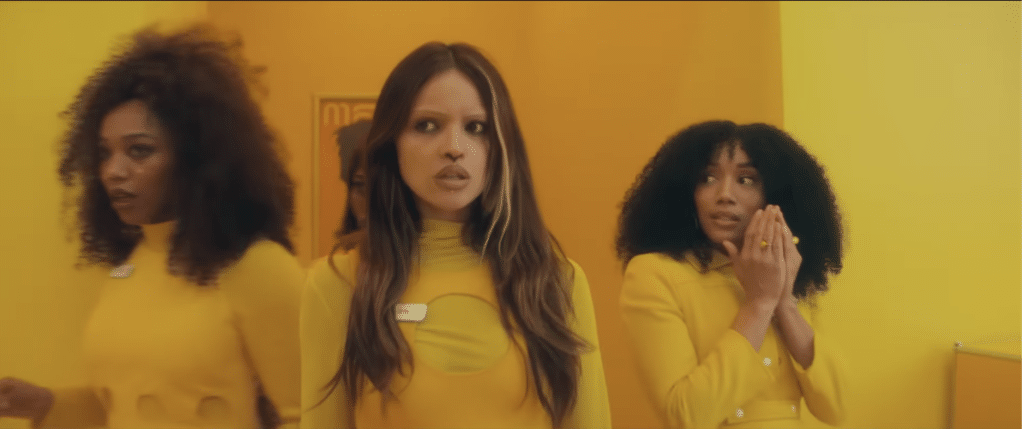
However, many of the movie’s archetypes worked well, including Eiza Gonzalez as Violeta. She’s a salesperson at Metro Design who, after enduring so much workplace abuse from her supervisor, Grayson (Will Poulter), “awakens” to the labor cause and organizes a riot to help the Velvet Gang during a fashion brand’s show. In contrast, Poulter is the typical oppressor who doesn’t realize there’s someone oppressed above him, and in that clumsy-boy-screwing-up vein he’s been working since “We Are the Millers,” things get even more fun from there. But even these two examples are very on the nose, serving as a compass so the general public doesn’t lose sight of the ideology that Riley’s script is trying to emulate. And it works because they’re archetypes deeply rooted in his oppressor/oppressed ideology.
A breath of fresh air, despite everything
Riley wants to draw it out for us until we understand that it’s necessary to wake up, that the definitive expression of our creativity is directly related to our freedom against all the capitalist movements that oppress us day and night. And he says it in a film that changes clothes every second, in a vibrant palette of colors and structures that dance on screen without losing their identity.
It’s something Corvette struggles with inside herself at every moment. By the end, she understands that things don’t need to be so black-and-white, something the movie’s general script could have emphasized more. But at the end of the day, “I Love Boosters” is a celebration of community, a breath of fresh air among so many disconnected blockbuster movies. And regardless of whether the working class unites, I hope Riley keeps serving up more colorful serves like this.