

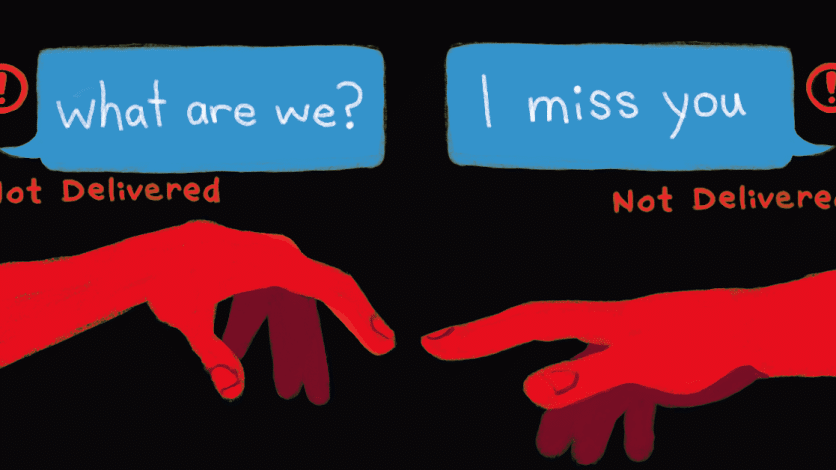
Stoicism is an ancient philosophy rooted in living a virtuous life by caring for others while simultaneously not letting external or internal factors control you. How the hell did we go from that to a lack of empathy?
“Behaving rationally does not mean ignoring your emotions. It means feeling them fully and deciding whether or not to act upon them.” –YouTuber Fads
If a man tells you the reason behind his lack of care is ‘Stoicism’, run for the fucking hills; he doesn’t know shit about the real Stoicism. He really means that the modern world has conditioned him to behave nonchalantly, embracing a kind of modern-day stoicism (with a lowercase s) that ruins dating, intimacy, and any chance at real connection.
Two summers ago, I was breaking up with my ex-boyfriend when his eyes turned into stone. So statue-like was his posture, you’d think my hair had vengeful snakes attached to it. There were no tears that welled up, no fight, not even a burrow of brow—nothing. I asked if he was okay, to which he explained,
“I’m sorry if there is no expression behind my eyes, I’m just very Stoic.”
It was the first time I heard the word, and I thought I was about to be murdered.
Maybe this is just an American thing tho, I thought. Maybe American men are just trash.
Are French men also Stoic?
Was this kind of stoicism a part of American culture?
Flash forward to today. I recently tried to do long-distance with a boy I met up with during my trip to Europe. Our time together felt magical, one you’d only believe if you saw it in a movie. Trust me, I have a love letter to show for it. The thing is, though, I live in the armpit of America while he’s in France…Yup, 4,000 miles away. I feel shattered by its inevitable end.

This past February, despite the doubts and inconsistencies that had already started to plague him, I went to revisit the guy. By day two of my visit, our end was decided.
“I am not sad because you’re here, right now, and you shouldn’t be either. There’s no reason to worry.” His words, not mine.
Out of luck, I had no other place to go, nor a dime in sight to change my flight or book a hotel. We agreed to make the most of my week-long stay.
I tried more than anything to wear his nonchalance until it became a second skin. “…no reason to worry…” What an impossible task. I cried in secret almost every day of my being there while he kept his composure. Why was I crying over a boy who couldn’t care less? I felt so ashamed. He felt like a stranger.
On my last day, he repeated, “It’s all going to be okay.” It all felt bittersweet.
And during our very last moments together, he proceeded to cry, practically sobbing on the floor as if all the emotions he kept hidden couldn’t stay in the dark any longer. His sudden emotions and our agreement to stay in contact, with the hope of recollection, made me feel like maybe it would be okay.
Funny enough, after returning from ‘the city of love’, I was ghosted. He never responded to a digital letter I sent (something we also agreed to do).
Out of sight, out of mind
I had never been more confused. You share intimate moments with someone, get attached, have sex, dive all in, FLY ACROSS THE COUNTRY FOR THEM, but in the end, it is the same result: cold, hard indifference. I couldn’t wrap my head around the switch-up.
“He has moved on. Can you blame the guy?”
“There was nothing else for him to say. He probably just changed his mind.”
“Out of sight, out of mind, the way it should be.” The responses from my friends and family felt all too familiar. I was scared once again.
“Some people choose not to let things affect them. It’s very Stoic.” ALAS!! The word I came to meet two years ago.
I grew to detest Stoicism, badmouthed it to anyone who’d listen. It seemed that stoicism was an international epidemic. I’m sure if I traveled to every country, I’d at least find one stoic asshole.
Eventually, my curiosity got the best of me. Surely an ancient philosophy would not condone this. A quick Google search: “The origins of Stoicism,” turned into a rabbit hole. Here’s what I found.
What is Stoicism?
Stoicism originated from Hellenistic philosopher Zeno of Citium, in Athens, 300 BC. He was originally a bookseller who studied Socrates and turned into the original Stoic. He coined Stoicism as the practice of virtue meant to help people assimilate horrible events with equanimity. It is the practice of feeling your emotions, no matter how negative or positive, and being aware enough to decide how/if to act upon them.
Tobias Weaver breaks Stoicism down. A virtuous life includes: wisdom, temperance, courage, and justice. Wisdom drawn from experiences, temperance through self-control and modesty, courage in the face of life’s challenges, and justice expressed through fairness and kindness toward others.
Though it has been practiced by notable figures throughout history, Stoicism was brought back into mainstream media and psychological practice by Albery Ellis, the psychologist who invented CBT. Now it’s a trending hashtag on TikTok. Stoicism’s popularity is without question, and for good reason, but why was my external experience with it so different?
Why did my friends and I experience similar dating histories time after time?
It is because mainstream media has confused apatheia with apathy. We’ve completely lost the plot of not letting feelings defeat us. Apatheia means freedom from extreme emotions — not apathy, a lack of emotion.
What was once something meant to protect you from suffering, a way to actually feel emotions and become powerful from overcoming them, has turned into an excuse to be casually cruel.
What Stoicism Is NOT
John Allen, writer and researcher, puts Stoicism into two categories. What stoicism IS vs. what it is NOT.
“Stoicism is not an individualistic philosophy focusing only on self-discipline. It focuses on the social responsibility of loving one’s neighbour, forming virtuous relationships, and helping others.”
What stoicism is NOT is the exact opposite. Allen’s article calls it “stoicism with a lower case s.” That’s the one I experienced. The one we disguise nonchalance under. It allows us to become self-sufficient, emotionless robots with no regard for how our actions might affect the feelings of others.
Under Domagoj Lalk Vidovic’s Medium article, Stoicism Can Be Brutally Toxic, Casey Juanxi Li commented, “I’m tired of stoicism being paraded around as an intellectual defense for refusing to engage with emotions.” Me too, girl, me fucking too.
The manosphere of Stoicism
Youtuber Fads describes this lack-of-emotion epidemic and the commodification of philosophy as the “manosphere.” Where toxic influencers around the world, like Andrew Tate, sell this ‘alpha male’ archetype that promotes less feeling and more go-getting, but then claim to be stoic.
Andrew Tate describes having a terrible life as a good man and taking a stoic approach by not being concerned with “how one feels,” all in the same interview.
“I refuse to break…cry…be depressed… I’m going to wake up and smile regardless.” He advises men and boys to follow these principles. As we already know, this is s(toicism) not Stoicism, and does not derive from any real ancient wisdom.
Meanwhile, he is a self-proclaimed mysgonist who glorifies the hustle culture. With 10 million followers, his videos get billions of views…it is no wonder that the misunderstanding of Stoicism has become so twisted.
A study on well-being. That’s because nonacceptance of our natural beings and a lack of community leads to seeking out less emotional support, less resilience, and depression–NOT the Lamborghinis and mansion’s Tate promises.
Choose self-expression
Upon reflection and research, I am growing to be less ashamed about my experiences in dating. I was dealing with stoics the whole time, not Stoics, and the only way to combat conforming to their ways is through self-expression.
“The Stoic ideal is therefore not to be ‘passionless’ (apathê) in the sense of being ‘apathetic’, ‘hard-hearted’, ‘insensitive’ or ‘like a statue’ of stone or iron. Rather, it is to experience natural affection for ourselves, our loved-ones, and other human beings, and to value our lives in accord with nature…”
–Stoic scholar, former psychotherapist, and author, Robert J. Robertson
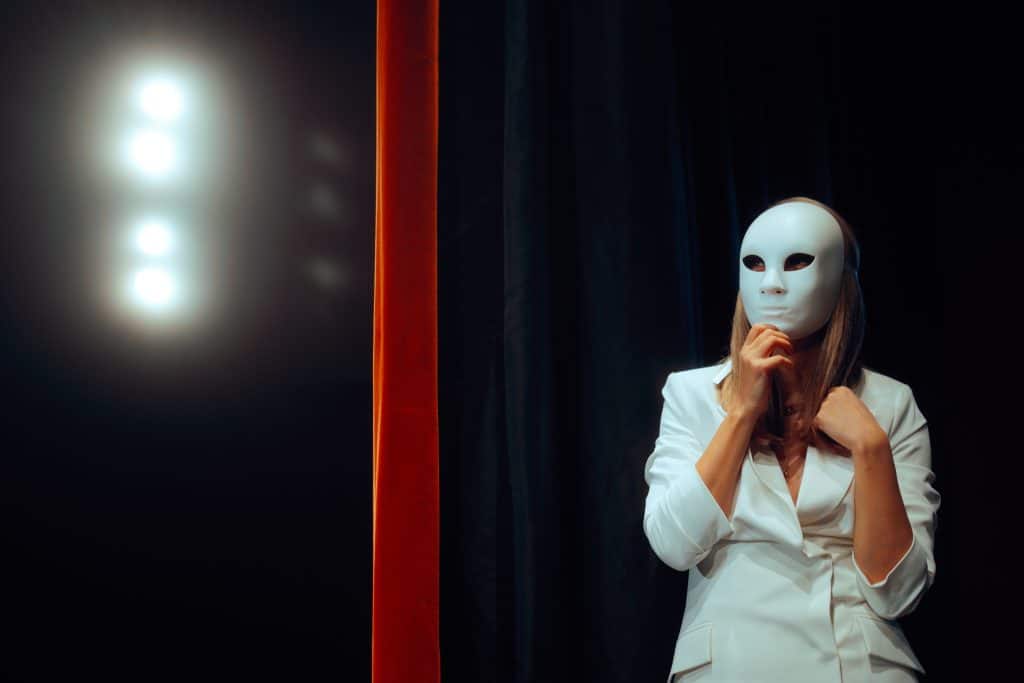
I am an emotional person, and I am loud about it. In a world that prefers to keep emotions silent, my self-expression comes off as more foreign than inexpressiveness. I now know that harsh detachment is not what the early philosophers of Stoicism originally intended. This new modern-day stoicism ruins dating, relationships, connection, and intimacy, and I, for one, am no longer accepting it.
The most fulfilling and healing relationships remain the ones we run to and dream about. When we see a couple, full of expression, dancing in public with not a care in the world, we say,
“Hey, I want that someday,” and believe it is fully possible…with authenticity, it can be.










Transcended___Walker
April 29, 2026 at 10:32 pm
As someone approaching 60, I can tell you that nothing about your expreince had anything to do with Stoicism, stoicism, or Broism. It was simply some fantacy you built in your mine that he didn’t feel the same about. But to put it in Stoic terms to go along with you distorted impression of the relationship, at best you were simply a perferred indifference to him one night and nothing more.
Alyssa
April 30, 2026 at 5:29 pm
Wow what a kind comment💓💓💓💓💓This article was just talking about being introduced to stoicism/research I found, the rising popularity of a non emotional human being, and trying to make sense of two out of MANY relationships I’ve experience and will continue to do so. Thank you!
Alyssa Rivers
April 30, 2026 at 5:43 pm
Preferred indifference falls under (s)toicism, btw. Key word, “indifference.”