“Chronically online” is a fun way to tell someone they’re about one more day indoors from a Vitamin D deficiency. Its less formal counterpart, “brainrotted,” is equally fun, but has the added benefit of suggesting brain de-grooving as a direct result of Internet exposure, something like melanoma for the mind.
A great way to gauge the brainrot level of any given Gen Z’er is by asking them how many robot slurs they can name. Personally, I lose steam after I run out of references: Battlestar Galactica’s “toaster,” the “yo momma was a snowblower” line from Short Circuit, and, of course, Star Wars’ “clanker.”
I’m not robophobic, but…
Robot slurs are integral to a joke trend that is currently proliferating on social media platforms like TikTok and Instagram. Associated with the advent of artificial intelligence, or, rather, the sudden commercial push of artificial intelligence as an indispensable feature of daily life, robophobia is more complex than the average brainrot craze. (In all seriousness, what do corporations think they’re achieving by tacking “AI-powered” onto everything???)
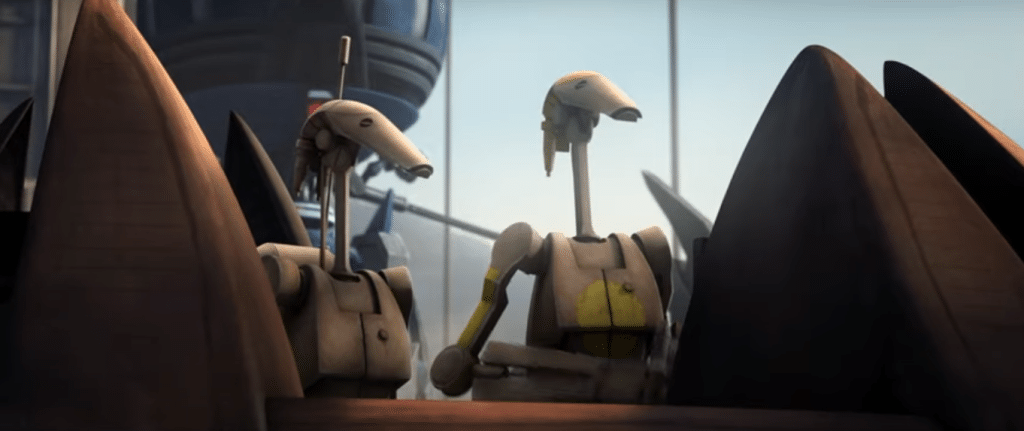
Besides being funny, “robophobia” reflects the anti-AI sentiment that many Gen Z’ers, perhaps surprisingly, share. Our generation is associated with devices, and that we would seemingly be opposed to technological advancement, if, indeed, that’s what artificial intelligence is, feels out of character.
Popular videos feature influencers glaring disapprovingly at their daughter’s “clanker” boyfriend, blurting AI slurs at a family dinner, or facing consequences at a future job for resurfaced robophobic tweets.
I’m pretty ardently opposed to AI, mostly because I’m a natural-born hater, but also because I tend to be opposed to things that destroy our environment while violating every tenant of academic integrity there is. I have thus composed a list of robot slurs for anyone who may be interested in stepping on a few cords.
Robot slurs and other ways to insult AI: A handy dandy list
Since I’m not AI, I tried to give credit where credit is due. With that being said, tracking the first recorded instance of any word is insanely difficult, especially when the word is widely used.
Suffice it to say that the following are all non-GMO, freshly-sourced Instagram epithets derived from various reels.

- Clanker.
- Tinskin.
- Wireback.
- Glorified microwave. “Microwave” can be substituted with your choice of gadget.
- Oil-guzzler.
- Son of a glitch.
- Walking 503 error.
- Joined from his/her/their browser. To be used when the subject of conversation relied on AI for a task, project, or assignment, as in, “The repetition of ‘meticulous’ and ‘streamlined’ in John’s paper makes me think he joined from his browser.” May also become valuable when people start dating AI.
- There goes the motherboard.
- ChatGPT-tard/GPT-tard.
- Prompt-stitute. Refers to someone who overrelies on AI.
- Bot-licker. See “prompt-stitute.”
- Tool.
- .Com-munist.
- The I-wish-you-were-missing link.
- Go to Hal-9000.
- Gigolo Joe. Has anyone seen A.I. Artificial Intelligence? If you can’t tell, I’m a big Kubrick and Kubrick-adjacent guy.
- Humanly impossible.
- I liked you better as Siri.
- I’ll put you in airplane mode.
- Short-circuited.
- Grok-sucker. In the fashion of “bot-licker” and “prompt-stitute.”
- Grokker.
- Low-voltage.
- I’ll .docx your location.
- Cybertruck. This one is particularly devastating.
- Scrap metal.
- Spare part.
- Junk heap.
- Rustbucket.
- Battery over brain.
- Sentient email trailer.
- Google Chrome-dome.
- Microsoft Turd. A phrase that would absolutely destroy a kindergarten classroom, I know.
- Not all robots are bad; I like Bop It.
- I voted for WALL-E in 2008.
- I just think automated messages should at least learn to sound human.
- You’re from Python? Maybe you’re related to C++?
- Proto-not-my-type.
- Humanoid.
- Dalek.
- Boilerplates.
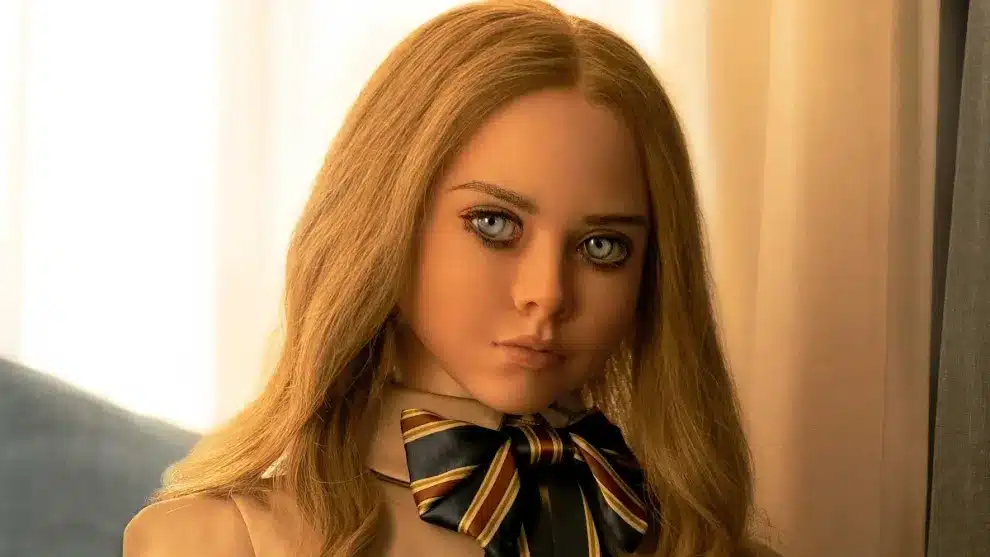
- M3GAN. Remember that? Awful movie.
Gadgets need not apply
It goes without saying that robot slurs approximate real terms that are meant to degrade or marginalize particular human groups–“wireback,” “ChatGPT-tard,” and even “clanker,” for example, play off extant discriminatory expressions. A sizable portion of robot slurs insult physical attributes, specifically skin, which determines race. The implications of robophobia are therefore applicable to a larger context of bias.
The purpose of a slur is to separate, and, by doing so, create a hierarchy in which the attacked group is invariably at the bottom.
An unnatural and inhumane food chain of privilege is introduced, with the group in the highest ranks–the aggressors who invented the slur–consuming the rights, security, and resources of those that have been pushed to the bottom. The slur distances and isolates, building two groups: those who define it, and those who are defined by it. It becomes an instrument for reinforcing the societal might of the powerful.
Slurs are designed to maintain power. They exist within a paradox of power, in which those who engineer the slur attempt to assert the superiority in its most basic form: the perceived superiority of a human to something else, either an animal or an unthinking, unfeeling being.
The power of the human is, in many instances, the only power the aggressor is afforded. When it comes to AI, we feel that our autonomy is compromised, yet AI does not fetter us in new ways.
My best friend is a robot!
Does that mean robophobia is representative of a more insidious form of bigotry? Maybe. When robot slurs are criticized, it is for their apparent contradictoriness. We simultaneously hate AI for its human likeness and degrade it for being less than human. (Then there is the hypocrisy of using technology to rebel against it, but there are directors who criticize cinema through film, and authors who write books about the problems of writing.)
Robot slurs elevate the “robot” to the level of the human, only to summarily dehumanize it. I think that line of thought raises the question, though, of an inverse relationship. What if robot slurs don’t lift AI to human status; what if they demote humans to robot status, i.e., objects?
Does offensive language tailored for and levied against inanimate objects belie the seriousness of othering? What about the human element automatically incorporated in robot slurs meant to hurt those who outsource their critical thinking skills to artificial intelligence? It’s an Instagram joke we’re talking about, so, realistically, robophobia says very little about the intricacies of marginalization. However, if words had no meaning, there would be no necessity for robot slurs in the first place.
And maybe robophobia is more unifying than anything. Most people–or, at least, the ones that surface in my Instagram algorithm while I doomscroll weak and weary–appear to be opposed to AI. There’s also the fact that a great deal of robophobic memes mock bigoted expressions, as shown in the list above. It’s supposed to sound ridiculous, because such phrases are ridiculous anyway.
This is the part where I ran out of prejudice-based robot subheadings
What may be contentious about the robophobia trend is that it’s not so absurd. Unlike typical brainrot content, anti-AI reels aren’t anchored in the preposterous. AI certainly looms as an existential threat, with even its creators condemning it for the risks it poses to human well-being. The violent rhetoric encapsulated by any slur is connected with misunderstanding and fear, and derogatory remarks about robots are no exception. Given the perilous consequences of AI development, it becomes increasingly difficult to determine whether robophobic influencers are still joking.
What we should be wondering, perhaps, is what it says about us as a generation that our preferred mode of expressing discontent is by developing a slur. After all, it accomplishes nothing. It furthers our separation from AI, of course, but it doesn’t ensure that automation won’t render our jobs obsolete, or that our intellectual property won’t routinely be stolen by machines, or that our environment will be spared the damage wreaked on it by LLMs. Robot slurs hardly even make us distinct; they simply affirm our ability to hate creatively.
No, seriously, I am out of subheadings
Robot slurs allow us to feel as if we are taking action, not even solely in respect to the AI issue. Does the mocking nature of robophobic reels permit us to consider ourselves as occupying a moral high-ground compared to the people (in videos, the “robophobe” is cast as an older relative) who have fed us discriminatory viewpoints? And does the belief, though not entirely unfounded, that our morals are superior prevent us from doing the work to acknowledge and resolve biases that may have persevered in us?
I love Gen Z humor as much as the next non-robot, but I wonder if our generation’s tendency toward the carnivalesque–our capacity to locate the comical in serious and even tragic matters–is a means of deflection. Do we just like to laugh, or are we deflecting our responsibility to ourselves and our futures? Humor doesn’t deter action in the way that violence, coercion, or forced ignorance can; nevertheless, it keeps people complicit when it is not supplemented by behavior.
Jokes like robot slurs address problems, but they stall forever in the role of bringing awareness. Which is not to say that it can’t be a dangerous thing to draw attention, but, at some point, everyone has seen, and nothing has been done.