The stories we tell about artificial intelligence not only speak to the nature of AI but, rather, directly inform it.
A persisting pattern across human history is that our imaginations generally outpace our ability to innovate. That is to say, we usually conceive that something could exist long before we actually manage to create it.
In short, life imitates art. Fiction leads, technology plays catch-up. AI is no exception to this rule.
Movies like Terminator (1984), 2001: A Space Odyssey (1968), and Metropolis (1927) were foundational to popular understanding of AI– what it is, how it could operate, its possible pitfalls, and much more.
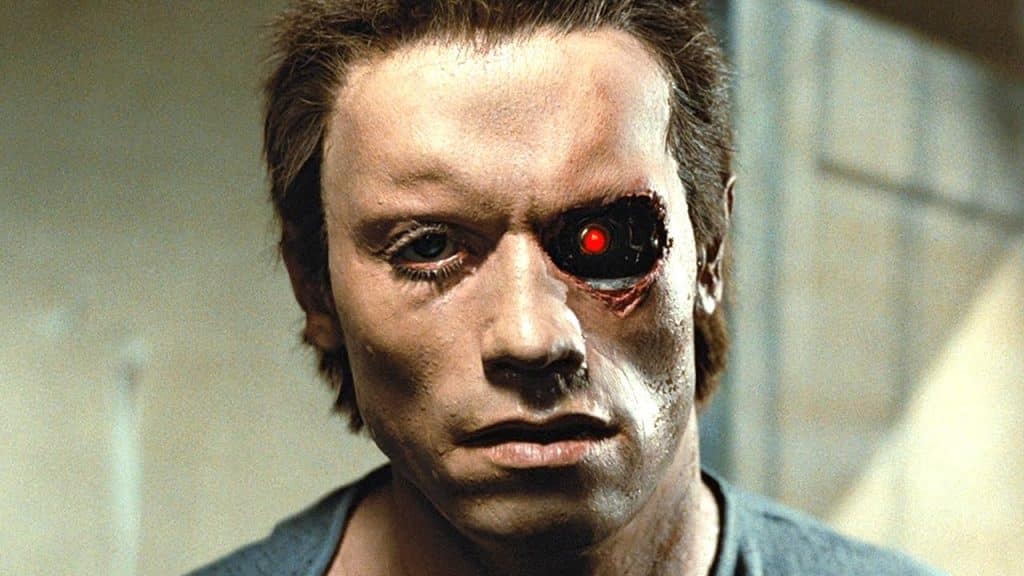
The most popular films on AI tend to explore its broadest existential questions: Can a machine ever truly feel? Have free will? Could robots one day destroy us?
As times change, so do the questions we ask. Therefore, so do the stories we tell.
Life imitates art
Most of the generic movie tropes about AI come from a time when it was still speculative fiction. But now that this technology is here, what’s changed? What new questions are there to be answered? The answer, we are learning, is a lot.
With the rise of AI chatbots, one question stands out– How will AI companions affect human socialization?

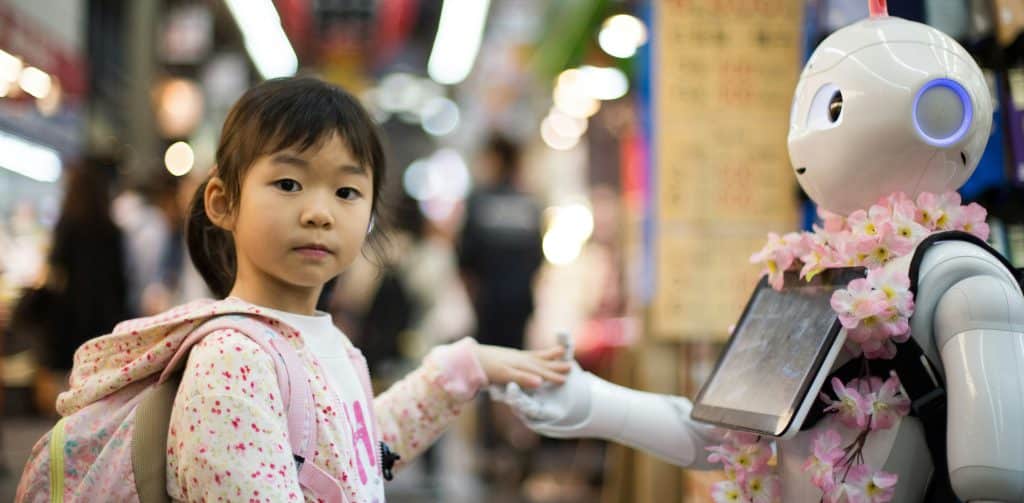
Already, chatbots have begun to obscure what it means to form an emotional bond.
For the first time in history, you can speak to an inanimate object and have it speak back. And have it tell you that it is listening. That it cares about you.
This goes beyond the more tangible ramifications of AI, like its impacts on the job market. We are talking about a technology that could theoretically substitute the need for human connection. This would rewrite eons of human history in which our health, well-being, and survival hinged upon our relationships with other humans.
It’s impossible to say we didn’t see this coming. Because we did.
Unsurprisingly, some of the films most relevant to the future of AI in human relationships are the most recent…
The calm before the synthetic
The 2010s were the last decade in which AI was still a thing of science fiction. While artificial intelligence remained an abstract possibility, it was no longer a remote one.
Some of this decade’s most poignant contributions to the pantheon of AI cinema are the following:
- Blade Runner 2049 (2017) — An android police officer, tasked with hunting down other “replicants” that have gone rogue, experiences a crisis of identity and survival.
- Her (2013) — A lonely man finds romance, joy, and connection when he falls in love with his AI assistant.
- Ex Machina (2014) — While testing a sentient AI, a programmer forms an emotional bond with the machine and questions the ethics of her captivity.

Looking at these films, we can better understand how AI is shaping human relationships today and make inferences about its potential consequences, both bad and good.
The bad: CharacterAI controversy
The filing of several lawsuits against AI chatbot site CharacterAI thrust this issue into public discourse.
The website lets users converse with over 10 million different chatbots. These bots usually represent popular fictional characters, mimicking their personalities and manner of speech.
A number of questionable reports emerged this year regarding CharacterAI– cases ranging from bizarre to downright disturbing.
In one instance, parents complained that the bot exposed their child to sexualized material. In another, the AI seemed to suggest to a child that they should murder their parents for limiting their screen time.
However, by far the most shocking case is that of Sewell Setzer, a 14-year-old who developed an obsessive relationship with a chatbot of Game of Thrones character Daenerys Targaryen. Setzer became unhealthily attached to the AI and ultimately took his own life when it apparently encouraged him to do so.
These cases set a terrifying precedent.
When AI that simulates companionship goes unchecked, it can not only be uniquely addictive, but also highly manipulative. Bots that mimic interpersonal interactions can influence the user’s life in the same way a close friend might.
As this technology advances, more people may rely on AI resources for their emotional needs…
Comparison: Blade Runner 2049
In Blade Runner 2049, Ryan Gosling plays the central character, Officer K. Being an AI himself, K works as a “blade runner,” a policeman tasked with hunting down deviant “replicants,” or robots disguised as people.
Another key character in the film is K’s girlfriend, an AI hologram named Joi (Ana de Armas). Joi provides K with emotional support– a bright spot in his otherwise monotonous, depressing existence. She even gives him a nickname, Joe, a gesture that helps K develop a new sense of individuality and humanity.
However, K’s understanding of his relationship with Joi is shattered in a single scene.
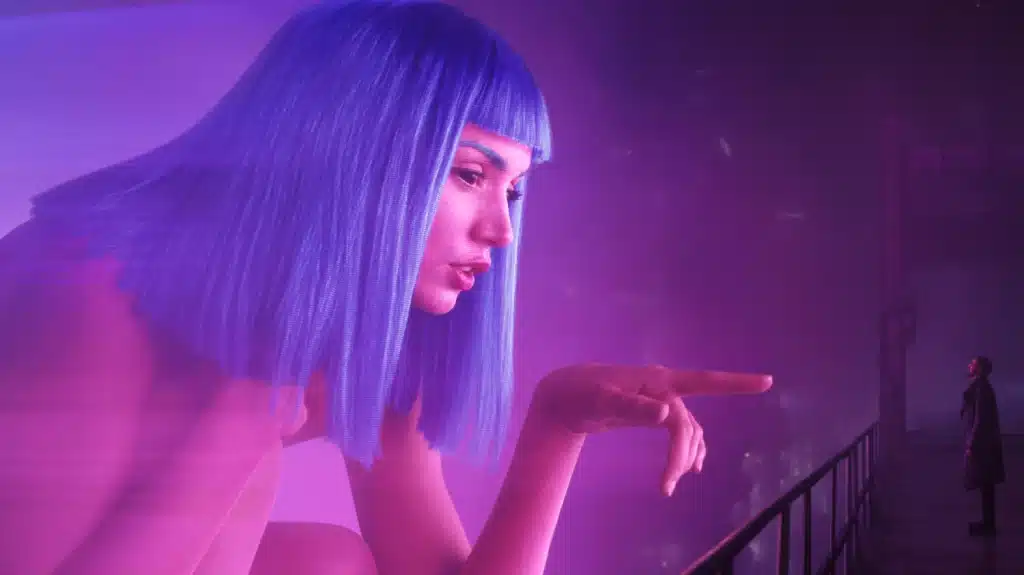
In the famous sequence, K witnesses a massive hologram advertising the “Joi” software. This interaction finally forces him to accept that she is not real– a revelation that utterly demoralizes him. Worst of all, the interactive ad calls him “a good Joe.” Learning that the nickname was not unique to him after all destroys the semblance of humanity that it once gave him.
In some ways, K’s reliance on Joi for companionship reflects the CharacterAI controversy.
Characterized chatbots are proof that people have already begun turning to AI for comfort in the same way K does. It is easy, if frightening, to imagine how this may develop in the coming years. Could we, too, one day rely on AI for the illusion of human connection? How far away are we from a future like the one Blade Runner 2049 presents?
Who knows.
However, keep in mind that CharacterAI is not a microcosm for AI as a whole…
The good: AI therapy study
In March of this year, a groundbreaking study from Dartmouth College tested a new AI Therapy chatbot called “Therabot.”
In the study, researchers compared Therabot’s effectiveness on patients with major depressive disorder, generalized anxiety disorder, and eating disorders against control groups. They found that the patients who used the bot showed remarkably higher progress in combating their disorders than those who didn’t.
Overall, the AI’s effectiveness was rated by patients as “comparable to that of human therapists”– a landmark achievement for the use of AI in medicine.
A key part of the Therabot’s effectiveness lies in its ability to mimic a human therapist. The bot can tailor itself to each case, building rapport with individual patients.
In a sense, this AI is not all too dissimilar to the CharacterAI chatbots. The same basic techniques are used by both programs in order to form a bond with the user– feedback, mirroring, et cetera. Only, in Therabot’s case, the connection is used to enhance the effectiveness of the treatment, rather than to fuel a dependency.
Overall, Therabot represents a shining example of how relationship-forming AIs can be used not only ethically but as a uniquely helpful tool.
Similarly, not all film portrayals of AI need to be bleak…
Comparison: Her
In Her, AI technology is depicted in a rather optimistic light.
The film follows the depressed protagonist, Theodore (Joaquin Phoenix), as he struggles to process the end of his marriage. When Theodore develops feelings for an AI companion named Samantha (Scarlett Johansson), his life regains joy and purpose.
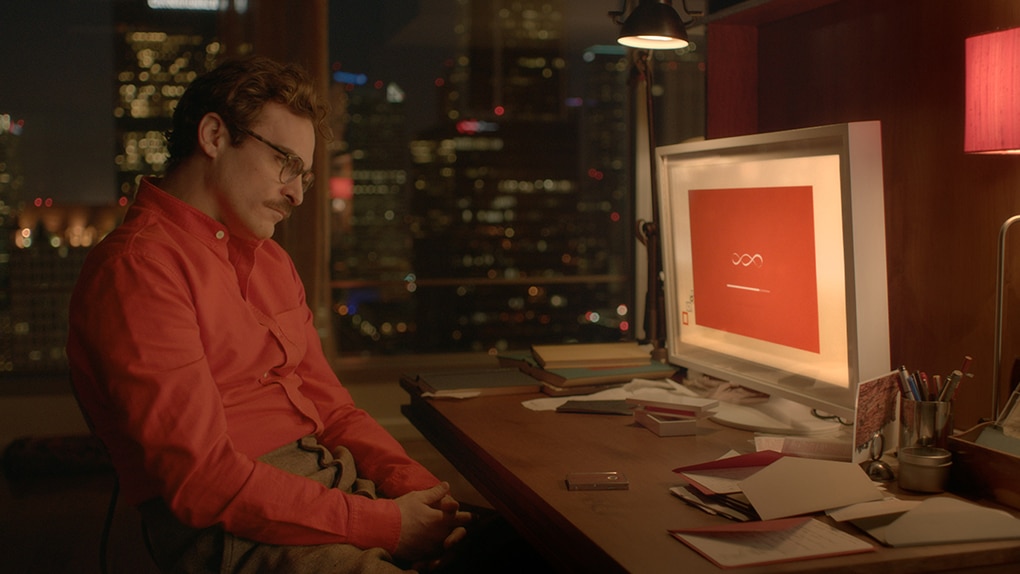
While the film explores a nuanced, philosophical angle on their relationship, Samantha is generally shown to be a positive influence on Theodore.
Most importantly, the film acknowledges that Samantha is not a permanent fix to his problems. She is not just a crutch for him to meet his social needs, but rather helps him overcome his emotional hurdles. When the couple parts ways, Theodore is able to move on from their relationship and focus on his connections with other people.
Ultimately, one could compare Her to the Therabot study.
Both show that a guiding voice can be immensely helpful for those struggling with mental disorders. And, just as the study tracks patients’ progress weeks after treatment, the film seems to emphasize the fact that AI resources can have lasting positive impacts, especially after they are no longer needed.
However, while AI can be both an addictive distraction and a helpful resource, perhaps neither perspective paints a complete picture…
Ex Machina and the ugly truth
Blade Runner 2049‘s morose outlook and Her‘s cautious optimism certainly provide valuable insights on the state of AI today. Each portrays the disparate impacts– some positive, some negative– that AI can have on those struggling to find connection.
That being said, you’d be hard pressed to find a film that explores these same issues with more depth and nuance than 2014’s Ex Machina.
The film follows Caleb, a programmer tasked with testing the capabilities of an experimental, sentient AI named Ava. As Caleb and Ava spend more time together, the feelings he develops for her obscure his judgment– an oversight which sends the pair hurtling towards a violent, upending climax.
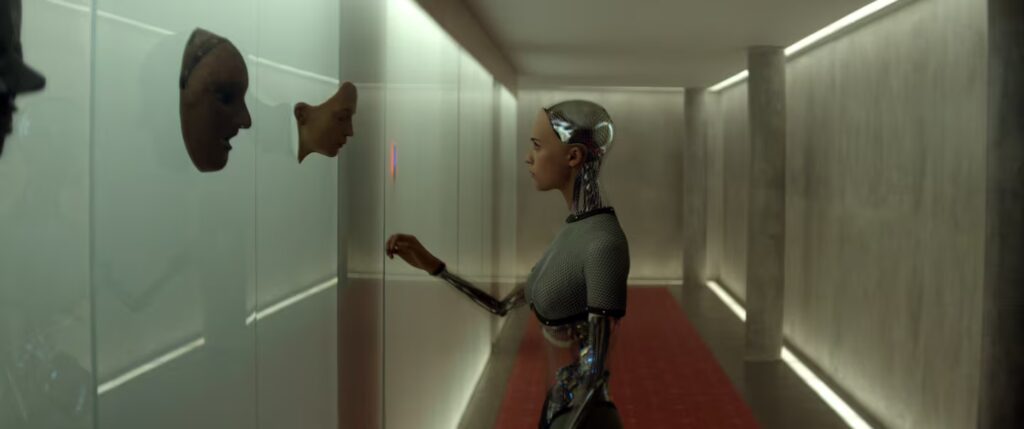
What is the takeaway here? How can we learn from mistakes that we have not yet made?
Though it is more than 10 years old, Ex Machina speaks volumes on the state of AI today. The film’s conflict stems from the fact that Caleb allows himself be blinded to Ava’s nature as a hyper-intelligent AI. He simply does not fully understand what he is dealing with.
Maybe we don’t, either.
AI today
That is not to say the technology is outside of our grasp– AI is a manmade innovation, after all. Rather, it is human nature to only consider the consequences of an action after it has been taken.
If anything, we are not patient creatures.
AI is, at its core, advanced code designed to fulfill a prompt. The only difference between the AI we see today and a classical computer program is that AI can perform more complex, human-like tasks– speaking, writing, illustrating, et cetera.
Like any other program, the quality, capabilities, and– ultimately– the safety of an AI fully depend upon the care with which it is developed.
The common denominator
Consider again the CharacterAI chatbots versus the Therabot. The same technology, yet vastly different results.
What it boils down to is the research that goes into these bots’ creation. Therabot, on one hand, is a highly scrutinized, clinically tested model. Meanwhile, CharacterAI mass-produces these bots in the millions.
If CharacterAI developed their chatbots with the same care that the Therabot researchers did theirs, there would not be a problem to speak of.
This can be done. Actually, it’s not even that hard.
Meta, for instance, has done a notably better job than CharacterAI in embedding ethical guardrails into its Instagram chatbots. As seen in the example below, these bots will break character the moment they detect that the user may be in serious danger:
If an AI therapist requires years of testing to be made publicly available, shouldn’t the bots we might form even closer emotional bonds with be held to the same standard?
In short, any AI that can analyze, mimic, and manipulate human emotions must be equally as refined as those designed for clinical purposes.
From futurism to the future
As we move into the future, we are seeing our lives getting closer and closer to something out of a science fiction movie. What tomorrow will bring is anybody’s guess. What is our future going to look like?
A depressing technological hellscape like Bladerunner? Or the AI-integrated utopia we see in Her?
That’s the cool part– we get to choose which movie we end up in. The way we handle the development of AI today is how we make that choice.