Perhaps 15-year-old me was blind to the glaring hate of the outside world. But ever since the COVID-19 pandemic, the rainbow I held so close to my heart seems to have withered and faded to a murky grey.
For many, the 2020 lockdown was the peak of queer expression. Separated from the scrutiny of the public, people finally felt safe enough to be expressive and genuine. Tragically, it appears that distance really does ‘make the heart grow fonder’. As shops began to reopen, authenticity was once again shut down.
U.K crime statistics report that, since the pandemic, LGBTQ hate crimes have risen by 41%. For the transgender community, this rate is a distressing 56%.
This increase is not coincidental — it’s symptomatic of a wider pattern.
The dependence on social media for news consumption has led to a drastic shift in values. Flooded with Charlie Kirk’s ‘trad-wives’ and clean girl influencers, platforms like TikTok and Instagram are encouraging Gen-Z to take on conservative ideologies.
Pitting young adults against the ‘enemy,’ that is, the queer community, conservative political leaders are using their online presence and physical to distract the voting population from more pressing matters like government corruption.
In witnessing this shift from pre-pandemic acceptance to the current homophobic environment, it becomes necessary to look to the origins of heterosexism, for, as Mark Twain once commented, “History never repeats itself, but it does often rhyme.”
History doesn’t repeat itself, but it does rhyme

According to the Oxford dictionary, heterosexism differs from homophobia in that it is not an individualized fear, but a systemic discrimination that enforces opposite-sex attraction. This infection is reliant on the dominant societal assumption that straightness is the morally ‘correct’ option. In doing so, it discards queerness as an unnatural outlier.

Because of the limited historical documentation surrounding LGBTQIA+ lives, it is difficult to pinpoint the exact genesis of hetero-normative belief. The sources we have, however, generally contend that the ‘transmission’ of heterosexism stems from the early Middle Ages.
Accounts from the North Carolina press indicate that Roman society maintained an ‘almost limitless tolerance’ of homosexuality. It was only after the Empire fractured, undermined by despotism and the ‘growing institutionalization’ of the thirteenth century, that attitudes began to change.
Persecution as a tool of political protection
In early Rome, queer eunuchs occupied positions of political power within the imperial court. Recognizing that these figures were difficult to overthrow through conventional measures, Christian bishops turned instead to homophobia. Without seeking endorsement from the church, they vilified the queer minority, weaponizing sexual stigma and pressuring emperors into enacting laws against homosexuals.
The run-off of this corruption peaked during the reign of Roman emperor Justinian. Under his rule, earthquakes, plagues, and famine were framed as divine punishment for queer existence. This narrative became the perfect excuse for the persecution of homosexuality, allowing him to sentence accused gay men to torture, mutilation, castration, and ultimately execution.
Once these rules were cemented, Justinian was able to turn them on his political rivals, coercing slaves to accuse his enemies of being gay simply so he could murder them legally.
Looking to the current rollback of queer rights within America, such as the bill Ending Radical Indoctrination in K-12 Schooling, we can witness an almost uncanny resemblance to the emergence of heterosexism.
Like Justinian, modern leaders such as Trump are using persecution as a tool of political protection.
The ever-growing political garbage pile.

Last January, the White House bill Ending Radical Indoctrination in K-12 Schooling was passed. It withholds federal funding from institutions deemed to be ‘indoctrinating’ children by supporting gender and sexual diversity.
For those school officials and teachers who continue to provide youth with accessible bathrooms, preferred pronouns or counselling, legal action has been enforced, removing them from their position within education.
A month later, on February 5th, an equally harmful bill was released. Banning transgender individuals from entering sporting events under their preferred gender, it’s transphobic titling, “Keeping Men Out of Women’s Sports“, perfectly encapsulates the White House’s view of the trans minority.
These are just two of the 71 dehumanizing bills pushed through under Trump’s administration. Dropping a new law every week isn’t about helping anyone; it’s a distraction from personal corruption.
If we don’t lift our eyes from our phones and pay attention to the bigger picture, that number will keep increasing. The truth of his crimes, such as the Epstein files, will be buried even deeper under the ever-growing political garbage pile.
Gen-Z’s reversion from individualism to purity culture

Despite having unlimited access to the plethora of information dismissing Trump’s claims, Gen-Z is quickly becoming the most conservative generation to date.
Amy Davies at Virtue Worldwide discusses this in her critical discussion of the 2024 study “The ‘voices’ of Gen-Z”, stating that, over the past 5 years, the rate of Republican voting has risen in Gen-Z by 50%.
One of the clearest reasons for this reversion lies in our consumption of political media.
Yale’s youth poll reports that since 2021, there has been a staggering 30% rise in TikTok news consumption, with 50% of Gen-Z relying on social media as their main source of information.
In Yale’s account, further examination reveals that reliance on social media directly impacts voting. There has been a 6-point shift in young adults voting for the republican party. For those who vote red, records display a heavy or complete dependence on social networking services.
The conservative fairytale

By correlating traditionalism with social stability, clips like the one below can push a dangerous illusion — one that teaches Gen-Z to interpret their unrest not as the consequence of poor governance, but as the ‘indoctrinating’ effects of queer and feminist communities.
The endless stream of happy heterosexual couples and their quiet, domestic lifestyle presents as an enticing mirage, one that Trump continues to push upon the public.
Gen-Z’s rapid consumption of conservative media, in combination with a refusal to seek out external information, leaves no space for an alternative narrative to exist.
Just as Justinian used moral panic and propaganda to scapegoat queer people and consolidate his power, today, curated conservatism on social media is shaping our generation’s political outlook.
In this environment, it’s no wonder that Trump has been so wildly successful in advancing his anti-LGBT campaign.
Love will come back
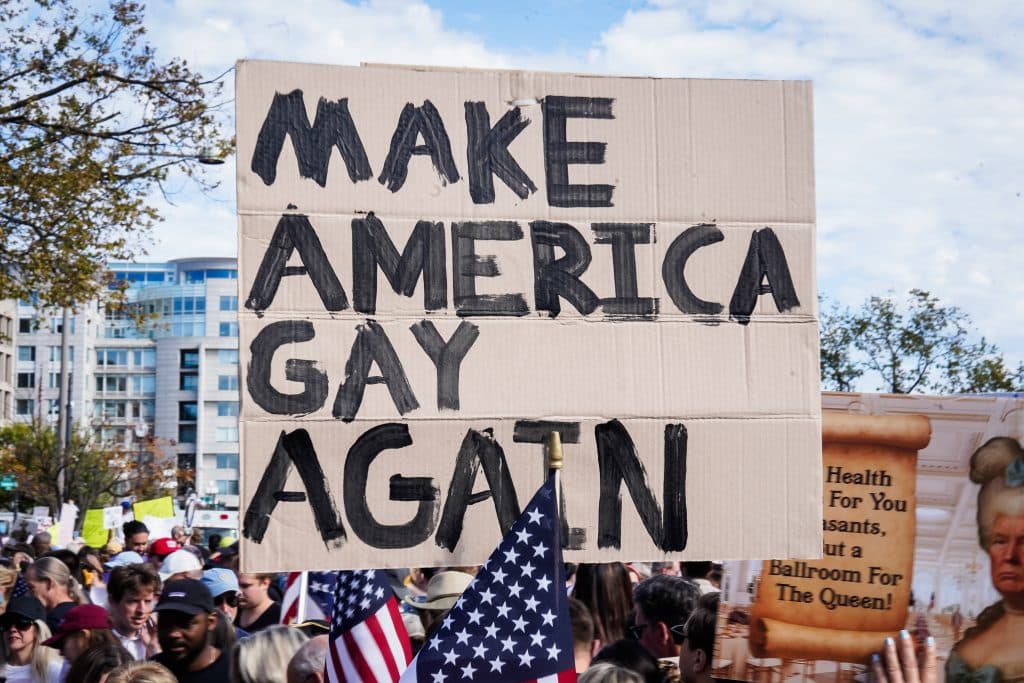
In 2026, the lives of LGBTQIA+ individuals continue to be a punching bag for those who promote heterosexism. After 700 years of hostility, the anti-homosexual attitude wields a seemingly infallible fist, one that, thanks to the resurgence of conservatism, is back in full swing.
Writer and psychologist Jeff Hasen’s assertion that Gen-Z is the “most informed, evolved, and empathetic generation of its kind” may feel increasingly hard to believe. It is lucky then that, despite post-pandemic ignorance, there are still young adults who continue to advocate for the queer community.
For those surviving dreamers of 2020, we must hold onto the belief that our future can be built on genuine acceptance. That with time and truth, it’ll all come back in the other direction.
Love will come back.
For hatred stirs up conflict, but love covers over all wrongs
– (Proverbs 10:12).