In the early morning of January 3, 2026, the United States bombed Caracas, Venezuela and abducted President Nicolás Maduro. This dramatic escalation came after a series of sea-based attacks on Venezuelan boats and seizures of Venezuelan oil tankers.
Since those initial strikes months ago, the US Central Intelligence Agency (CIA) has also carried out a drone strike on a Venezuelan port facility.
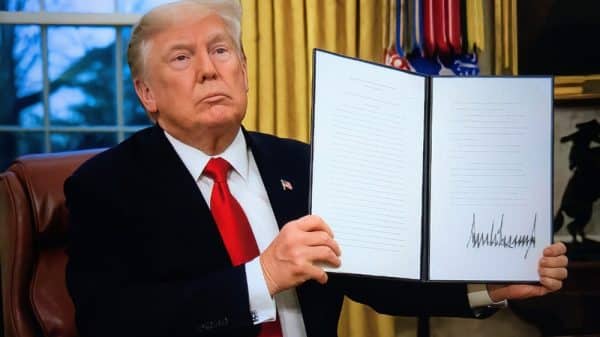
These actions have become entangled with allegations of narco-terrorism and oil theft from US officials, including President Donald J. Trump and deputy chief of staff Stephen Miller.
Now, the future of Venezuela and further US military intervention is up in the air. Potential for continued escalation remains, as President Trump seems to openly endorse regime change favoring US corporate interests. In particular, the US oil industry.
In the midst of current developments, it’s certainly worth considering the rhetorical justifications leading up to this moment in more detail.
The charges against Venezuela
Months ago, seemingly out of nowhere, the Trump administration adopted an intense focus on Latin American “narco-terrorism.” (At least, in words. Many noted Trump’s pardon of former Honduran president Juan Orlando Hernández, who was convicted of drug trafficking, in December. Venezuela’s Maduro is currently facing drug trafficking charges in New York.) Even more baffling, the allegations centered around Venezuela, rather than bordering nations like Mexico.
These statements coincided with US airstrikes on alleged Venezuelan drug boats. US forces extrajudicially killed at least 120 people in at least 35 strikes since September 2025.
The White House and its affiliates first used allegations of drug trafficking to justify US military intervention. But, the narrative around these attacks continued to morph from there. The emphasis on cartels and terrorism dwindled as references to Venezuelan oil and minerals, and even questions of regime change, increased.

Allegations of “narco-terrorism” became allegations of oil theft. Trump aide Stephen Miller wrote on Twitter/X that “American sweat, ingenuity and toil created the oil industry in Venezuela. Its tyrannical expropriation was the largest recorded theft of American wealth and property.”
By “tyrannical expropriation,” Miller seems to refer to Venezuela’s nationalization of its oil, which ousted foreign corporations and transferred ownership to the Venezuelan state.
Now, in a jarringly brazen attempt to pursue Venezuelan natural resources via regime change, the US is essentially staking its claim to direct the nation’s future governance. The removal of President Maduro, and even the intervention in Venezuela itself, may be just the beginning—if we can even call it that. To understand what the US is doing in Venezuela now, it’s important that we look back.
Revitalizing retired rhetoric
In foreign policy, language is particularly important. Convincing a domestic population that national forces and taxpayer dollars are necessary abroad takes significant effort. (These attempts to persuade the American public to support foreign intervention aren’t always successful, either. Public opinion polling on US military aid to Israel has made that clear.)
There’s no shortage of rhetoric to evaluate in the case of the current US intervention in Venezuela.
While the constant refrains of cartel activity and terrorism are staples of Trump’s foreign policy, there have also been callbacks to other eras. Just one example is the recent classification of fentanyl as a “weapon of mass destruction.” The phrase presents an uncanny parallel to the unsubstantiated claims US officials used to advocate for the Iraq War.
Then, there’s US opposition to Venezuelan sovereignty, justified with a US-centered framing of natural resources and industry. As the US attempts to claim ‘ownership’ of Venezuelan oil, it equates past nationalizations of resources to attacks on the US. The exclusion of US corporations seems to be the current administration’s primary concern, as the US takes sales and profits of bountiful Venezuelan oil—in fact, the largest oil reserves in the world—under its control.
(It’s also worth noting that Venezuela has a history of supplying oil to US adversaries, such as China. One particularly controversial collaborator is Cuba, which is under US embargo. Countries like Cuba and Venezuela have been on the receiving end of significant US sanctions.)
What seems to be flying under the radar, most concerningly, is the idea of “regime change” itself. In this context, the term seems to be little more than a euphemism for violating the principles of national sovereignty and self-determination. Steering a foreign government into compliance with domestic economic interests can’t be democratic in any meaningful way. When the rationale behind intervention can be boiled down to domestic “allegations,” the real motives get even murkier.
Even with US insistence (across the political spectrum) on labeling Maduro a dictator, the Trump administration isn’t particularly focused on incorporating the usual value-based justifications. Trump isn’t referring to national liberation or democracy for the Venezuelan people, but to oil.
Uncovering US imperialism
Though recent US actions in Venezuela have been striking in their visibility and controversy—particularly with the seizure of Maduro on drug-trafficking charges—they aren’t historically unprecedented. The US has a pattern of supporting or deposing foreign leaders based on US prospects under their governance.
The US has made many apparent interventions on the behalf of its business interests. Desiring access to foreign markets and natural resources for investment and extraction, these interests seek favorable political conditions abroad. In practice, liberal democratic capitalist political models have pitted themselves against socialist policies in countries like Guatemala and Chile.
The United Fruit Company
One example of US business interests interfering with foreign governance involved an American multinational corporation: the United Fruit Company (UFCo), known today as Chiquita. UFCo grew bananas on plantations in Latin America before taking their produce to market internationally in the US and Europe. (This is where the term “banana republic” comes from.)
In Guatemala, UFCo had immense influence as a corporation. The landowning company was economically dominant and politically powerful. UFCo ventured beyond just bananas and the plantation land needed to produce them; it also monopolized Guatemalan railroads and communications infrastructure. The company had accomplished this preeminence in collaboration with past Guatemalan leadership, such as military dictator Jorge Ubico.
But, with the democratic election of Guatemalan President Jacobo Árbenz in 1950, things changed. Árbenz was pursuing agrarian reform to redistribute hundreds of thousands of acres of large, uncultivated lands to landless peasants. Naturally, a sizable portion of this land was held by UFCo.
As a result, UFCo went to the US government, lobbying intensely for US intervention to depose Árbenz in Guatemala. (Some of the most powerful US officials at the time had their own connections to UFCo. The Dulles brothers—then-Secretary of State John Foster Dulles and then-CIA Director Allen Dulles—both did legal work for UFCo.)
Amidst Cold War-era anti-communism, UFCo depicted Árbenz’s land reforms as a communist threat to raise US government support for intervention. Eventually, that campaign paid off in a 1954 CIA-backed coup that ousted Árbenz and installed a military dictatorship. The dictatorship went on to target political opponents and firmly reject land redistribution, returning to a favorable relationship with UFCo.
Salvador Allende
Another example of US intervention in foreign affairs took place in response to the democratic 1970 election of socialist president Salvador Allende in Chile. Like Árbenz, Allende focused on economic and social reforms that threatened US business interests. One such threat was the nationalization of key Chilean industries, including the copper mines that US-owned copper companies needed.
As a result, the US government applied economic pressure to destabilize Allende’s government. It applied a so-called “invisible blockade” and cut off international aid to Chile. The CIA also aimed to supply the opposition in Chile by sending covert funding to anti-Allende forces. One example was a newspaper called El Mercurio, which received over $1.5 million from the CIA.
But, US intervention began years before Allende won his election. While Allende was running for office, the CIA funded Allende’s electoral opponents and anti-communist propaganda efforts to prevent his victory. There had even been talk of supporting a military coup to keep Allende out of power in 1970. That was years before his ousting in a CIA-backed military coup in 1973.
The coup, led by General Augusto Pinochet, resulted in Allende’s death and a brutal dictatorship rife with human rights abuses. It also marked the beginning of a new era, in which Pinochet’s regime outlawed political opposition. In his violent campaign against socialists and communists, Pinochet targeted and harshly punished Allende’s supporters.
A Latin American history
Given its proximity to the US, Latin America is a region that’s distinctly entwined with US imperialism. One of the most telling pieces of historical evidence is the Monroe Doctrine, which President Trump has recently invoked as the “Donroe Doctrine.”
This 1823 proclamation from President James Monroe warned European colonial powers not to interfere in the Western Hemisphere. The doctrine, initially appearing as US opposition to foreign colonialist intervention, evidently also served to consolidate US hegemony over the American continent. The legacy of this line of thinking survives today.
The US spurns the nationalization of resources in Latin American countries and rhetorically implies an entitlement to investment and profits, even at the expense of those living in the affected countries. A Latin American leader’s openness to foreign investment, control, and ownership is what determines their supposed legitimacy. And, when such nations take steps toward economic independence, US sanctions cause instability and poverty.
The danger of “foreign” policy
The current case of intervention in Venezuela can reveal much more about broader US policy, and the kinds of considerations we often make about “foreign” policy.
If this example illustrates anything, it’s that foreign policy is dictated by domestic narratives. It inherently creates a degree of separation, of different nationalities and lived experiences. Knowing this, we have a particular responsibility to thoroughly scrutinize the language we hear and the narratives we accept. When we’re unable to access international perspectives beyond national government and media, language can deceptively reframe history to permit violence.
Then, there’s the common tendency to dismiss foreign policy, assuming that its effects will be remote and obscure. But, it’s often the events that seem most distant from domestic US life that serve as the strongest examples of the hypocrisy and contradictions of national politics. These events influence us domestically, not just through what does happen but also what doesn’t. (With so many domestic issues to address, it’s telling that our leaders choose to send funding to unpopular conflicts abroad.)
Foreign policy also raises key questions about what national interests are and how they manifest. What does “national interest” really mean? Who decides and articulates the “national interest”? Within the nation, whose interests are represented and whose aren’t? What makes one interest more legitimate than another?
As the Trump administration seems positioned for military escalation abroad, the stakes of this rhetoric are high. Trump is already warning that additional US interventions will unfold, from Colombia and Mexico to Cuba and Greenland.
With entire national populations under threat of violent conflict, it’s crucial that we can see beyond narrow interests that are apathetic to harm. We need to historically interrogate and dismantle such interests, which prioritize plunder and profit over people.
Looking back, we can see the continuity of US corporate aims. But, in the act of revisiting the past, we might also develop new and necessary understandings about the world we’re living in today.