On March 28th, thousands of “No Kings” protestors declared that Trump’s attacks on democracy were unacceptable. Over 8 million people in the U.S. and around the world expressed their outrage with his administration. Predictably, Trump tried to mock it (and compared himself to Jesus while doing so). But, online, some anti-Trumpers also expressed frustration. With everything happening, they say, No King’s is not the right response.
What is the No Kings protest?
The first No Kings protest occurred on July 14th, 2025. It was a way for massive numbers of activists – including moderates, liberals, progressives, leftists, and non-MAGA conservatives – to protest Trump’s moves towards authoritarianism. In February of that year, he called himself a “king” on his social media accounts. The official White House account quickly made illustrations of him wearing a crown.
In the first six months of his presidency, Trump made several openly antidemocratic moves, many of which continue today. These included an executive order banning birthright citizenship, enabling masked Immigration and Customs Enforcement (ICE) officers to abduct people in the street, and targeting press outlets and universities he didn’t like.
Then, he decided to hold a military parade on June 14th. People criticized the parade as another example of authoritarianism. Non-democratic nations like Russia, China, and South Korea practice military parades to display their strength and intimidate opposition. The U.S. has held some before; however, this is generally to celebrate winning a war. And the fact that the parade was on Trump’s birthday didn’t seem like a coincidence to many people.
In response, people formed No Kings protests on the same day. Millions of voices and thousands of cities drowned out the noise of Trump’s birthday parade.
No crowns- and no demands
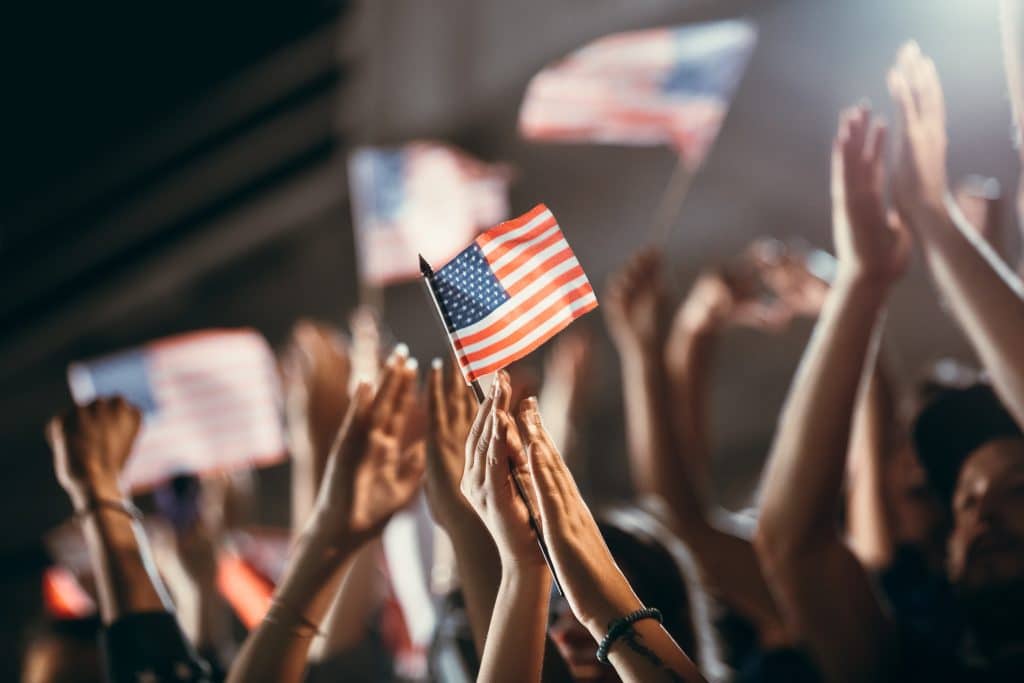
The organizers of No Kings originally wanted the protest to be a one-off, in defiance of Trump’s military parade. However, because the protests drew so much momentum, it grew from a day to a movement. On October 18th – the second No Kings protest – 7 million Americans attended in one of the largest single-day protests in American history. It was a popular movement to support popular democracy.
But even in a democracy, numbers aren’t everything. In the days leading up to the third No Kings protest, on Saturday, March 28th, I expected to see Republicans disparage it. What I didn’t expect were a lot of criticisms coming from those who also despised Trump. And in my opinion, they were all very fair.
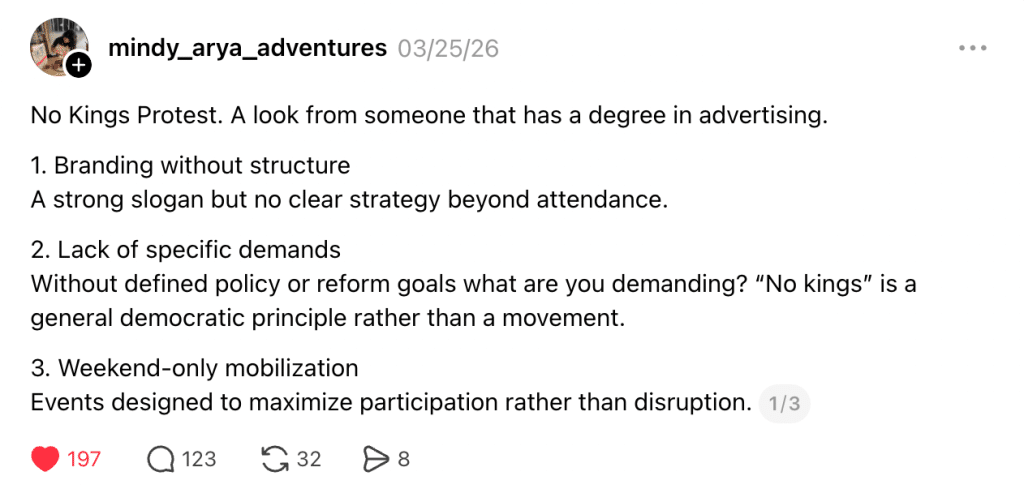
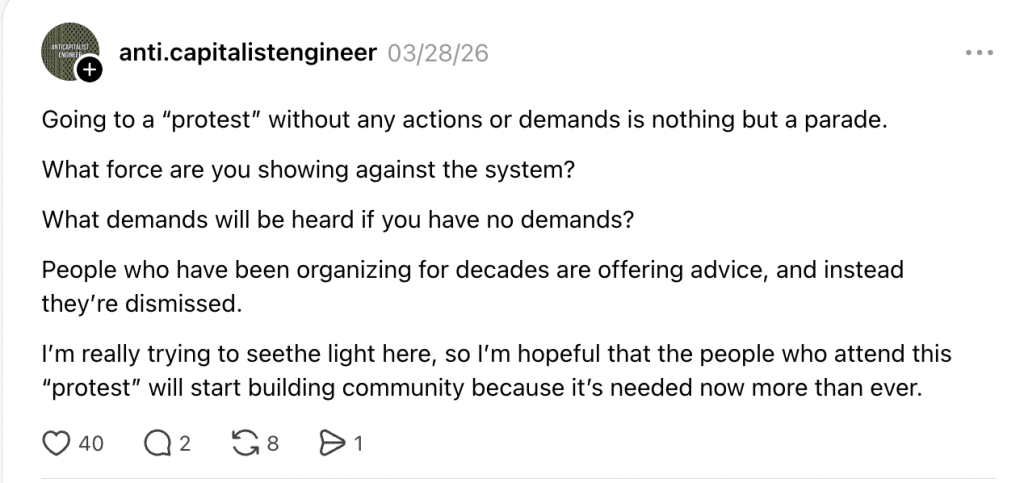
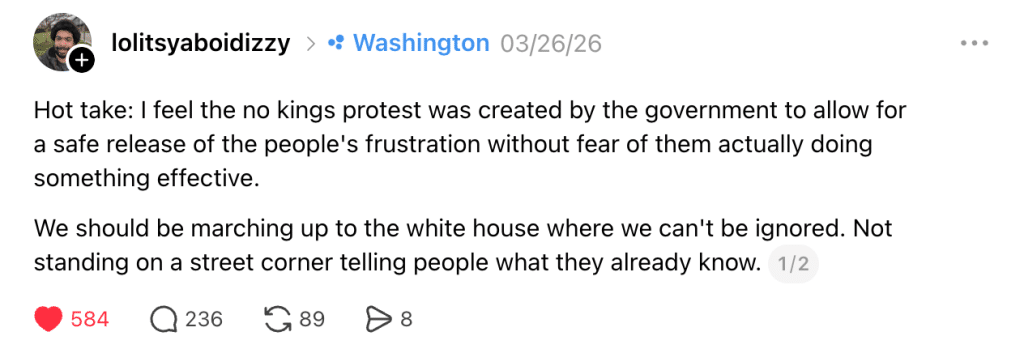
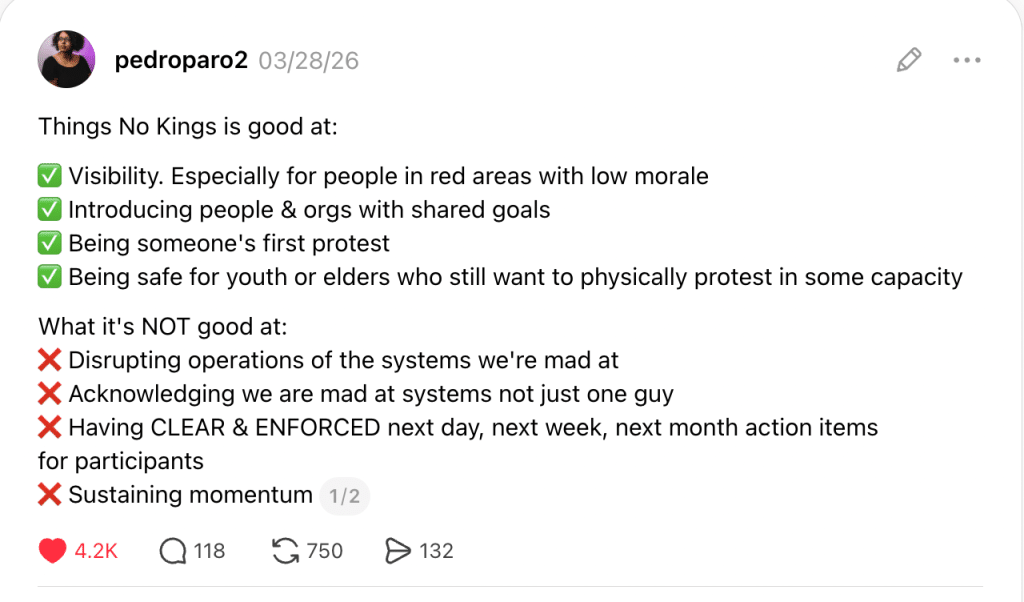
The first thing that social media leftists criticized was the fact that the movement had “no clear demands.” The whole concept of the No King’s movement is based on preventing a bad future with a monarch. Because of this, it has no straightforward policy agenda for politicians to act on. No King’s protestors have advocated for environmental regulations, improved healthcare, and LGBTQ+ rights. Their official website condemns ICE, describing them as “[m]asked secret police terrorizing our communities.” It also condemns the war on Iran, attacks on civil liberties, and rising costs. But this movement is mostly a reminder of America’s revolutionary history, and a warning about its dire potential future, rather than a call for action today.

Others discussed how No Kings is inherently nondisruptive. It takes place on Saturdays, so no one has to leave their job to get to it. This is convenient for many protestors, but it also means that life can go on as normal before and after. No King’s protestors also generally only demonstrate in police approved-areas (which makes demonstrations easier to avoid or ignore), take RSVP lists (the specific one I went to did not, but you can imagine the danger in making a database of protestor information), and do not serve as a model for long-term change.
Also, if you imagine authoritarian governments in a simple top-down structure, where a single “king” is trying to impose authority over “the people,” you can avoid asking yourself more emotionally difficult questions about how you fit into systems of power. Trump is an awful person, and he needs to go. However, the portrayal of him as a “king” who must be dethroned ignores that he is the President because of a democratic election. He is the President because the people are divided, undereducated, prejudiced, and poor.
Weekend protests can’t solve problems like that.
Midwest politics
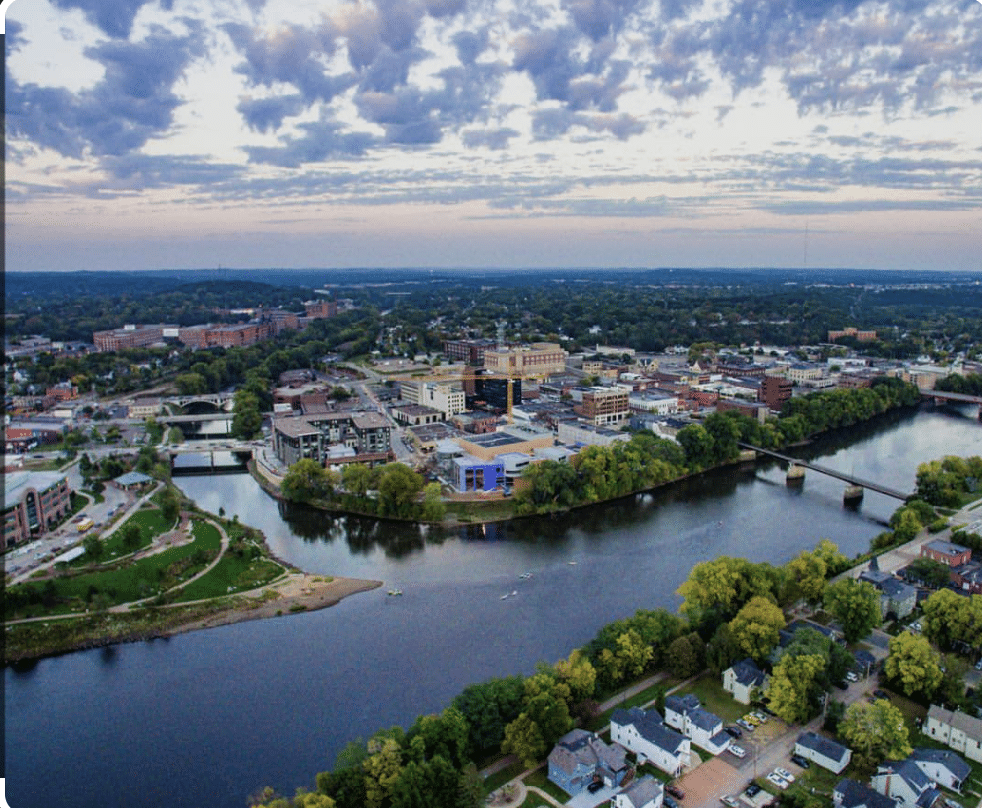
I’ve been to two out of three No Kings rallies, on October 18th and March 28th. Both were in my hometown of Eau Claire, Wisconsin. Eau Claire is an interesting place, politically. We’re a city in name, but small enough that, like in a small town, people recognize each other. University of Wisconsin–Eau Claire is a progressive campus, but the conservative, rural town of Chippewa Falls neighbors it. And we have a lot of people who want to change the world, but we follow the “Midwest nice” tradition of never muddying waters.
But suppressed beliefs can erupt powerfully. During the 2025 spring election, a professor flipped the UWEC College Republicans’ table, and the university placed him on leave. And last Halloween, the College Republicans posted an Instagram picture of someone dressed as an ICE agent arresting someone in a stereotypical Latine garb.
These events were striking, but what was even more striking was that no one talked about them. After Halloween, some began writing political messages in chalk on the sidewalks. Most were encouraging, but others were more confrontational. I remember a meeting with the UWEC Democrats where they condemned the Halloween incident half the time, and spent the other half telling us that we should never mimic a recent chalk message that said “Fuck UWEC Republicans.”
I worry that people classify political actions as solely “good” or “bad” depending on their level of comfort. When people see protests this way, “violent,” “unethical,” “illegal,” “disruptive,” “angry,” and “disobedient” have interchangeable meanings.
When that random student wrote their insult, they did not harm anyone. Maybe it made UWEC Democrats look slightly worse, but no reasonable person could hold them responsible for an anonymous student’s message. And while I believe in bridge-building, they were insulting a specific group of Republicans, trying to hold them accountable for making fun of the terror that undocumented immigrants live with.
Honestly, I think that in circumstances like that—when the government hunts someone, and others mock their pain—anger is the best gift we can give. Humans are wired to feel anger when injustices happen to other humans. So, for a group of people who are so frequently dehumanized, wouldn’t it be a gift to know that someone out there can feel angry for what’s been done to you?
As someone who comes from a red area, I, at least, have needed that gift. Despite the flaws of No Kings, one good thing about attending these protests, for me, has been the feeling that I have a right to be frustrated, instead of pretending everything is normal.
The rallies
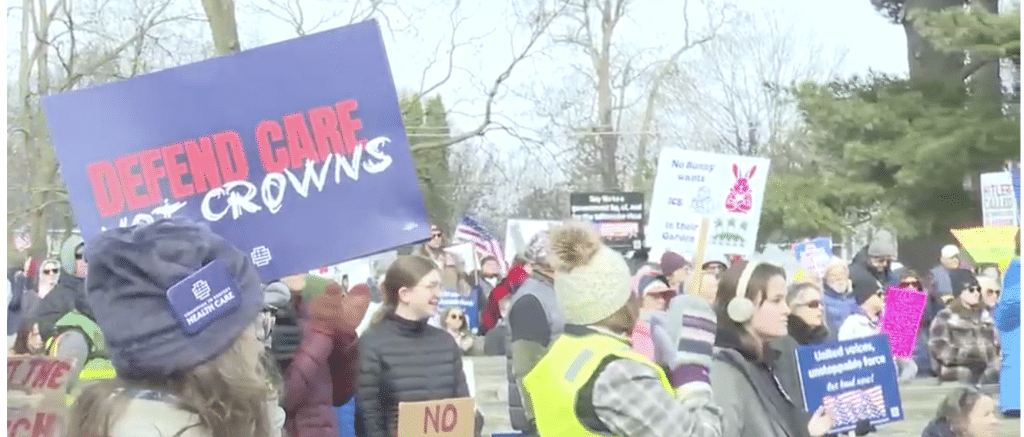
From what I can remember about October 18th, the protest began at 10:00 a.m. in a park near the campus. I was in a group that marched through campus, so we didn’t see many people, but I remember feeling hopeful when I looked at all the people marching beside me.
This time, I wanted to evaluate the protest more critically. A loudspeaker was playing “Born in the U.S.A.,” “No King But the People,” and other patriotic country songs. Most of the signs were patriotic, and occasionally Christian. These included “Jesus Rejected Empire,” “No Kings Since 1776,” and “Proud American, Ashamed of Trump.” But there were others, like “Hats of Hate” featuring a KKK mask and an ICE mask, and “Fags and Queens Will Bow To No Kings” that showed a radical presence, too.
The event organizer, Cyndi Greening, began the protest by saying, “It’s been suggested that I give a moment of silence for Renee Good and Alex Pretti. However, I would also like to give a moment of silence for the servicemembers in Iran, and the Black and Brown people being held in ICE detention centers.”
We had the moment of silence. Then, she added, “I think what we’ve learned these past few months is that no one’s coming to save us. Certainly, no one from Washington.”
She then added that seven coalitions, including the Eau Claire Democrats, League of Women Voters, and Indivisible, were present because we all had to do more if we wanted to get Trump out of office. There would be two bands present after the marching, so we could listen to them while we talked with the coalitions. Sadly, she said, she couldn’t fulfil our requests from last time to get food trucks because the weather was too cold.
I felt bad for her. It seemed like she was trying to get the participants more directly involved by turning the protest into a picnic. How does anyone strike a good balance between something that draws in the apolitical while still being politically forceful?
The last thing she did, before sending us onto our marches, was to bring an immigrant up to the stand. He spoke about fearing for his life, his daughter’s life, his dedication to the country, and his conviction that he belonged there.
“A child born in this country has to carry proof – just in case she is treated as a stranger in our home,” he said. “But we are a nation of immigrants. We are not strangers to America. We are America.”
First steps to the throne
That – the intense America-ness of No Kings – might be why I didn’t see many people my age at the protests. For many reasons beyond Trump-oligarchy, climate change, systemic racism, homophobia, and COVID-19, Gen Z has the lowest level of patriotism by age group, with about 41% claiming they are proud to be an American. I get it. I’m not a huge fan of this country either. And I don’t like the fact that, to criticize it, you must first specify that you love it. Immigrants, in particular, often feel they must display “hyper-patriotism” to gain acceptance. So, while I don’t doubt that the speaker does love his country, I also think it was something he knew he had to say.
However, if apathy towards America was the reason I didn’t see many young people, I don’t know if that’s particularly fair. Yes, America may be awful, but we all still live in America. What happens to it happens to us, and everyone around us.
One weekend of action is not enough, that’s true. Real change happens when people are willing to be disruptive, critical, and can organize into communities. But I think there’s still something important about a movement – even a very flawed one – where people can gather, be frustrated together, and know that expressing those emotions is alright. That’s the first step to being an activist, and it’s necessary in a country where most people aren’t.
Unfortunately, people need to learn to speak for themselves and others before they can learn how to fight. Is that fair to all those being hurt now? No, it’s not, and they deserve better. But it’s the truth. Hopefully, as No King’s continues to grow, people will feel motivated to do more disruptive, long-term acts of defiance.