The James Broadnax case reflects long-standing criticisms of the Texas death penalty system, particularly concerns involving racial bias, class inequality, and the use of capital punishment to reinforce the legitimacy of the Texas justice system. By comparing the Broadnax case with other death penalty cases in Texas, this analysis will examine whether the Texas justice system has implemented meaningful changes to ensure fairer trials and more equal treatment under the law.
How does capital punishment work?
In Texas, the death penalty applies only to capital murder, not simple murder, which is an important distinction. Aggravating factors include killing a child, killing a police officer, committing murder during a robbery, killing more than one person, or committing another felony during the same event, such as rape or kidnapping. This is a simplified, grosso modo explanation; in reality, the process is far more complex.
The case
Authorities condemned James Broadnax for robbing and killing two men outside a Dallas music studio. Broadnax and Demarius Cummings participated in the robbery; however, the murders of Stephen Swan and Matthew Butler remain a question.
James Broadnax confessed to the crime while intoxicated. Later on, Mr. Broadnax said he did not care about his life at the time. Prosecutors also misused rap lyrics to secure his death sentence before an all-white jury after excluding all seven potential Black jurors. In 1986, Batson v. Kentucky ruled that excluding jurors on the basis of race violated the 14th Amendment and the Equal Protection Clause. Later on, a Black juror was reinstated.
Demarius Cummings confessed to the crime with a signed legal confession, along with DNA evidence on the murder weapon found in one of the victim’s pockets. The Texas Attorney General’s Office described the evidence as questionable, and his request for a 180-day commutation or reprieve of his death sentence was denied.
Mr. Broadnax received capital punishment on April 30, 2026. His last statement was:
“To the family, I prayed for years that any of my choices would create heaviness in your heart and burdens on your spirits. I prayed to God for your forgiveness. Despite what you think about me, I hope to God that prayer was answered. But no matter what you think about me, Texas got it wrong. I’m innocent, the facts of my case should speak for itself, period. Let this moment be what finally sparks the revolution that will be televised; none of it was worth it. Queen Emmit, I love you, my promise still stands, it always will. Keep fighting, stay strong, keep God first, never stop believing. I love you forever and a day. I love you, Queen. Peace, love, and light, that’s what I stand for. God bless everybody.”
The history of capital punishment
In 1981, the court sentenced Clarence Brandley to death for the rape and murder of a 16-year-old white girl. He worked at the school as a janitor with someone else; both of them found the body. The police officer said, “One of you is going to hang for this.” The police officer looked at Mr. Brandley and said, “Since you are the n****r, you’re elected.”
Mr. Brandley was a Vietnam veteran, spent 10 years on death row, and faced an all-white jury. He obtained a retrial with Jerry Pickett, who said in his 30 years of practicing law, it was the most shocking case of the effects of racial prejudice.

He never received any compensation from the state nor a simple apology. The state never found the person who committed the crime.
The Randall Adams case demonstrates that capital punishment is not only racial but also reflects class inequality, inefficient police procedures, and the pressure to secure convictions in serious crimes such as the murder of a police officer.

Randall Adams was inside the car when David Ray Harris shot police officer Robert Wood, although Adams claimed he could not clearly remember the events due to the consumption of alcohol and drugs.
Randall Adams spent 12 years on death row while witnesses contradicted one another, and prosecutors allegedly pressured or incentivized some witnesses to support their version of events. The real shooter was David Ray Harris, who later implicated Adams in the crime.
Harris testified against Adams at trial, but his role in the crime shaped his testimony. However, because Harris was a minor at the time, he could not face the death penalty, while the state focused its case on Adams instead.
In the documentary The Thin Blue Line, Harris later confessed to the crime and admitted he had committed the offense for which authorities never charged him, leading to Adams’s exoneration. Harris later received the death penalty for the kidnapping and murder of Mark Mays.
The exoneration epidemic
According to the Death Penalty Information Center (DPIC), in its report The Innocence Epidemic, for every eight people executed in the United States, one individual sentenced to death has been exonerated. The glamour around the death sentence punishing serial killers, evil people, and mass killers is a lie.
We can analyze James Broadnax, Randall Adams, and Clarence Brandley: they held laborer jobs, graduated from high school or lower, and had no prior criminal record. The 16 cases of exoneration in Texas involved individuals with no criminal history who also had laborer jobs.
A significant number of people under capital punishment are individuals from the working class. We are not justifying the crimes committed by these individuals; however, we are questioning the structure and the hegemonic culture around the death penalty, including the “common sense” and the idea of “superior morality.”
The collateral damage
The death penalty produces collateral damage; it extends throughout the structure of society. Correctional officers, victims’ families, the families of the condemned, and society become more subjective and morally involved in state executions.
Capital punishment is justified by the hegemonic narrative of necessary acts of justice to explain when the state kills the “worst criminals.”
However, the execution process demonstrates the reality of a disturbing system built on institutional violence, emotional trauma, moral conflict, and the normalization of death through a state procedure.
A psychological study at Louisiana State Penitentiary by Dr. Michael J. Osofsky and Howard J. Osofsky interviewed fifty correctional officers who participated in executions to see if there were any consequences.
The study revealed that many officers suffered from guilt, emotional dissociation, insomnia, anxiety, and moral questioning after participating in executions. Many officers publicly supported the death penalty; however, many of them privately described it as a mechanical and dehumanizing process.
The state of Texas does not provide any type of psychological help to the people who administer lethal injections. The machinery of death does not maintain its parts; it simply replaces them. Trauma becomes normalized through the hegemonic narrative of punishment and the idea of a “greater good.”
One officer straps an arm, another straps a leg, and the executioner administers the drug. The responsibility for the death is distributed among several individuals, not just one. The bureaucratic execution of a public institution transforms into a professional routine to kill another human being.
An officer questioned how future generations would judge us as a society that legitimized executions while failing to address poverty, violence, inequality, trauma, and lack of opportunity.
A medical technician noted the contradiction of using medical procedures designed to save lives to instead end lives.
One correctional officer said, “I’ve never seen a rich man executed,” which remains true.
In Texas, Robert Durst shot a man he claimed acted in self-defense, dismembered the body, and authorities later convicted him of tampering with evidence, though they never executed him. Later, he murdered Susan Berman in California and faced murder charges.
Prosecutors argued that Robert Durst believed Susan Berman knew too much about the disappearance of his wife, Kathleen Durst, and killed her to silence her.
In the documentary The Jinx, he answered questions about the disappearance of Kathleen Durst, the murder of Susan Berman, and the Morris Black self-defense case.
He couldn’t answer the interviewer’s question, went to the restroom with the microphone on, and confessed: “There it is. You’re caught,” then “Killed them all, of course.”
He spent less than a year in prison and passed away due to natural causes at the age of 78.
Class inequality has an important role in the death penalty. A high number of people in the working class are more exposed to institutional violence and wrongful convictions, legitimized through hegemonic narratives of justice and morality.
The stories of the men and women involved with the execution of death row inmates at the Walls Unit in Huntsville, Texas.
Unusual and Cruel?
The Eighth Amendment states: “Excessive bail shall not be required, nor excessive fines imposed, nor cruel and unusual punishments inflicted.” The problem centers on the word “and,” because the punishment must meet both conditions for the death penalty to qualify as cruel and unusual.
The major criticism of the three-drug procedure for the execution of inmates is that the first drug used on the inmate paralyzes his body, making him unable to detect any type of pain. However, this drug is banned for animals by the AVMA because it is painful for animals.
In a legal argument, the death penalty is not an unusual punishment because 27 states have the death penalty. But things change in active states practicing the death penalty, with four states not practicing it. Should it be qualified as unusual due to the lack of practice?
Abolitionism by the Supreme Court
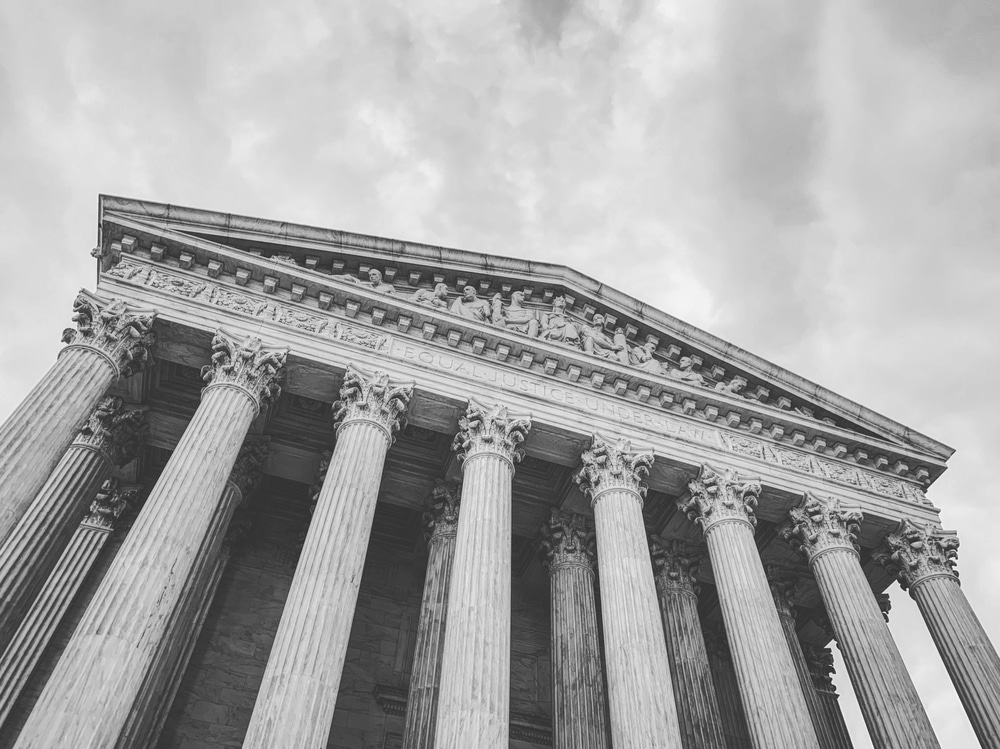
Furman v. Georgia was a legal case in 1972. The Supreme Court ruled that the death penalty for rape violated the Eighth Amendment because authorities applied it in a discriminatory manner. The Court overturned all death sentences imposed from 1972 to 1976.
The Supreme Court acknowledged that authorities applied capital punishment in rape cases disproportionately against Black people and often used it to target Black men, with 89 percent of Black men being executed by capital punishment from 1930 to 1973.
The historic importance is the state admitting that capital punishment was profoundly influenced by race and social class.
One thing is certain
There are so many different conclusions through so many different lenses: a tool for the bourgeois state to maintain the social order, to discipline the working class as an illusion carried by the bodies of working folk.
The bureaucracy builds the legal system to protect its power and conceal the truth; religious law commands, “You shall not murder”; and humanitarian principles argue against executing people.
One thing is certain: humans are prone to error.
The State may administer courts, laws, and prisons; however, it cannot administer life. To claim that power is to normalize violence and disguise inequality as justice. A system built on race and class should never hold the authority to execute capital punishment.