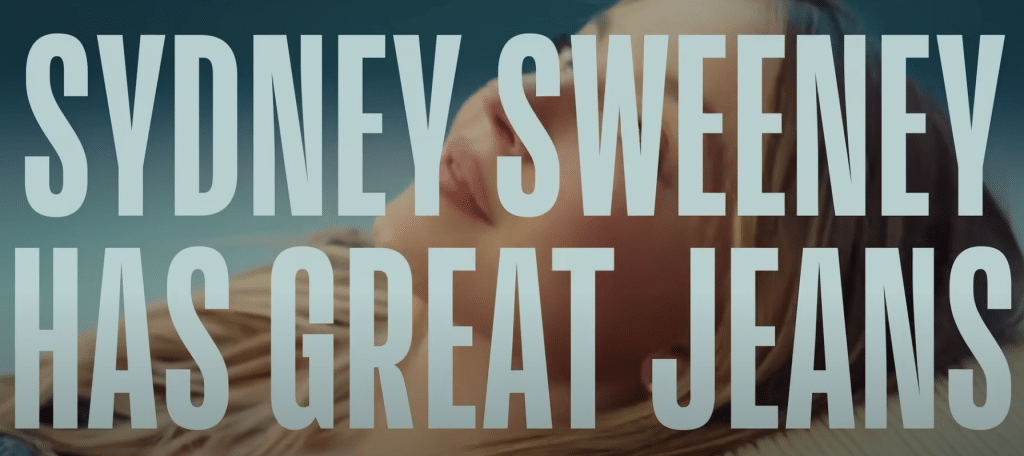
As the camera pans over her physique, Sweeney says, “Genes are passed from parents to offspring, often determining traits like hair color, personality, and even eye color…my jeans are blue.” At the end of the ad, a male voiceover notes, “Sydney Sweeney has great jeans.” Whether aiming for wit or using a scientific analogy to suggest that American Eagle jeans endure across generations, the ad has drawn scrutiny for rhetoric that resembles eugenic language.
Sydney Sweeney’s recent American Eagle campaign has stirred up quite the controversy. At face value, it’s a nod to Brooke Shields’ 1980 jeans commercial. The AE jeans campaign flaunts Sydney Sweeney in an all-denim outfit. She uses jeans as a play on words for “genes,” just like Shields’ ad.
Those who have concerns about the ad take to social media to express their discontent. Often, contemporary politics are used as the cultural context for the problematization.
Many are concerned with the campaign’s message, given Sydney Sweeney’s image as a blonde, blue-eyed celebrity who has successfully built and capitalized on that specific visual persona.
Sweeney isn’t a stranger to this style of provocative campaigning. Another example is her “bath water” ad for Dr. Squatch.

However, her American Eagle ad touches a very different political and sexual undertone.
In a polarized political climate like today, where mass deportation is taking place, conservatism is on the rise, and the country’s administration seeks to unravel the diversity in our country, does the campaign function as an idealistic projection of a ‘real’ American?
A breakdown of the ad
To understand the relationship between consumerism and politics, and to explore the analogy between fashion and biology, let’s examine the ad closely.

The camera lingers on Sweeney’s body, inviting viewers into a slow, deliberate gaze. The positioning of the camera encourages us to catalogue her so-called ‘idyllic’ features.
This visual strategy doesn’t just sexualize her. It also reinforces the wordplay of “genes” and “jeans,” blurring the line between biological inheritance and consumer culture. It’s as if her physical traits and the product itself are equally transmissible across generations.
By bringing attention to Sweeney’s beauty, rooted in her blonde hair, blue eyes, and conventionally attractive figure, the ad turns the word “genes” into more than a clever pun.
Instead, it becomes a rhetorical device linking physical beauty to the idea of genetic inheritance, suggesting that one can pass down attractiveness like a pair of jeans.
This message is especially clear in the voiceover’s confident line: “Sydney Sweeney has great jeans (genes),” once again blurring the line between fashion marketing and the language of biology.
Given the United States’ history with eugenics, it doesn’t come as a surprise that critics see similarities in the ad.
Eugenics in America
Eugenics is the false idea that we can “improve” humanity by controlling who gets to reproduce.
The eugenics movement was an early 20th-century theory that sought to “purify” and “improve” the American race. This was done through mass deportation, forced sterilization, and a major halt to immigration.
Scientists created a long and ongoing list of “eugenic” qualities. They were categorized as physical and mental qualities observed by non-white, non-American families and individuals living in the United States. Depending on the kinds of “eugenic” qualities an individual exhibited, they could face sterilization, as seen in the Trait Book by C.V. Davenport.
Although once used to legitimize racist ideologies, these theories have long been discredited and are now recognized as pseudoscience. However, the brutalization of non-white Americans during the eugenics movement didn’t appear out of thin air.
In the second half of the 19th century, the United States welcomed an influx of immigrants. Nearly 12 million immigrants arrived in the U.S. between 1870 and 1900, and they faced hardships such as job competition, poor living conditions, and social displacement.
But what does this have to do with eugenics? And why is it relevant to Sydney Sweeney’s ad?
American dreams and American genes
In 1924, the United States Congress passed the Johnson-Reed Act. This federal law established a national origins quota system.
The Johnson-Reed Act set strict limits on who could enter the United States. It allowed visas for only 2% of each nationality already living in the country based on the 1890 census.
The law disproportionately favored Western and Northern Europeans, while excluding Southern and Eastern Europeans. It also completely banned immigrants from Asia.
The law caused mass deportation, further displacing the families that had left their native homes to come to the United States.
By creating and implementing a discriminatory immigration policy, the United States was able to project an image of the “ideal American,” whose features reflected white, privileged individuals.
Thus, American genes became something to prove rather than a neutral marker of nationality, reinforcing the idea that citizenship and belonging have ties to whiteness and selective ancestry.
In this way, immigration policy was not just about controlling borders. Rather, policing who could embody the so-called American ideal.
Advertising in current politics
Current political debates mimic this past. The rise of conservatism, a concern with “real Americans,” large-scale deportations, and strict immigration policies have fueled the fallacy that some people belong more than others.
Although the language may be different, the logic, which ties identity and worth to ancestry, is familiar. At the same time that politics reasserts who belongs in the nation, advertising reinforces who belongs in the culture.
Fashion campaigns like Sweeney’s don’t just sell jeans. They sell an image of Americanness tied to whiteness, youth, and sexualized femininity.
The claim that the ad has eugenic undertones isn’t far-fetched. Given the deep history of discrimination in the United States and the current political climate, I don’t blame critics for drawing parallels between the two messages.
What may have started as a careless oversight in marketing quickly becomes something much larger. This reveals how brands often fail to consider how their messages resonate in a culture where politics touches everything—even jeans.
Jeans vs genes: the beginning
This isn’t the first time that an ad has used the play on words between “jeans” and “genes.” In 1980, 15-year-old Brooke Shields participated in a Calvin Klein jeans ad where she discussed genetic inheritance while wearing a pair of Calvin Klein jeans.
Shields attempts a humorous struggle with the jeans onto her body as she says, “Genes are fundamental in determining the characteristics of an individual…occasionally, certain conditions produce a structural change in the gene which will bring about the process of evolution.”
Shields goes on to explain the different ways that evolution occurs. First, she discusses “selective mating,” followed by “gene drift,” where “certain genes may fade away while other genes persist.”
She concludes, “And finally, by natural selection, which filters out those genes better equipped than others…this may result in an entirely new species, which brings us to Calvins, and the survival of the fittest.” At the very end, a narrator’s voice-over bluntly states, “Calvin Klein jeans.”
Despite its attempt at humorous undertones, the ad received major backlash. In an interview with Vogue, Shields recalls her surprise at the controversy. Many claimed that the ad further sexualized her in the public eye. This was already a touchy subject, considering that she was still a minor.

Her famous line—”You want to know what stands between me and my Calvins?Nothing”—was immediately noted as a sexual innuendo. However, it begs the question of whether her sexualization was a public projection or if it was written into her script.
Nonetheless, this campaign set a precedent for jeans advertising: It was bold, controversial, and undeniably effective. It cemented the notion that denim, an everyday staple, could carry layered meanings—sexual, cultural, and even ideological.
The role of analogy in fashion
The larger question at hand remains: What role do consumerism and marketing play in the analogy between fashion and biology?
Where Brooke Shields’ Calvin Klein ad relied on humor and tongue-in-cheek wordplay, Sydney Sweeney’s American Eagle campaign feels heavier and slightly unsettling in today’s context.
At its core, Shields’ awkward choreography and exaggerated struggle with her jeans invited laughter, treating the science analogy as a playful joke.
In contrast, Sweeney’s ad presents a polished, lingering gaze on her body, leaving less room for humor and more space for viewers to take the message literally: that there is a genetic link between beauty and desirability.
Since the cultural backdrop has changed drastically between the ’80s and now, this shift in advertising matters immensely. In the 1980s, the analogy was an attempt at clever marketing; in 2025, it teeters on reinforcing old hierarchies.
The ad crosses a line—but at what cost?
Considering how much controversy Shields’ ad caused, it comes as a shock that American Eagle would try to replicate it in the first place.
But today, brands feel the need to go to controversial lengths to break through the noisy media landscape. As seen in both the Sydney Sweeney and Brooke Shields ads, brands rely on provocative imagery and cultural buzz to stay relevant. Yet the stakes have shifted completely. Where controversy once sold shock, it now risks a revival of historic exclusion, especially when “genes” and lineage become marketing strategies for beauty and desirability.
Cutting consumer ties
In modern society, it feels more par for the course to cancel brands and boycott their products than to address the larger issues at hand, which are typically products of our political leaders.
Perhaps it is easier to boycott a pair of jeans than it is to confront a government that is actively writing discrimination into law.
If our current moment didn’t feel as reminiscent of an era in which eugenic ideology was widespread, then perhaps Sweeney’s ad could be read at face value, as a simple nod to Brooke Shields’ Calvin Klein campaign.
But outrage lands where consumers feel they have power.
We can stop buying from a brand, but we can’t as easily dismantle a political system actively working to erode diversity in this country.