

It’s difficult to imagine modern men’s fashion without the military’s influence. The military-industrial complex has shaped contemporary style more than we often realize. Iconic staples like cargo pants, pea coats, bomber jackets, chino pants, T-shirts, and trench coats all have military origins. Designers create these pieces for utility and durability — qualities that remain central to men’s fashion today.
The structured silhouettes, rugged fabrics, and clean finishes that define contemporary menswear trace directly back to military aesthetics. Brands like Urban Outfitters, Zara, and Carhartt build on this legacy, integrating military-inspired elements into everyday streetwear. The growing popularity of thrifting also reflects this influence, as surplus military garments find new life in civilian wardrobes.
What is Military Surplus?
The military calls its excess stockpiles “surplus” and auctions them off to various local sellers for a fraction of their original value. Surplus items often originate from overproduction, phased-out designs, or stockpiles that accumulate after a conflict. It can come in the form of gear such as clothing and uniforms. In this way, surplus stores, while authentic, are less expensive than retail stores.
Military surplus stores originated in the early 20th century, when governments sold excess gear from major conflicts, such as World Wars I and II, to the public. Valued for its durability and functionality, this equipment gained popularity among civilians, leading entrepreneurs to open surplus stores.
Combat Capitalism in Military Fashion
As certain fashion trends gain traction, such as authentic surplus military garments, they become increasingly sought after. This rising popularity, in turn, influences fast fashion brands to capitalize on the demand. They do this by producing and selling imitation versions at increased prices.
The flow of trendy clothing moves from original surplus sources to mass-market retail, suggesting a pattern of aesthetic appropriation and commodification. This process contributes not only to increased consumer desire but also to cycles of overproduction, overconsumption, and material excess. These are key components of the fast-fashion industry.
Let’s look at some examples of authentic military garments and their fast-fashion counterparts.
When Fashion Copies Function: the Military Pea Coat
The navy pea coat is a timeless classic in men’s fashion. Originally designed in the 1800s by the Dutch, the coat was popularized by the British navy and is perfect for long voyages during conflicts. These wool coats are not only durable but also necessary for cold weather.

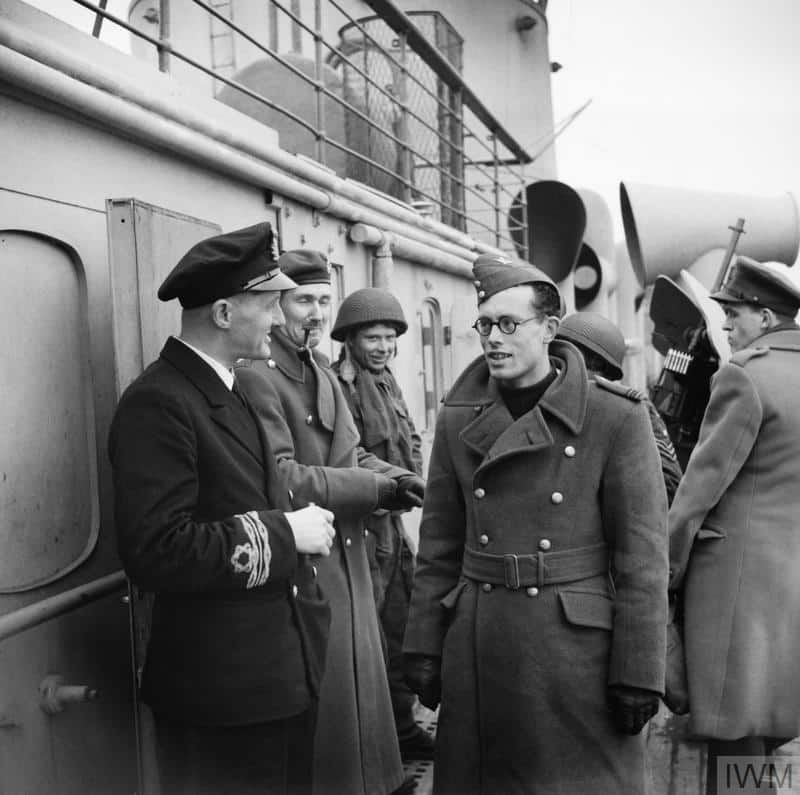
Today, popular brands and retail stores usually sell wool-blend coats for over 100 dollars.
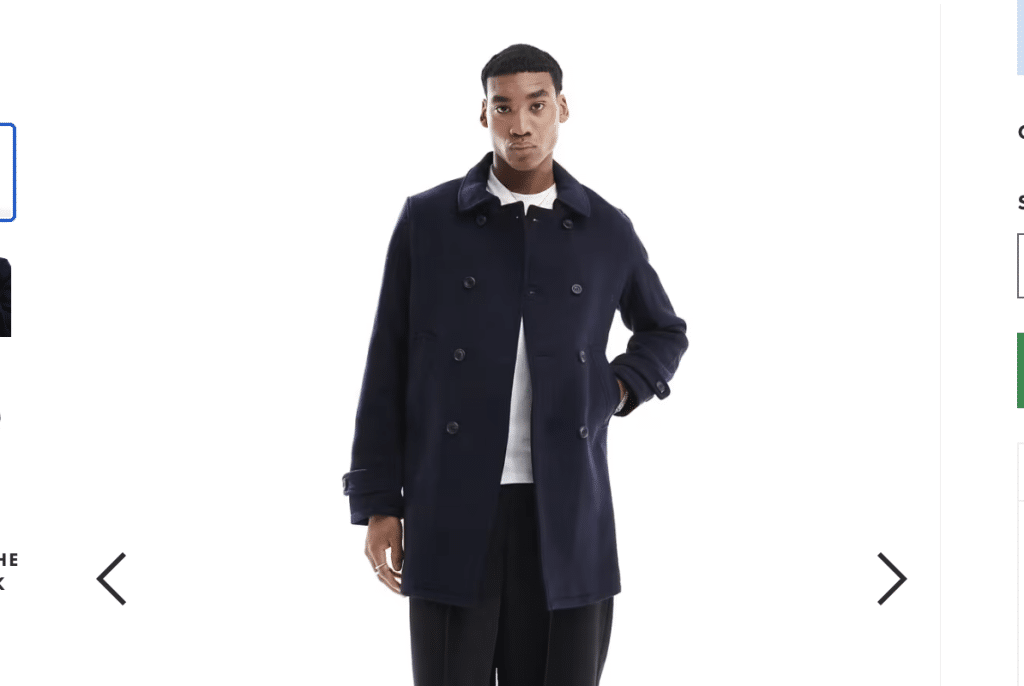
This ASOS pea coat retails for $242! Although people widely recognize ASOS as a fast-fashion brand, its average price point sits at $57.16 as of 2017.
The brand known for its trendy apparel proves that fast fashion is not always related to low prices. Moreover, the scalpers’ dean coat pictured above is far from an authentic, military-grade navy pea coat. The inner lining is 100 percent polyester, while the outer layer is 80 percent wool and 20 percent nylon.
From Fact to Faux: Military Shearling Coats
Next are shearling jackets. Rising in popularity within men’s contemporary fashion, the shearling coat is not only a winter staple but also fashionable outerwear.
Originating in ancient times for its warmth and practicality, the shearling coat has journeyed through centuries, continually reinvented across diverse cultural and fashion eras.
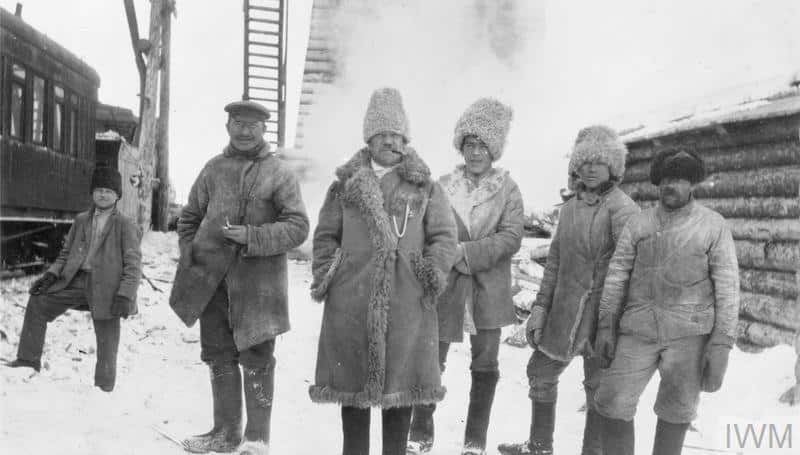
The image above captures Russian workmen during the North Russia Intervention from 1918-1919. They are pictured wearing hefty shearling coats to stay warm during brutal weather.
Commonly used in World War I, pilots wore shearling coats to stay warm at higher altitudes.
Pictured above, a pilot wears a shearling coat as part of their combative uniform. Following World War II, Hollywood glamorized the shearling coat. It eventually became a status symbol, where high quality and authenticity were important elements.
Now, shearling coats, whether real leather or faux, can be found in popular retail stores.
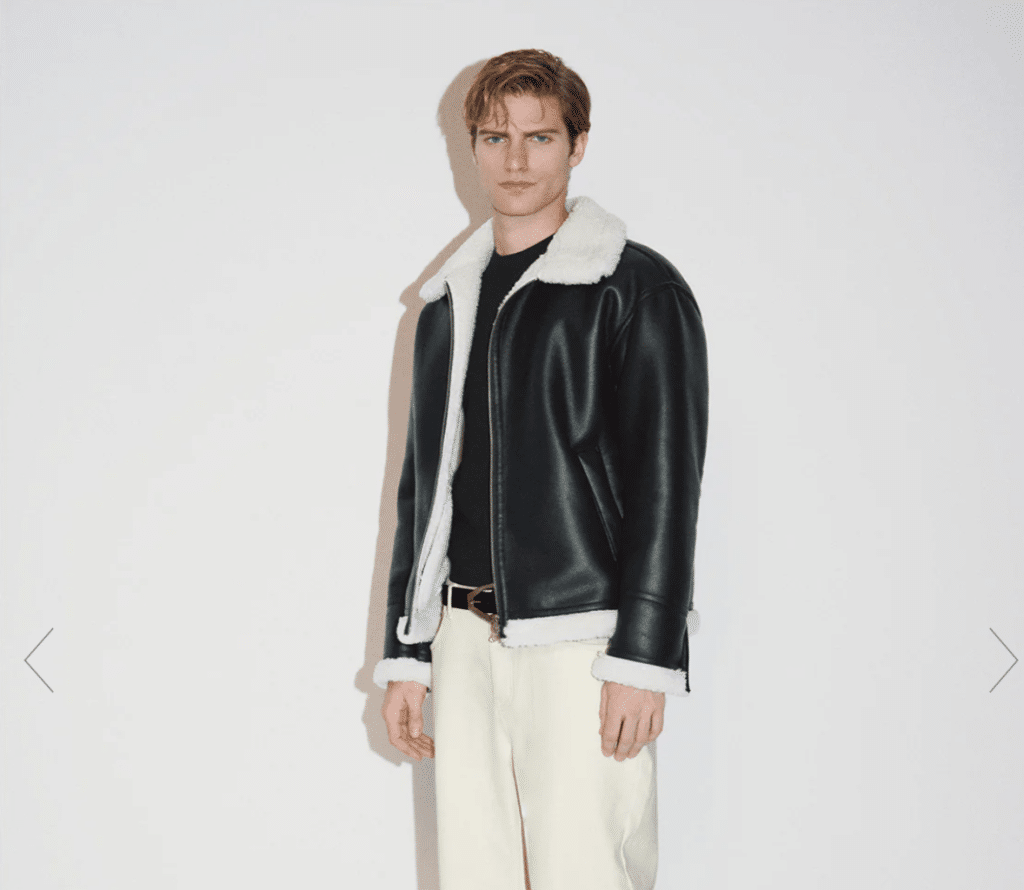
The Urban Revivo Leather Sherpa Lining Jacket retails for $129 on their website. The brand, known for its trendy and fast-paced style, is a perfect example of how the fast-fashion industry uses replication.
The coat’s widespread appeal, possibly driven by its visibility in 1970s cinema and earlier public adoption in the 1950s, suggests the military’s aesthetic influence remains rooted in men’s fashion.
For over seventy years, the shearling coat endures as a staple of men’s outerwear, even though most brands mass-produce versions today.
A Brief Thought on the T-shirt
The T-shirt is more than just a closet staple; it’s a necessity.
The T-shirt is the very foundation of men’s fashion. Originally worn as an undergarment for sailors, the lightweight T-shirt was a perfect layering piece and easy to wash.
Today, the T-shirt is more than just a layering piece. It’s an essential component of both men’s and women’s apparel. The simplicity of the T-shirt influences entire aesthetics, such as “model off duty.”
It’s hard to imagine what contemporary men’s fashion might look like today without the military T-shirt as the capstone of street style.
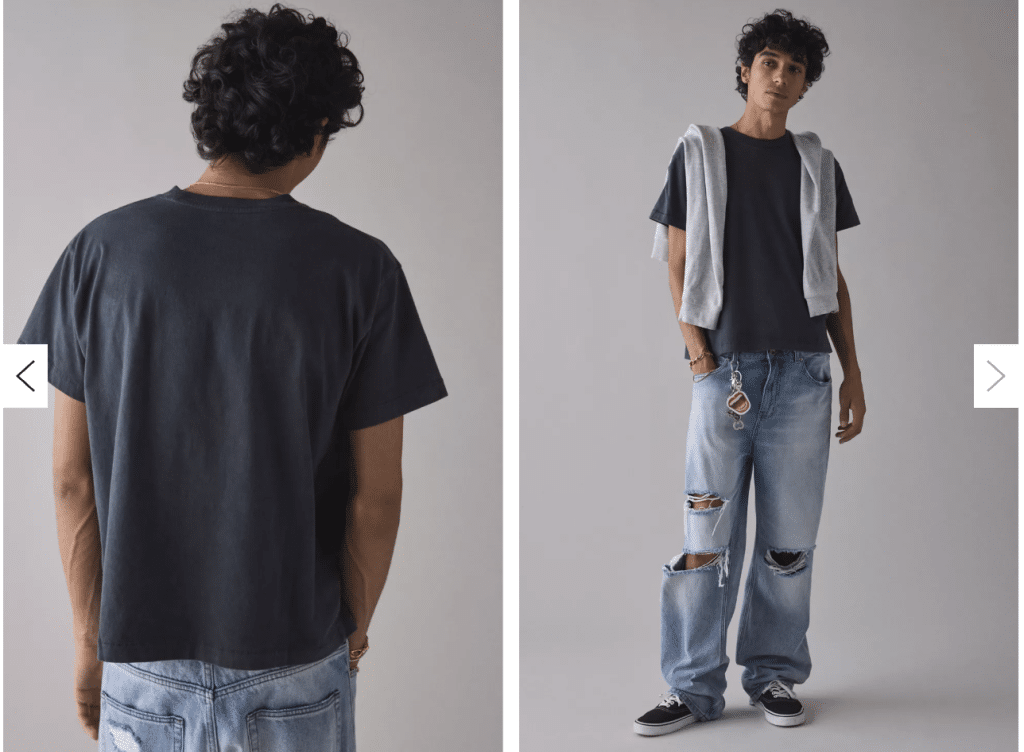
The Urban Outfitters BDG Bonfire Cropped Cotton Tee retails for $29.
Because T-shirts are so widely available, I’m not suggesting that people go out of their way to find authentic military versions. Still, buying T-shirts sustainably remains difficult. Fast fashion dominates the market with inexpensive options often made through unethical labor practices.
This dynamic differs from garments like the shearling or pea coat, where mass-produced replicas are sold at a higher price than original military surplus. In these cases, the gap between the consumer and the labor behind the garment widens even further, emphasizing the deeper disconnection created by fast fashion.
Olive Green Origins
The OG-107 pants, AKA fatigue pants, were originally designed in 1952 and used during the Vietnam War. The name simply stands for “olive green-107.” This specifies the color and style.
Due to their breathability and comfort, the OG-107 pants are gaining popularity once again. Mainstream brands are modifying the original design to align with modern aesthetics. Opting for a wide-leg rather than a straight leg is one example.
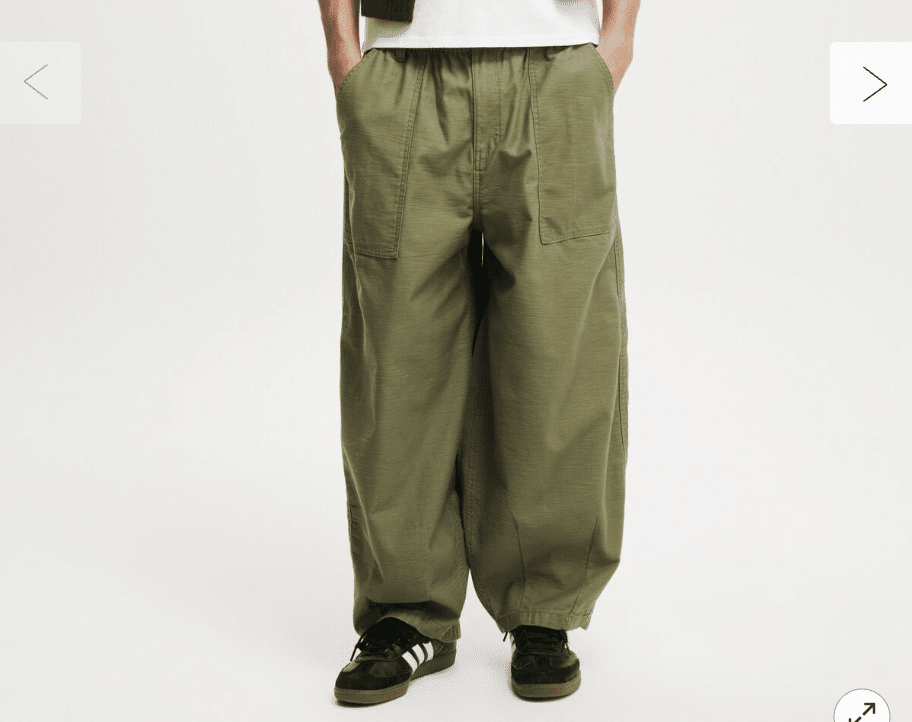
The Super Baggy Balloon Pant from Cotton On retails for $69.99. It’s clear from the placement of the pockets, color, and overall shape that these pants are modeled after the military fatigue pants. The baggy, comfort-casual style of the pants leans more towards streetwear than a recognizable military garment.
The Surplus to Retail Pipeline: Problematic or Convenient?
It’s no secret that retail and fast-fashion brands produce clothing at a rapid pace. With every new trend, brands must increase their turnaround rate simply to keep up with constantly evolving aesthetics and standards.
By continuously introducing new merchandise at affordable prices, it encourages customers to make frequent purchases. Corporations benefit from the high volume of sales at the low cost of production.
Fast fashion often relies on underpaid, exploited labor in the Global South. Poor working conditions and low wages benefit large corporations and investors, while harming employees.
On a global level, the fast-fashion industry contributes 92 million tons of textile waste annually. It is also responsible for 20 percent of global water waste and produces twice the amount of clothes today than in 2000.
So what is the real impact of opting for fast-fashion rather than military surplus?
According to USAspending, military spending is $2.26 trillion, of which $1.8 billion is given directly to textile and garment manufacturing. The military has access to the highest-quality materials and a margin that allows for multiple versions of garments to be produced, creating “surplus.” However, garment production in the military is considered to be more regulated, traceable, and better funded.
The Politics of Excess
Although military surplus is a byproduct of excessive military spending, surplus stores are considered eco-friendly, as their purpose is to reuse and reduce reproduction. However, if not for their excess and public consumption, the integrity of their sustainability becomes obsolete.
Military surplus exists because of massive state overproduction, often tied to imperialism or conflict. So is reusing surplus ethical? Or does it risk normalizing military expansion?
The similarities of consumer waste in the military and fashion industries may be more than just a coincidence. They suggest a deeper entanglement with the United States’ excessive military spending.
While the production of surplus military garments is often justified by defense preparedness, the sheer volume of leftover inventory speaks to a larger pattern of overproduction. When these items enter the civilian sphere, whether through surplus stores or as inspiration for fast-fashion replicas, they continue a cycle of commodification and waste.
In this way, the consumer excess tied to popular fashion trends could be seen as an unintended side effect of the country’s disproportionate investment in military infrastructure. This reveals how government surplus filters into everyday consumption habits, possibly extending into the US’s contribution to global waste.
Therefore, what does it mean to dress sustainably in a world where both militarism and capitalism are inherently wasteful?