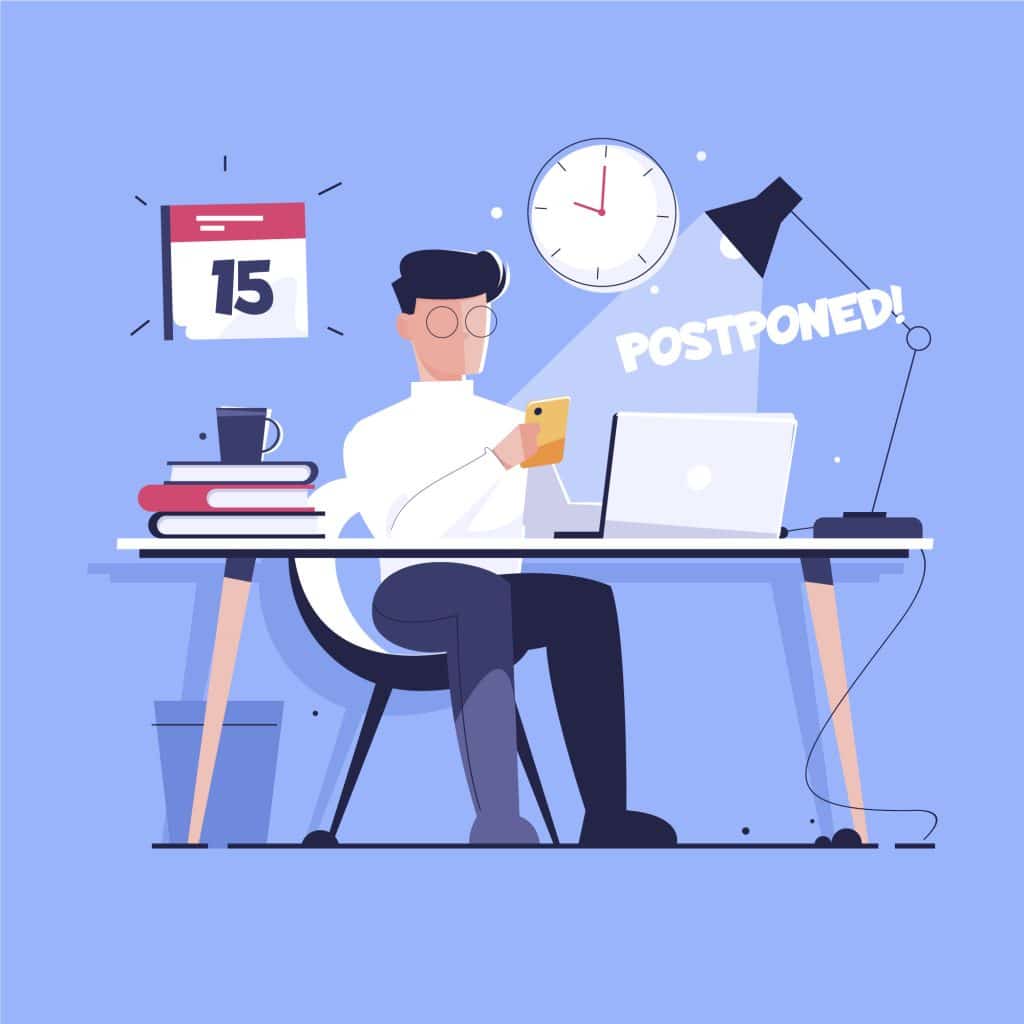
“I’ll do that task after responding to this email… ah, I also need lunch… and this desk really needs reorganising… I should probably buy that new planner..and oh… ah… I’m overdue for this deadline now.”
Sound familiar?
It’s the everyday mental spiral so many of us fall into.
As a final-year university student juggling three jobs and two major projects, I know this pattern all too well. I postpone things until “a better time, mood, or light” , fully aware that if I don’t just crack on, they’ll never get done.
We all do it. Procrastination has become so common it feels like part of being human in 2025. But lately, it feels heavier: less about laziness, more about mental overload. Why do we delay even the things we want to do? And did people before us ever experience this strange paralysis?
Then vs Now: from survival to a never-ending race
Our prehistoric ancestors didn’t have “email anxiety” or a million red dots blinking at them. Life was simpler, and so were their tasks: hunt, gather, build, rest. Every action had a clear purpose and reward.
But procrastination isn’t new. As Mental Floss points out in “Procrastination Through the Ages”, humans have been putting things off for thousands of years. The Greek poet Hesiod warned his brother not to delay work way back in 700 BC. Philosophers like Aristotle and Cicero later called it a moral weakness.
Still, it looked different before modern life. For centuries, people focused on tangible tasks such as harvesting crops, mending clothes, raising families. Delay carried real consequences: if you didn’t plant on time, you didn’t eat.

Even a century ago, our grandparents’ to-do lists ended at sunset. You baked bread, hung washing, repaired a fence, and when you finished, you were done. No inboxes. No notifications. No constant reminder that you “should” be doing more.
Our parents, growing up in the late 20th century, began to feel early modern distraction: television, advertising, and the creeping culture of comparison. But the internet, smartphones, and “always-on” work changed everything. Now, there’s no finish line. Just more.
Today we face a new kind of wilderness. Instead of predators, we face choices: what to start, what to scroll, what to ignore. Our brains, wired for survival, struggle with endless decisions. So we shut down, delay, distract. Not out of laziness, but overload.
As Jaymes Corey, author who helps people break free from the perfection trap, one of reasons we procrastinate, explains:
The science of delay
Psychologists say procrastination isn’t really about time, it’s about emotion. According to Verywell Mind, when a task triggers anxiety, boredom, or self-doubt, our brains look for instant relief.
Avoiding the task gives us a small hit of dopamine, a quick comfort that teaches us to repeat the cycle.
In other words, every time we say “I’ll start tomorrow,” we’re training ourselves to feel momentary relief instead of long-term reward. Over time, it becomes a habit, not a flaw, but a deeply human coping mechanism for an overwhelming world.
The digital trap
Technology, for all its benefits, might be our biggest enabler. Our ancestors battled predators; we battle pings and pop-ups.
Every buzz or banner hijacks attention, dragging us from one micro-reward to the next. Focus becomes harder to sustain, and even a brief distraction can cost twenty minutes of deep work. Meanwhile, hustle culture whispers that if we’re not working, we’re failing, which only fuels the guilt spiral.
We’ve built a world where doing one thing deeply feels unnatural. The brain that once evolved to survive nature is now surviving the internet.
Is procrastination even real?
Not everyone thinks procrastination is the enemy. The blog By Title Only argues it might not even be real.
At least, not in the way we think. It suggests that what we call procrastination could simply be reprioritising: choosing something more emotionally necessary, like rest or reflection.
Maybe, instead of labelling ourselves “lazy,” we could see delay as information, a signal that our mind needs something different. In a world obsessed with constant output, maybe slowing down is an act of quiet rebellion.
The mental health loop
Of course, the cost is real. Studies link chronic procrastination with anxiety, low self-esteem, and exhaustion. We avoid, we feel guilty, we punish ourselves and then avoid again. It’s a feedback loop powered by self-blame.
For many young adults, including me, procrastination doesn’t feel like a choice; it feels like survival.
When you’re juggling deadlines, jobs, and family, sometimes avoiding one thing is the only way to stay afloat. It’s not laziness. It’s a nervous system asking for a break.
Breaking the cycle
So how do we break it?
According to The Guardian’s 2025 wellness feature “I tried to not procrastinate for a week. Here’s what helped the most,” change starts small.
Forget the long to-do lists and focus on moments. Set tiny, realistic goals, reward small progress, and accept that rest isn’t failure.
Some strategies really do help:
Here at Trill we talked about procrastination before – check this article out if you want to look more in depth into the concept.
- The five-minute rule: just start. Usually, momentum takes over. In my own experience – once you started that task you were dreading about, you feel better for it and eventually get it done.
- Task batching – group similar things to protect your focus. So if you have university work, do as much as you can in one go without distracting to do anything else.
- Digital hygiene – turn off notifications during deep work. This is by far the best advice, as in the age of digital overload it is crucial to give yourself space and time.
- Self-forgiveness – instead of guilt, offer yourself grace. I hope that after reading this article you feel more encouraged and maybe understand better how our brain is not wired to be so overwhelmed.
- Write down everything you want to get done — and jot down your thoughts and feelings for each task. This isn’t a rigid to-do list. It’s a way to off-load your brain and create a broad overview of what’s ahead. By mapping your thoughts and emotions alongside each task, you can deconstruct complex projects into smaller, more manageable steps — making it easier to start, stay focused, and actually get things done.
You can’t bully yourself into productivity, but you can build trust with your brain again. And that starts with kindness.
Working with our brains, not against them
Maybe our ancestors didn’t procrastinate because they couldn’t afford to. Their world rewarded immediacy, action led to survival. Our grandparents worked within visible limits. Our parents faced rising distraction. So what about us? We live in a world with no off-switch.
Our brains were never built for this level of noise. So the next time you catch yourself putting something off, remember: your brain isn’t broken, it’s simply overwhelmed, overloaded, it feels threatened.
Give it time. Reflect. Put all what distracts you away. And maybe, the moment you stop fighting your mind is the moment you finally start.