This 4th of July, America celebrated its 249th anniversary with the usual fireworks and pomp and circumstance that prove our national pride. But sitting on the Boston Harbor, surrounded by patriotic festivities while the news buzzed with talk of political unrest and war, I couldn’t help but wonder—were we proving our pride to the world, or ourselves?
What does it even mean to be a proud American anymore? Faith in our nation is at an all-time low, and young adults are leading that statistic with the least pride out of any other generation. And can you really blame us?
You don’t have to look far to find the damage the U.S. has done around the world, nor our hypocrisy. We claim to stand for freedom of speech, but respond to protests with violent military forces, and detain people for anything from articles they’ve written to memes on their phone.
Historian Philip Gleason once wrote,
“To be or to become an American… All he had to do was to commit himself to the political ideology centered on the abstract ideals of liberty, equality, and republicanism… it was open to anyone who was willed to become an American” (qtd. Song, “What Does it Mean to be American?”).
But even Gleason knew this was far from reality. Every day I see the bar of what makes “a true American” moved further. So many of us have to prove our Americanness to even participate in the conversation.
But despite all that, I can’t say I don’t feel some sense of American pride. I think something in me will always resonate with the idea of America. All our ugliest moments are a part of us. But are the most beautiful ones not as well? Optimism, Hollywood, music, boldness/audacity, superheros, opportunity, and more are just as much a part of our story.
So how do you reconcile those things? How do you piece together these dissonant realities into a cohesive identity? That’s the million-dollar question on the American mind. And you only need to look at the art and media we’re producing to see it.
Kendrick Lamar’s “Great American Game” Superbowl Halftime Show
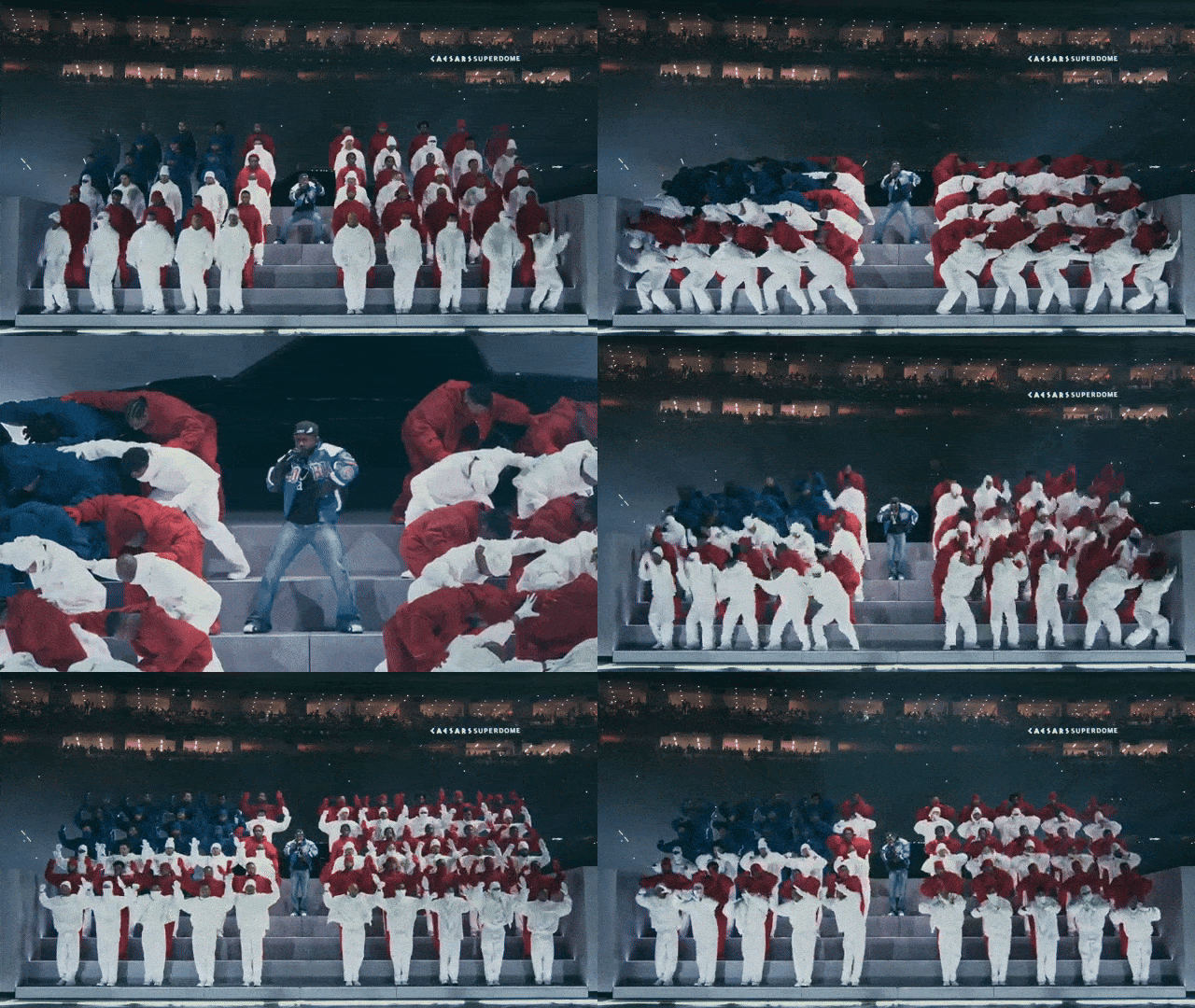
Although baseball is considered the great American pastime, you’ll be hard-pressed to find an American that thinks of the U.S. and doesn’t think of football. And the Super Bowl is the ultimate display of our love for not only the sport, but also arguably America itself.

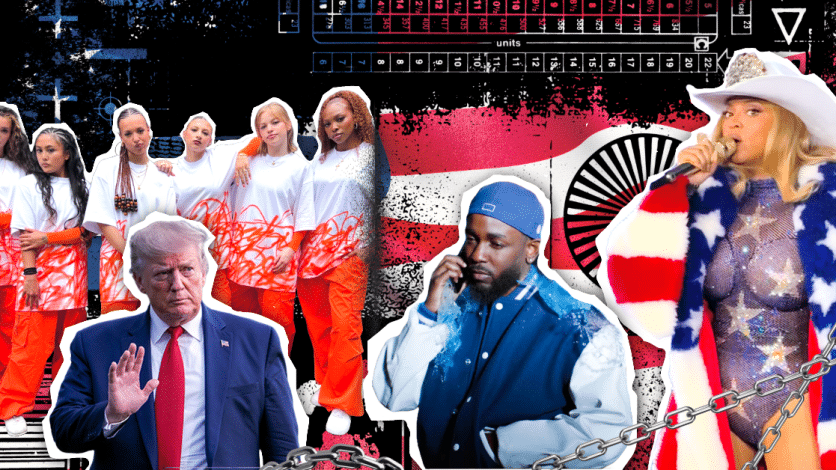
Over 127.7 million people tuned in to watch the 59th Super Bowl this year, and all eyes were on Kendrick Lamar’s halftime show. But the Grammy and Pulitzer prize winner didn’t just give a show, he gave a mirror to the American condition. Decked out in red, white, and blue, and surrounded by a mix of American iconography and symbols of the West Coast Hip-Hop that he was raised in, Mr. Lamar showed us what it means to be an American right now.
The performance is framed around the idea of Mr. Lamar’s “Great American Game,” which starts with the image of a dark field lit up with four symbols: an X, a circle, a square, and a triangle.
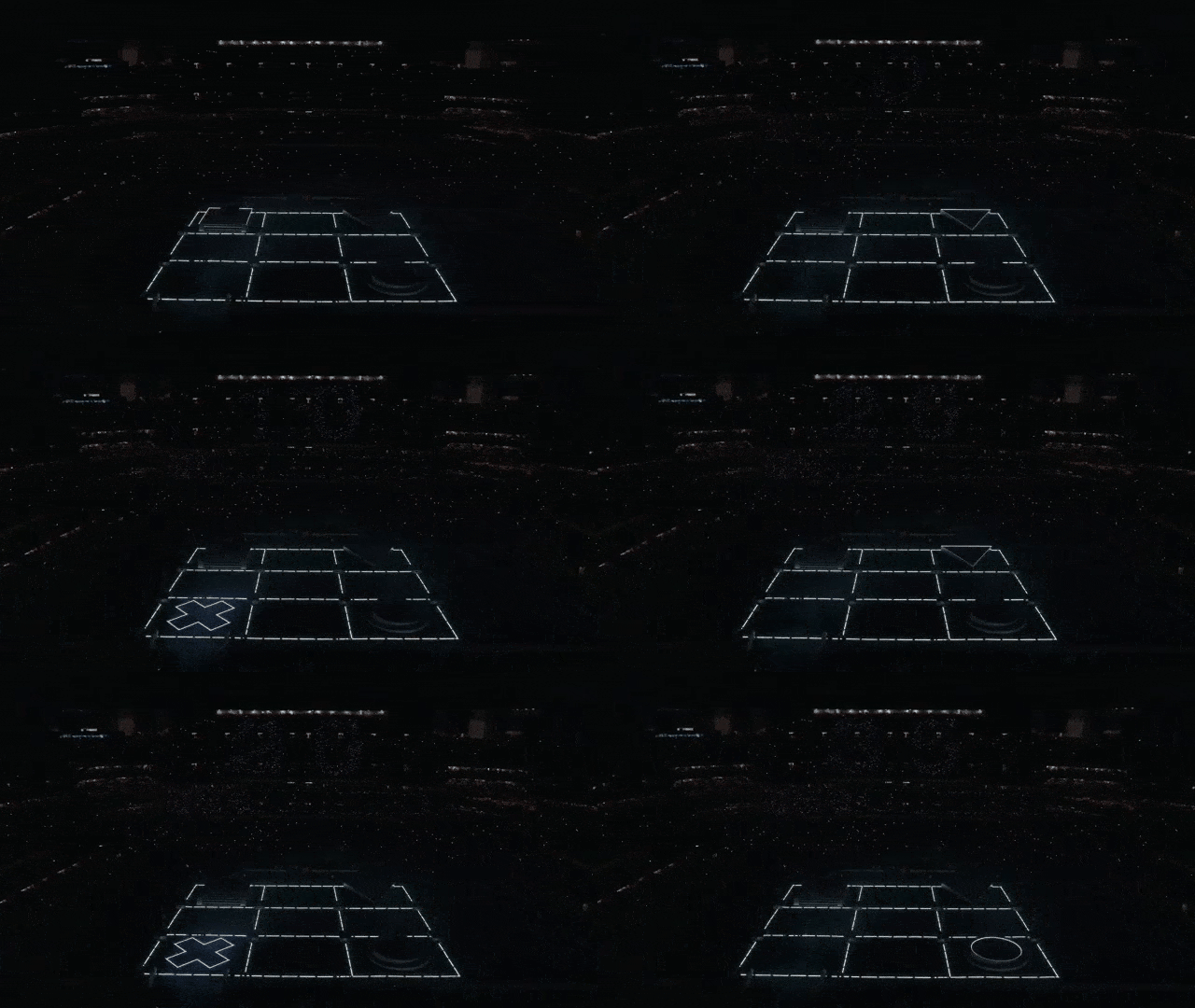
There are two dominant interpretations of what this image is alluding to: the popular Netflix dystopia “Squid Game,” and the buttons of a PlayStation controller. As professor Tiana Clark puts it,
“Both references point to one main conceit for Mr. Lamar’s premise: the gamification of the elusive American dream, which for too many of us has become the “dream deferred,”” (Clark).
Life in the U.S. is a rigged game, especially for minorities. Uncle Sam, played by Samuel L. Jackson, is always there to keep us in line and “deduct a life,” if needed. He doesn’t care if you know it’s your game to lose. You’re expected to smile and play along.
But that’s not the whole point. The focus isn’t just the game, but us watching it at home. Kendrick’s commentary between songs is essential:
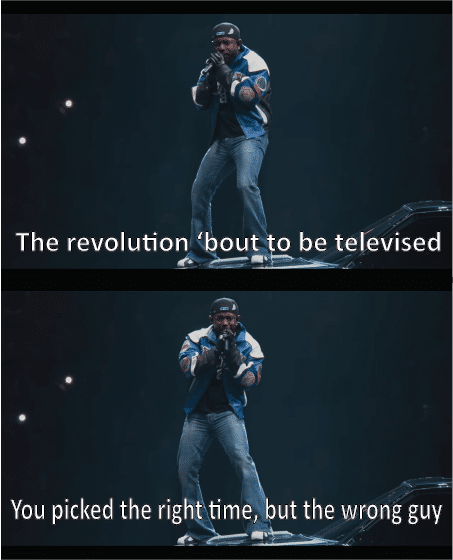
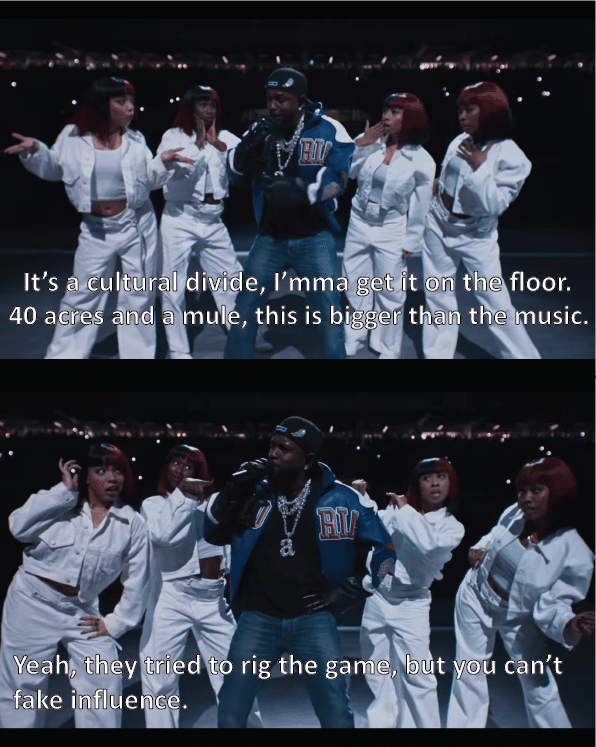
He ends the night not with the ever-popular “Not Like Us,” but with “tv off,” a call to action. A black screen reflecting ourselves. Clark puts it best:
“It’s a diss track to America, an audacious indictment delivered as a rallying anthem designed to unite us and revive our weary, burned-out reserves… ending with a wake-up call meant to remind us that we do, indeed, have control, and the controller in our hands. We have the tools for resistance and revolution at our disposal. Kendrick Lamar’s transgressive joy might just be the antidote to political burnout and apathy…” (Clark).
The performance recognizes the injustice of the system, while imploring you to reclaim your joy and power in your identity.
Beyoncé’s Redefining of American Representation in “Cowboy Carter”
If there’s one artist that embodies the American experience on the global stage, then we’ll find few better fits than Beyoncé Knowles-Carter. This Texas-born genre-traversing superstar constantly pushes the limits of excellence. But that doesn’t stop many from attempting to diminish her right to take up space on the stage.
Which is perhaps her motivation for her bold dive into country music, “Cowboy Carter.” This album and tour is dripping with American iconography, history, and musical allusions. It doesn’t ignore the dirtiest parts of the U.S., instead, it recognizes them while propping up our victories won in spite of them. It is a complete reclamation of not only Black people’s place in country music, but also their place in American history and identity.
“Yes, she’s draped in red, white, and blue, but her vision of America is built on the innate understanding of its countless evils and atrocities… Clearly, the American project is still in process — and for Beyoncé, the promise of what the country could be is enough to keeping fighting for it” (Billboard).
As Chloe Boccara points out in the Oberlin Review, the very act of a Black woman becoming a cowboy, a predominantly White-male symbol of America, is a subversive act that “reclaims and reconstructs our image of America.”
After seeing the show, famous drag queen Trixie Mattell commented:
“I just left feeling hopeful for America. She made me happy about America… I called my brother, who’s like a rather probably conservative libertarian, and I said, ‘I think you should see Beyoncé… It encouraged me to imagine a reality where America could use its power for good” (The Bald and the Beautiful).
Co-host and fellow drag queen, Katya, responded in a later podcast after seeing the show herself, “[I felt] hopeful! It was, it wasn’t like an elegy to America, it was like an anthem. And it was like, I don’t go up for any kind of country music—certainly not hers—I cried. 7 or 8 times.”
Trump’s Ominous Portrait Paints a New Direction for America
Every generation of presidents brings a new presidential portrait that’s known to set the tone for the direction of the administration. It also, importantly, reflects the current mood of the nation. President Barack Obama’s 2018 portrait by Kehinde Wiley in particular was famous for its uniquely personable and humanistic quality. And the infamous President Trump is no exception to this pattern.
However, his portrait paints a much different future for the U.S. compared to previous administrations. Trump stares out at the viewer with a stern, penetrating expression from a dark background. It’s a sharp contrast to the warm smiles many presidents—including him during his last presidency—make during their portraits. The lighting is ominous and dramatic, although not as intense as his previous photo taken in January, which drew comparisons to his 2024 mugshot.
When asked about the expression Trump was making in these new portraits, press secretary, Karoline Leavitt reportedly replied: “America. Is. Back.” Ms. Craighead, who took the photo, reported, “A scowl is ‘his favorite pose,’ … He doesn’t want to smile because it seems weak, is probably what he would say.” (NYT).
Another notable difference from previous portraits is the absence of the American flag in the background. Instead, this iconic symbol, which “has served as the backdrop for every president since the 1970s” (NPR), is made into a tiny pin stuck to his lapel. It’s replaced by this consuming darkness, which for me, drew to mind the recent portrait of King Charles III done by Jonathan Yeo in 2024.
Although both portraits were approved by their subjects and their painters adamantly claim neutrality, it feels impossible to ignore what they portend and imply about the state of the nation.
MOTIV’s Heartfelt Expression of the U.S. in WSWF’s Mega Crew Mission
Korea’s most iconic reality dance competition, “Street Woman Fighter,” has come back for a third season. This time, MNET has taken the competition to the global stage, featuring crews representing different nations around the world.
MOTIV Crew, led by 25-year-old powerhouse, Marlee Hightower, has been doing Americans proud by representing the U.S. One of their recent “missions” has been the Mega Crew Mission. MNET challenged groups to create a large scale performance, expressing their country for the world. Most crews took this as an opportunity to demonstrate their national pride, but MOTIV had a more nuanced take.
Their performance, titled “We the People,” is “a powerful fusion of critique, celebration and reflection. The piece explores the complexities of American society and reminds us that in a divided nation, we, in all our diversity, are the most honest reflection of this country” (MOTIV).
It is a masterclass in storytelling, using the uniquely American art form of Hip-Hop to convey the mixture of joy, aggression, community, resistance, and conflict that is living in the U.S. They show the delicate balance between the escalating violence of the reds and blues, and the diversity of people in white caught in the middle. With 11-year-old dancer Miyu, they show how the new generations begin fighting for a better world, but end up inheriting the aggression and anger of the adults.
Honestly, my first time watching this performance, I cried. It still makes me teary eyed. And I’m not the only one. This mission has been resonating with Americans around the nation, some not even fans of the show.
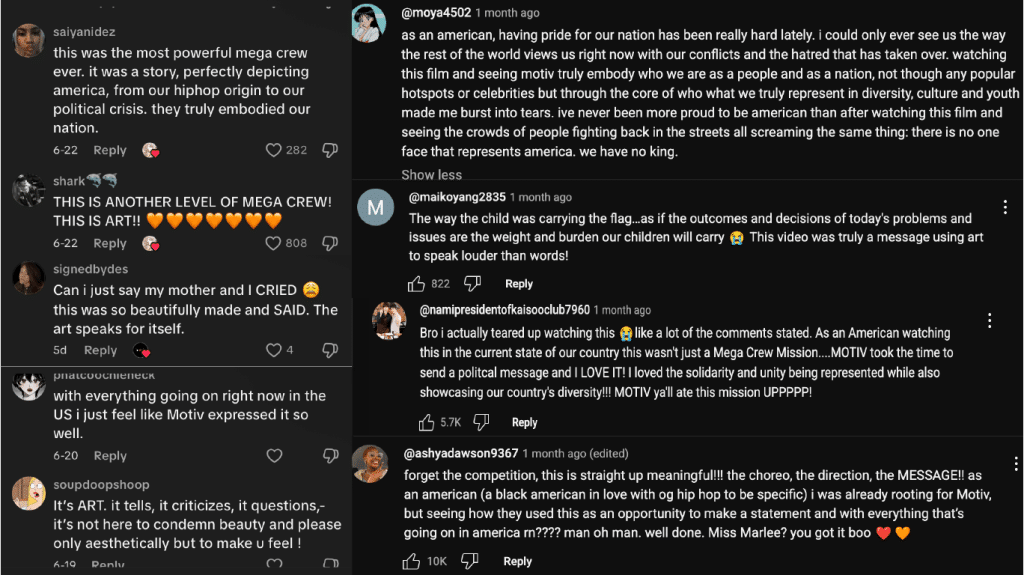
Marlee responded to the support on her Instagram.
“So the Mega Crew Mission is out, and I’m reading people’s messages. I have always felt very powerless living in America and it’s been really really hard to know how to use my voice properly. So to see that people understand the message, and are moved by the message from all over the world, makes me feel like I’m actually doing something that matters” (Marlee).
From the voices of the American children and people
It’s easy to feel like these kinds of national identity crises are a privilege of the elite. But it only takes a look around to see that it’s affecting all of us.
The Globe recently did a survey on “how it feels to be American,” and the responses were staggering. Here are a few that stayed with me:
- “Some days I live in panic that America can’t come back from this, at least not an America I can be proud to belong to” (Elliot, nurse, Hampshire County)
- “I live in an America where my people are hated, disappeared, and separated from their loved ones. I am an American in an America I no longer recognize, one that looks like the place from which I escaped” (Juan Wulff, student, Needham)
- “Being American means holding two truths simultaneously: loving your country enough to demand better from it, and believing that better is possible” (Reya Kumar, communications specialist, Boston)
- “Despite everything, despite feeling some days like America neither wants me, its native son, nor my wife, an immigrant, I’m proud of the America of Tom Paine and Sam Adams, of Frederick Douglass and John Brown, of Abraham Lincoln and Ulysses S. Grant, of Eugene Debs and John Reed, of Medgar Evers and Viola Liuzzo, of Mahmoud Khalil and Noor Abdalla, of the Los Angeles anti-ICE protesters. That America isn’t going away without a fight.” (Joshua, data technician, Newton)
Even the children feel it. This art class was asked to make artistic representations of what the flag meant to them. The arts speaks for itself.
This issue doesn’t discriminate and it doesn’t spare the innocents. As Americans we are divided, but we are united in this struggle to make sense of our selves.
What is a ‘proud American’?
So, what does it mean to be a proud American? After combing through all this media, I’m brought back to a James Baldwin quote:
“I love America more than any other country in the world. And exactly for this reason, I insist on the right to criticize her perpetually” (Notes of a Native Son).
I am just as much proud of America, as I am ashamed by her. And I love it too much to allow it to devolve into destruction. Being a proud American means acknowledging that it has never truly been great, but it can be better.