Invincible is the pinnacle of a modern-day superhero, or what we describe as the anti-hero. His character blends the authenticity and selflessness of a superhero with real-life problems. The animated series contains intense gore, action and darker themes combined with heartfelt moments and complex relationships. Society craves the relatability fostered by the series’ moral ambiguity.
His boss, Cecil Stedman, says, “We can be the good guys, or we can be the guys who save the world. We can’t be both,” arguing that violence is excusable when it’s in the sake of the people and the greater good, but it causes Invincible to question his character. In today’s age, the idea of a revolution is toyed with in America, as well as other parts of the world, raising questions of our own responsibility. Is “Invincible” taking on a revolutionary point of influence? As the audience relates to the character in so many complex ways, causing its popularity, does that relatability transfer into a political sense?
What and who is Invincible?
“Invincible” is an animated adaptation of the popular comic series. It features a multitude of well-known voice actors, such as Steven Yeun as Invincible/Mark Grayson, Walton Goggins as Cecil, and Aaron Paul as Powerplex– the characters I will be focusing on.
It follows the life of the half-human, half-viltrumite (alien supervillain) Mark Grayson. Mark becomes Invincible when his powers emerge, inherited from his father, Omniman, who we later learn came to Earth to prepare it for the Viltrumite takeover. He battles his father throughout the series, bringing up major moral dilemmas regarding their relationship, his upbringing, and his responsibility and role as a hero.
The themes surrounding Powerplex and Invincible’s responsibility as a hero and human being finalize the third season, prepping us for its continuation in season four. As it has begun airing, will these themes continue?
The classic superhero of the past has a history of selfless, perfect morality. Although unrealistic, he always makes the right decisions in the public interest. In response to society’s natural craving for relatability and nuance, the anti-hero has gained popularity in recent hero-related media. The anti-hero is complex; he is real, and he makes decisions based on flawed reasoning and personal motives. While he normally holds pure intentions, granting him the hero name, he is human and allowed to make mistakes.
The antihero and relatability
Mark Grayson perfectly embodies this title, as the complexity of his family dynamics and personal relationships sway his decision-making, sometimes for the worse, but always up to interpretation. He has intense moments of weakness, struggling with his own values and beliefs. Whitney Ryan says for Domestika that, “For fans of the comic or the animated series, Invincible is more than just a character—he’s a reflection of our own search for identity, purpose, and strength in an ever-complex world.”
Powerplex
Once Invincible gains his superpowers, he inherits the responsibility that comes with it. That responsibility is crippling and causes him to question his own character. When it is revealed that his father is working to destroy Earth, Invincible has to choose between his relationships and the responsibility of his career. He is no longer simply working to defeat villains and save civilians; he is battling his father, as well as his own character. There is no longer a clear right or wrong.

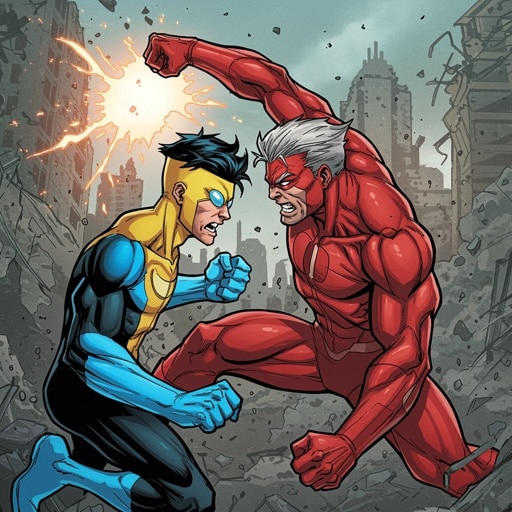
It is at this time that the father and son have a horrific battle, destroying much of the city and killing massive amounts of its inhabitants, including Powerplex’s family. Powerplex becomes a supporting antagonist in season three due to this incident, using his background as a Global Defense Agency scientist to manipulate electricity. He targets Invincible, demanding that he face justice. Just because he is a superhero does not make him above the law. It does not justify the lives lost due to his carelessness. He is very effective in getting to Invincible’s head, as he already struggles navigating his moral responsibilities. He confides in his boss Cecil, who repeats a quote from his past, “We can be the good guys, or we can be the guys who save the world. We can’t be both.”
Cecil’s quote
Episode seven of season three focuses on Mark’s boss, Cecil. We learn his backstory, providing a basis for his ideals. We learn that the character originally obtained a much more traditional set of morals, but learned that strict morality evidently resulted in more loss. These experiences transformed him into a pragmatist, excusing manipulation and violence for the sake of the greater good of humanity. He convinces Mark that saving the world often requires abandoning the traditional superhero sense of purity, further fostering moral ambiguity within his choice-making.
This arc captures a very realistic philosophical conflict between idealistic justice and utilitarian power. Cecil argues that outcomes are more important than rules and ethics. Because Mark attempts to embody the classic superhero notion that hero’s follow concrete morality, he struggles to adapt to this logic.
“That’s the problem with demons. You only see good and evil. Black and white. Well, I need to keep things gray,” said Cecil Stedman to Damien Darkblood, the demon detective.
Tie it to the real world
The series embodies an unapologetic portrayal of violence. It is brutal, and it is real. His power comes with real consequences, as demonstrated through Powerplex’s experience. Powerplex forced Mark to hold accountability. Making him question whether his violence is acceptable as long as it creates a better future. Mark wants to be a traditional superhero, as he grew up watching on TV, but quickly learns how unrealistic that is.
Through Powerplex’s experience, we learn the consequences of Invincible’s responsibility. As Invincible attempts to save civilians from the Viltrumite takeover, we learn the nuance that accompanies progressive change. Liberation requires loss. Systemic change is the most traditional and morally correct. But in reality, gradual reform has proven ineffective, as conditions have only worsened over time for the working class. Currently, 1/4 of households are living paycheck to paycheck, according to a CNN study.
His internal conflict and argument with Cecil mirror the experience we face today. The quote is relevant as we discuss the rapid rise in economic inequality and the crucial liberation of the working class. The character’s dilemma echoes these tensions, functioning more as a cultural mirror than as political propaganda. As headlines flood the news of injustice, how do we take a break from our rigorous work lives, in which we depend for our survival, to help and evoke change? Like Mark, our cultural responsibility is crippling.
Revolution
The statistics influence the argument that the systems are broken, deeming revolutionary change necessary. Is it better to remain a morally pure individual or sacrifice your self-image for the sake of a better outcome?
Dark woke is an internet term used to describe a darker version of political awareness. It justifies radical or violent solutions for the sake of systemic justice. This ideal aligns with Marxist-Leninist ideology, as adopted by the Black Panther Party. Like Cecil, they acknowledge that unethical violence may be the only solution for progress. He argues that saving humanity may require immoral actions, excusing violence and manipulation. When systems are fundamentally unjust, peaceful reform may be ineffective.
“Invincible” is known for its immense violence and gore, with more blood splattering the title screen with each episode. How does being known for its violence and praised by fans for its moral ambiguity foster relatability? What does that say about our role in society today?
So?
The show does not promote this political ideology, but rather gives us a platform to relate. We face similar dilemmas regarding our own responsibility as civilians. Modern audiences are often drawn to morally conflicted heroes because our political sphere is morally complicated. Institutions are flawed, and solutions are unclear. “Invincible” encompasses these ethical tensions. Cecil’s quote is immensely relevant today, as we debate the liberation of the working class.
As we witness characters balance ideals with harsh realities, we are reminded of our own role as citizens. As our government and major corporations fail to meet societal needs, responsibility is placed in the hands of the public. Do we trust that institutions have our best interests in mind, or challenge them? What responsibility do we as individuals hold within these systems? That being said, the show resonates with its contemporary audience as it dramatizes similar moral and political questions. Questions that shape our views on responsibility, power and social change. As “Invincible” teaches us, there is no clear right or wrong, and that is what makes us human.