Last week, Mitski fans across the planet gathered at their city’s respective record stores equipped with scissors and glue to hear Nothing’s About To Happen To Me ahead of its highly anticipated release. Pleasantly, a quaint Crafternoon transpiring at the Mitski listening events is comparable to forks found shockingly idle in a kitchen drawer.
This participatory kind of third-space atmosphere inevitably prompted insightful conversation with newfound acquaintances. I believe this to be an intentional setup on Mitski’s team’s part that contemporary communities are increasingly deprived of in both the digital age and within the timeless diorama of Mitski’s topsy-turvy tale.
Interrogating the tragedy of comfort
The eponymous sentiment “Nothing’s About To Happen To Me” carries a polarising essence – reassurance in stagnation yet an anxious abstinence from the unfamiliarity required for fulfilment. On her latest LP, Mitski interrogates the tragedy of such comfort through a feverish haze.
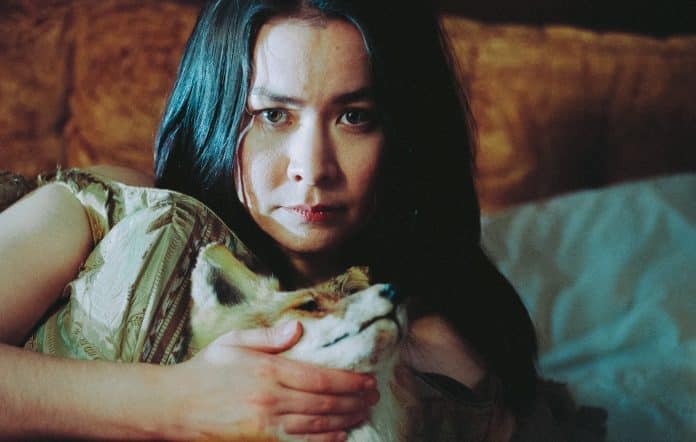
Mitski’s eighth studio album follows “a rich narrative whose main character is a reclusive woman in an unkempt house,” boasting gothic sensibilities and marking the songstress’s first dabbling into the realm of concept album.
Opening track In A Lake‘s accordion invokes something of a busker – the beacon of an unchanging township, manning the same post for decades, seemingly primordial and ageless. Mitski’s sanctified lake is a pocket unaffected by time and excused from change. Strokes of strings “backstroke forever” through the mirage. In A Lake is one sea-shanty that’ll never set foot beyond land, and hence listeners are aptly introduced to Mitski’s recluse alter-ego and her cloistered reverie. Ultimately, a hand-stitched haven sheltered from change is unsustainable, and folky production is pierced by prongs of traffic, car horns, and the ceaseless cacophony of enigma.
The record’s lead single Where’s My Phone? comes crashing through these sanctuarious scaffolds. The track boasts fuzzy rock production, teasing a “Bury Me At Makeout Creek” renaissance. Here we bear witness through the cracked door to Mitski’s tumultuous quotidian. Like all addictive indulgences, phone usage renders its victims into a dissociative state, and attempts to perpetuate this thoughtlessness through baiting illusively endless pleasure. Mitski chases this perpetuity, “I just want my mind to be a clear glass, clear glass with nothing in my head.”
Inhospitability is extrapolated
Nothing’s About To Happen To Me responds to Mitski’s previous record, The Land Is Inhospitable and So Are We, with bitter skepticism. Whilst the much-loved My Love Mine All Mine venerates “Moon, a hole of light / Through the big top tent up high / Here before and after me,” Where’s My Phone? proclaims a subversive rejoinder, “If night is like you punched a hole into tomorrow / I would f*ck the hole all night long.” This omnipotent puncture in the night that once represented heaven or the afterlife now stripteases a tomorrow. When the reprieve of death has been replaced with the illusory perpetuity of living, a tone of tenderness, love, and acceptance has been replaced with stress and sharp, fuzzy bedlam. This overwhelm is universal, and its caricature is the ringmaster of the LP.
Similarly, whilst Cats mirrors My Love Mine All Mine‘s swoony production, it inverts its principle. The act of loving, initially depicted as one’s single true possession, has been mortgaged, deemed useless unless serving another. Unspooling this track, Mitski spoke with The Current about the demonised qualities shared between felines and women.

“I thought about cats and how often there are people, especially dog people, who don’t like cats because they think cats are mean, when actually, I think the layer below that is that cats just aren’t obedient. It’s not in their language or mentality to follow commands. It’s not that they don’t love people. It’s not that they don’t feel affection. It’s just that they’re not dogs. They don’t follow a pack hierarchy. They just live independently. They love you how they love you, and they do what they want. And I think often cats are demonized for that in a similar way that I think a lot of women maybe are misunderstood for that quality, just because we might not be exactly what women are supposed to be in patriarchy, just because maybe we don’t, I don’t know, follow certain narratives that are expected of women. Maybe because we’re not obedient, we are thought of as bad.” – Mitski for The Current
Incompatibility has festered insidiously, yet the housecat retiring to the bed’s feet sleeps with the simplicity that there is no other option. The addressee of Cats, however, understands that stagnation is the price of peace without becoming – peace comes at a claustrophobic cost when not paid with reckoning.
Mutual vulnerability as paradox
Throughout the vaudeville, our protagonist’s insecurities as a lover manifest a perceived autonomy gap between herself and her counterpart. On If I Leave, she is entirely replaceable; whoever is charitable enough to believe they owe her affection is absurdly immune to such a possibility.
Mitski’s character frames her darkness as Sisyphean, and losing her lover would mean the sole witness to her surreptitious selfhood is thrown to the fishes. Having no second outlet from the hovel and oversaturating her romantic relationship, it’s an icy incarceration of two individuals. Mitski employs Victorian horror to instantiate this suffocation for the track’s music video.
The vivarium begins to valley
Dead Women tests the limits of this dilapidated comfort and seeks security in a promise, even (or especially) one of tyranny. Our doting demoiselle fantasises a step-by-step method of how her lover could swiftly dispose of her. The crooked fantasy bestows her with twisted reassurance, cooing lullabies of how generously kind her lover must be to not have stabbed her 27 times just yet. Mellow guitar and haunting vocal doo-ing concoct a harrowing ballad of how her lover might benefit from her graceful demise. These fictional offences of “Ransack[ing] the house for what you’ll auction” among other pitying revocations of agency mirror how women are commonly taken advantage of beneath a facade of respect. Women are dehumanised before and after death, “you’re hosting the viewing / Saying, ‘She gave her life so we could have her in our dreams’ / ‘She gave her life so we could f*ck her as we please'” perpetuates the album’s nucleus of consciousness as divorced from autonomy.
The latter single, I’ll Change For You is a smoking area for apathy, this permission wreathed by delicate orchestration. Gentle bossa nova and soaring strings are chemtrails over milquetoast pleas. The trajectory of Mitski’s production is one of increasing gentleness across her discography. Words wielded like carmine-blade axes have metamorphosed into Stanley knives within a kitchen drawer cocoon – made sharper through their prevalence in the quotidian. The lithe pedal-steel and muted organ refracting through her rock origins are simultaneously sobering and phantasmagoric. A shudder of honest clarity pierces through the hoarder house in slow-mo, before it pierces again, and again. For the voluntarily stagnant, dread returns like moonlight.
To let the housecat kiss the doorstep
Since we last caught up with Mitski, the harsh, tiresome commonplace landscaped by her previous record has acquired inhabitants – Mitski herself sporting an eclectic assemblage of scarves and hats. As taught by its successor, the self, in tandem, is a torrid and pulpy realm, yet one must erode the border between the two. This inhospitability, of both capriciously vast land and sloshy cardiovascular seas, must be confronted in order to progress towards fulfillment. Get out of the house and attend a community crafternoon.