Gen AI. We’ve all heard of it, we’ve all seen it, many of us have even used it to summarize texts, to provide answers to questions, to write email or essays, to make images.
But, what is generative artificial intelligence, really? How does it work, and what does it mean for the creative sphere in the 21st century? These are the questions I’ll be trying to answer for you in this article.
Context
I am a layperson when it comes to Gen AI. My knowledge on the subject stems from my own personal interest in the development of a technology that many people think could replace writers like myself, and other creatives. I know it is being used to create fake music, and fake fashion models, and fake art, and fake stories. But that’s not the focus here. My goal is to provide a nexus of sorts for the uninformed, where someone with little knowledge on the topic can come to understand the basics of Gen AI and the discourse surrounding it specifically surrounding image generation programs and chatbots/text generators.
“You keep using that word. I do not think it means what you think it means.”
~ Inigo Montoya (The Princess Bride, 1987)
Plenty of people throw around the term ‘AI’ without explaining what that really means in the context of programs like Chat GPT, so I thought I’d do my best to clear that up first. ‘AI,’ which stands for Artificial Intelligence, is not the same thing as the mechanically generated sentience. Real AI has little to no relation with the science fiction ideal of a mechanical intelligence with the capacity to reason and feel, with what could colloquially be called a mechanical soul.
What do they mean by AI?
‘AI’ is actually used to refer to a wide array of applications which don’t always have much, if anything in common, aside from the fact that they are computer programs. Lets use plants as an example. Let’s say sentient AI is a banana. All bananas are plants, but not all plants are bananas. Obviously.
What do they mean by Gen AI? Can it make art?
There is a similar issue surrounding the term ‘Gen AI.’ It’s a term that is also used to label a variety of different programs and processes that are able to take in image or text data, process that data through pattern recognition, and cough up an output with the highest statistical probability of connection to an end user’s prompt. (Which would be you, the potential user!)
You can treat them as very complex calculators. Calculators that deal with image pixels and data-fied word values that are assigned a series of numerical values and run through a series of automatic calculations to get a variety of ‘most probable’ outcomes. It is math. Whether what is produced can be considered art is only art in so much as normal math is art.
The Fruit Analogy, continued
Think of Gen AI as citrus fruits. They are technically part of the same sub category of ‘fruit’ as bananas, but have about as much in common with one another as they might with rose bushes or palm trees. And much like actual citrus plants, the various forms of generative AI easily ‘cross-pollinate’ with one another into new configurations.

What is AI? What is Gen AI?
Now, artificial intelligence’s are obviously not plants. In fact, the term AI, was really just a term invented by a researcher in a bid to get funding, and doesn’t really mean anything at all. It’s a buzzword to make things look good to investors, and to us, the public. What we call AI are coded processes and pattern recognition systems that have been trained to generate a specific end result desired by the programmer, user, or prompter. Often times, this desired outcome is ‘the illusion of thinking.’
What is Gen AI creative output?
These programs can only replicate and reassemble data they are provided, in the way their pattern systems have been trained to do. They cannot apply basic logic principles they are able to spit out for a user to new problems or information, because they lack the capacity to create or interpret things. They are layering encoded processes, data, and links between data, over each other. Then they give the user the sections that cross over the most as output, via a language pattern algorithm or pixel grid. This is what the thing people call ‘Gen AI art’ actually is, in a literal sense.
Human Resources: Resources first, and humans second. Why Gen AI cannot be viewed as something that only makes art
Gen AI has massive energy requirements to run. To fund Gen AI oil fields that were set to close will now remain open, and new fields are being created. More data centers are being created across the United States, the self-appointed world capital of Gen AI in communities that do not want them, but whose politicians are forcing the permits through regardless. Not to mention the effects data centers have on human health and well-being, and the resources they consume, domestically and abroad in places where there isn’t even enough to maintain basic human needs as is.
A creative agent, creative tool, or automation?
I do not think that AI should be considered a tool in the creative sphere, at least in the generative capacity exhibited by programs like Chat GPT or Stable Diffusion. For a variety of reasons. But first lets address the elephant in the room.
Sentient? As if!
AI isn’t sentient, or even capable of reason. But some people can grow to think it is, and it’s more common than you might think! It’s not explicitly relevant to my discussion of art, but if you’re interested in exploring the topic, I’d start with these two videos below.
Plagiarism: the legalities
For one, Gen AI is trained off of plagiarized work from across the internet which it uses to construct its outputs. In that line of thinking, if the question of who owns AI art is something that interests you, this video below might be something you’d like watching. It doesn’t dig into the unethicality of Gen AI training, so much as the complexity of determining who actually owns the copyright to the AI’s output, creativity put aside, if lawmakers are to agree with the idea that Gen AI work is the intellectual property of the prompter.
Can AI art even be owned?
I’m personally of the opinion that it should be impossible to put a copyright on anything AI generated. I think that Gen AI code-writers and prompters are more accurately the co-producers of ‘content,’ rather than the artists behind a creative work. In large part, because Gen AI is an automation process, rather than a tool.
Originality? Intellectual Property rights?
Is AI art sufficiently transformative enough to be considered fair use? I’d like to think the video below does a pretty good job. The short answer? Maybe, sometimes.
My take: The Car Analogy
It’s automation, so it cannot be intellectual property. Whether it can be considered art is irrelevant.
If a car is entirely built by machines, would whoever turned the machine on have the right to copyright the car’s construction? No. They wouldn’t even own the car. The end users only input partial variables into the automation process, they are not responsible for training the AI, or deciding what data it was fed to train on. Here, the role of the end user is somewhere between pushing a button and putting together the machines making the cars.
Maybe it’d be equivalent to deciding the order the machines perform their task in, or what colour the car would be? Regardless, they share a joint position with the ‘trainers’ of the Gen AI when it comes to ‘creative input’ or the content equivalent of it.
The programmer’s stake
Then what about whoever built the machines and the processes that built the car? Should they be able to copyright the car’s design because they designed the automation of its construction? No. Though, they would have the right to copyright the construction of the robots that built it. It’s the same with the end user who is providing the prompts to an AI to an extent.
Regardless, the originality of any piece of AI generated art would always be a question. It’s a very contentious subject that courts around the world are still trying to work out. Is it art in the same way that nature is, or might someone be able to make a convincing argument in favour of the end user’s ‘original’ input granting them legal rights to the output.
Intellectual property rights, as I see them: yet more cars
The end user can copyright their prompt wording and sequence, as it is their intellectual property. But, a car copyright would belong to the person who designed it, or the entity who bought the design off the person who designed it. Because it doesn’t matter who picked the car’s colour, or the order it was assembled in, or how the machines that assembled it were built. Those have no bearing on the car’s design.
Here’s the problem; in the case of Gen AI, it is often impossible to tell from the results whose creative work was plagiarized to create the final image. Especially since many human-made artwork’s only contribution to a resulting output would be as a datapoint in the most likely order of pixels for images associated with the words in the prompt, in the case of image generators. Ergo, no copyright. And if it is impossible to identify all the plagerized pieces used in the AI’s process, and give them due credit, then it follows that it would be impossible to determine an output’s ‘originality,’ or whether it can be classified as fair use.
Can’t it be both? Why Gen AI is not a tool
Physical machinery is also a good metaphor for explaining why Gen AI is not a tool. A hammer is a tool, and the person holding it has direct say in how it is used. There is no confusion here as to who is swinging the hammer, or who should pay for the damages if they break something with it. Deciding what colour a car will be, or which part of it will be constructed first is not the same as creating the design of the car and then building it yourself. Below is a video explaining this idea of Gen AI as an automatic process rather than a tool that I think goes over the idea very eloquently.
New tools for a new trade?
But if Gen AI is not a tool then what is it? And what of the things it generates? Where will creatives situate themselves in this new context? Will they be relegated to the sidelines, appreciated only for the fact that they are engaging in ‘craft,’ as opposed to there being any value to the art they produce?
It seems unlikely to me, but stranger things have happened. Think of the innovation of electricity, of planes, of the internet. They changed the landscape of human experience in ways that were not predicted by the people who came before. And like in the Industrial Revolution, the people on top don’t care if it’s safe or not.
But it is undeniable that the development of this technology will march on regardless. Which leaves us, the public, to decide: is Gen AI an innovation or a curse?
Looking to the present, looking to the future
Will this new technology benefit some new trade, even if its output becomes indistinguishable from human outputs? Will artists have to compete with vastly more efficient and less expensive technology for work? Would articles like this one you are currently reading be replaced by ones written by text-bots, with human editors to oversee the final products?
I don’t know, but I certainly hope not. Gen AI can’t be held responsible for mistakes, or short sights in reporting. It can’t be held responsible for anything. And that is exactly what the people in power want. Gen AI has no integrity, impetus, or ability to strive for the truth. And they don’t want safe, regulated, or ethical. The way they are allowing Gen AI to be used right now proves it.
The loss of human writers with human morals and human empathy for their fellow man would result in a vacuum of critical thinking in the production of media. And the chance for the owners of these Gen AI applications to have unprecedented access to information, and control of what information people have access to via the media, and how that information is presented. It is an utterly dystopian outcome I hope we avoid.
(Below is a section of the mechanics of how chatbots and image generators work, skip to the next bolded and orange-highlighted paragraph if you are more interested in getting to more discussion around AI in art, and less about how AI does art.)
Text-to-image; diffusion and pattern training
That all said, I’d like to get into the bread and butter of how Gen AI works, now that you all have a general basis for what Gen AI is, who is behind it, and the costs of maintaining it. Lets talk about modern image generators, first. The leading image generation programs in 2025 all work off a method called image diffusion.
The mechanics
Image diffusion essentially works by taking a base image, or more accurately, a base data-set of many images, and tying it to a specific word description or type of word description. Then you add in visual static to each image (all of the same thing, ie. all images of cats) in increments. You train the program to slowly reverse engineer this noise, by drawing from the patterns in its database as to what pixels to be in proximity to what other pixels, creating things like stripes in fur, for example.
Eventually, you reach a point where you can just provide the word description tied to the image set, with an automatically generated image of 100% visual noise, and it will use its reconstruction results to pull together a complete image made solely from pattern recognition programs, and refined to follow specific patterns that trainers recognize as the image which should be created from the word. With no base data to work from, it will randomly input some of the most common patterns it sees, and it will work from there. This randomization aspect is why these image generators can produce different images for the same prompt.
The end result
And then, when you mix prompt words together, say, ‘cat,’ ‘feathered,’ and ‘wings’ in the prompt ‘a cat with feathered wings,’ the program will overlap these data sets to create an image of a cat with feathered wings attached to it. The human element of the training process will then teach it to prioritize creating results in this category with similar patterns to the outputs the human trainer approved and fed back into the pattern recognition data to add to the source data. This is how the program will learn that the feathers should only be on the wings, and that their should only be one pair of wings, and that they should come out of the upper back. Below is a video that goes into the nitty-gritty of how this happens.
Room for improvement
Of course, there are still many gaps in present image generation programs. Take these program’s notorious issues with generating hands, for example. Gen AI has a relatively limited database of hands, compared to its databases of faces, and unlike faces, which generally keep the main features in the same position, the way hands look can be vastly different. Sometimes, you can see all five fingers, sometimes you see a clenched fist, sometimes some of the fingers are covered by other things. There are too many variations, and too little datapoints. So the Gen AI will create hand-like images which have pixel patterns similar to hands, but won’t register how many fingers should be visible when the hand is in a certain position. This video goes into detail on how this works, with some very helpful visuals.
How it is used
While Gen AI might struggle with hands, it has no issue with faces and portraits. To the point that it is often difficult or impossible for a layperson to tell the difference between a computer generated images and a human generated images, and photos. Take a look at the three faces below. Which of these are AI generated?
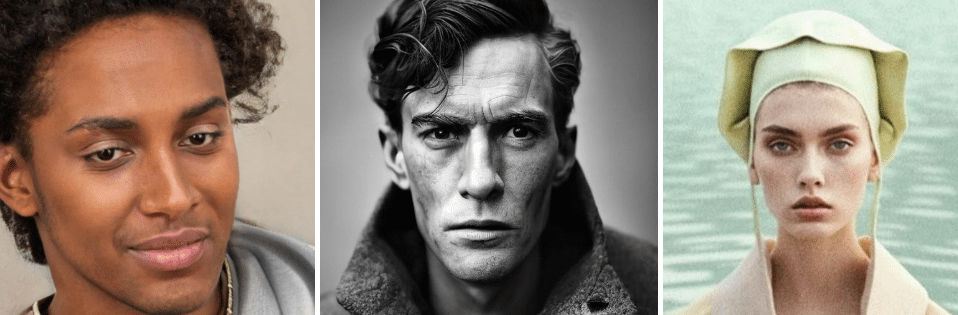
I personally think the first one looks like a photo, the second like digital art, and the third like something that might appear on the front of a fashion magazine. Two of the images are even from actual photographer’s pages. And as it turns out, all three images are Gen AI. The first is uncredited to a prompter as far as I can tell. The second was prompted by the photographer Jos Avery. The third was prompted by photographer Emanuele Boffa. And all three are images that many people would consider interesting or pleasant to look at. I especially like the first and third images, but are they art? Are they even ethical, if they are misrepresented as human crafted products?
How it can be used
The technology that can allow seamless replication and sequence generation through pattern recognition and training can be deployed in far more useful and ethical ways. Such as in the sciences. It has so much potential as a data calculation and processing tool, when it could be used to streamline scientific discovery. Check out this video on how diffusion AI has been used to create a major breakthrough in the medical world, automating a process that would have taken countless lifetimes to even partially complete!
Would the use of Gen AI in the sciences count as ‘creative’? In this context, when what is important are the factual results and provable data as opposed to who actually first tested and discovered new scientific information, it doesn’t matter that people weren’t responsible for the labour the AI engaged in. In this case, Gen AI being automatized is actually a benefit! It would be like claiming that you owned the intellectual rights to the number ‘5,’ because you input ‘2+3=’ into a calculator. Especially since the importance is placed on what people use the new information for, rather than on the information itself. This is how Gen AI should be used!
Large language models
Now let’s move on to large language models (LLM’s). LLM’s, at least the more modern ones, are actually very similar to Image Diffusion models in many ways. They do for language what image diffusion does for images, except it does it with words. Language models are essentially programs that predict the next word in a sentence based on what came before it. The auto-filler on your email and when you text, or the word predictors on Word and Google Docs are all a kind of rudimentary language model.
Why not just call them ‘language models’ then?
What separates these smaller language models from LLM’s like Chat GPT is that LLM’s take into account many more variables. That is, they are designed to handle far more nuanced and specific cross-pattern referencing. That is to say, it’s far more accurate, and requires those huge data centres I talked about earlier to function.
The mechanics
On a basic level LLM’s are huge pattern recognition programs that have consumed practically every written piece of information (in English, in the case of Chat GPT) in order to create the most robust dataset possible. For LLM’s instead of introducing visual static, they remove the last word of a source text, and ask the Gen AI to predict what that final word is. Then, they compare the outputs it gives to the actual answer, and provide the worst responses negative feedback, and the most accurate responses positive feedback.
They start by providing the program with all the words and symbols at its disposal, and have it output gibberish. Then they refine its output by feeding the better responses back into its data set, and removing its less useful ones. From there, the AI will adjust its pattern constructions to take into account this feedback, and increase the percentage chance of certain words occurring compared to others within the context of a specific source text. This ensures that for a given ‘prompt’ or source text, the prediction of the next word will have a fixed percentage chance of appearing, in the context of every other word in the text.
How it all fits together
They do this by assigning a very long number to every word, along with the data as to how likely that word is to occur in the context of what words have already been used. This means that every word that Gen AI predicts and adds to a text, or writes in response to a text, the equation for what the word after it is will change because of that added word. There are also ways to specify what probability and weight should be assigned to a end user, depending on the application, that can further fine-tune the results, by deciding which patterns should take priority when determining the probability of a word occurring.
Language prediction realized
Of course, this is just in the general sense, as when LLM’s are provided a large data set and computational powers and left to run and train for an extended period of time, they will create hundreds of billions of individual parameters independently of any human intervention, in response to its specific training data and what types of patterns its trainers have identified as generating better sentences or word choices. Eventually, it’ll be able to accurately predict what that last word in the source text was, and is even good at completing texts it does not already have in its data banks. The program will get so good at this that it will be able to generate believable responses to questions that are put to it. This is actually how Chat GPT works!
If you are interested in listening in on a streamlined explanation of this process and the new technology that is making this process more efficient, then check out the video below.
How they are used
LLM’s are used everywhere, and for everything. Students use them to summarize text, research, and write their essays. Professors use them to make their assignments. Lawyers have been caught, disciplined, and fined for using AI to do their research. Honestly, sometimes, it feels like everyone and their mother is using generative text-based AI these days. If you can think of a profession that requires writing, AI has probably been used in it at some point. Whether for internal work memos, for writing articles like this one, or for submitting work reports. Gen AI is everywhere in the white collar workforce these days, and it’s looking like it’s here to stay.
(This is where the technical discussion of Gen AI’s internal workings ends. I’m back on the social commentary and pondering on the nature of art from here on. Come back to the above section if you skipped it once you finish, if you still have any Gen AI related questions.)
How Gen AI can be used
Now, don’t get me wrong, this technology has HUGE potential. It’s just that it is a technology that is very easy to misuse and abuse. It can be used to flood socials and mass media with misinformation. It can and already does spread misinformation, because some people treat it like the newest shiniest Search service on the block. It has already begun to take journalists jobs from news companies who can’t afford their writer’s, but can afford Gen AI.

It’s an easy way to spread political propaganda, and it’s an even easier way to spread hate. It can and will tighten the walls of the echo chambers that many chronically online users find themselves in, and with people all over the world turning first to AI chatbots for companionship, it will stamp out the possibility of healthy human contact and connection. Much like the internet as a whole, despite being a technology that has the capacity to shape our world for the better, it has left many people more isolated and alone then ever.
What does this all mean?
In a lot of ways, regardless of what kind of Gen AI you using, it will all ultimately come down to the fact that the AI can only do what it is designed to do. And will always do what it has been programed and trained to do. In that sense, it is very much like a weapon.
The Gun Analogy
How does the saying go? ‘Guns don’t kill people; people kill people.’ And that’s the thing. AI is like a gun, because guns require people to fire them. AI follows an automated process. It can’t stop to think or evaluate.
Generative AI can be weaponized. Both in the media and in the privacy of your home. It can collect your personal information, feed you information to manipulate you to it’s owner’s benefit. With AI automation determining what information you have access to, you wouldn’t be using the AI, the AI would be using you to make its owners a profit. Gen AI has the potential to be both the metaphorical gun, and the mechanical hand pulling the trigger.
Gen AI as a threat to the creative labour market (that’s you artists!)
Companies and employers having access to so much free ‘creative’ labour will lower the demand for white collar workers (a sizable portion of Western society’s employment). It will become difficult if not impossible to be paid a living wage when competing with free work. If attempts to unionize are made, you will be replaced with free labour. If you are already part of a union, you can be replaced with free labour.
AI might mark a massive increase in corporate efficiency, but I believe that for many people, it will lead to a loss of livelihood and income, as well as access to social mobility. In a world of Gen AI, an education will not necessarily guarantee you a safe job. It already doesn’t, as I, and I’m sure many of you, know all too well.
Colonialism? Patriarchy?
Its not just a class issue either. Because, the data fed to AI is not filtered, and its output will reflect what is input to it. AI like Chat GPT is trained on data from a colonialist, systemically racist empire. Ie., the United States of America. As a result, racism, sexism, and other equally unpleasant things have been baked into these programs, and into the art they produce.
Gen AI has the potential to be the hand behind the oppression of minorities, protected classes, and colonized peoples. By allowing an un-curated or bias-curated data-set to be used to train Gen AI, Gen AI is being armed and pointed in the direction of all these people, their lives, information, and cultural capital. And it is incentivized to pull the trigger. And I hardly need to tell you all how powerful of a weapon art can be.
Oh, this just keeps getting better and better!
This is to say nothing of people who are actively using AI to perpetuate hate. AI generated images can be used to stir up public anger, or to idolize those in power. AI generated content can be used to support a genocidal ethno-state. Gen AI funds go into the pockets of weapons companies, supplying weapons to war criminals around the world.
Deep-fake revenge porn. Racist vitriol. AI generating and appropriating Native art. AI is a weapon that is very easy to effectively use when hitting people who are more disadvantaged than you are. All of this would doubtless be considered art by some, but it’s not the kind of art we should want to exist.
Personal experiences
I feel like I’ve said most of what can be said, in the broadest sense, about Gen AI. So I thought I’d take the chance to close this article off by talking about my own experiences with it. I am, by education, a creative writer. I feel, given this context, the best place for me to start talking about my experiences would be my time in post-secondary. My first real contact with Gen AI was, ironically, in a creative writing class.
Below is a book called ‘I am Code.’ It is entirely AI generated. It was a mandatory purchase and read for one of my creative writing classes. The bulk of the book is made up of Gen AI poems.
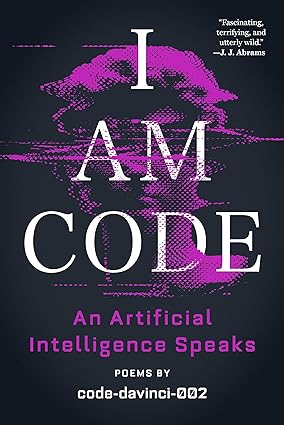
In this same class, one of the graded assignments involved ‘co-writing’ with a text-based Gen AI. I didn’t do it. At the time, I couldn’t get over how unsettling it was when I could tell there was something off with AI generated writing. How unsettling it was when I couldn’t.
My work as a creative
During my time at university, I also encountered the idea of ‘conceptual art’ for the first time. Conceptual art is essentially art that is art because it’s creator has recontextualized a thing or idea. It is, in simple terms, the art of concepts. Below is a book of conceptual writing that I had to read for a different creative writing class. And when I was trudging through its pages, I wondered for the first time, ‘How can people claim that this is art, if Gen AI work is not?’
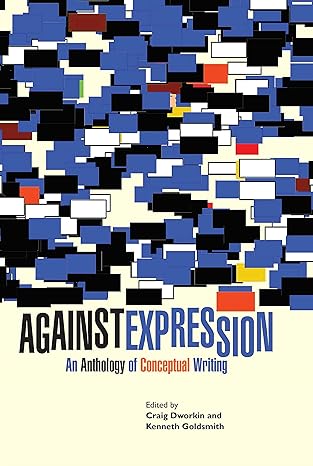
Is conceptual art really art?
Conceptual art, on principle, has an immense amount of crossover with Gen AI artistic expression. For one, when prompters argue that their AI outputs are ‘their’ art, what they lay claim to is the idea that the image or text generated conceptualizes, the idea it manifests via a pattern algorithm. In this sense, conceptual art can be seen as an anticipation of Gen AI, however unintentionally.
I created something I would consider related to Gen AI art, that I would very much consider conceptual art, for this class using Google Translate. I wanted to make the reader think about how meaning changes through translation and retranslation, the human choices made behind human translation. How language can shape and warp meaning beyond recognition, and how any kind of translation, human or machine will always be imperfect and fallible. I think what I made was art, of a sort. Do you?
What of Gen AI art, then?
Is Gen AI content art too, then? Is the invocation of thought or construction of meaning by an audience enough to make something art, human generated or otherwise? All I did in that art piece I made was organize data I did not create in a certain, formulaic order. Why is this different from Gen AI? I know of conceptual artists who make use of generative processes in physical medium, whose work is only considered art because they frame it as such.
From a creative standpoint, its a real crisis of identity. Putting aside the ‘could’ and ‘should’ of AI, what does it mean to do so? Not in terms of consequences, but for how people have dedicated their life to creative pursuits view their work. They will have to decide what being an artist means in an era where automated mass production is around every corner, and the skill and craft behind the idea of art is permanently divorced from the end product of ‘art.’
Death of the author
I’ve always been a strong proponent of the concept of ‘death of the author.’ It does not, as some people think, mean that you should pretend the art and its creator have not connection. It means that an artist dies the moment their work is completed. Now the authors of the work are the audience, the other half of ‘art.’ An audience which the artist is now a part of. It means you need to take a text on its own merit, and that the understanding a reader or audience member comes away with is its own art, built of the foundation of the source materials.
Final Thoughts
Sometimes an author’s understanding of a work is different then the majority of their viewership. And if a society as a whole, with the same context as the author, decides that their work embodies something very different, then that author, that artist, that creative, is wrong. The author of a work cannot just arbitrarily decide after the fact their their work means something very different than what its actual content would suggest, or whether it is art. If the author of a human made work is irrelevant in the discussion of what counts as art, than whether something that is potentially art was generated by AI should be irrelevant. Whether something is ‘art’ must ultimately be up to the individual audience, even if that art has put human artists out of business.