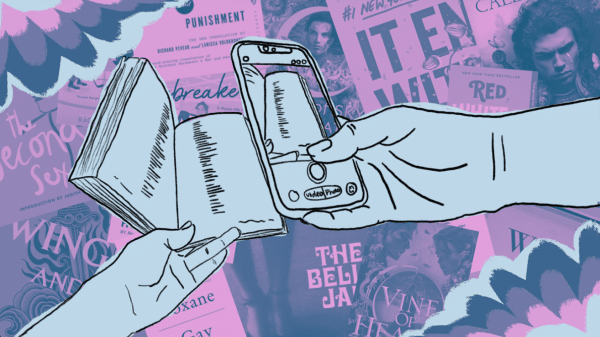


There’s a bookcase in the corner of the living room in my mother’s house. It’s filled with character; wonky, obtuse, and well beyond vintage chic. The overstuffed shelves hold years of memories: books we’ve never read, ones with notes in the margins and others so loved they barely have a front cover holding them together at the seams. I look at the corner of the room where it lives every time I come home, and on my last visit, I noticed something new.
I realized how many of the books on it have one thing in common—nearly all have been adapted into movies or TV shows. Poor Things, Conversations with Friends, One Day, Normal People, even Twilight. It’s less of a bookshelf and more akin to a Netflix home page in disguise. It’s strange to think about, as though our bookcase is more like a forgotten Blockbuster, rather than a personal library. This bookcase to me represents current reading habits. The books aren’t just novels, they’re the source material for the adaptations they become.
A book’s real cultural moment doesn’t seem to arrive as it used to. With social media/BookTok beginning to shape what we read, it feels like adaptations aren’t just a bonus anymore but the blueprint. I’ve started to wonder: Do we actually read, or do we just curate shelves to align with the media we enjoy? Are we witnessing a decline in literary value or simply a transformation in how literature lives alongside the screen?
This all sounds a little confusing, doesn’t it? So let’s look at how it’s happening (and why, in some ways, it might be a good thing?)
The book doesn’t hit til the trailer does
Books rarely seem to burst onto the scene the way they used to. Instead of novels gaining traction through word of mouth or personal recommendations, their cultural relevance often hinges on their adaptation into film or TV. Unlike traditional reading habits, the books that find their way onto our shelves tend to do so because of the media they inspire.
Take Sally Rooney’s Normal People, for example. Although the novel quietly built a devoted following, it wasn’t until the BBC adaptation that it became a cultural moment for Gen Z. We all loved watching Connell and Marianne’s romantic mishaps as we sheltered at home (or at least I did). After the show’s release, everyone became a devoted follower of Rooney. Come on, admit it, you only read the book after the series dropped. It’s okay, I did too.
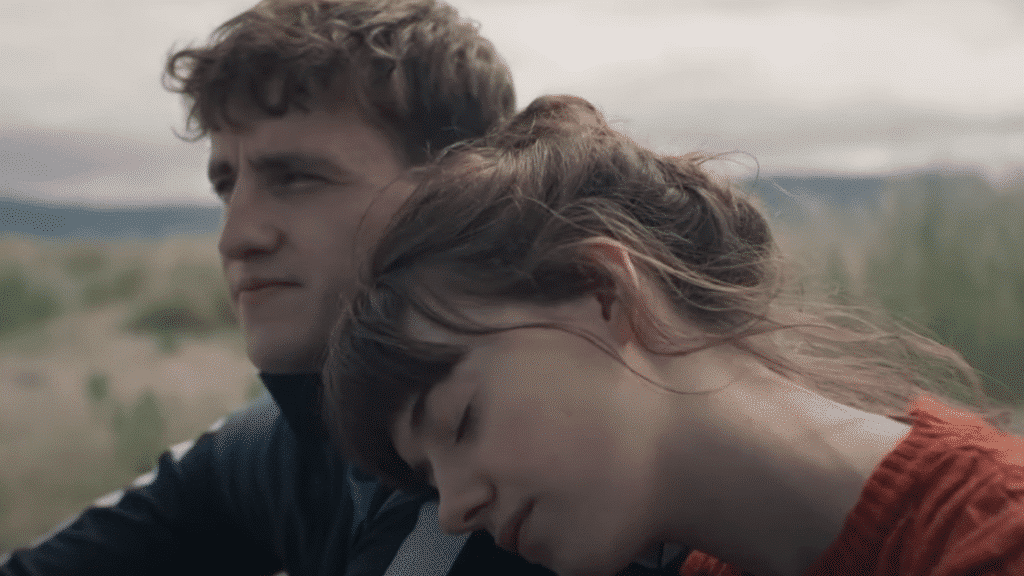
Normal People was a moment; a phenomenon. We rushed to buy it, read half, and feel satisfied just knowing the story. The now-famed novel by Irish author Sally Rooney was thrown into quiet fame following the success of the series. Of course, timing played its part. Amidst worldwide lockdown and collective isolation, we were drawn to television.
Even beyond that, Normal People endured. It wasn’t just the story that stayed with people, but the way it looked, sounded, and felt. We really rooted for Connell and Marianne’s white‑pasty romance. They became more than characters on a page; they were reshaped by the adaptation and morphed into something bigger.

Adaptations have the power to supersede the book, not conceptually, but in scope. We can attach new memories and feelings to the stories that stick with us. The attributes of a cinematic story lend themselves to narratives we care about.
Ostensibly, we like to believe that books inspire the content we watch, and when the writing truly resonates, it deserves its place in our cultural sphere. But if we look closer, we can see that the adaptation becomes the author of how we remember the book.
When the adaptation rewrites the memory
It can appear that adaptations guide our reading preferences. The bookshelves we fill, big or small, have evolved into miniature cinematic libraries. In examining other modern adaptations, we can see how movies constitute the definitive representations of media. André Aciman’s Call Me by Your Name (let’s call it CMBYN for convenience) shows us how films can become more ubiquitous than the novel.
When I hear the title, I think of Timothée Chalamet perched up against the fire and the gorgeous architecture of Crema accompanied by a vibrant soundtrack—not the author’s descriptions of the Italian countryside. It’s interesting to ponder Aciman’s view. He himself made it clear that he had apprehensions about potential changes to the world he had created but ultimately expressed fondness for the film.
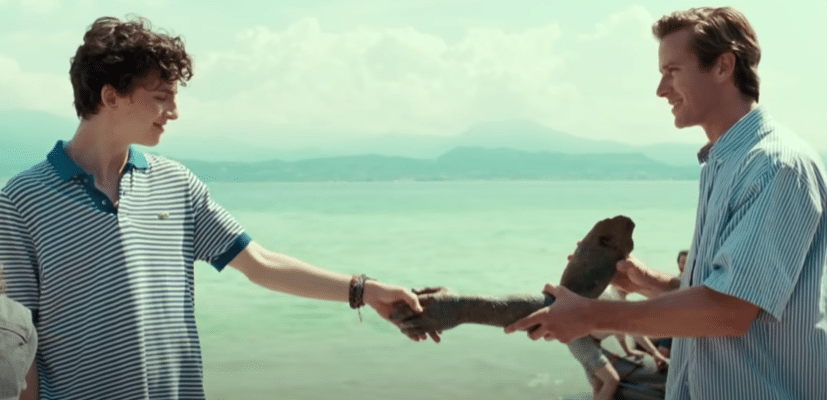
Sufjan Stevens’s raw emotional performance for the film will forever be tied to CMBYN and Aciman came to terms with this. He knew the story was no longer fully his, that it had moved into another space where the music, performances and visuals of Luca Guadagnino had altered his prose.
Stevens’s songs don’t sit in the background either; they intertwine with the scenes. “Mystery of Love” is part of our memory of the story. The soundtrack doesn’t overlay the film’s narrative; it connects with it and bleeds into how we experience the heartbreak somewhere in northern Italy.
Luca Guadagnino’s adaptation has taken precedent in our minds.
Adaptations are everywhere, even if we don’t always notice.
Embarrassingly enough, I fell victim to the very thing I thought I had been so perceptive of. With pertinent bookcase in full view, my family and I watched Poor Things last week. I had naively thought that this 2023 picturing starring Emma Stone was an original work. I devoured the film, blissfully unaware that it was in fact a book that my own bookshelf had been babysitting.
I was told by my younger (smarter) sister that Poor Things was an adaptation of a novel. As a supposed Glaswegian, I was embarrassed not to have known that the film was adapted from the seminal novel by the famed Alasdair Gray. I’m living proof of how easily we can accept adaptations as the definitive version of a story.
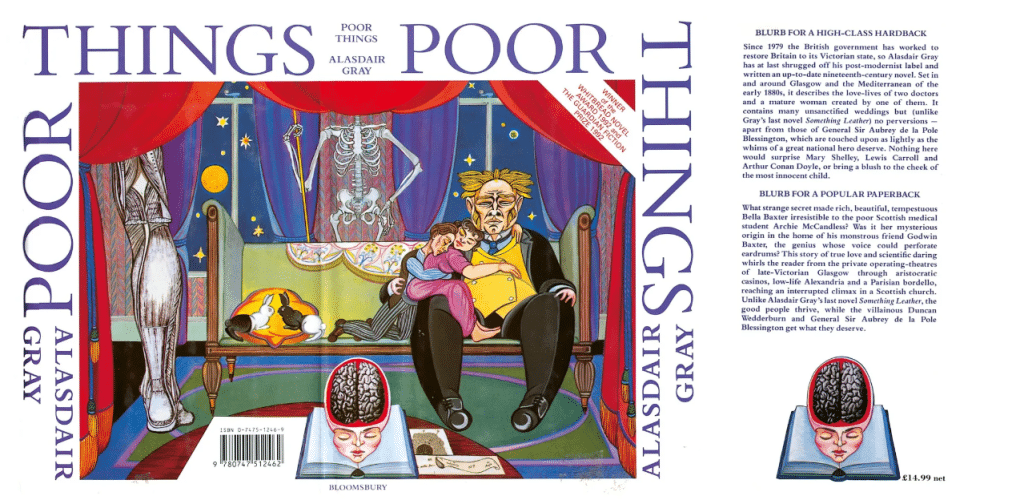
Without meaning to, we often treat the screen as the source. But adaptations can still spark curiosity. They can push us to trace things back and to ask where the spectacle came from in the first place. Yes, adaptations can sometimes overwhelm or even eclipse the original ideas they’re based on. Yet it makes me wonder: Is there a strange symbiosis between screen and page? If so, does it have to be a bad thing? Stay with me for a moment.
So…what’s left on the shelf ?
It’s kind of, sort of, a good thing. What my embarrassing viewing of Poor Things demonstrates is that adaptations give us a newfound capacity to read. My first instinct after watching the film was to run out and find a copy of Poor Things. There’s almost a novelty in this way of consuming content. We now have multifaceted ways to engage with the narratives that intrigue us.
Adaptation, in a literal sense, is a susceptibility to change. The ideas stemming from novels are clearly brilliant enough to deserve more. Although there is an arguable saturation of fiction, each example has inspired many of us to read the stories we love in a new light (me included!).
Adaptations can redefine how we analyze books. Was said adaptation good? Did it deliver on what the book didn’t? An expanse of questions arises if we consider how success is achieved from adaptation. It makes us appreciate the transition from shelf to screen more.
I began drafting this article as a staunch opponent of everything I’ve just argued—but throughout the writing process, I have gained a stronger appreciation for adaptations. They introduce us to ideas we might not have otherwise seen. Be curious, and have another look at the bookcase…if you want.