
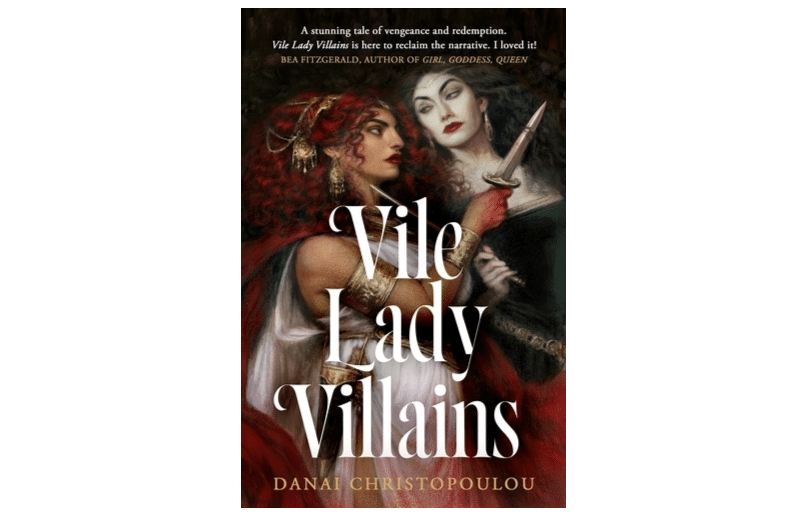
This is a book about many things. The existential horror of discovering that you are a figment of imagination. Violence as a love language. The villains fighting for their own Happily Ever After. But fundamentally, this is a story about the importance of taking your future into your hands.
The Premise: meet our Vile Lady Villains!
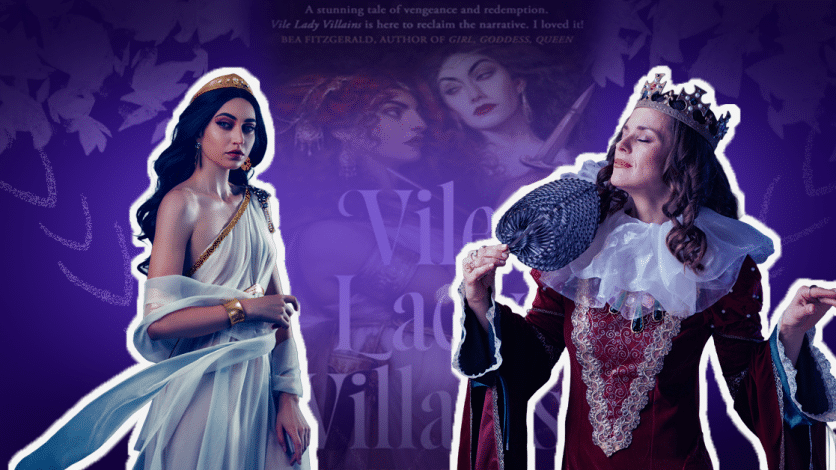
In plainer terms, this story is a crossover between Aeschylus’ Agamemnon and Shakespeare’s The Tragedy of Macbeth. A rewrite that tries to give Lady Macbeth and Klytemnestra their own happy endings, by plucking them out of their original stories and getting them together.
Together, Lady Macbeth (now calling herself Anassa) and Klytemnestra (not calling herself Claret) must travel in the realm in between worlds. All while running from the ghosts of dead stories hungry for blood, a god that should have died long ago, and supernatural phenomena straight out of a horror movie. They are isolated, and alone on this journey of self-discovery and survival, save for the ambiguous aid rendered by the Fates and William Shakespeare himself.
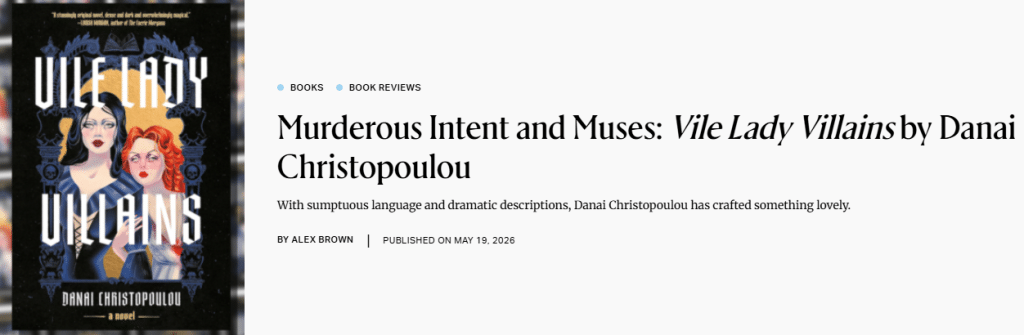
While the two women start out as reluctant allies, their dynamic morphs into a romantic relationship in the second half of the novel. The story ultimately concludes with a hopeful, if ambigous ending for the lovers. Their final words of the story conveyed in a letter to Shakespeare bidding him farewell, among other things.
The source material
Now, for those of you unfamiliar with the source materials, I will be giving a brief summary for your convienience.
Agamemnon by Aeschylus
Agamemnon is about the family of the King Agamemnon (who was one of the leaders of the assault on Troy, as depicted in the Iliad.) Klytemnestra, Agamemnon’s wife, kills him as he is bathing shortly after his return from Troy, in revenge for his murder of their daughter, Iphigenia. In the original story, Klytemnestra goes on to marry Agamemnon’s cousin, before being killed by her son, Orestes, in retaliation for his father, Agamemnon’s murder.
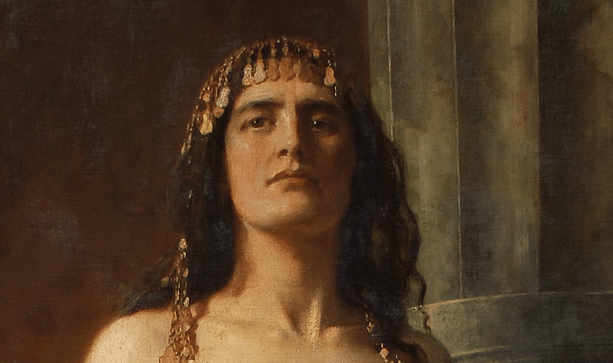
However, the Klytemnestra we meet in Vile Lady Villains is pulled out of her world just after killing Agamemnon. It is shortly before she would have spoken these lines that she is pulled into the place between stories.
“And the dark sprinklings of the rain of blood
Fell upon me; and I was fain to feel
That dew—not sweeter is the rain of heaven
to cornland, when the green sheath teems with grain”
Aeschylus, Agamemnon
A fact that is clearly reflected in some of the earliest lines she speaks in the book: “I rise from the rusty waters, hair dripping with my husband’s blood. … Sticky, hot droplets coating everything, even the chamber walls’ floral patterns, the mighty lions painted on them blurred, weeping. … My knife has run its circle round Agamemnon’s neck, bringing forth blood like rain to sate the thirsty wheat fields of my heart,” come on the fifth and sixth pages.

It is this image of a woman drenched in crimson that earns her the moniker of ‘Claret’ from Lady Macbeth.
The Tragedy of Macbeth by Shakespeare
The Tragedy of Macbeth, by contrast, is about the Lord and Lady Macbeth, and how their desire for power drives them to ruin. Of course, things may have gone very differently if they had not believed the three weird witches prophesy. It is just as the Chorus say in Agamemnon, “The wage of wrong is woe.”
Lady Macbeth
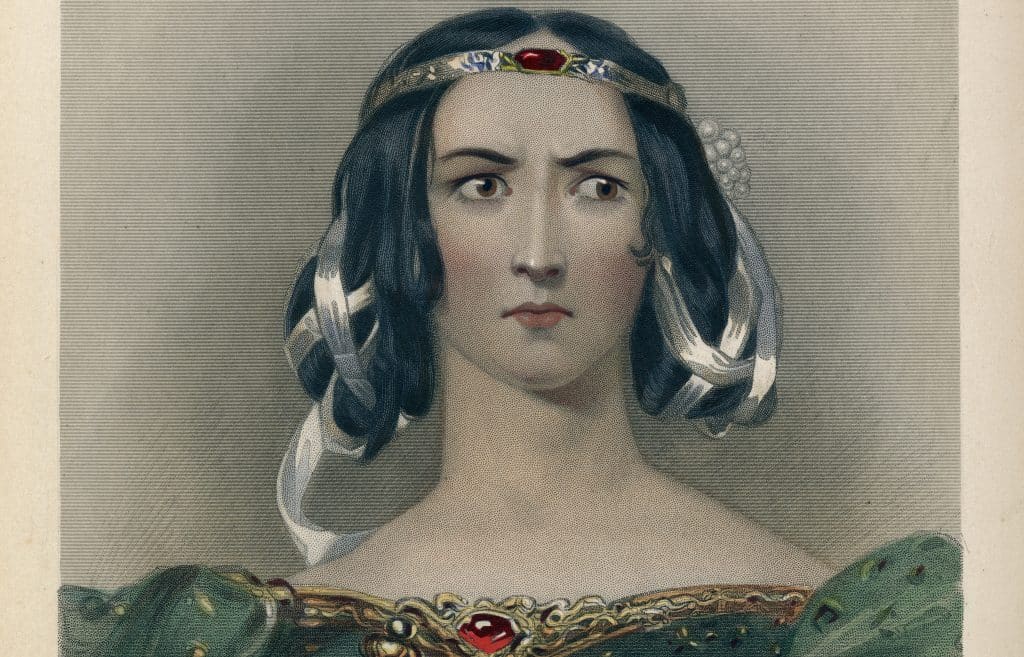
The Lady Macbeth we meet has already stained her and her husband’s hands with blood. But, she is ferried into an otherworld as the trees consume her castle, before she has the chance to meet her demise. The Lady we meet is just as power hungry as she ever was, her earlier sentiments of
“The raven himself is hoarse
That croaks the fatal entrance of Duncan
Under my battlements. Come, you spirits
That tend on mortal thoughts, unsex me here,
And fill me from the crown to the toe top-full
Of direst cruelty. “
and
“Bear welcome in your eye,
Your hand, your tongue. Look like th’ innocent flower,
But be the serpent under ‘t.”
From Act 1, Scene 5, are likewise mirrored in her later statements in the book. “Hope snakes around my ribs like jasmine, sweet and terrible” on page one-hundred seventy-one, and “His ears are red like ripened fruit. I should sever them and plant them in his garden, see what colour flowers will sprout from them. See if they’ll do a better job at listening to his creations’ cries for help” on two-hundred three.
It is this viciousness, the execution of her desire for Queenhood that earns her the given name of Anassa from Klytemnestra.
Genre
You’ve got an idea of who our heroine villains were now. So, lets take a look at who Christopoulou molds them into.
Romance
Claret and Anassa are both violently intense. Where Anassa wields her words as blades, Claret brandishes her knife in the face of gods. Both have blood on their hands, and before the story’s end, both will have more.
This conniving duo wield romance as a weapon. All the while, aware that it means leaving their back open to the other’s blade. But by the end of this story, they would willingly take that blade, if only it meant they could keep the other close. “I reach out with my devil’s hands and cup my demon’s face, leaning down until our lips are but a feather apart. … I push her back against the carriage, falling into her kiss like it’s a knife” (p. 273).
A sentiment that the book makes sure to drive home with multiple sex scenes between them in the second half of the book. The descriptions of it were a bit too flowery for me, it was otherwise decently written.
Horror
While their intense personalities and appetites make them perfect for one another, their volatile natures are also vital to their survival of the story’s more unsettling scenes.
Now, the horror of this novel is subtle (mostly) and might just be my favourite thing about this book. Aside from the cadence and diction of the narratorial voice, of course. I don’t want to spoil any of it for you here, but I will say that both characters, especially Anassa face as series of trials. These trials (in the fashion of a typical Hero’s Journey) test their personal and emotional limits and allow them to develop as characters. These result in changes that even the character’s themselves recognize.
In that respect, I think we see more meaningful growth from her, as she is the primary protagonist. Claret, regrettably, takes up the role of a secondary protagonist. But she does have her moments of lyricism.
“I drop the torch. It fizzles horribly, a smell like fumes from sacrifice filling my nostrils; the smell of burning blood.
Finally, the torch goes out.
And the darkness starts to whisper.”
p. 79, Vile Lady Villains
The prose tends towards the poetic and literary regardless of which character’s headspace we are in. But I must say that Claret’s voice has a sort of bold bluntness to it which I find immensely enjoyable. The breather you get with her short punchy lines from long flowy prose should not be underestimated. It’s as Claret says on page one-hundred twenty-one, “Let this world’s horrors maintain their forms, for once. Let deadly waves be waves instead of long-dead daughters, meant to drown your heart in sorrow. Let threats resemble threats.” Extended metaphors and similes are all well in good, but they are most effective when used in conjunction with other techniques.
Creativity and imagery
Of course, that’s not to say that metaphors aren’t important. The one thing that this story truly excels in is it’s vivid imagery via extended metaphor, after all. For instance, the brilliance of Claret’s frequent comparison of Anassa to a corvid, even unknowing of her specific magical connection to the birds. “I cast a sideways glance at her … My little blackbird has hatched a complicated plan” (p. 259).
This pairs excellently with Anassa’s characterization of Claret as wolf-like. “Our crimes have mingled on my skin, her kills and mine. … I tried so hard to wash the blood of … all the needed deaths I sheparded, only to meet a woman-wolf who relishes in the reminders of her actions” (p. 30-31). And like actual wolves and ravens, they work together symbiotically, a predator and a scavenger, with the scavenger leading the way. It is the perfect analogy for their relationship, but hardly the only reoccurring image through the text.
Another central literal and figurative image throughout the text is that of drowning. This following quote from page one-hundred eighty-five is my favourite example of it’s figurative use. Anassa’s inner monologue declares she has “come across a shipwreck, but instead of schools of swollen sailor corpses, nibbled on by little fish, instead of wooden planks covered with plankton, every surface around me drips with words; in words it drowns.”
Other motifs
Another image frequently associated with Anassa is the forest. This works well in parallel with the other major imagery connected to Claret, that of thunder, blood and flame, sharp metal and hungry teeth. For better, or for worse—as in the case of one particularly vivid line on page two-hundred seventy-one. “I imagine Claret’s cloak, her hair, glowing like a bloody candle while she screams and melts and blazes, leaving only ash behind.”
Speaking of description, there’s one more setting from the book that I just have to show you all. “The moons are lower in the sky now, a pearly chain inching closer to the sea, about to be absorbed by the horizon. The stars have all but been snuffed out, the skies above swirling in pink and silver hues, the rocks around us cast in kinder shadows” (p. 54).
My favourite elements
But I have to say, my favourite motif has got to be the consistent conflation between violence and eroticism. It’s just woven through the other imagery so ingeniously. And it makes perfect sense, within the context the imagery provides. Afterall, what do a wolf and a raven do together, if not kill? What is a flame in a forest, if not death and new beginnings? What purpose has a blade, if not to rend flesh from bone? What death is more violent and romanticized than drowning? There’s just something about the mixture of danger and vulnerability in the lines that I find very appealing. I’d be willing to bet that Claret would agree. “What could have brought on these impulses, when I was thinking only of her neck, and my knife, and how the two should kiss?” (p. 16-17).
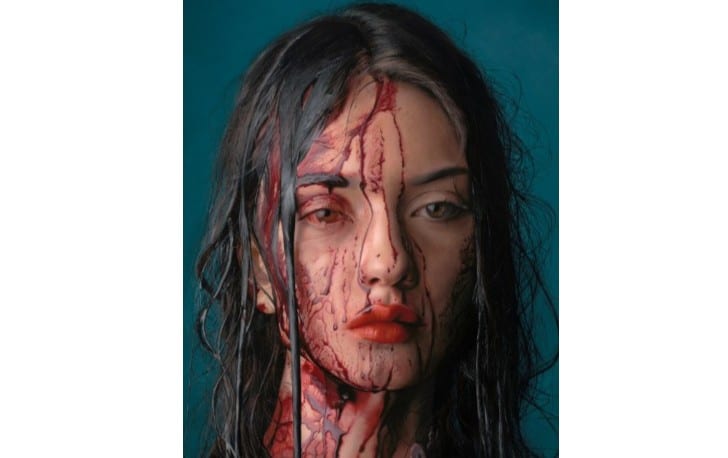
Now, let’s get into my favourite part of this book: its rich sensory engagement, and the poetic quality of the writing!
Senses
There’s one thing I noticed immediately about both the narrative and character voices of this novel. They both do an excellent job engaging the sense in new and vivid ways. Something I think you will have noticed from my chosen quotes already. The story works to incorporate many senses. Especially those which don’t lend themselves to the written word as easily. This really helps the descriptions stand out.
My top tactile sensation pick comes from page three. When Anassa notes that she knows “there is truth in the witches’ words. It’s a peculiar feeling, like a beak pecking at my bones, a constant soothing rhythm.” My favourite multi-sensory description comes on page eighty-five, also coming from Anessa. There “are too many voices to detangle, a cacophony of statements reverberating through [me] clogging my nostrils and my eyes.” Finally, my favourite taste description (not related to the erotic scenes) comes on page eighty-nine, thistime from Claret. “I don’t know what death tastes like, but it can’t be this. It can’t be sweeter than ambrosia, stronger than fig wine. Not when I’ve spilled so much warm blood while still alive.”
Sonic qualities
Now on to the sonic element! While it might not be something you notice at first, because it flows so naturally, Vile Lady Villains is drowning in alliteration arranged in rhythmic sequences. It gives certain lines a particularly memorable quality to them, and they sound absolutely delicious when read aloud. My two favourites would be firstly the description of one of the fates from page sixty-one. “This time [Aisa’s] tiny lips do move, revealing teeth like crescent moons, sinister and sharp.” And secondly, Anassa’s description of Claret on page two-hundred twenty-one. “[She is] a sunlit carnage, a sword that I would guide straight to my heart and let it pierce it, a holy heresy of hips and hair”
Closing comments
Now, as you may have noticed, I have only pulled quotes from the first three quarters of the novel. That was intentional! I sincerely hope that you all will go check out this book after reading this review. This is a decent debut novel from a writer who is clearly passionate about their writing and their message. They’ve clearly put a lot of effort into this. While I can’t say its my favourite debut novel of 2026, I do think it makes for an interesting read. Especially for a nerd like me who likes reading meta narratives. And, fiction about the philosophical implications of story-telling (in a reader-friendly package) a la “Is the realm of writing also the realm of death? Are words dead things, stacked upon one another?” (p. 162).
Of course, if you’re not in the mood to ingest a heavy dose of in-your-face feminism and existential crisis by-proxy with a dash of saphic erotica and magic, that’s perfectly understandable. Maybe this just isn’t the book for you. But hey, if you’ve made it to the end of this review, you’ve got to be at least a little interested. Right?
Now, if that sounds like a little much for you at the moment, but you are looking for some good magical horror centering women and girls, I would highly recommend You Did Nothing Wrong, Teenage Girls Can Be Demons, and Tantrum. After all, there’s no such thing as too much magical horror! Whatever you decide, I wish you the best of luck with your next read!