
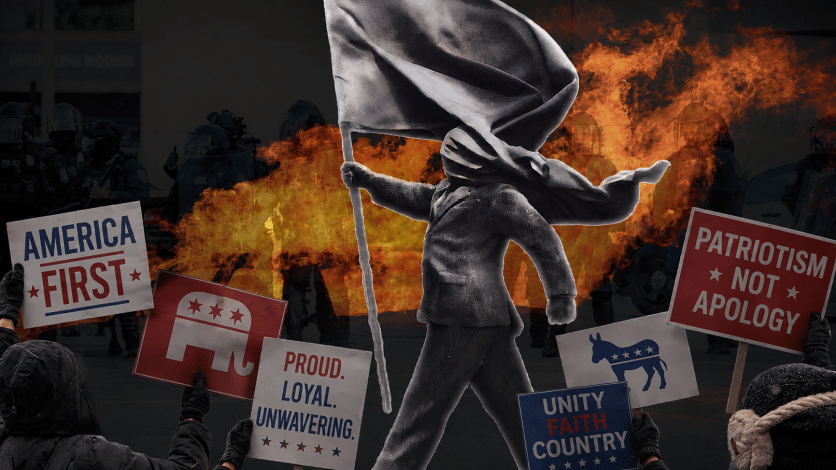
In the early hours of Wednesday, April 29th, a new statue joined the collection located in central London near Waterloo Place, St. James. The pieces previously erected here depict military figures, lords, dukes, and more, conveying ideas of military strength and imperialism. But this new statue seems to tell a different story.
A man in a suit and tie marches confidently forward, holding out a large flag in front of him. The flag’s excessive size causes it to be blown in his direction. It obscures his face, blocking his vision and preventing him from seeing that he is about to take a dangerous tumble from the pedestal.
While the other statues nearby promote ideas of justice, prestige, bravery, and an overall sense of superiority, this new statue stands apart. Chaos, a lack of direction, and a dangerous pull toward blind faith seem to be the theme here.
So what exactly is this statue trying to say? What context regarding the artist and our current sociopolitical environment might paint a clear picture of this artwork’s message?
To understand all of this and more, we first need to learn about Banksy – the elusive artist behind this statue, as well as many other widely recognized works.
Who is Banksy?
If you’ve ever seen this iconic artwork of the girl with the balloon, you’ve seen Banksy’s work.
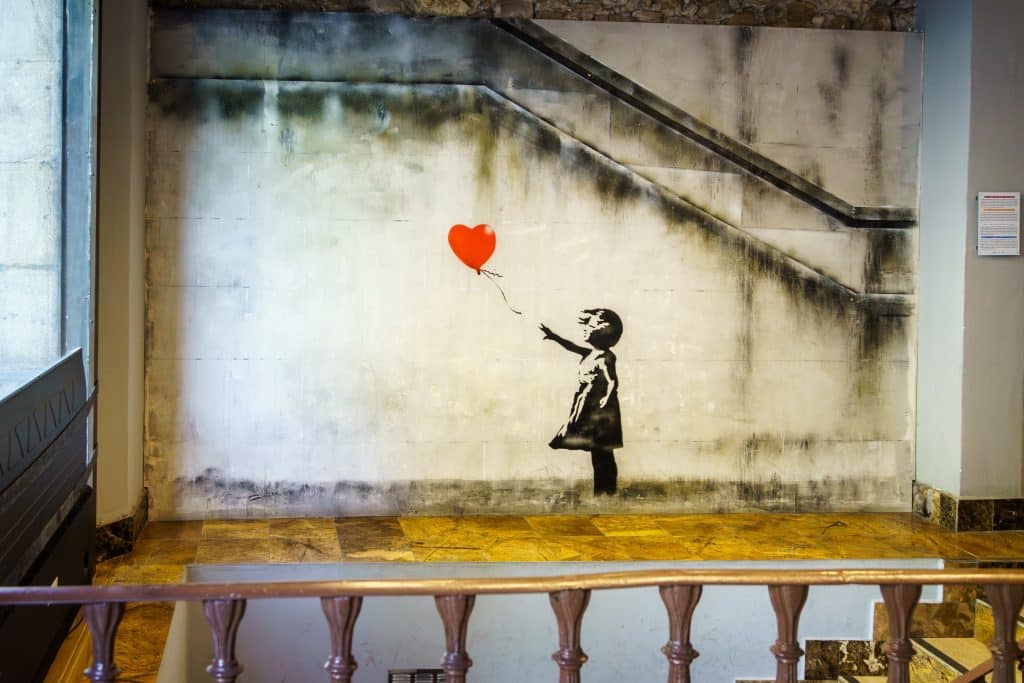
Banksy is an elusive – and up until just recently, anonymous – artist who uses primarily stencil graffiti art to make a statement, ask a question, or tell a dark joke. Active since the 1990s, his art has caught the attention of a growing fanbase of people who appreciate his ability to talk about a range of complex topics through simple artworks that pack a punch.
While Banksy’s true identity was recently uncovered, I will avoid describing him much further in this article. Part of what makes his art so powerful is that it stands on its own – not meant to reflect a single person’s thoughts, boost their status, or build upon their fame. The art is meant to live a life of its own, and Banksy’s intention wasn’t meant to be revealed.

I believe that to truly understand his most recent work, we must preserve his anonymity. At least for now.
With that out of the way, let’s take a closer look at the statue.
Blinded by nationalism
While most of Banksy’s art is graffiti, this most recent work takes a much different form. To me, it feels as though the art had something so important to say that it broke free of a two dimensional form and took its place among all the other statues already firmly planted nearby.
Two posts are up on Banksy’s instagram page that feature the statue. The first is a video of it, the second is a painting done by the artist known as “Pete the Street.” Neither post explicitly reveals the meaning of the statue, but the comments seem to be generally in agreement.
The widespread consensus is that the man in the suit represents nationalism – or more broadly, blind faith. He is too sure of his allegiance to question it, and too wrapped up in his own convictions to look at anything else around him. This is what will ultimately lead to his demise.
However, what this man’s faith is devoted to is not explicitly mentioned. The flag bears no colors or designs that make it specific to any one country, idea, or group.
A reflection of the times
While I do believe that this blank flag is meant to represent any that might fit in its place, I also think it was most likely inspired by something specific. When thinking in terms of our current political climate, we live in an age of extreme polarization. The identity of one group is often built almost solely around the idea of NOT being something else.
Voters are encouraged to demonize those who are different, and conditioned to believe that questioning the ideas of those within their own group is a betrayal. In the world of politics, it’s not uncommon for people to adopt the “my way or the highway” kind of thinking that nationalist ideas require.
This phenomenon can be understood as party to party conflict – in the U.S., this is most evident in the case of Democrats and Republicans – but it’s also relevant internationally. As intolerance for immigration becomes increasingly hostile worldwide, and white supremacy appears more tolerated, nationalism takes center stage.
The figure in Banksy’s statue reminds many observers of a politician due to the inclusion of a suit and tie. This is another element that speaks to the piece’s potentially political inspiration.
Public responses
Any Banksy fan is well aware that one of the most defining elements of street art is impermanence. Its beauty resides not in a gallery, museum, or wealthy collector’s home – it lives with the people. Be it due to time, weather, or those who find the art disruptive, street art is rarely long for this world. It is meant to be appreciated, and then lost; often part of its meaning might be gained through its removal.
To better understand the significance of Banksy’s new statue, I reached out to Rebekah Beaulieu, an expert in museum issues and the CEO of the Taft Museum of Art in Cincinnati Ohio.
“Street art is inherently place based: it de-institutionalizes the piece from the museum or gallery space, establishing art’s place in our everyday world,” she says. “Banksy’s practice to install works covertly means that a site formerly devoid of art now is defined by its presence.”
As a result of this dynamic, Beaulieu explains, street art can often be confrontational. You don’t have to go somewhere to see it – it’s right in front of you. “Because street artists place their art in our everyday environment, they force people to engage with art on our daily commutes, while taking a coffee break or taking a walk.”
Unlike most street art, this work is not two dimensional. It towers high above onlookers and is planted firmly in a central position. When I first read about this artwork, I expected it to be removed quickly, or viewed as a nuisance in the public area it was installed in. I was happily surprised when I realized I was wrong.
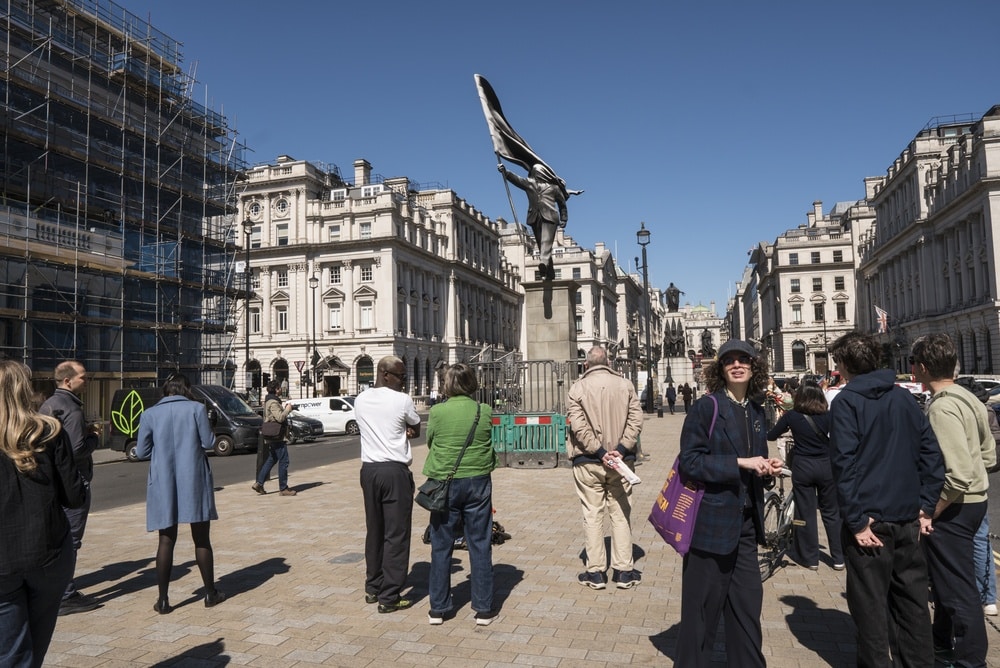
Banksy’s statue has its critics, but has generally been met with great enthusiasm. If my theory about what inspired it is true, this may be because people are craving artwork that represents what they’re feeling in the social climate around them.
The statue is currently still standing where it was placed, and London authorities have made no plans for its removal. To me, this feels like a testament to the public’s love of the famous yet elusive Banksy – would other artists have gotten away with doing the same?
While the man in Banksy’s video didn’t seem to like the statue, others have described it as “genius,” “important,” and “powerful.”
As the instagram user @theonlyaurora commented, “If you don’t like it, either you don’t understand or you see yourself in it.”
What we can learn from it
As with all of Banksy’s work, this piece commands our attention by calling into question a phenomenon we may have observed before. How should we feel about it? Assuming that this statue is about nationalism, blind faith, and dangerous allegiances, how can we learn from it?
To me, one of the most obvious messages we can take away from this is the importance of de-centering our pride.
“His vision is obscured by the flag, signifying that he is blinded by patriotism, perhaps government messaging; the man is not thinking for himself. Because he has traded vision and clarity for blind trust in the State, he is doomed to fall into the unknown.”
– Rebekah Beaulieu
To me, it feels like this man considers his value as an individual to be intrinsically tied to what this flag represents. When our identities become intertwined with our allegiances past the point of humble pride, we are fated to follow these alliances to dangerous ends.
To separate oneself from something once inspiring, now turned extreme or dangerous, we need to exercise a generous amount of humility. Turning on something we once so vocally supported can often feel like a sort of self-inflicted humiliation, the possibility almost unbearable to consider.
However uncomfortable, Banksy’s statue begs the question: what do we put our faith into, and are we becoming too blinded? Is it time we take a step away from our flags to look around us? Or are we already shifting our balance into a dangerous next step?
Whether or not this artwork is removed any time soon, its message has already been spoken loud and clear. All we have to do is listen.
If you want to read more about the art everyone’s talking about, check out this article about art to see in NYC this spring.