
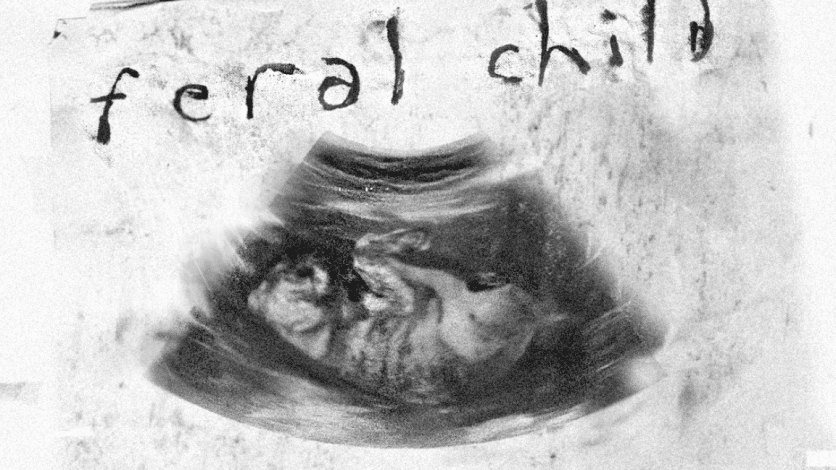
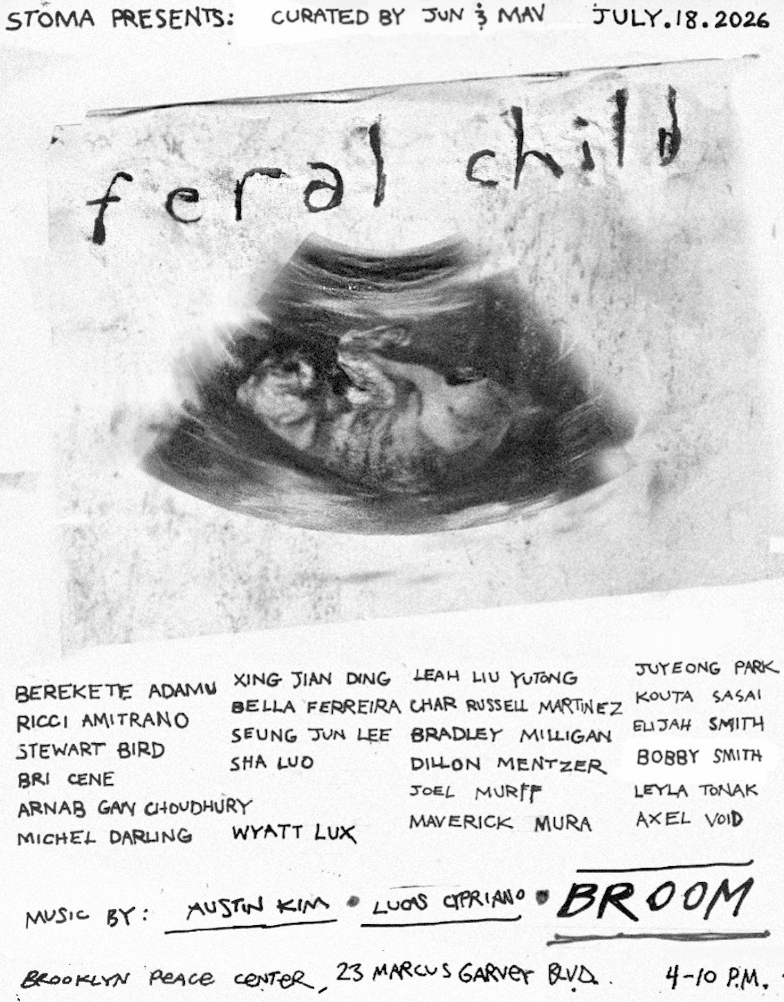
It’s 4 in the afternoon, and there’s a summer storm hanging over New York City. It’s dismal weather, but I’ve made my way to Brooklyn anyway, because there’s no way I’m missing tonight’s opening. At least, not when its title has been stuck in my head all week. Feral Child is a new group art exhibition that first caught my attention through Instagram. Beneath a poster of a warped ultrasound, the gallery’s curators Maverick Mura and Seung-Jun Lee had written a curatorial statement that opened with the phrase: “A tiger scratching at the walls of its cage.” Their writing piqued my interest; I was sure I had stumbled onto something deeply resonant. I can’t speak for everyone, but I get the feeling that we all feel a bit like the tiger these days.
A Holy Atmosphere
Feral Child is hosted in the Brooklyn Peace Center, a sleepy church-turned-community-hub on the border of Bed-Stuy and Williamsburg. Oddly, an old church makes for the right setting for an exhibition celebrating artistic detachment. As the rain breaks, musty sunlight floods the rafters, washing the air in a holy stillness that conflicts with the animalistic art hanging on every available patch of wall.
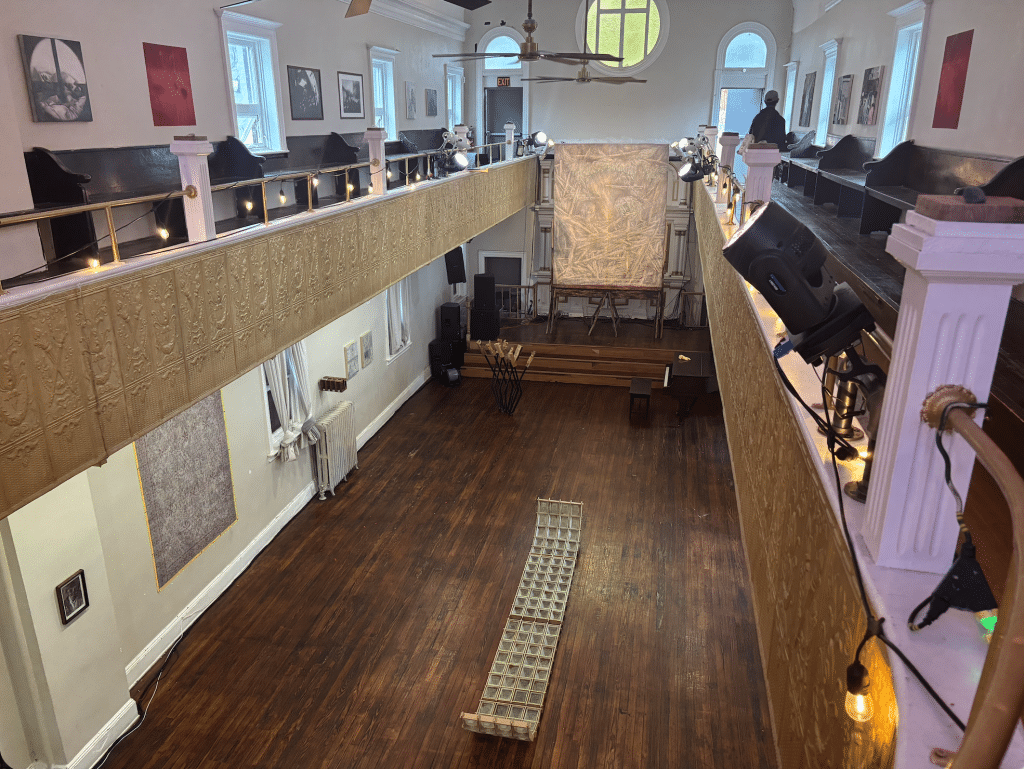
It takes a conscious act of detachment to truly appreciate the exhibition at all — at least, the paradox of it. Inside, you get the sense that there’s a hazy alliance being honored between art, bodies, and the Holy Spirit itself. I leave my umbrella at the door, half-preparing myself to be saved.
True to its name, Feral Child is a show that feels, at all times, visceral. The art ranges from massive chimeric sculptures to frenzied graphite sketches. Each and every piece oozes with presence, a definite weight. Even on my first walk-through, I feel the effects of this cohesion, the indescribable impact that comes from each piece building toward a larger vision.
Sticking to the Philosophy
On the first page of the program, Mura and Lee highlight the idea of “Becoming Animal,” an artistic philosophy made popular by another creative duo, Gilles Deleuze and Félix Guattari. Crucially, “Becoming Animal” doesn’t mean acting like one. Instead, it serves as more of a call to return to the raw, the nomadic and the constantly moving. In a continued show note, curator Seung-Jun Lee writes, “Detachment is not withdrawal, it is a shift in perspective. It allows the artist to step outside inherited ways of seeing before re-entering the world through a more personal encounter.”
By all accounts, this would seem like a lot to keep in mind, especially going into an exhibition for the first time. Yet, once again, the show’s curation deftly clears up any of my confusion. This isn’t something you can truly articulate, it’s just something that’s felt.
You can sense that there are dozens of overlapping inspirations, but as you move between painting and sculpture, you find yourself holding onto a sense of understanding. Tonight, everything is speaking the same, impossible language, and that’s saying something considering there are 22 different artists on display.
Meet The Artists
I get to talking with one of them, a sculptor named Elijah Smith. He’s an easy-going guy, a student at Cooper Union, and the man behind two atavistic forms. We’re standing in front of his first piece, “Hidden Cost of Sculpture.” To me, it looks like a cross between an anvil, a vice, and the moribund coin-operated binoculars you see scattered all along the Brooklyn Heights Promenade.

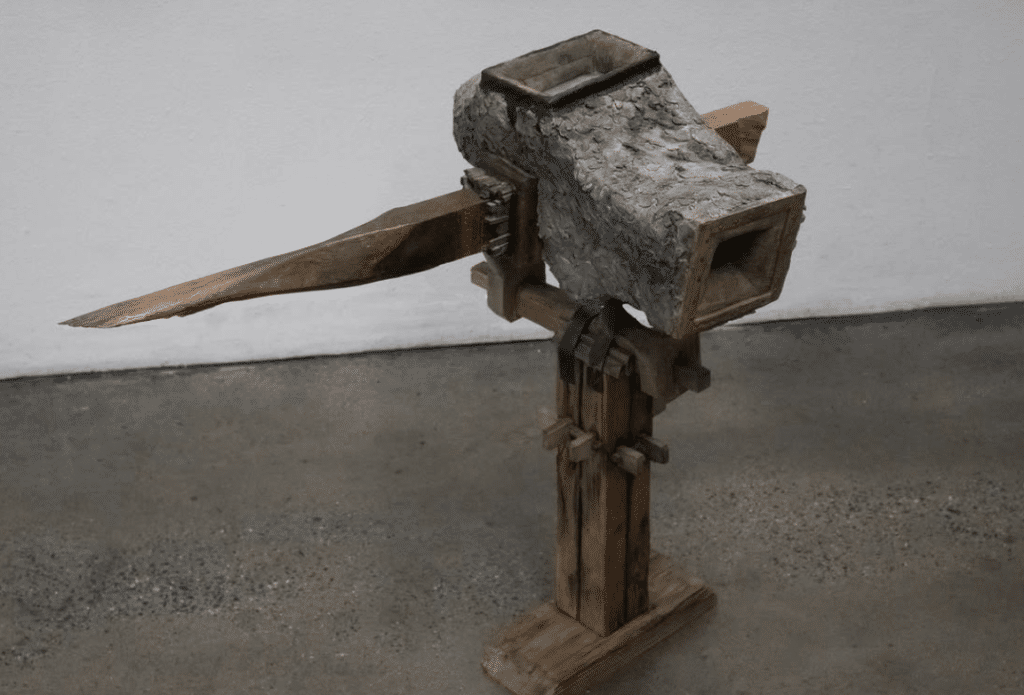
“In one crit, people were actually debating whether this counts as found art,” Smith says, gesturing to a sunken-in square on the top side of the piece. “Like, they were saying that this might be a re-used picture frame… As if this would ever just end up this way.”
You can see why they’d be inclined to wonder. Smith’s art sits right on the tipping point; almost anatomical, not quite utilitarian, and heavy above all else. Smith frequently works with cement, steel, and plexiglass, but, I mean, his piece is figuratively heavy as well. There’s an internal weight in Smith’s work, a promise of complex internal mechanisms that remain, as of yet, unseen.
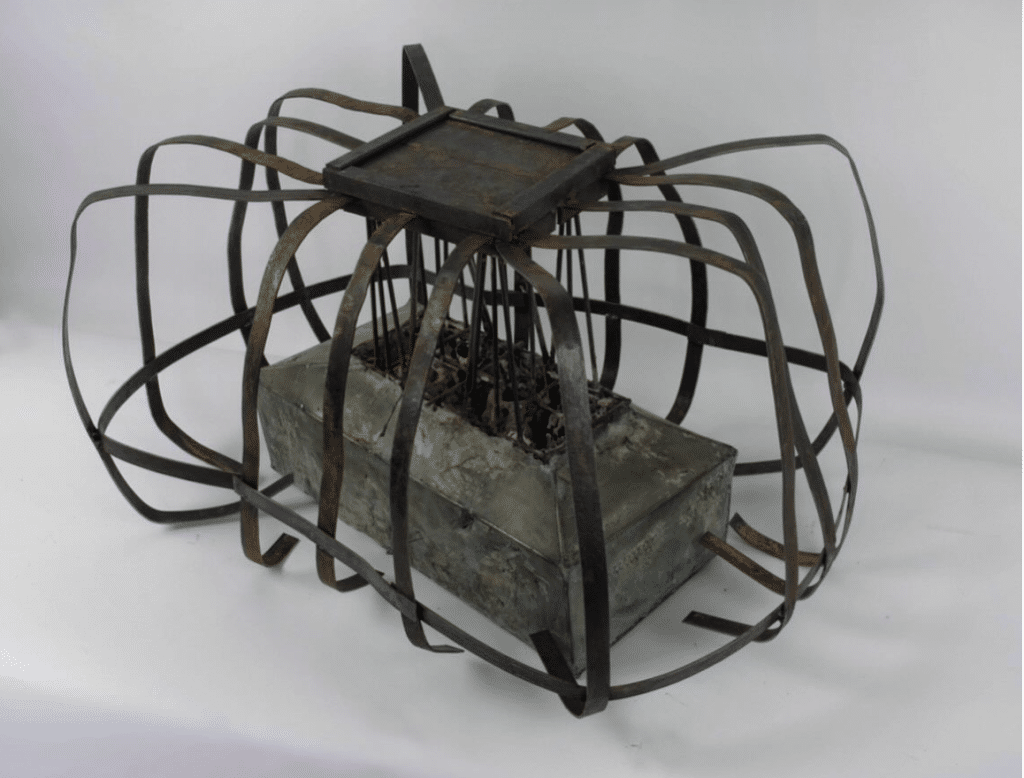
I still have the words Feral Child swirling in my head, and, looking at Smith’s piece, I imagine these might be the kinds of tools that would come in handy in some untamed, undiscovered landscape. An artist friend once put me on to Gary Larson’s finest comic: “Cow Tools.” It’s a bizarre one-panel comic, depicting a cow standing in front of obviously misshapen, unidentifiable tools. In the best way, Smith’s work doesn’t feel far off — arcane with a lingering sillage of purpose.
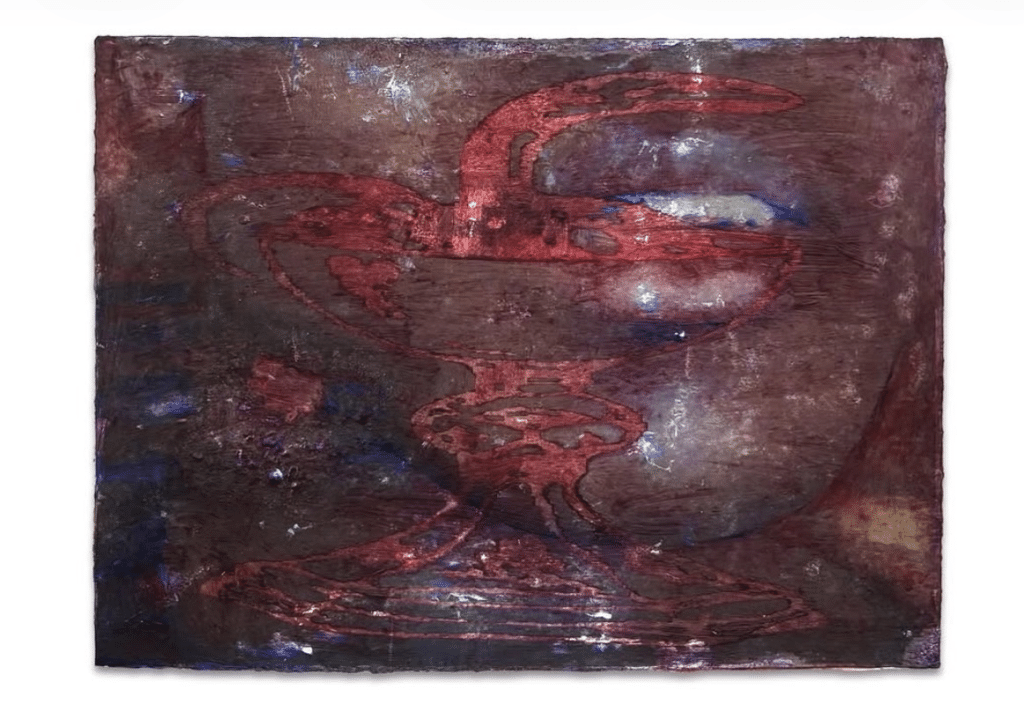
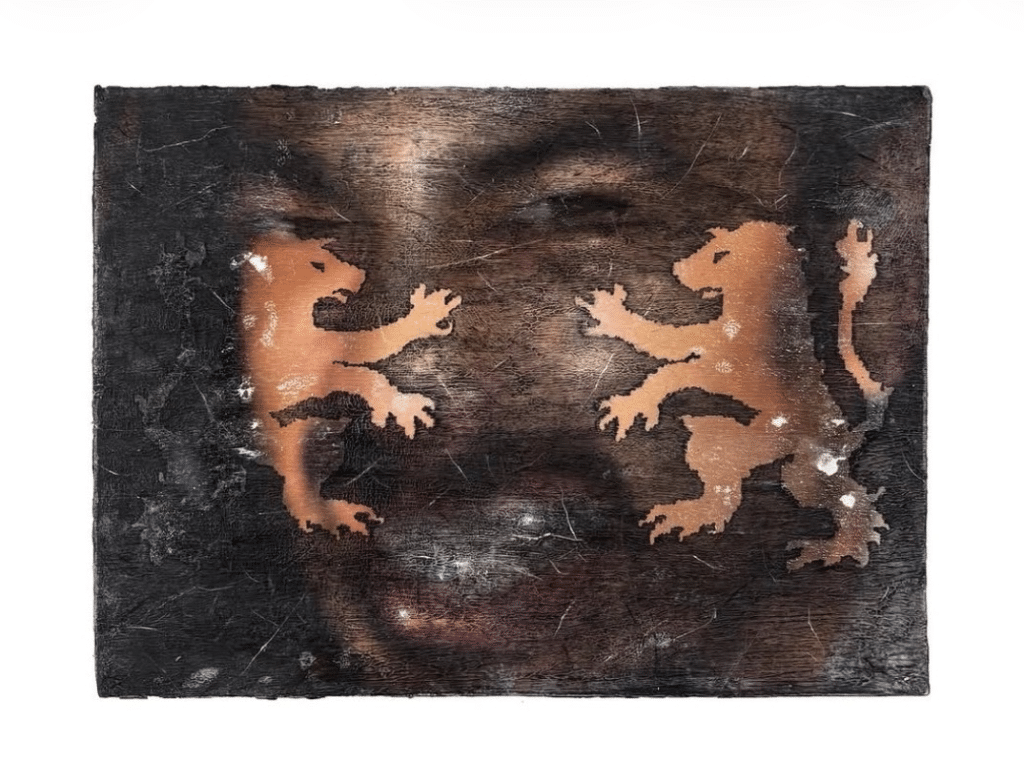
On my second lap of the gallery, I get a little too excited having finally spotted the two pieces by Brooklyn-based artist, Michel Darling. I’m new to most of the artists tonight, but I’ve loosely fan-girled over Darling’s work for the better part of 3 years. His pieces for Feral Child include a pair of paintings titled La Sex and La War. They depict semi-blurred, scratched-out faces, superimposed by heraldic lions. The medium is listed as, “Aluminium, steel, inkjet, acrylic, oils… and paper mounted on a wood panel.”
The Featured Work
What can be said about these pieces? You try explaining the magic of seeing an artist’s work in person — let alone an artist you admire. The feeling is somewhere halfway between tracing the lines on your own palm and meeting an A-list celebrity. There’s a sense of familiarity; an, Oh-I-know-you-ness to a painting you’ve raked over countless times before. Only, now that painting is really right in front of you. You’re able to feel emotion in every scrape. You can catch the slightshine of aluminium. It’s as overwhelming as it is grounding. You catch yourself feeling grateful.
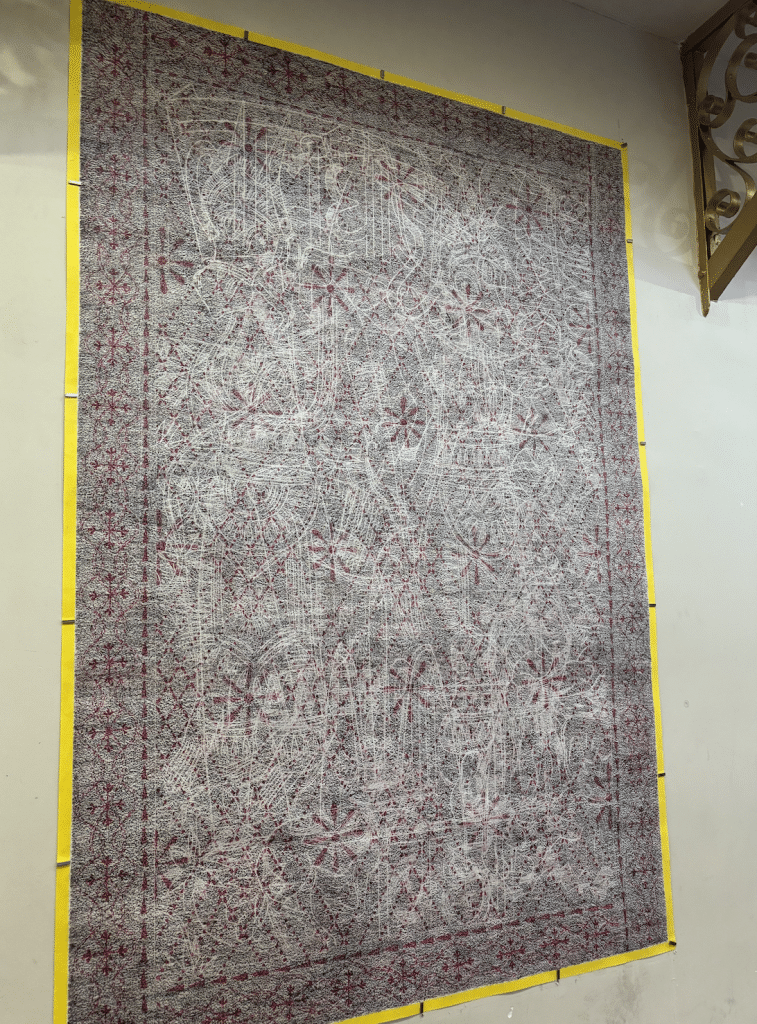
Elsewhere in the gallery, there are two sprawling pieces by Arnab Gan Choudhury which hang like cryptic tapestries. These are genuinely vast pieces, covered in complicated patterns, overlapping to the point of delirium. What’s more baffling is that these pieces are done almost entirely in crayon.
Debris (#), a piece by Bradley Milligan, also caught my eye. It’s been tastefully arranged along an uneven wall, with 27 panels set up in rows of threes. These multi-color panels function as a catalog of Milligan’s day job. Essentially, by collecting the loose detritus, joint compound, and automotive polish, Milligan establishes a set of abstract images, each one tied to his own physical labor. Some are more interesting than others — the roundel of a dart board, a sagging American flag — but it’s their arrangement that sells the whole thing for me. Mura and Lee chose to set these up, not on an uninterrupted stretch of wall, but along the natural angles of the Brooklyn Peace Center. As a result, the work lives as a sort of industrial moss, always creeping a little beyond its enclosure.
I make a point to meet the only photographer in the exhibition, a sweet kid named Dillon Mentzer. His two pieces are both monochromatic city-shots, obscured to the point of abstraction. Again, I can feel that same weight. It emanates from Mentzer’s shots just as it did Smith’s sculpture. In passing, I think: what a good choice it was to frame these photos with wood. It adds something to the work — depth without end.
Mentzer is eager to explain his process to me. For the photos, he utilized unconventional tools such as a fish-eye lens, tape-mounted onto a Nikon L35AF, or the delightfully ambiguous “glass block.”
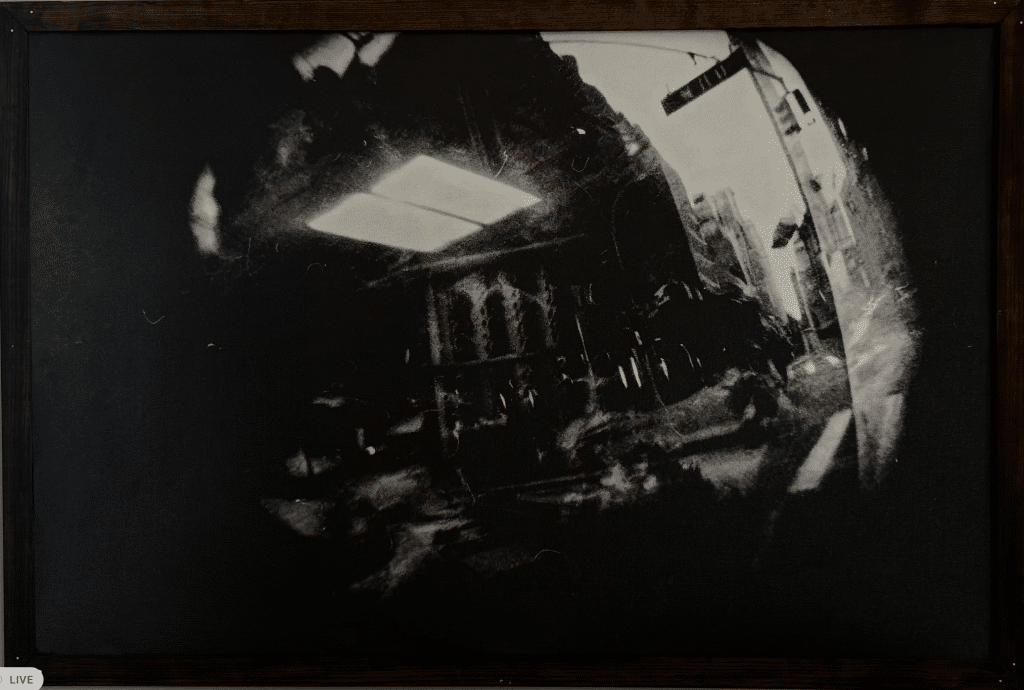
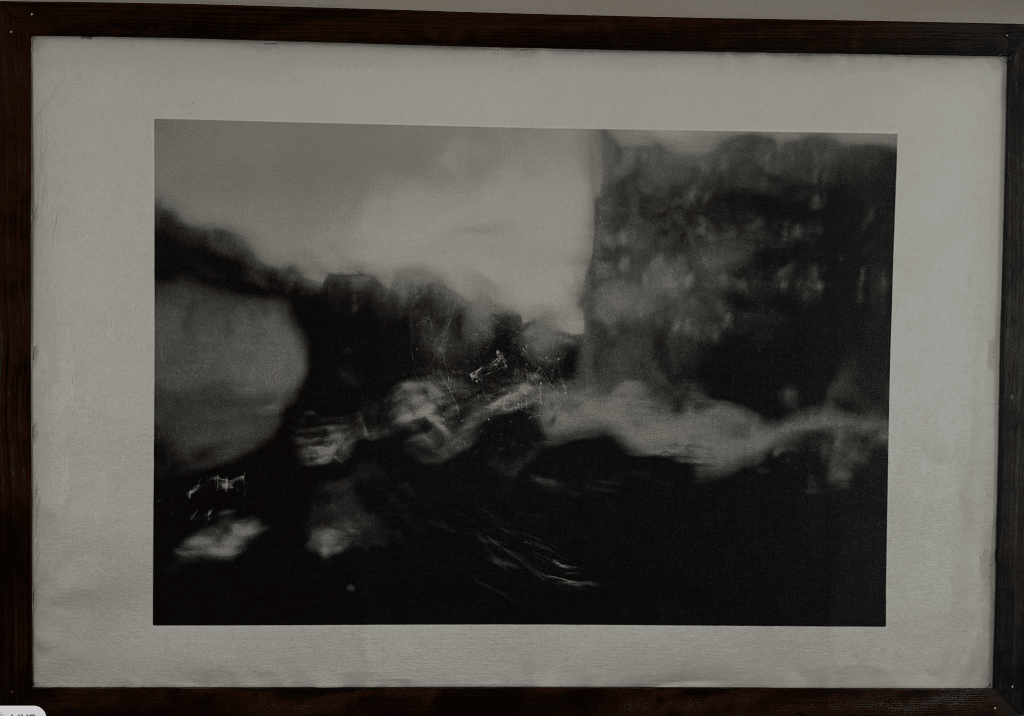
“They’re both actually two separate photos… the first is a stair set, and the other was a street photo…” Metzer says. “So, basically, I took the negatives and pressed them together upon light, and then I used my iPhone to shoot them…”
In both cases, the effect is total distortion. I’m getting disoriented just trying to make heads or tails of it. Again, I catch myself thinking about detachment, about finding new meanings and re-entering the world anew. Mentzer’s photography is a test of Feral Child’s thesis: the blurring of many realities into something strange and truly unique.
Meet the Curators
While guests mill around in the rafters, I make for the entrance. Outside, I meet up with Seung-Jun Lee, one of the two curators. He’s evidently tired, and he has every right to be.
“We’ve been working on this for six months,” Lee says, taking a long sip of a Celsius. “We were always here in the morning, from like 6 am. I got work off this week too.”
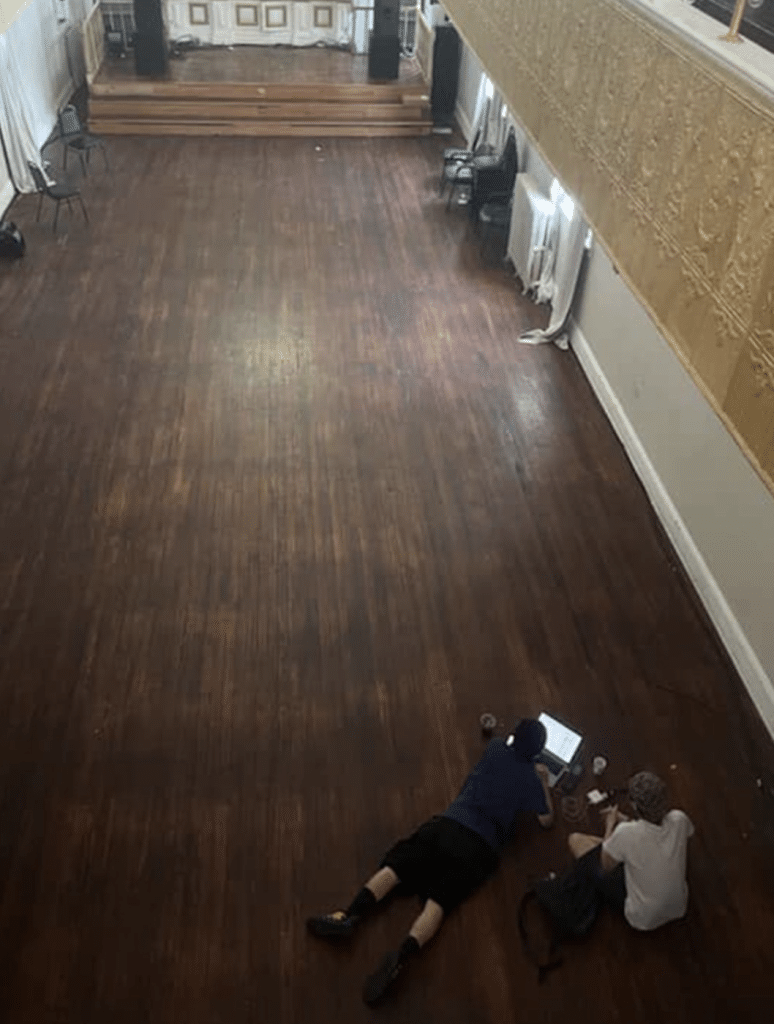
As if they didn’t need more work, Lee and fellow curator Maverick Mura are also showing their own art. Lee’s piece is actually one of the exhibition’s largest: a towering graphite centerpiece, located right at the altar, visible from nearly anywhere in the space. As paradoxical as it sounds, Lee tells me he wanted it to blend in.
“As a curator, it’s weird when my piece is the biggest and in the direct center… But, honestly, I wanted to find cohesiveness in the scale… Working with people is hard and it’s a lot to ask someone to make a piece that big, for this space. So I took that on myself. I was never separate from my curation.”
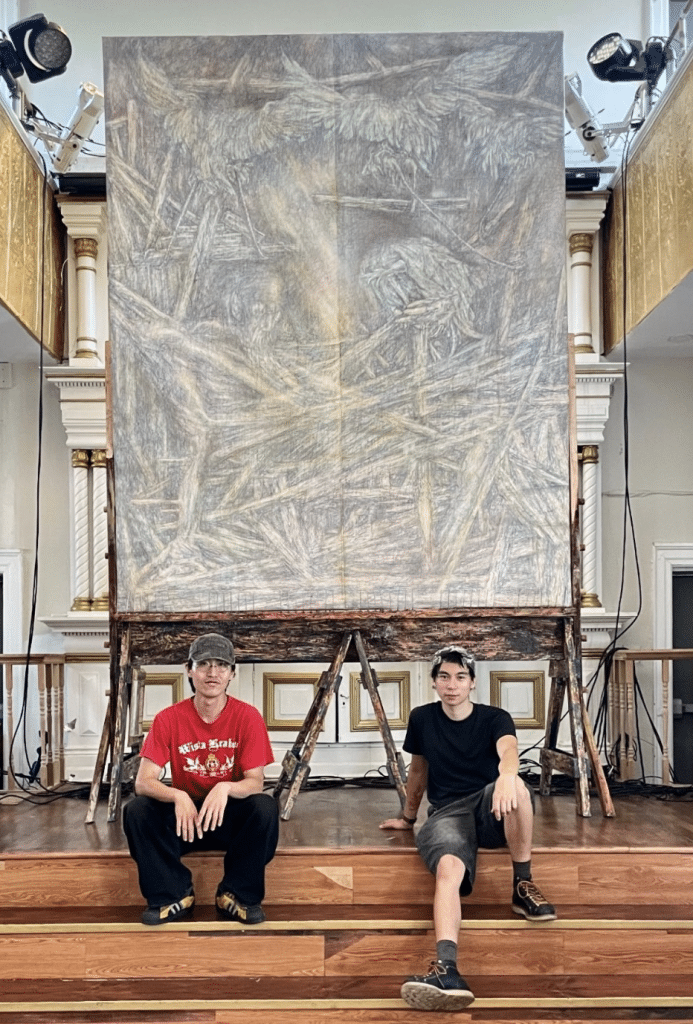
Lee and fellow curator, Maverick Mura, were already friends before, but Feral Child marks the first time the two pooled their mutual creativity into a single large-scale show. The whole time Lee and I have been talking, Mura has been popping in and out of the building, greeting new guests with an easy smile, every bit the curator.
“I’ve actually learned a lot from Mav,” Lee says. “He has more eye for detail… Like for example, he made the frames for Dylan’s piece which… I mean, that’s a lot more work… but I think it was worth it.”
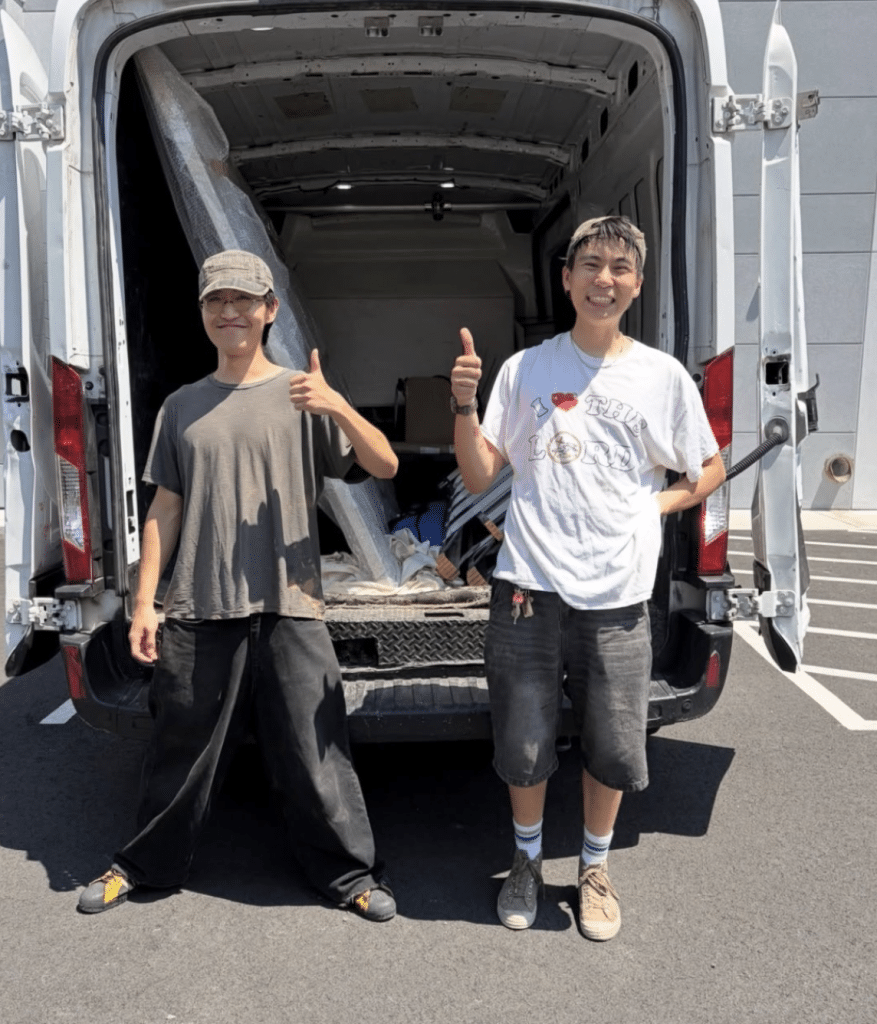
I smile to myself, because I know the frames were worth every bit of extra time and effort. In fact, they completely changed the way Mentzer’s work interacted with the rest of the exhibition. These kinds of decisions are not insignificant. In fact, there seems to be no such thing as a small choice when it comes to gallery curation, even down to the show’s name.
“I got really interested in actual feral children. Like when they return to society and how the reintegration affects them,” Lee says. “The writing (statement) for this show is about detachment and relating to that through the feral… Because things are a lot more rigid now… We have more exposure to everything, so nothing’s really mysterious.”
A Multi-Media Exhibition
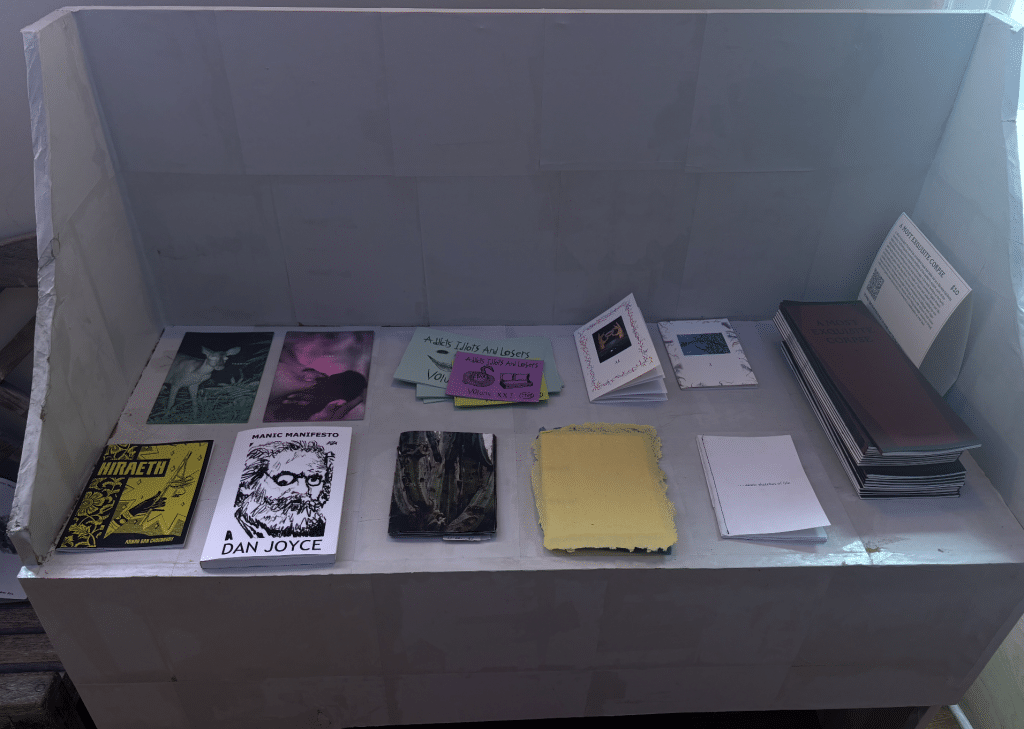
There’s not just physical art on display at Feral Child. Upstairs, I find a table covered in zines with titles like, “Manic Manifesto” and “Addicts, Idiots And Losers.” The program, designed by Mura, features a second, longer statement from Lee. Here, he muses on forms of visibility and the vital role of artist as conduit for reimagining the world. It’s all wonderfully poetic.
E.B. White once wrote, “A poem compresses much in a small space and adds music.” Looking at Feral Child like a poem, I’d have said that the only thing missing was music, but of course, at exactly 5 o’clock, everyone is called to the nave. Here composer Austin Kim has taken a seat at a grand piano. Kim is sitting in the shadow of Lee’s colossal painting, which is a fitting backdrop for the beautifully eerie music that follows. It’s a slinking nocturne, haunting and delicate. Lots of pent-up pressure.
Later Kim told me, “I’m not really a performer. I compose most of my stuff, but I don’t really play, so it was interesting trying to dial back what I wrote versus what I could actually perform.”
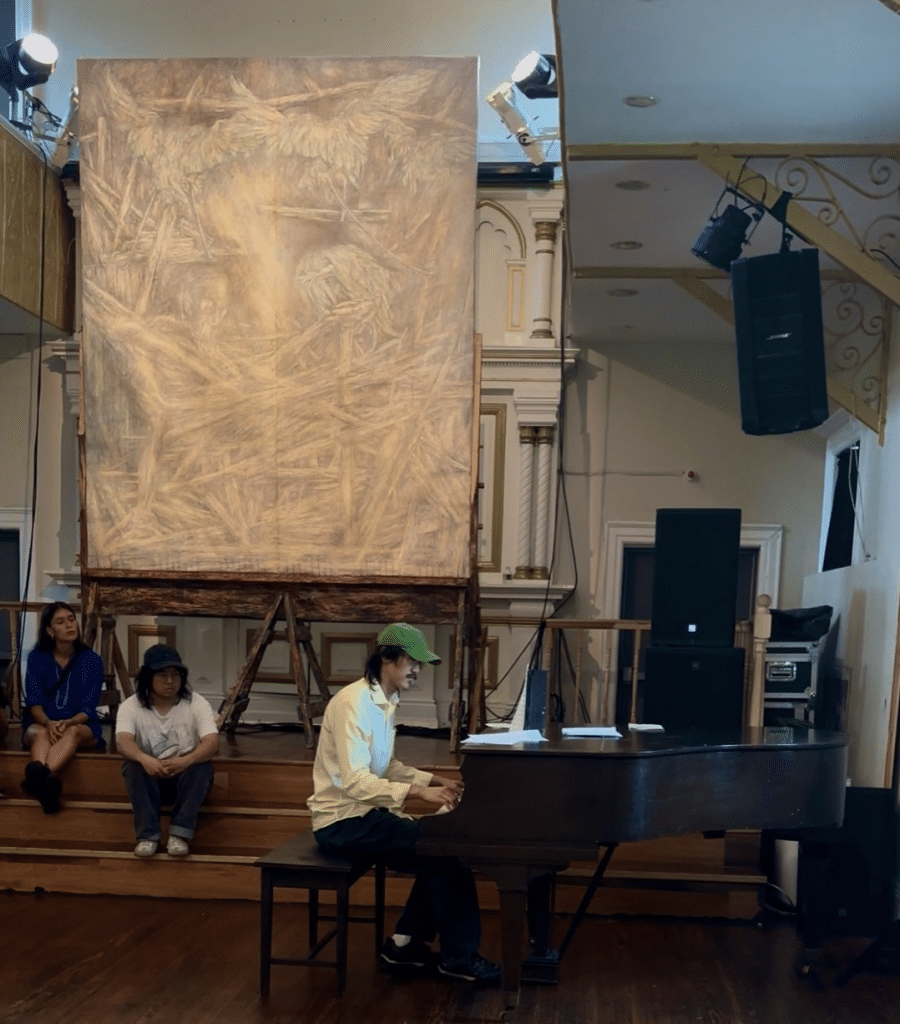
After the performance, the crowd thins a little. Kim will be back to perform the same song at 7 o’clock, and then at 10, the Brooklyn-based ambient group Broom will be performing. For now, the exhibition hall is once again filled with the same halfholy quiet as before.
The Impact of Curation
I’m thinking to myself about all the talent required in good art curation. It’s not until this show, until Feral Child, that I can honestly say I understood the value of a well-assembled gallery.
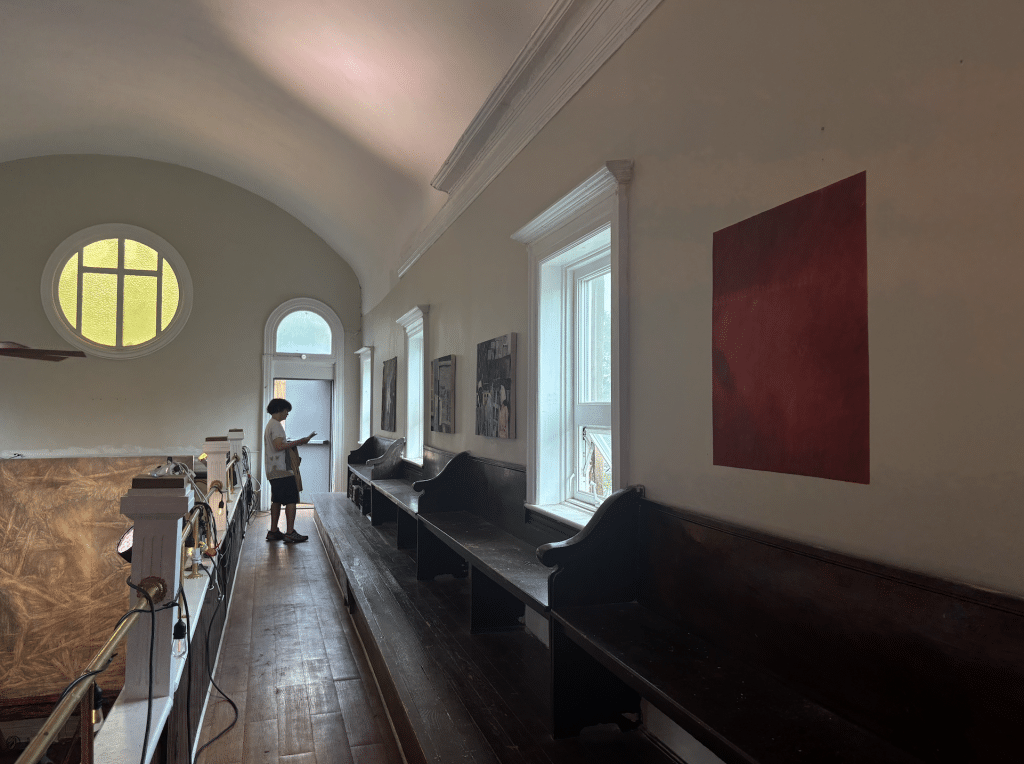
We tend to think of curation as the simple act of acquiring artists and hanging their work. A nail here. A painting there. It only dawns on me at the end of my visit that I feel as though I really got it. There were works of art that confounded me, sure, but I feel confident the intended effect hasn’t been lost on me.
This is a state of zen that can only be achieved through good curation. An audience doesn’t have to leave knowing everything, but they should at least come away feeling sure of the collective effect.
Impromptu Performance Art
Down in the main hall, a woman is peering in at Lee’s smaller piece — a graphite sketch of a roller-coaster, featuring traced-imprints of pennies in the center. This particular guest is so focused, she hardly notices her son, a little ball of pure, unadulterated 5-year-old energy, who is currently pinballing around the room at supersonic speeds. He darts around the gallery at random, touching works that are likely off-limits, ultimately even testing a few keys on the grand piano.
Eventually, the sound of little fists banging on the piano is enough to shake the woman out of her reverie. Quickly, and somewhat embarrassed, she ushers her child out of the gallery, scolding him all the way.
Poor kid. I watch all of this happening and I can’t help but think to myself that he should’ve been the mascot for the entire show. A live performance piece. In Lee’s statement he writes, “Art does not merely represent life, nor does it exist apart from it. Rather each continually transforms the other through the act of exchange.” Truer words have never been spoken. I hope that kid never stops running wild.
Learn more about the artists and curators:
https://www.instagram.com/lifeisajuke
https://www.instagram.com/maverickmura
Learn more about the Brooklyn Peace Center: