


Pulitzer Prize-winning novelist Toni Morrison once said,
“I think of beauty as an absolute necessity. I don’t think it’s a privilege or an indulgence… It’s what we were born for.”
The Paris Review Podcast/Toni Morrison
And since you never realize you have something until you lose it, we notice the lack of color (and beauty) in the coldest, darkest, and most sterile months of the year, at least in the Northern hemisphere: winter.
This winter in particular is proving to be especially harsh, forcing us to take refuge in our homes to protect ourselves from snow, unprecedented temperatures, and icy winds. Just think of the snowstorms that recently paralyzed the United States and the continuous rains that offer no respite.
The time has come to welcome some sunshine and better weather, because spring isn’t too far away (or at least we keep telling ourselves that). And what better way to do it than by admiring beautiful paintings that evoke springtime? Here they are: 5 works of art that can brighten this gray winter with warmer tones.
1. Margaret Macdonald Mackintosh, The Mysterious Garden

I like to think that this first work by the Scottish artist Margaret Mackintosh is a subtle, almost daring choice. Mackintosh, originally born in England but residing in Glasgow, was part of a group of artists called the “Glasgow Four,” which is not a British punk-rock band, unfortunately. It included her sister, her husband (Charles Rennie Mackintosh), and their friend Herbert MacNair.
These four met at the Glasgow School of Art and practiced the so-called “Glasgow Style,” an artistic movement based on geometry, a mix of Celtic and Japanese culture, and various media of expression, such as ceramics, textiles, and watercolors. In short, a style that captures the geometry of nature and of the human being.
And this is precisely what The Mysterious Garden conveys to us: the geometry of nature and the peace of sleep and dreams, like a seasonal hibernation. The eight figures watch over the subject in the foreground, waiting for her to wake up, themselves drowsy from a long wait.
Mackintosh conveys tranquility and torpor through the smoky, ethereal colors as well. Incidentally, the artist was not in the habit of using a sketchbook, relying solely on imagination to represent concepts, and I like to believe that in this case, she decided to depict spring, poised to awaken from her long sleep.

2. Vincent Van Gogh, Terrace of a Café at Night (Place du Forum)“
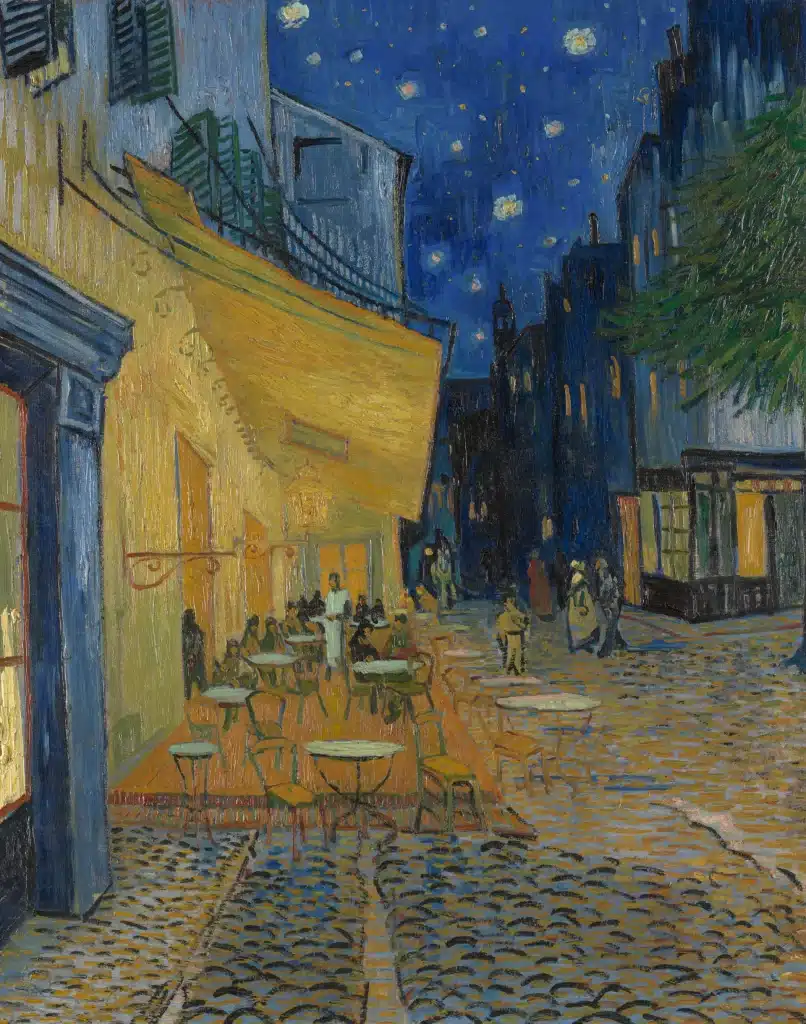
Now, I don’t believe they had Aperol spritzes when Van Gogh decided to paint the masterful Terrace of a Café at Night, but that’s what this painting conveys to me. A hot summer night, drinks with friends, and paying attention both to the conversation at the table and to the strangers strolling in the street. Van Gogh is probably turning in his grave because of my simplistic analysis of his work, but then again, he was always a somewhat restless type.
The use of colors in this work is powerful, almost unsettling in its precision. Van Gogh, who had intended to paint a night scene for a long time, intensifies the contrast of the starry sky through the yellows, oranges, and reds of the street. The scene is taking place during evening service, despite being rendered in vibrant colors.
Yet that yellow reminds us of candlelight, the beach illuminated by a bonfire, and the silent moon presiding over the night. The stars are reproduced in their position oon September 16th or 17th, 1888, the year the work was created. It must have been a warm, late summer evening, with the most nostalgic clinging to the last remnants of warmth.
Which brings me back to my initial theory: This painting evokes bubbles and warmth and carefree chatter. It matters little whether it points to the end of a season or the beginning. Sitting with friends, sated by the ups and downs of summer, and intent on enjoying the last moments before the leaves fall from the trees. Isn’t that the best feeling ever?
3. Pierre-Auguste Renoir, Two Sisters (On the Terrace)
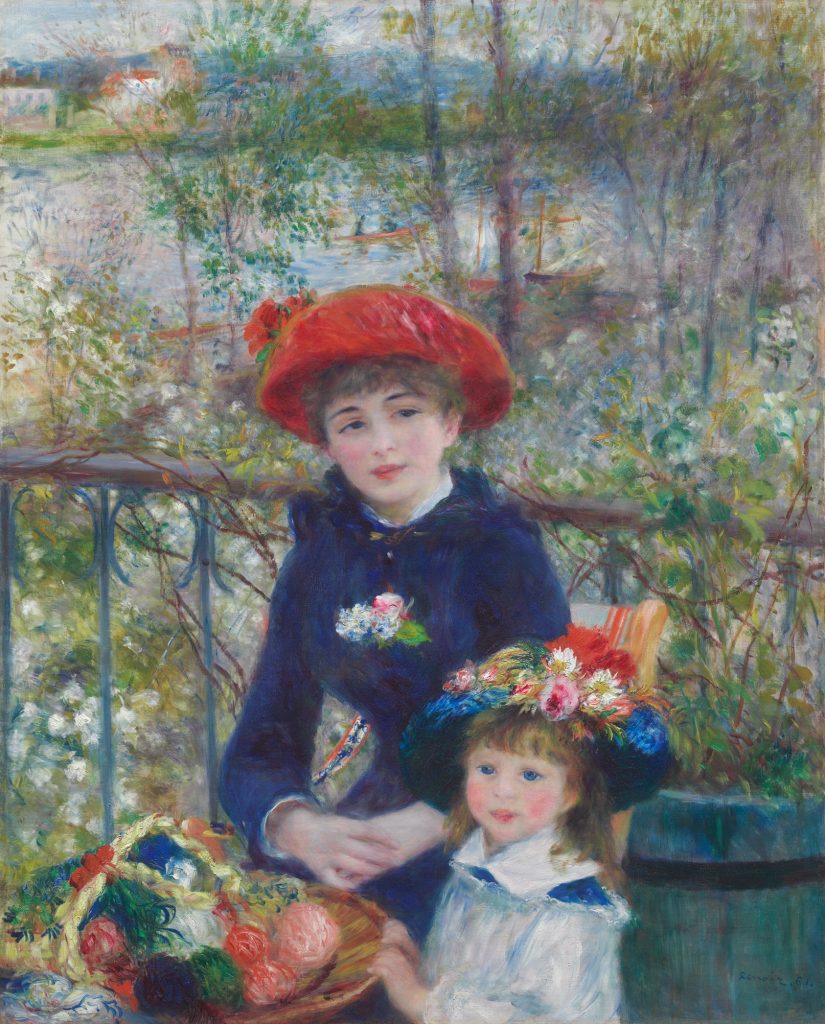
The first feeling one experiences when admiring this work by Renoir is a poignant sweetness, a softness embodied in the curves and colors that strike the observer. The vibrant red of the hat is the focal point of the painting, and it brings out all the greens, grays, and blues.
This popular painting by Renoir reminds me of past springs. Not the one that awaits us, but those in which I clung to my mom’s sleeve as we walked to school together, and I worried about getting too close to the flowering bushes and frightening the first buds.
It’s no coincidence that Renoir conjures such feelings in me, as he has always been celebrated for his use of color and interplay of light. Furthermore, the painter places the human figure and peaceful lifestyle at the forefront, celebrating simplicity in a complex, sophisticated way.
Renoir himself was extremely aware of the power of contrasts and the importance of appreciating something through its opposite. Just consider the fact that he encouraged the use of warm, radiant colors through the use of black, even calling it “the queen of all colors.”
Perhaps this is what is meant by “beauty is in the void”: the perfect balance that is created when being and non-being are in equilibrium. Sorry, I didn’t mean to get so deep and philosophical there. Renoir tends to have this effect on people.
4. Georgia O’Keeffe, Red Cannas
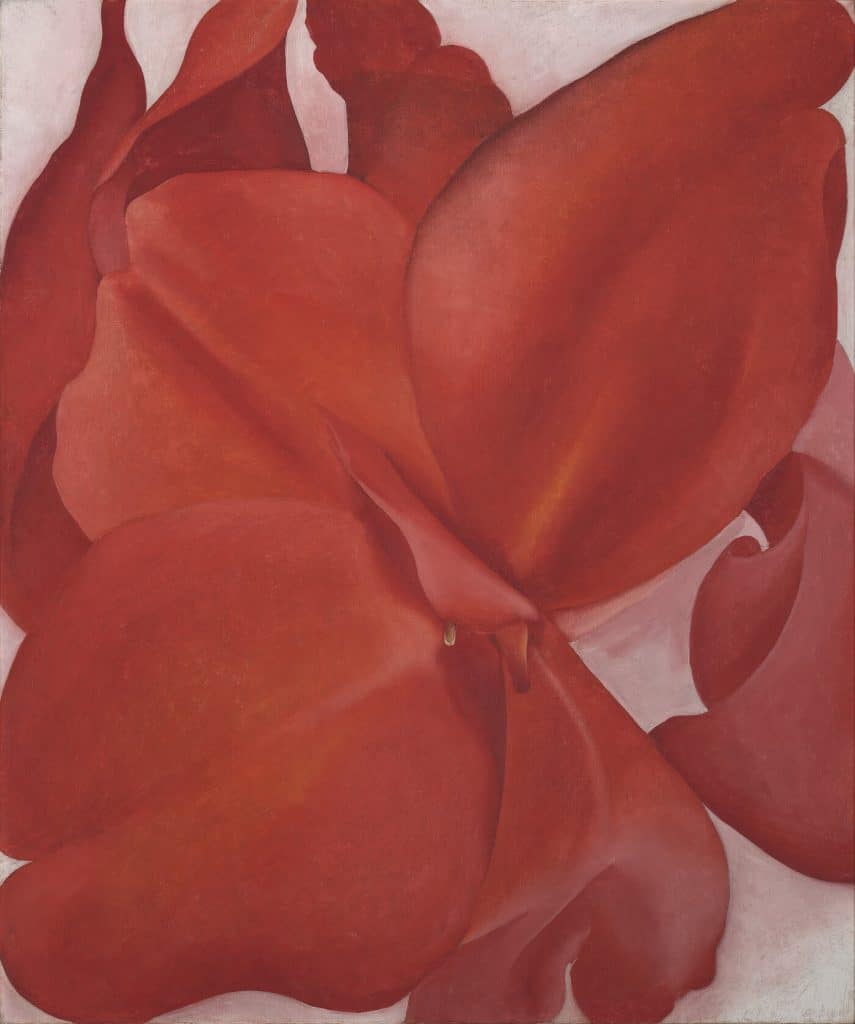
Having reached the fourth painting, I think it’s quite clear that I have a soft spot for reds, especially when used to create a beautiful floral subject. This work, therefore, scratches all the right itches in my brain and simply leaves me breathless. There’s nothing wrong with the whites, grays, and soft blues of winter, but this work simply rests the eyes after these last monotonous months.
Cannas alternates the reds of the flower in the foreground with the pale pinks of the background, creating plays of light that don’t aim to delineate the subject but rather guide the eye to the next petal. The artist has, in fact, experimented extensively with artistic compositions that focus on the boundary between reality and abstraction.
Don’t rack your brains too much over possible subliminal messages and personal interpretations, because that’s not the point of the painting. Cannas gives us only one clue about what drives the artist to choose her subject matter. O’Keefe says,
“Before I put a brush to canvas, I ask myself, ‘Is this mine? Is it all intrinsically of myself? Is it influenced by some idea or some photograph of an idea which I have acquired from some man?’”
Ms. Magazine/Georgia O’Keeffe
Now, this is the energy I want to bring into Spring 2026.
5. Gustav Klimt, Field of Poppies
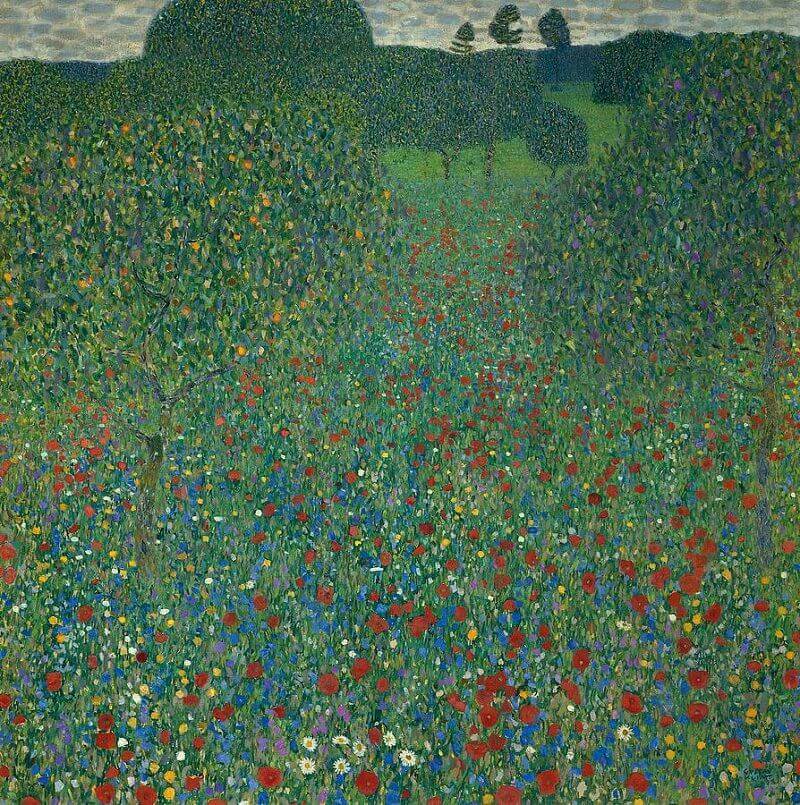
As I was saying, reds and floral subjects. This painting is my happy place that I visualize during Pilates classes. And that I continue to visualize when, leaving the class, the icy wind bites at my cheeks and makes me regret being born. Perhaps that sounds a little dramatic, but the moral of the story is that I love this artwork.
The greens, yellows, whites, reds, blues—all the colors together are delightful in their arrangement. Klimt spent months finding the right green for the rose bush, and the attention to detail definitely paid off. Similar to other paintings by the artist, such as the more well-known The Kiss, Death and Life, and Judith, the dream enters the dimension of reality, influencing it with its hazy outlines and seemingly infinite horizons.
But in this particular painting, we also find influences of Van Gogh’s Impressionism, the artistic movement based on the use of color and light. Akin to Van Gogh’s paintings, the brushstrokes and subjects appear more blurred the closer we get and more defined as we move slightly away. Much like what happens in life.
And so, here we find ourselves observing a wonderful field of flowers, with meadows and trees stretching into green hills. Let’s internalize this image, hold onto it tightly, and walk with our heads held high through the snow and rain, knowing that soon we will be able to savor the warm air of that landscape.
To cap it all
I hope that refreshing your view with these warm summer and spring paintings has helped you envision better weather. It certainly had a meditative, almost therapeutic effect on me. If escaping the cold northern winter seems impossible, you can also check out some of these winter craft project ideas that bring art directly into your hands.
If you’re still not satisfied but feel inclined to continue your search for new works of art, check out these Gen Z artists already making waves in 2026. One thing is certain: We are all in it together, and we will emerge victorious from this unfortunate season. And if we have found opportunities to reconnect with art or discover new works, then I would say it was worth it.
For now, I will retreat into my long hibernation, manifesting Aperol spritzes on flowering terraces and warm May sunsets. And who knows, perhaps in the future we will find ourselves reminiscing over the days of soft light and biting winds. We will miss the hot chocolates and the many layers needed to survive. But one thing is certain: That day is not today!









Gabriele
February 11, 2026 at 1:45 pm
Articolo bellissimo!