Ancient Greek poet and author Homer is considered one of the most influential writers in history. His epic, The Odyssey, is one of the most powerful works in Greek literature. Christopher Nolan’s adaptation incorporates some of Homer’s central themes; however, Nolan bends the conventions a little and adds non-linear storytelling to suit the nature of contemporary cinema. Nolan still sticks to the themes of war, resilience, love, and familial bonds.
Nolan’s non-linear choice
A group of suitors from Ithaca and nearby islands settle themselves at tables, befriend another, and share food. Many have their eyes on Penelope, others have them on Odysseus’s wealth, and one has his eyes on Telemachus’s head. That’s how the film begins. It’s been years since Odysseus has come home to the palace. We’re not introduced to a warrior and father fighting to get back home just yet; rather, we’re placed on hold. We feel the fear, the loss, and the pain in Penelope’s eyes. We see the hopeful attitude Telemachus carries and the chance the suitors can no longer anticipate to seize Odysseus’s assets.
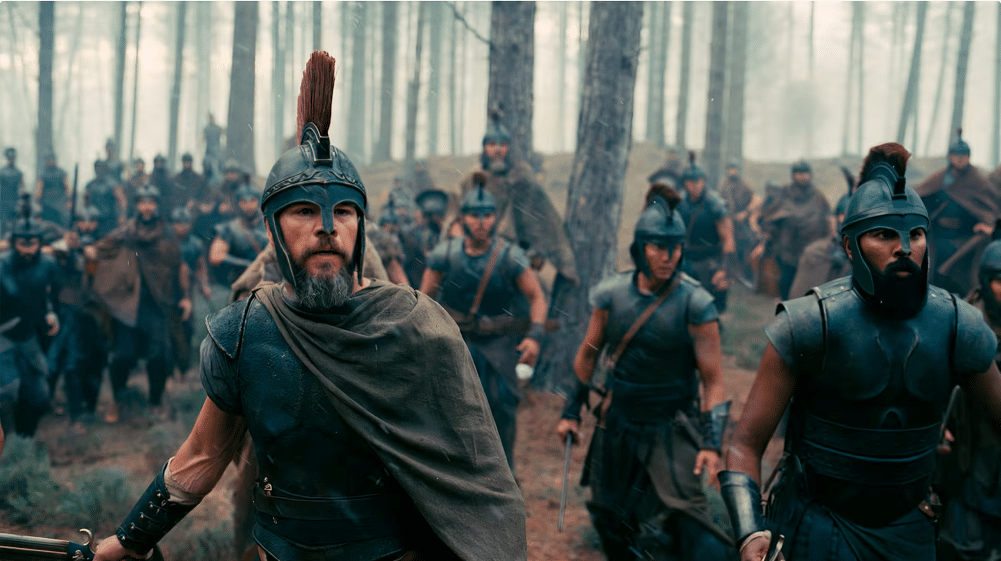
Christopher Nolan refuses to carry the audience away from the Trojan War or its warriors and hero. Flashbacks of an Ithaca soldier (Sinon) build timeless curiosity when he quickly becomes a fallen soldier who stands with a sacred gift for Athena. For Odysseus and his other men inside, this “gift” is their key way to win the war. But wait, we’re back to the insolent suitors whom Telemachus struggles to control. He reassures them of his father’s miraculous return.
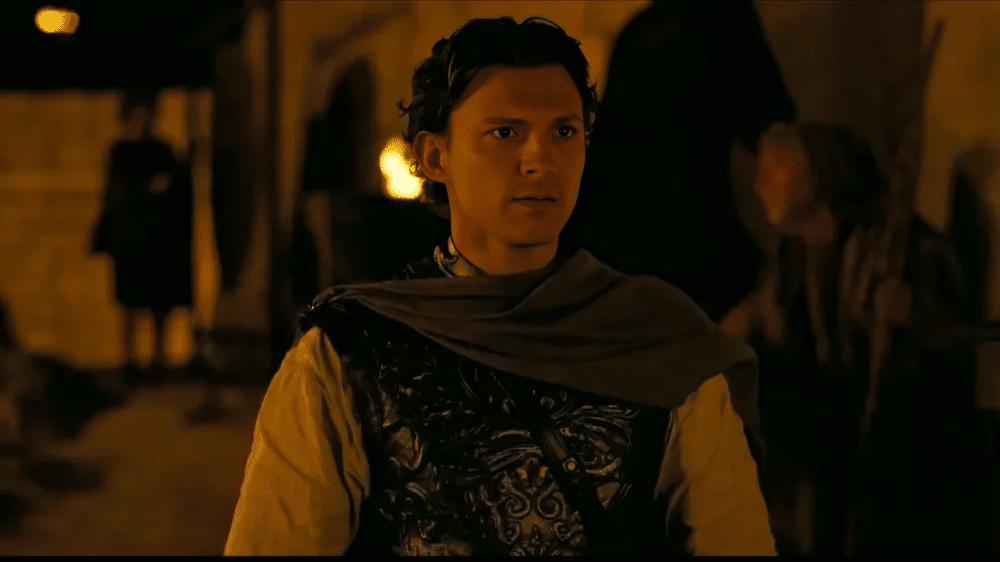
Tom Holland’s Telemachus marvels at his father’s life while Matt Damon’s Odysseus persists in scenes and moments his character is not in. Nolan makes a unique move in this cross-cutting timeline as Odysseus remains in numerous conversations.
“Some say he’s rich or some say he’s poor,” Jon Bernthal’s Menelaus tells Telemachus. “Some say he perished. Some say he’s imprisoned. What do you say?” The conversations about the Trojan War and Odysseus’s whereabouts play a pivotal part in this non-linear, relative timeline. Who’s holding onto hope, and who is a disbeliever in Odysseus’s fate? This intentional shuttle between the past and present tests the audience. Those who haven’t read the poem and can’t foresee the ending.
Do you believe Odysseus will return home, despite his obstacles?
It’s the obvious question, but it becomes serious in between these passing moments. Christopher Nolan lays out all the odds against a successful return through this consistent structure that fractures the audience’s faith.
Enemies Is Nolan’s Best Weapon
What makes The Odyssey much more tolerable is the battle that every character takes on. There are battles between men and nature, cyclops, and kin, as well as the ongoing battle of adhering to Zeus’ law. Nolan stirs characters’ psychological consciences by presenting “breaking Zeus’ law” as a deterrent to human civilization, and worst of all, trust and self-fidelity.

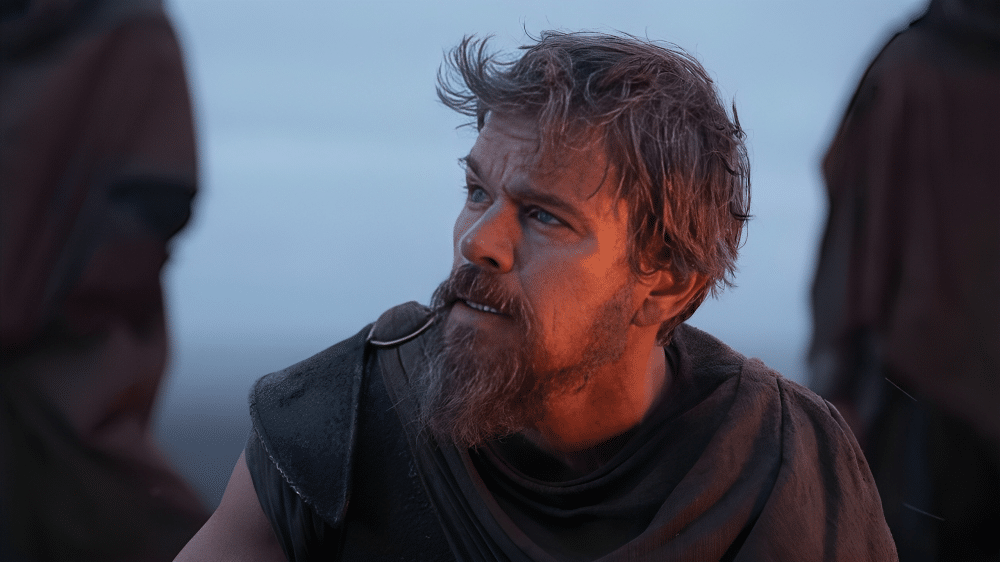
In Homer’s poem, Odysseus takes on physical Gods on Mount Olympus. Nolan reframes the mythology so that the consequences trouble both the external and internal worlds of every character. Odysseus is not only a warrior with external obstacles—escaping a cyclops, the underworld of Hades, Sirens, and Calypso’s island—he’s also suffering from within.
Nolan captures the classic mythological external and environmental threats profoundly. But the internal conflicts are beyond just finding and reaching home are subtle until the end. It’s then Odysseus realizes that breaking Zeus’s law (Xenia) is what brought his men closer to death. No matter if they sailed through manageable drought or faced extreme starvation, they were doomed from the start. Odysseus and his men only won the Trojan War because they infiltrated Troy—destroying the sacred bond between guest and host.
Odysseus turns sacred things like hospitality into a weapon of deception. Nolan uses Odysseus’s consequences as a reflection, a mirror of the grotesque he unleashed that then consumes him and his men. And for the audience, we’re getting piece after piece until the puzzle comes together. So, Odysseus’s return comes with realization.
Zendaya’s Athena appears as a projection of Odysseus’s broken psyche, and her appearance sits in for a little until the very end of the film, where Odysseus expresses his guilt to his wife, Penelope. Betraying Troy and Athena came with the expense of losing himself and his way back home. Nolan challenges the return of Odysseus throughout the film, but it’s when Odysseus sets foot on his home island that stomachs churn. The crowd gets silent. Odysseus betrayed his own humanity and moral code; will his own people—his wife and son—forgive him?
This “enemy” effect of Nolan’s goes beyond self-betrayal; it’s there already, in the light and the dark. It sits at the table with the parasitic suitors and welcomes disloyal servants and desperate opportunists. Robert Pattinson’s Antinous makes a compelling mastermind and aggressive suitor who plots Telemachus’ assassination, leading a faction to follow along.
Nolan places Olympics in every narrative; he makes every character fight for something, and he doesn’t make it easy—it comes with a price or wound. Nolan once said, “The best characters are the ones who are driven by a massive, all-consuming internal conflict, which then forces them into friction with the outside world.” This is evident in Lupita Nyong’o’s Helen of Troy and Clytemnestra. Helen fights to be seen as a human rather than an object, and her twin sister, Clytemnestra, seeks vengeance against the betrayal of her daughter.
Whether characters defy the gods or defy each other, the friction is pleasing.
Nolan Stays Away From Traditional Fantasy Tropes
“You’re not always going to be the strongest or the fastest, so be the smartest,” John Leguizamo’s Eumaeus tells Telemachus, a piece of advice Odysseus told him once. The sound design team certainly lives up to it in every moment of the character’s love, fight, and struggle to survive. Nolan and the sound team don’t offer traditional and boring sword-and-sandal battle scenes. Rather, they deliver them with intense and oppressive sound effects.
Rhythmic sounds make the scenes important in every detail. They even had the subtle humor of a “dummm” sound over the scene when Anne Hathaway’s Penelope slaps Odysseus when she is told to remarry. Ludwig Göransson, the composer for the film, created a low, vibrating sub-bass drop and experimented with 35 bronze gongs to match the intimate human interactions.
The Mediterranean feels hostile given the rhythmic roar of the ocean. It’s almost as if you’re there in the room with Penelope and the suitors or running away from a cyclops and sailing against the heavy wind. We’re all included. We feel the physical blow and dark feeling of every shocking and uncomfortable scene.
You’ll feel deeply disturbed by the scene in which Odysseus’s men dine in for a feast in Samantha Morton’s Circe’s tiny cabin. The unsettling visceral flesh-and-bone sound effects disturb viewers as they witness the horrifying metamorphosis. Human anatomy is performed with wet, squelching sounds. And for the audience, appetites are magicked away.
Nolan’s choice to shoot The Odyssey with IMAX cameras was a brilliant idea for a Greek mythological film because it immerses audiences in the experience. The color depth and rich contrast of the 70mm IMAX film do exceptionally well in somber moments.
Audiences are certainly pulled into claustrophobic environments like the Cyclops’ cave Odysseus barely escaped. Nolan’s IMAX technique breaks away from traditional spectacle as the sound team engineered custom soundproof and auditory experiences to capture raw close-ups
Nolan’s The Odyssey will certainly gain a “Best Movie of the Year” nomination, but so should Matt Damon for his flawed Odysseus, Tom Holland for his resilient Telemachus, Anne Hathaway for her grieving Penelope, and Lupita Nyong’o for her courageous dual roles.
The Odyssey is now playing in theaters.
GRADE: A