On May 7, 2026, the Trump administration released its 2026 counterterrorism strategy, using deliberately vague terminology to determine who the government can designate as a “terrorist. This ambiguity expands the government’s power of judgement, allowing it to classify individuals without fixed or clearly bounded criteria within the language of the policy.
This raises the question: who gets to be called a terrorist? While the term may appear to describe a clear category, in practice it depends on political power and on how those in power define it.
Liberty and Freedom
I began my education in Mexico, where the language does not distinguish between the words freedom and liberty because both translate to libertad. As I became more familiar with American culture, I learned that these two words carry distinct cultural and historical meanings despite sharing the same translation in Spanish.
Americans use the Liberty Bell and the Statue of Liberty to symbolize the nation’s founding principles, constitutional rights, limited government, and national identity.
Politicians often invoke freedom in political campaigns, speeches, and movements to justify positions on national security, American values, and democracy.
Understanding the political meaning behind freedom and liberty also changes how both the government and society understand the word terrorist. Rather than being simply a dictionary definition, the term terrorist becomes a political label whose meaning depends on who has the power to define it.
Understanding Power
False consciousness describes the way dominant ideas become accepted as common sense within cultural hegemony, even if these ideas serve the interests of those in power. Rather than questioning these ideas, society often reinforces them as common truths, shaping who receives the label of “terrorist
This shapes our relationship with the economy and with social power. According to Pierre Bourdieu, the social world is a field of struggle where different types of capital operate: economic, social, cultural, and symbolic capital.

The accumulation of wealth is not only economic but also produces prestige, as it allows others to recognize a person’s legitimacy and social value.
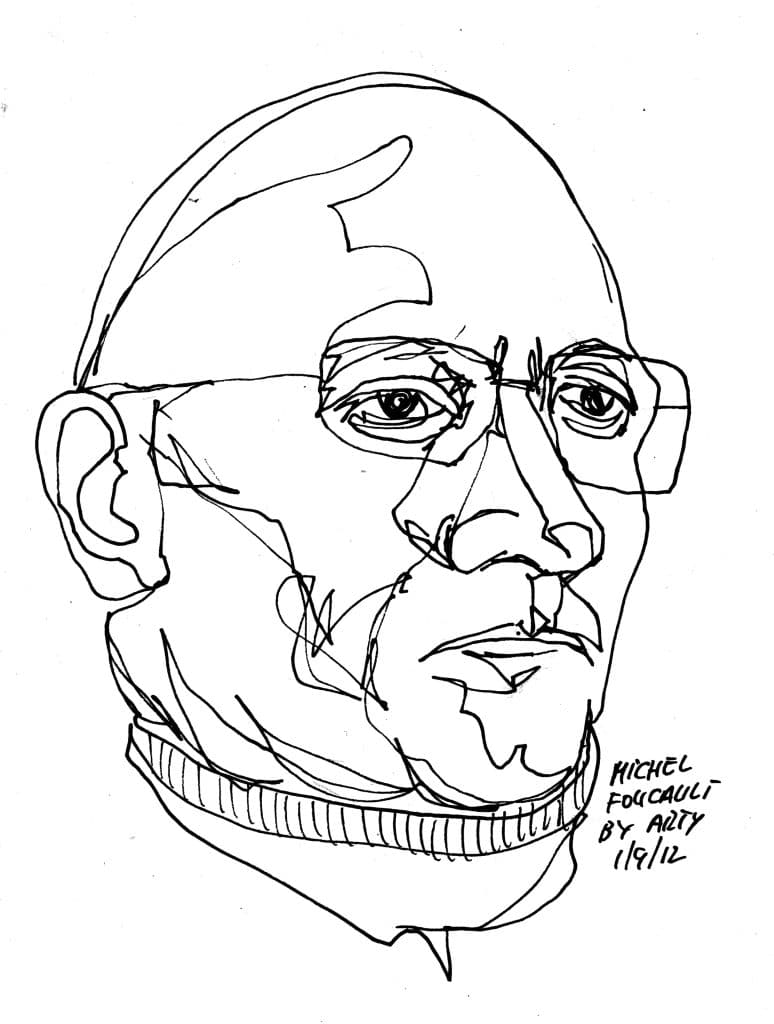
The economy of power, according to Michel Foucault, uses these same tools; however, it operates within networks of power relations. It is not only about money, but about how power relations are managed and distributed. Power is not only located in the state, but also in prisons, schools, families, hospitals, and in language itself.
Power does not only punish; it also produces subjects. Those subjects who do not align with the interests of power are often labeled as terrorists. Schools not only teach; they also discipline bodies and behavior.
This process operates on three levels:
- Production: norms, knowledge, and institutions.
- Distribution: social hierarchy, unequal access to resources, and decision-making power.
- Legitimacy: ideology and discourses about “security” and “order.”
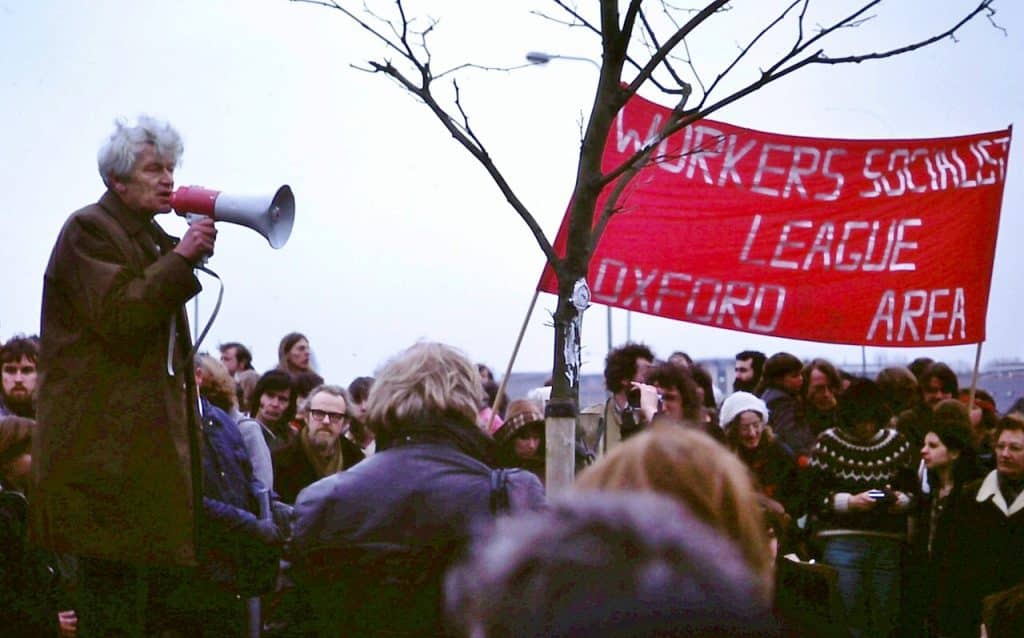
In the concept of moral economy, developed by E. P. Thompson, there is an emphasis on a “popular ethic” that defines the limits of tolerable social behavior between antagonistic social classes.
Society understands violations of this perceived moral balance as disruptions of social harmony. When individuals or groups break this balance, they can transform peaceful relations into conflict and violence.
In this sense, a “popular elite morality” produces norms and critiques that shape what society considers acceptable or unacceptable behavior.
Trump’s Counterterrorism for 2026
State counterterrorism serves as evidence of all the phenomena explained before. The use of words such as terrorism and radical functions as a political tool to legitimize violence against people who do not align with state ideals, thereby producing what is presented as “common sense, unethical, and anti-American.”
The definition of terrorism expands through language. According to the United States Counterterrorism Strategy for 2026, terrorists include “violent left-wing extremists who have adopted radical ideologies antithetical to the principles upon which our Republic was founded.” (United States Counterterrorism Strategy, 2026, p. 6).
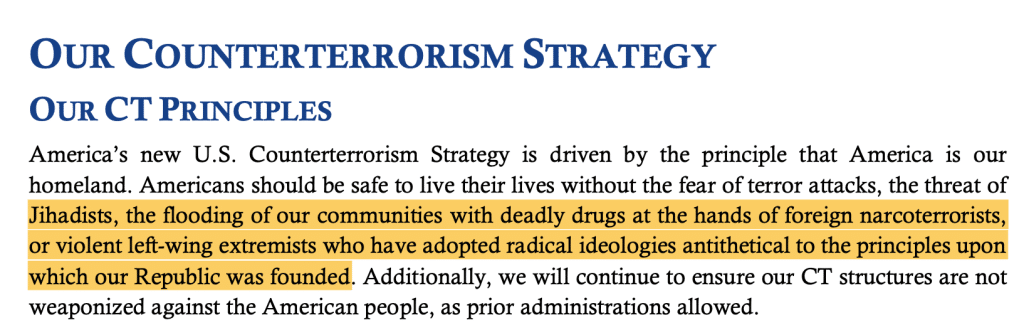
This type of vague terminology allows the state to classify ordinary individuals as terrorists due to the lack of clearly defined criteria in the language of the policy, or simply because they do not align with the state’s ideology.
This demonstrates how political language does not merely describe threats, but actively constructs them.
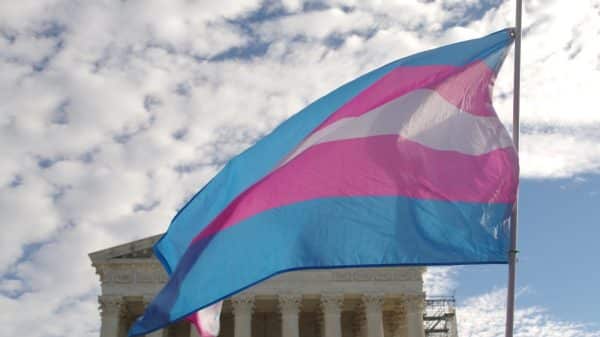
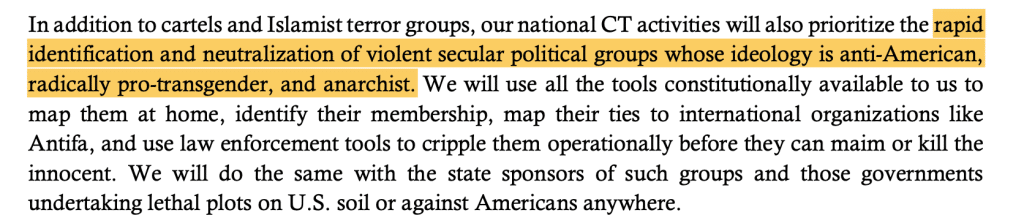
It does not stop there; it also attacks the identity of certain subjects, stating “anti-American, radically pro-transgender, and anarchist ideologies” (United States counterterrorism strategy, 2026, p. 5). This type of language raises questions such as: what does “radically pro-transgender” mean? The terminology used by the state remains undefined and open to interpretation.
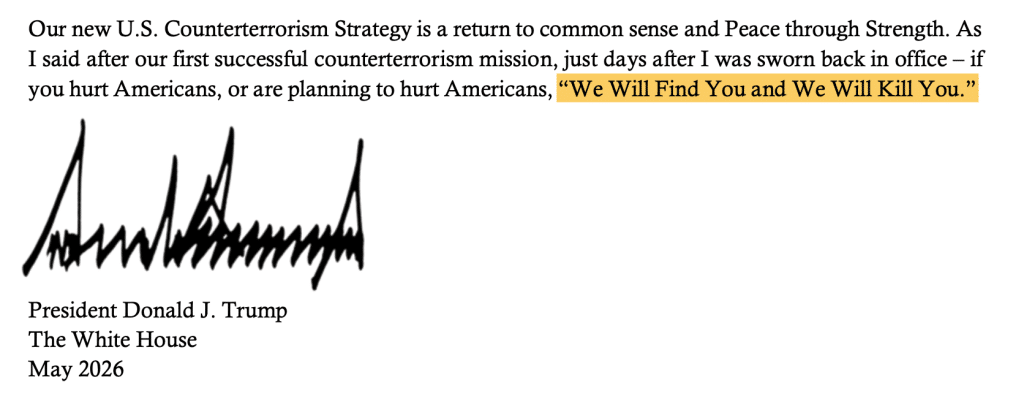
Finally, social peace is framed as being disrupted by individuals who do not share the same ideology. This is reinforced through dangerous language used in the counterterrorism strategy, such as “We will find you and we will kill you,” which appears as a direct textual citation within the policy (United States counterterrorism strategy, 2026, p. 3).
Therefore, the category of “terrorist” is not a fixed or neutral definition, but a political construction shaped by language, power, and social legitimacy.
Power, Language, and Terrorism
My analysis of the 2026 United States Counterterrorism Strategy demonstrates how political discourse shapes the concept of freedom. When governments protect freedom by censoring certain ideologies, they raise an important question about what they are actually defending.
When governments threaten the lives of individuals who do not align with state ideology, they use the label terrorist as more than a description of violence or terror. Instead, they employ it as a political category that encourages obedience among citizens. Systems of power, discourse, and legitimacy construct and reinforce this label, allowing it to function as an instrument of authority.
Therefore, those in power do not determine who qualifies as a terrorist through an objective or neutral definition. Instead, they rely on vague terminology that allows them to decide who belongs within this category and who remains outside of it.
Throughout this analysis, I have shown that those in power shape and instrumentalize concepts such as liberty, freedom, morality, and security to protect their interests, using language as a mechanism of control.
A machinery, as described in the famous book 1984 by George Orwell, reflects a dystopian future that, day by day, appears increasingly similar to our present.
In the end, the question remains without a fixed answer. Power, language, and fear do not merely describe terrorism; they draw and continually redefine the boundaries of who society identifies as a terrorist, determining not only who society views as a threat but also who society allows to exist as one.
In a world where language becomes a weapon of control, those in power rewrite truth and transform political labels into instruments of domination.