

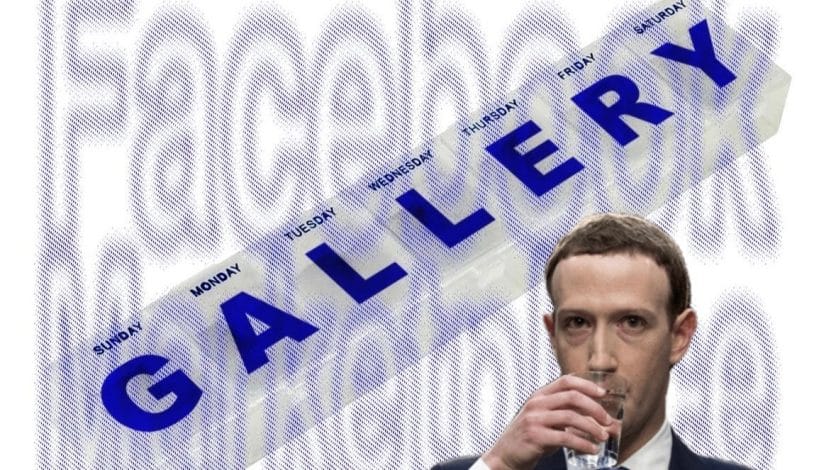
An hour before doors open, Arthur Michel is standing in the middle of a totally empty gallery. Really, it’s not a gallery yet, so much as it’s Suite 204 in a Chinatown apartment complex. It’s by no means a glitzy Chelsea art-hub, and it’s certainly not a flashy hotbed for New York City’s top critics; however, it’s the perfect venue for a unique event: the Facebook Marketplace Gallery.
The premise is simple… For one night only, young artists from across the country come together to fund a one-night gallery exhibition. Then, the minute the show ends, every piece of art promptly goes up for sale on Facebook Marketplace.
Michel has taken the place where you’re likely to find baby clothes and more-than-gently-used couches and turned it into his own personal Sotheby’s. It’s gloriously rebellious. It’s maddeningly ingenious. But as of now, it’s nowhere near ready. At least not yet.
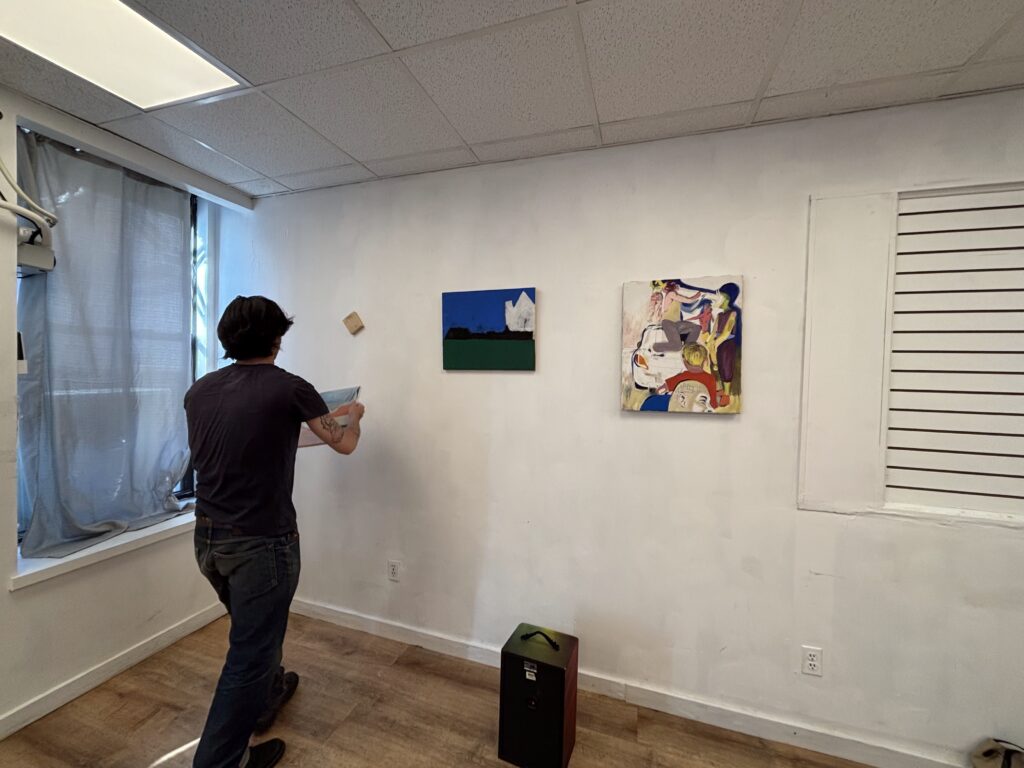
“If we run out of command strips, I can always run to get more,” Michel says.
Currently, Michel and a team of other artists are hanging several pieces that have just arrived. Green Saran Wrap litters the floor, alongside dozens of fold-out chairs, three cases of Natural Light beer, and a handful of screen-printed t-shirts that read, “We met and love each other so much at the Facebook Marketplace Gallery.”
From the outside, Michel’s process of setting up appears startlingly relaxed. He sizes up a blank wall, casually trying one painting, then the other. There’s none of the expected art-world angst. He isn’t panicking about wall labels or space constraints. If anything, Michel seems more than confident that everything will eventually find its place, even if they do end up needing more command strips.
Michel’s assuredness doesn’t come as any surprise. The Facebook Marketplace Gallery has already given him plenty of practice acting as a curator, with tonight’s gallery marking the fourth official event of the year. The first gallery took place in January of 2026, drawing a crowd of around 50. From there, each successive event has grown in attendance, so much so that a recent gallery hosted in Michel’s own apartment attracted more than 120 guests in a single night.
By the looks of it, everyone is already in high spirits. Several of the featured artists have arrived and are smoking cigarettes on the fire escape. Among them are emerging talents from prestigious art schools like RISD, The New School, MassArt, and Parsons. Most of them have recently graduated, though some have been living in the city for years. For these artists, the big question is: what now?

The Art World’s Accessibility Problem
In passing, someone on the fire escape jokes, “Hi galleries, hire me please… Look at me… I’m so young and hireable.”
On a warm June evening, it’s easy to laugh at jokes like this, but the anxiety behind them is decidedly real. Whether fresh on the scene or a well-established local, artists know it has become borderline impossible to secure representation at the city’s big-name galleries.
This hardly counts as breaking news. Despite its ongoing status as a global arts hub, New York City has reached a definite tipping point as of late. In March, artist and curator Josh Kline made waves by confronting these issues in his piece “New York Real Estate and the Ruin of American Art.” In the essay, Kline denounced the failings of the New York art scene, citing, among many relevant factors, “The epochal transfers of wealth to the already wealthy.”
Essentially, the art world is experiencing a crisis of its own creation. Galleries across the world have consistently chosen to scale up while charging ever more exorbitant prices to an ever wealthier audience. They’ve elected to sell the atmosphere of total exclusivity, and as a result, it has never been harder for young people to buy art, let alone feel connected to it.
Why the Facebook Marketplace Gallery Works
“I don’t think a lot of young people know how to buy an artist’s work, even if they like it,” Michel explains. “I just want normal people to feel like they can have art, so the whole thing doesn’t end up with rich people in penthouses trying to buy a new personality. Art collecting doesn’t have to be this pretentious thing... Art should come from the people that you know and meet in your actual community. That’s my philosophy on it at least.”
It’s admittedly pretty clever that Michel’s solution to industry elitism is to put beautiful works of art up for sale on the most widely accessible platform available. Instead of scaling up for an increasingly limited clientele, the Facebook Marketplace Gallery is turning in the exact opposite direction. They’re using the platform usually reserved for selling used kitchen appliances to bring together a community of artists and art lovers in a way that the high-end galleries never could.
A major factor in the Facebook Marketplace Gallery’s success is its direct locality. Facebook Marketplace’s settings allow users to set their location and the maximum distance they are willing to travel to make a purchase, effectively creating digital communities that can often become real-world connections. Michel realized that this was the perfect place to showcase local artists because it would display their work only to the real people they see and interact with every day. No faceless buyers. No corporate bidding wars. Whether Michel is trying to or not, the Facebook Marketplace Gallery is making a perfect commentary on an art scene that has largely become impersonal.
“There’s a real love for what they’re doing,” explains featured artist, Nat Leon Hilton. “Arthur and the others really know their stuff. They know art history… A lot of them are working as art teachers for kids… Everyone just enjoys it… There’s real quality and intelligence to all of it.”
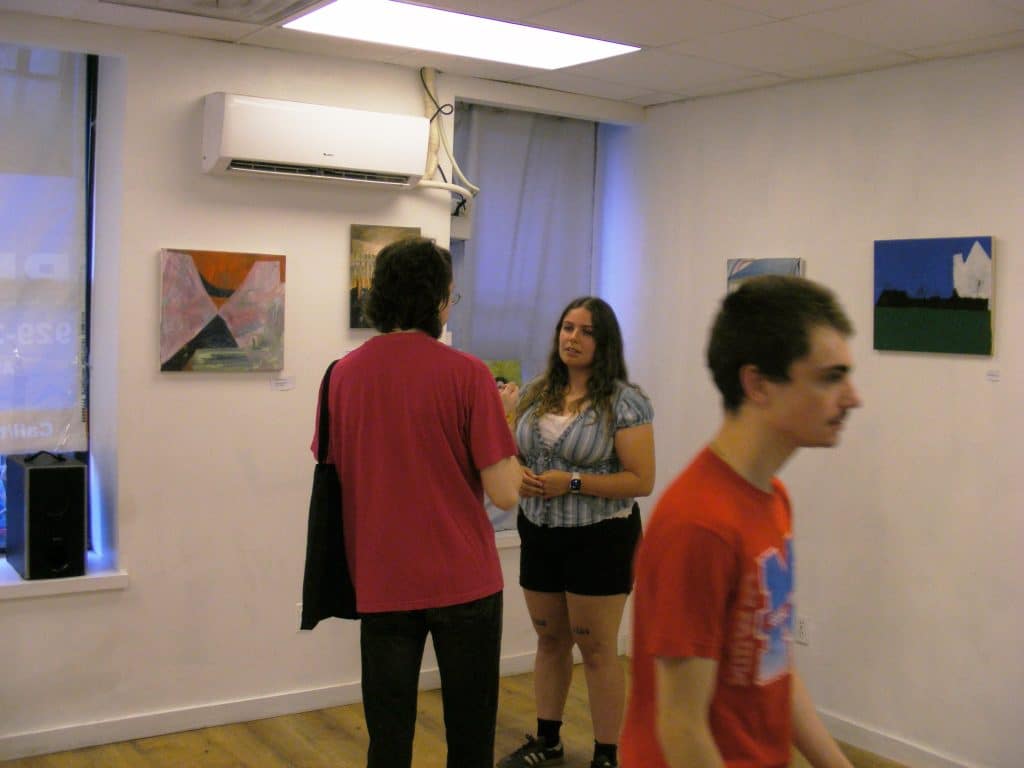
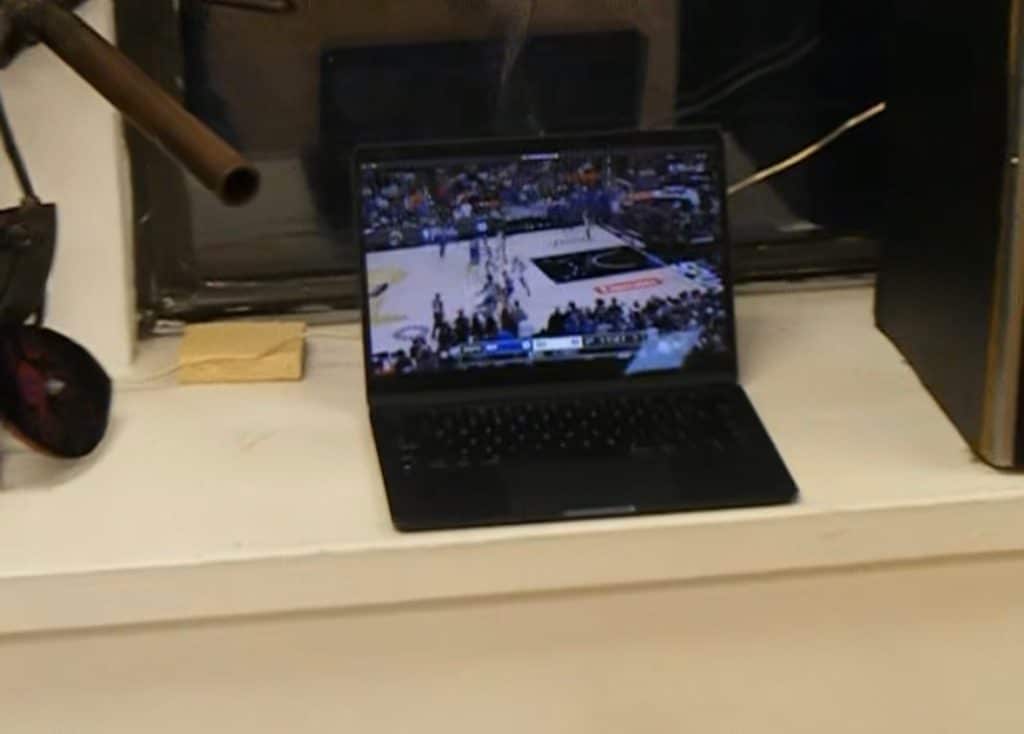
Just one look at the finalized gallery confirms that it truly is a labor of love. While every featured artist is passionate about their work, there is still a delightfully tongue-in-cheek element to the entire event — a kind of carefree energy that gives the whole space a wonderful sense of realness. These aren’t your detached, glassy-eyed art collectors. They aren’t curators with a penchant for the bland. These are the kinds of artists that will have the Knicks game playing off a MacBook in the corner of the gallery.
“Hey, you, white shirt!” Michel is yelling down at a stranger on the street, “Come to our gallery!”
“Where is it?” they call back.
“Upstairs! Room 204!”
While unorthodox, this interaction is actually one of many guerrilla marketing campaigns, engineered by Michel and fellow MassArt graduate Solon Perry. For the inaugural gallery, Perry came up with the idea of screen-printing advertisements directly onto spare bricks and scattering them throughout the city. These days, Michel typically designs satirically, brain-rotted posters that usually feature a vaguely crude depiction of Meta CEO, Mark Zuckerberg. This gallery’s official poster depicts the tech billionaire as Leonardo Da Vinci’s iconic Vitruvian Man, albeit with a tasteful QR code to cover any indecency.
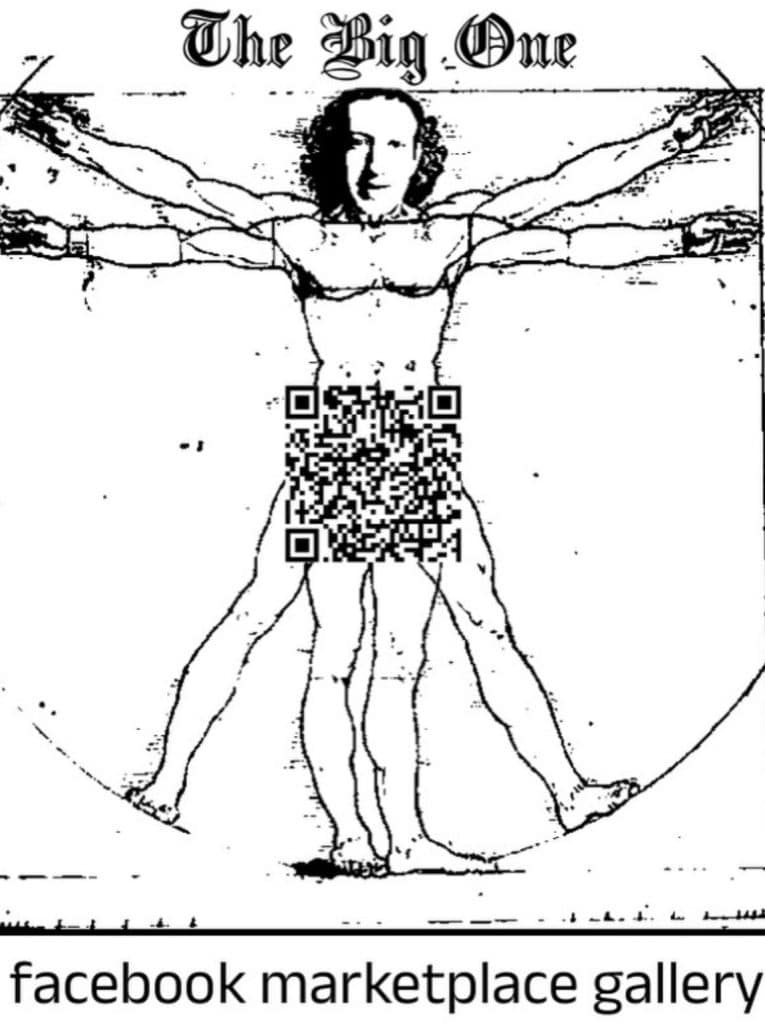
“I’m trying to strike a balance between being unserious enough that I can be comfortably approached and serious enough to have people, without a doubt, respect what I’m doing,” Michel explained.
You could honestly say, “mission accomplished” on this front. Several featured artists are making their Facebook Marketplace Gallery debuts tonight, but you wouldn’t guess it from the way Michel welcomes them into the event. Parents are starting to trickle in, too, and someone is spreading a rumor that two covert art collectors might be making an appearance tonight. People can’t help but gravitate. Also, a free beer doesn’t hurt.
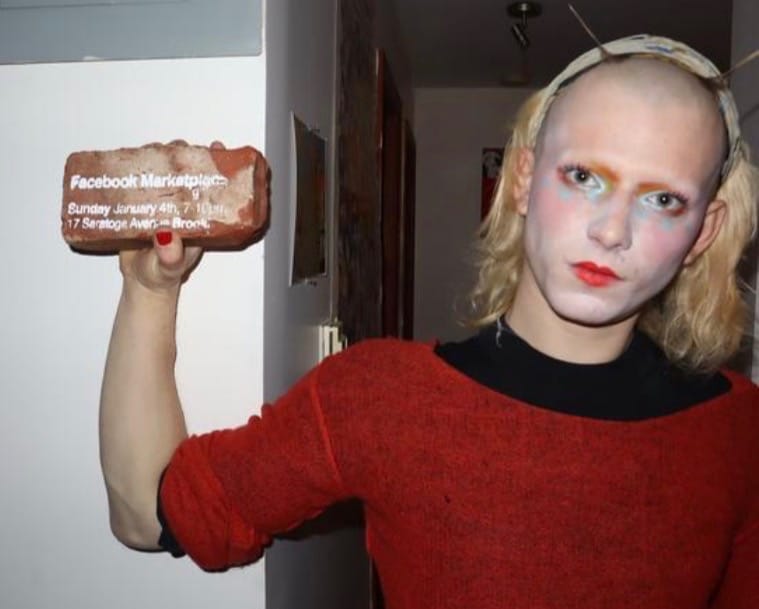
“I really appreciate what Arthur has done by getting people together like this,” said folk artist Ben Hood. “I think this is a really accessible space for artists to take [the art world] by the horns and really move it in our own direction.”
For most young artists, anything less immediate may no longer be a viable option. Those with the proper resources, time, and money often find themselves pursuing graduate degrees just to prolong the inevitable. But for the rest, events like the Facebook Marketplace Gallery are vital ways to engage with an art community outside of academia.
Recent MassArt graduate and featured artist Ruby Hewitt doesn’t even buy that graduate programs are worth it in the first place. Sitting on the fire escape, dressed in a black and white polka-dot dress, Hewitt is going off on the institutional push toward grad school, and honestly, you can’t blame her.
“It’s just crazy to be a sophomore or a junior and have a critique where a professor basically just says that you should go to this specific grad school if you want to keep going with art… I’ve definitely gotten that a few times,” says Hewitt.
She described an artist friend who went to Columbia University for grad school.
“Columbia is supposed to mean you’re set,” Hewitt explains, “And he was a really brilliant artist. But even after graduating with an MFA, he still couldn’t get any gallery interest.”
Stories like these paint a patently bleak picture for emerging artists across the world. They’re told to jump through dozens of hoops, only to end up back where they started with even less money than before. So why do some still choose to spend thousands of dollars on MFAs that might not ever pay out?
“I mean, it’s understandable,” Hewitt says, “It’s a safe way to stay being an artist for a little longer.”
In the end, that’s all these artists really want. Unfortunately, being able to create freely without worrying about online followings and bureaucratic galleries has become a luxury that most young artists simply can’t afford.
Despite the serious conversations unfolding on the fire escape, the mood back in the Facebook Marketplace Gallery is now bordering on electric. The Knicks are winning, the artists are laughing, and the art all looks phenomenal.
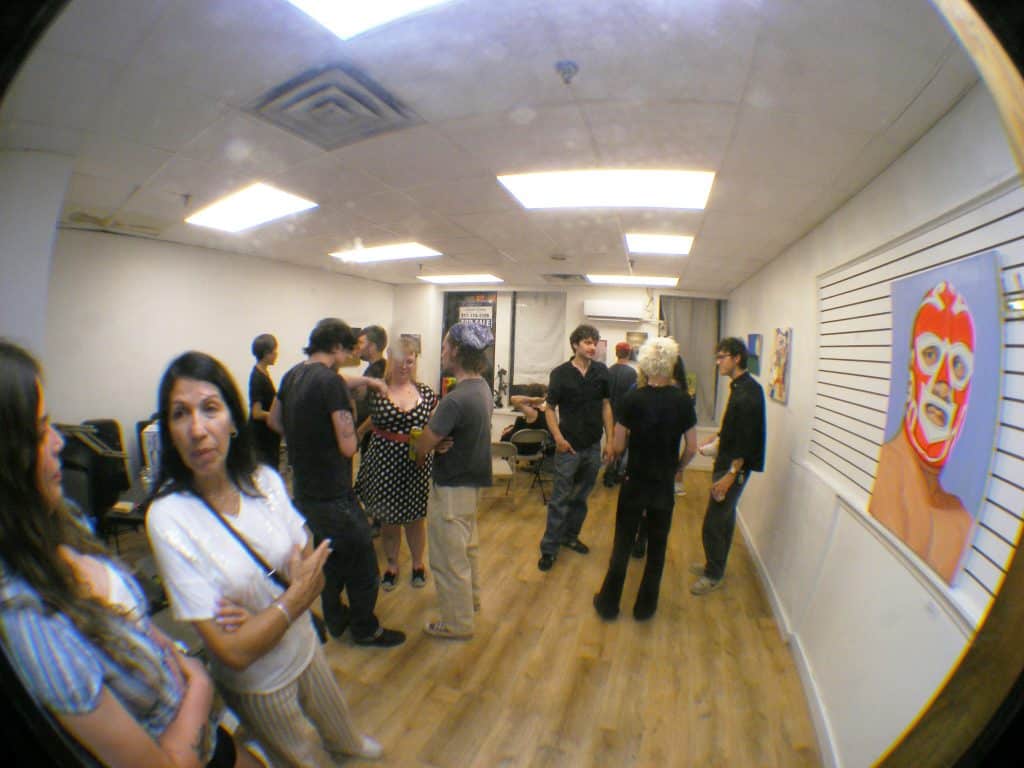
This is what an art gallery should feel like; what they could all feel like if money weren’t the main motivator. Galleries, more than auction houses and museums, are now experiencing the consequences of their own ruthless corporatization. As more big-shot galleries have been forced to drop artists and employees alike, it’s become clear that “value” isn’t what sells art to real people. Art is too undeniably primal, too irresistibly human for that. If galleries genuinely want to stay in business, they’re going to need to start showing some real passion. Considering the turnout for tonight’s Facebook Marketplace Gallery, they might even want to start taking some notes.
You can find out more about the Facebook Marketplace Gallery below: