The perfect author to bring you for part 2 of our Books Abroad content series is none other than Jhumpa Lahiri. As I mentioned in the last part, Lahiri is a master of capturing relationships, and her relatable dynamics will bring you comfort in your lowest moments.
All Things Jhumpa Lahiri
Unaccustomed Earth is Lahiri’s third book, preceded by The Namesake and Interpreter of Maladies (which also won the Pulitzer Prize). These books, one novel sandwiched between two short story collections, are thematically connected, says Lahiri in the newspaper “Living in Limbo”.
Specifically, she states that the characters of Interpreter of Maladies are loosely the parental generation of immigrants who first land in the U.S.A, and the character of Gogol from The Namesake is based on that generation’s children. Unaccustomed Earth’s characters are meant to be those children now in adulthood, in the roles the original characters were in then.
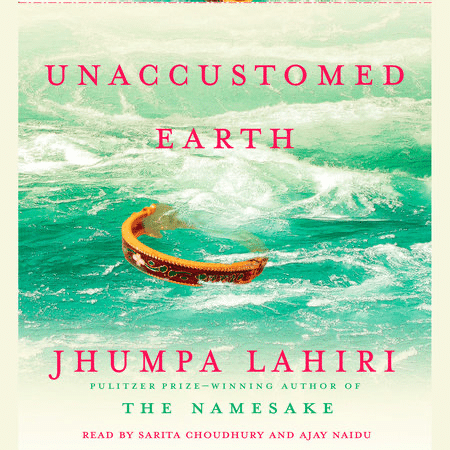
This third story collection is intended for adaptation into an eight-episode Netflix series set to premiere in 2026. It seems as though the cast is rather stacked with names familiar to those who have seen pivotal Bollywood and Hollywood films and TV shows. Siddhartha is one, and if you are familiar with Bollywood, Freida Pinto from Slumdog Millionaire is cast as well.

What inspired Unaccustomed Earth
Lahiri was inspired by a quote by Nathaniel Hawthorne, originally from The Custom House. It was from this that she tried to base the lives of her characters, both the parents who were once in the place of the children in Lahiri’s other books, and the current child characters.
A lot of the characters in this story collection are heavily Americanized, both parents and children alike. In the first story, Ruma says she has essentially lost her ability to speak Bengali. Both Ruma and Amit chose to marry Americans rather than Bengali men and women, respectively, as their parents would have wished.
This speaks heavily to the quote that inspired the book, as these children and their parents have all been moved to new soil rather than maintaining generations in the same place. One child character, Usha, who is largely still unAmericanized in the beginning, even from the outset, had a strong desire to become more American, which eventually wins out.

Jhumpa Lahiri’s writing style
Jhumpa Lahiri is a master at writing the relationship dynamics of her characters. Normally, she writes a lot about estranged relationships between parents and their children, as well as about disgruntled marriages among the parents themselves. Sometimes the focus of a story will be the initial married couple, but more often than not, these characters are secondary to their children, whose voice carries the story.

For this particular story collection, this makes sense given what I mentioned earlier about the thematic connection. Jhumpa Lahiri’s work has been called relatable for many people. One Afghan woman, who was then a student, and commented for “Living in Limbo,” said she took the two-hour drive from Amherst to the venue, not because of a similarity in background, but because she understood the discomfort present in Lahiri’s work.
“Dislocation,” Lahiri states, is the aim of a lot of her work, and to a lot of people, she does not seem to be missing the mark. Her prose is succinct, but not hard to read. Still, Lahiri writes with a realness that can be felt and understood by her readers.

The story of Ruma
The story of Ruma is one between her and her dad, to whom she has been estranged her whole life. It is now a little while after her mother’s unexpected death that her dad comes for a visit whilst Ruma is pregnant for the second time.
She aches for her mother, to whom she was close, and in the course of the week that the father is there, he’s proven himself useful in a way that Ruma thought could have only come from her mother. Her father seems to have become quite close with Akash, Ruma’s firstborn child. The story ends on a rather final note, though not the one that most of us would want, but could expect. Still, without giving spoilers, it has a sense of closure to it.
Sticking it out for a child is a facet of this collection that is consistent, where one relationship between a parent and child or a couple is estranged. But then there is the children or a child that the character with a grievance gravitates toward and keeps them in the relationship. In this case, it is Ruma’s son, her father’s grandson. In the third story, the husband, who is at odds with his wife, hangs on mainly because of his undying devotion to their children.
The story of Amit
I did not feel the same sense of closure in Amit’s story as I did with Ruma’s. The assumption is that everything gets worked out between him and his partner, Megan, but it leaves us in a kind of open-ended, airy place where it didn’t feel as thoroughly settled.
What interested me about this story is that it is the opposite of what we often see in other books about living as an immigrant, and in the book itself. By that I mean that Amit’s circumstances, as far as how he grew up and his parents being largely well off in both India and the United States, but also his criticism of India, were fascinating. He talked about his visit to Calcutta once and how bored he was while stuck in his family’s home there, yet at times, he seems to miss India. His family abruptly leaving him to move back to India, surely left some emotional scars, as he was not at all prepared for it.
I said in the first part of this content series that many of Lahiri’s characters have a deep-seated devotion to India that they try hard to pass on to their children, and though Amit travels to India, his parents don’t instill in him a lasting love for it. They even go so far as to send him to a boarding school in Langford to keep him from joining them in India for his dad’s new job.

The stories of Hema and Kaushik
This last part of Lahiri’s book, I thought, was a bit inventive, as she spent the entirety of part 2 talking about one particular couple throughout the course of several short stories. These acted like little snippets into their lives and subsequent relationship. The two seem maladjusted to each other, to be fairly honest, as a lot of the couples in Lahir’s work are. Their relationships are of similar circumstances and not much more.
You can see this in the connected short stories. I am a sucker for them as I love to follow characters through the arc of their lives. I also have a particular fondness for when it is done with short stories. This is because it really allows the person to feel and delve into a moment with the characters. After all, everything feels immediately magnified and intimate. Each of Lahir’s stories seems to truly bring something new with every ending.
And just like that, Lahiri’s characters, who were all well-traveled and kind enough to take us with them, are bidding us farewell. We close the door on Lahiri’s emotionally impactful stories and will soon move on to a set of Korean Short stories called Snowy Days and Other Stories.

I think this collection of stories was better than the Japanese ones, but that’s just my take on the two books. We shall see what the Chinese ones have in store for us. Leave a comment if you have read this book or the Japanese short stories collection. I hope to have you all here for part 3 of this Books Abroad content series! Until next time.