For many years, the Christian right has struggled to gain political relevance. But now that they have it, it’s causing new problems. Different denominations are seeking to create a “Christian nation” – and they have very different ideas of what that means.
Finding the light
Christianity has been the predominant religion in Western countries for centuries. However, in recent decades, America has seen a “rise of the Nones,” as an increasing number of Americans self-identify as atheists (who believe in no religion), agnostics (who believe that God’s existence is impossible to know), or as “no religion in particular.” These “Nones” made up 5% of the population in the early 1970s, but in 2025, make up 28%.
However, recent evidence suggests this anti-religious shift might be stabilizing, or even reversing. A lot of it is thanks to Generation Z. People tend to stereotype this generation as politically progressive, materialistic, and much more queer than previous generations. None of these things is incompatible with Christianity per-se (except maybe materialism). But, given the way the world interprets religion, people with these traits are less likely to feel at home in religious communities. However, Generation Z has struggled with deep isolation, particularly since COVID-19. Religion offered many a sense of security and community they were missing.
Many churches have also listened to Gen-Z and adapted to welcome their beliefs. In recent years, queer-friendly churches have risen throughout America. There are about 9,500 queer-friendly churches throughout the country now. This is triple the number that existed in 2003, when scientists began tracking it. The Methodist and Episcopal denominations have released acceptance statements. Even several Catholic churches have moved in a more accepting direction.
Churches have also made efforts to address social and political issues that young people care about. Church services can give young people a way to help causes they care about. Through action and service, this can mitigate the anxiety young people face about the future.
A new side of an old religion
However, it must also be said that the rise in religion has a lot to do with politics.
For many years, President Trump has worked to create a narrative that American Christianity is under attack from secular Democrats. In his second term, he has repeatedly infused government and Christian practices. This has included creating an Executive Order to “eradicate anti-Christian bias,” planning to hold a prayer gathering on America’s 250th birthday, and releasing a memo that allows government workers to “participate in religious expressions of faith,” which critics say could create a hostile environment for co-workers with differing beliefs.
Christian nationalists – people who want America’s government, culture, and identity to be unwaveringly Christian – are among Trump’s strongest supporters. While Christianity preaches doing good, a nation run by Christian nationalists would arguably not be good for anyone. It should come as no surprise that Christian nationalists tend to despise other religions. After all, they believe America and Christianity are intertwined; they believe that Americans who follow other religions (or no religion) are not “true Americans,” and not worthy of the same rights or respect. Since some Bible verses have been interpreted as condemning queerness, it should also come as no surprise that many Christian nationalists are queerphobic and transphobic. But it doesn’t stop there. Christian nationalism is also linked to racism, ableism, and misogyny.

These other prejudices have less to do with textual Christian beliefs. Instead, they come from prototypical, historically-constructed Christian nationalist beliefs on what a Christian should be. The “nuclear family,” for example, is a relatively new concept (in fact, many biblical characters were in polyamorous relationships). But Christian nationalists often accept the myth that this family structure is “holy” because it was portrayed that way. Some may justify taking away women’s rights on the grounds that this divine family structure must be created.
Christian nationalism can be incredibly amorphous. That matters, not only to marginalized groups, but to Christians. Christians themselves don’t agree on very much. Likewise, Christian Republicans might not hold the same views on what a “Christian nation” should look like.
Breaking bread, breaking ties
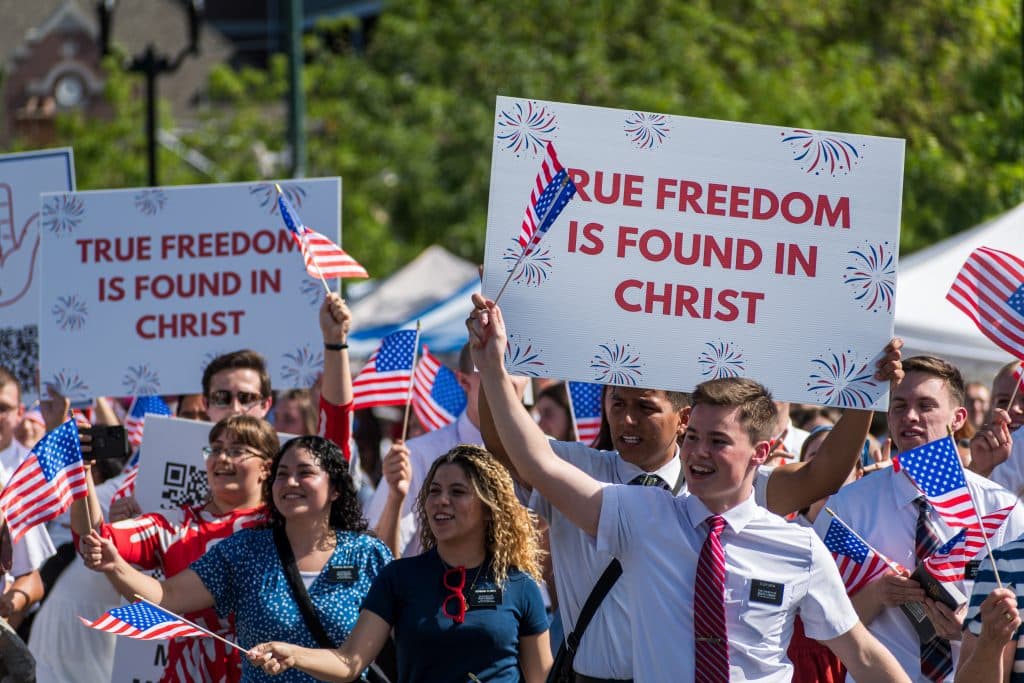
As Trump’s control grows, the actions he takes to create a “Christian” nation will not just alienate nonreligious people. It will also spread to people who believe in different versions of Christianity than the administration.
White Evangelicals have been one of Trump’s most important voting blocs. But recent polls suggest that Trump is becoming (relatively) less popular with them. In August 2025, 61% of surveyed white Evangelicals supported him, but now, this percentage has dropped to 52%.
Their main reasons seem to be disapproval of the war in Iran, Trump’s hardline immigration stance, and the fact that, compared to other Republican candidates, he doesn’t have much passion for erasing the LGBTQ+ community or stopping abortions. Although he has, as a President, stripped trans people of legal rights and appointed the Supreme Court justices who overturned Roe v. Wade, his Christian supporters arguably have a much more genuine desire to see these so-called “unholy” things disappear than he does. As late as 2016, Trump supported letting transgender people use the bathrooms they wanted. He has also been relatively quiet about DEI since the war in Iran started.
Furthermore, in recent years, Trump has compared himself to God quite a few times. On Easter week, when Trump faced charges of falsifying business records, he shared a Truth Social message from a follower who remarked, “It’s ironic that Christ walked through his greatest persecution the very week they are trying to steal your property from you.” Around the same time, he shared AI images depicting himself as Jesus Christ. Several Christian leaders condemned him for blasphemy. Most recently, Senator Lindsey Graham has said in a thank-you speech after winning his primary, “Mr. President, you’re not far behind God, but we’re gonna start with Him.” The statement quickly went viral – and not in a good way.
While Christians are at the top of the country now, at the same time, Trump’s actions have backed them into a corner. They have two choices. First, they must either accept (or ignore) the premise that Trump is god-like, despite how clearly sacrilegious the idea sounds. Or, they will have to push back and risk losing the community of pro-Trump Christians and their dominant social status.
Recently, the administration might have knocked one group of Christians off its pedestal. On June 5th, the Department of Defense slashed its list of recognized religions from 200 to just 31. Some of the options cut include atheism, paganism, Unitarian Universalists, and Mormons. Mormons, despite being reliably conservative, have viewed Trump less favorably than most religious groups for years. One proposed explanation is that his personality does not mix well with a faith that preaches quiet humility. Also, Mormons have made efforts to make their church more diverse, in part because large numbers of people are leaving. Trump may make that harder.
Unsurprisingly, Mormons did not like that soldiers could no longer identify as Mormon. So the Pentagon revised it, but listed every religion as “Christian” except for Mormonism. Utah Senator Mike Lee, a Mormon and a Trump ally, posted a two-minute video on X demanding change.
It’s a fair sentiment. The problem is, Lee supported Trump’s administration, which always wanted to dissolve the separation of church and state. Obviously, this wasn’t what he intended when he gave that support. But what a state does when the people let it have a say on religion is, well, whatever it wants. While such a state might not get involved in “denominational disputes”, it always can. And there is no denying that this is the social contract Lee agreed to.
Divided on holy lines
While in university, I studied Political Science and English. Although I initially went into Political Science thinking I wanted to study political systems, I became drawn to political theory. This asks more abstract questions about what the real meaning of things like “justice,” “legitimacy,” and “freedom” are. It also asks what kinds of political institutions might help us achieve them.
The main political theory professor once belonged to the Mormon church. Me – and, I believe, most of the students he taught – were high-strung, frustrated, self-righteous liberals. We knew that old, religious men out-of-time ran our country and were trying to repress our vision of a new world. But we didn’t look more deeply into it.
Indeed, modern Christian nationalism is directly trying to persecute people and restrict their freedoms. But I think it was also true that, because we were young and afraid, we developed a quasi-religious sense that being the persecuted ones made us virtuous. We believed that even if we did nothing to bring good to the world, we were smarter, more egalitarian, and more consistent in our beliefs than any religious person could ever be.
The most important thing that this professor taught me was the importance of intellectual humility. No matter how smart one is, it’s dangerous to see ourselves as inherently smarter than those we disagree with.
As a professor, he tried not to talk about modern politics. Sometimes he did, but it was selective bits to avoid larger, more substantial issues. We would ask him about his thoughts on current events. He would give just enough so we wouldn’t keep asking. Since he realized we didn’t know much about religion, he would often say that, once the people most Christians considered “heathenish” were out of the way, the different denominations would turn on each other until one gained control.
Once, to illustrate this, he told us about his time as a Mormon missionary in Texas. He first informed us that Mormons (or, the Church of Latter-day Saints) have widely different beliefs from most Christians. While they believe that Christ rose from the dead to save humanity from its sins, they differ from most Christian denominations in three important ways.
First, while most Christians believe in the Trinity – the theory that God, Jesus, and the Holy Spirit are the same being in three different forms – Mormons believe they are three distinct beings. Second, Mormons believe in a “law of eternal progression.” This teaches that humans, angels, and gods share the same essential substance and differ only in their proximity to holiness; through intense devotion to God, humans can become divine beings. Third, Mormons believe that centuries after God sent Jesus, he spoke to an American prophet named Joseph Smith, leading to the creation of the Book of Mormon. To many Christian evangelicals, these beliefs are not “different” – they are downright blasphemous.
So, as a Mormon missionary in evangelical Texas, my professor was not successful. He joked once that he only converted three people, and all of them left within a couple of years. He mostly spent his days walking up to doors that people immediately slammed in his face.
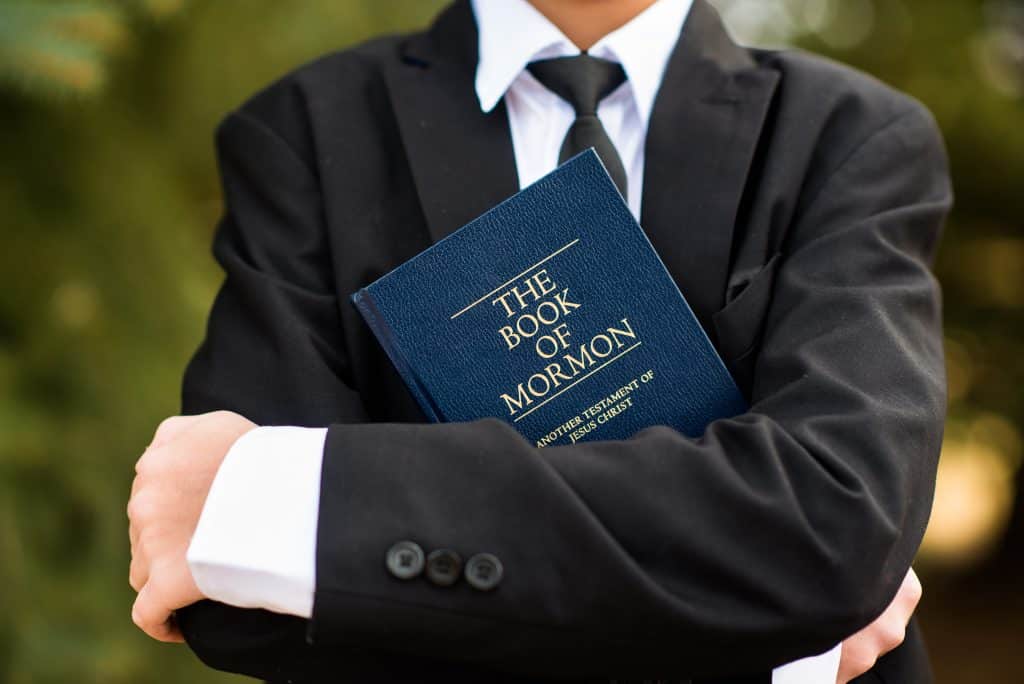
Once, however, when walking through a neighborhood with his Mormon suit, the book of Mormon, and a partner (their missionaries travel in pairs), he was shot. The missionaries aren’t allowed to use phones, and he didn’t know where the nearest hospital was. So, he wandered through the neighborhood, trying to get help. He knocked on the same doors he’d knocked on throughout the day. Instead of offering to save the people inside, he asked them to save him. They refused. Seeing that he was Mormon, they were fine with letting him bleed out.
Eventually, he did find a hospital. When he talked about it in class, it wasn’t a source of pain for him. It was more or less an old story we could learn from. And I did. Until that point, I’d been too intimidated by rising Christian nationalism that I never realized how deeply, how quietly, members of that movement could despise each other, too.
Eating their own

One of the more interesting things I learned in this professor’s classes was the views of a Nazi political theorist, Carl Schmitt. His political thought begins with his attempts to define what politics is. Similar to how morality is defined by a distinction between good and evil, and aesthetics by a distinction between the beautiful and the ugly, he claims that politics is defined by a “friend-enemy distinction.” Every political action stems from the understanding that there are enemies in the world (typically other nations) that pose a collective threat to a group’s survival. He claimed that, because politics is set up this way, liberal ideals of compromise and diplomacy are a facade, masking how the world truly works.
Many people believe that dictatorships, as a whole, are not sustainable because the people will eventually revolt. I’m not optimistic enough to believe that. What I do believe, however, is that an ideology of division will cannibalize itself if no one stops it. If politics depends on an enemy, and if that enemy is vanquished, a new enemy must always take their place. And then, just as paper folds into itself, people who were considered “good” by the regime will one day find themselves outside of its lines . People who choose this expect that, because they might be the type of people the administration prizes now, they will be safe in the future – but that is a dangerous mistake.
Although I’m still no expert on Christianity, this current administration’s attempts to consume its own citizens – the ones who they claim are not “real Americans” – feels evocative of, and yet incredibly different from, one of the Bible’s most famous stories: the Last Supper. In it, Jesus offers bread and wine, representing his body and blood, to his disciples, including one whom he knows will betray him.
Authoritarians eat their own because they believe a uniform national and cultural identity – including a strong religious identity – is the only way to survive the world’s perils. By contrast, the Last Supper is a story about a person who accepts an imminent threat, and chooses to give all of themselves to others, without distinction between friends and enemies, letting themselves be vulnerable to save those around them. While I doubt America needs “Christianity,” I do think that, to bridge the deep political and social divides that have formed over the past decade, it does need people with that quietly brave, patiently selfless spirit.
Until then, we might never find the light.