Adam Sieswerda is many things, but surely not camera-shy. A life under the lens is all he’s ever known. In his mother’s (Amy Jenkins) documentary, viewers are invited into increasingly personal moments as the family struggles with his transition.
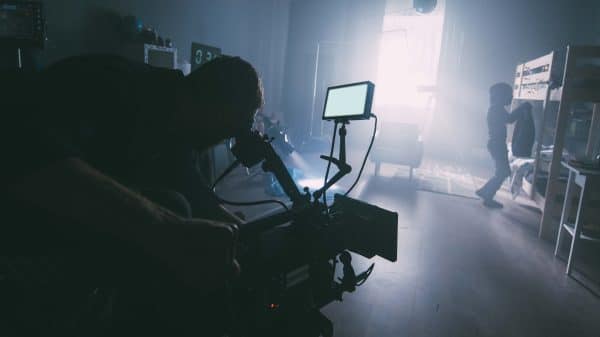
“I grew up being filmed by my mom, filming myself, and my dad and my little brother also filming. We’re just a family that captures the moment for ourselves, and it wasn’t ever really the purpose of making a project for another audience,” said Sieswerda.
He and his family are used to recording sensitive conversations — like multiple ones included in the film, as his parents deal with his transition and general teenage angst — that many people might never do under the watchful gaze of a camera. But to them, it was an important family archive.
He said, “There were times when I was a teenager where we would say, ‘We’re going to have a conversation, sit down and film this because we want to capture the conversation and everything that is changing in this moment.'”
Jenkins clarified that the family calmly allowed one another to request certain moments not be recorded if they wished. “We’ve been really fortunate to always have open dialogue about what to record, when to record. We’ve always respected one another’s boundaries.” Even with that, the documentary is hardly starved for content.
A family archive turned into a film.
Sieswerda said Adam’s Apple, which premiered at the SXSW Film & TV Festival, only really came into fruition as editing began.
“It was very much a collaborative effort between Adam and me, but also our editor Kristina Motwani and our producer Brit Fryer. Occasionally, we had a story consultant, Carter Sickels, come in,” Jenkins added.
This committee met on weekly Zooms for up to 8-10 hours discussing scenes; the edit ultimately took over a year. Jenkins and her son were so closely attached to the story that they needed outside perspectives.

“What we really wanted to do was to tell a story about the family. Have an intimate portrait of the family, but also have it rooted in unconditional love. So, a lot of our decisions of what to include in the film had to do with how that supported our narrative and what moments within our family helped show that,” she said.
Adam’s Apple doesn’t shy away from the hard moments.
Sieswerda ensured one scene in particular survived the extensive editing process. The scene in question depicts his frustration with his mother keeping an old stocking that has his dead name.
“I found, in retrospect, a lot more understanding and patience for my parents’ processes of accepting me. They have memories that they’ve formed from when I was a toddler that just don’t exist in my mind, and attachments that they formed that take time to work through, and it’s a nuanced process,” he said.
He found that how steadfastly he asserts himself made the scene important. Additionally, he believed it shows that moments of “negotiating other people’s processes still need to be rooted in love and care.”
The film represents “how reckoning with change is a universal experience, and parents are always needing to let go,” said Jenkins. “Let go of their expectations; let go of their child when they leave home.”
Adam’s Apple documents Sieswerda’s struggle with his self-expression, having feared doing certain things that may taint how others perceive his masculinity.
“When I came out as trans, I was very concerned with that being taken seriously. Obviously, for good reason, because you want your gender identity to be taken seriously. But I had all of these limiting prejudices or expectations. Someone won’t take me seriously as a guy if I wear nail polish, for example.”
But over the pandemic, this began to change. He said, “I was very grateful, or very lucky, to be in a class where we were reading a lot of gender theory. That was the first time I was experiencing many of these texts. There were a lot of revelations in myself about what made me happy, what didn’t make me happy, what being a man and what being a trans man meant to me.”
Not everyone may transition, but everyone was a teenager and may see themselves in Adam’s Apple.
Sieswerda considers his struggle with gender expression a fundamentally universal experience, and hopes the documentary reflects that.
“Many of the questions I had, or the things I thought I could or couldn’t do as a boy in the world, were questions that my cisgender friends who were boys had. I really want people to notice that in the film, and reflect on it themselves. That we all actually have this process of self-questioning.”
When he transitioned, he actively sought out trans-male role models, rather than cis-men like Superman. He could still connect with these cis-male figures, but found they lined up less with his experiences.
He said, “They were limiting in a way, because it was a very specific and very traditional way to be masculine… it makes things easier to see someone else doing life the way that you are doing it.”
Wishing to depict the trans joy he searched for as a child, he avoided merely highlighting his worst moments.
Jenkins added that “the film shows how crucial it was for Adam’s mental health to transition in high school when his peers were also going through puberty.”
“Ultimately, what we want to communicate is unconditional love for trans kids. And that not only means unconditional love from other people to them, but also of trans kids for themselves. They feel like their identity is something that is inherently good, natural, loving, and lovable,” Sieswerda said.
Adam’s Apple is scored exclusively with music he created during the teenage years depicted.
He said, “Choosing songs that I had previously written rather than creating new original music or having someone else do new original music was an important decision, because those songs were the way that I was expressing myself creatively at the time.”
How did Adam name himself, or his film?
Adam’s Apple seems to reference a specific instance where Adam tells his mother he wishes he had one. But that may not be the case.
“Maybe that was the light bulb moment. I’m not even sure, but also given that his name is Adam, it just came up and stuck. We never considered anything else,” said Jenkins.
Sieswerda found the scene pivotal; he chose the name Adam because of its ingrained masculinity.
“I wanted that when I was younger because I thought it would help me fit in. Now, to me, it’s a symbol of something that I can take and say, ‘Within my trans-masculinity, this is equal to that image.’ That symbol is in no way less or different; it just is another valid way of being a man in the world,” he said.
Amy Jenkins’ ‘Adam’s Apple’ had its World Premiere at the SXSW Film & TV Festival on Friday, March 13th, 2026. For more information, visit the film’s website or SXSW listing. Quotes adjusted for clarity and length.