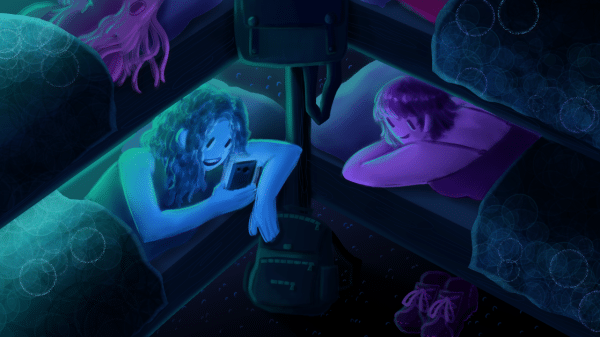


The room is quiet except for the glow of a phone screen.
You scroll.
Then scroll again.
A video appears. A meme. Someone’s holiday photos. A friend is celebrating a new job. Another post. Another swipe.
Maybe someone will message. Maybe someone will react to your story. Maybe someone will send you a reel they thought you’d like.
These small notifications have become signals of belonging, tiny reminders that someone, somewhere, is thinking about you.
But sometimes the screen stays silent.
For Generation Z, connection has never been easier. Messages arrive instantly. Group chats run late into the night. Social media allows us to watch hundreds of lives unfold in real time.

And yet loneliness among young people is rising.
A survey by Oxfam found that 47% of Gen Z in the UK say they often feel lonely, despite being the most digitally connected generation in history. Data from the Office for National Statistics also shows that young adults aged 16–24 are among the most likely to report loneliness in Britain.
The contradiction is difficult to ignore.
If we are more connected than ever before, why do so many of us still feel alone?
Communication without connection
Loneliness is often imagined as physical isolation, an empty room, a silent phone, and no plans. But for many students, it appears in quieter, more complicated moments.
Sometimes it arrives after the noise.
Alex, a second-year computer science student from Ukraine at the University of Leeds says he sometimes notices loneliness after spending time with others.
“I’m quite social most of the time,” he said, “but especially after hanging out with people, I feel it.”
Being online does not necessarily solve that feeling.
“You’re communicating with people,” he explained, “but you’re not necessarily getting that connection.”
I asked Alex whether social media makes him feel connected. Listen to a snippet of our interview to find out what he said.
Despite spending a significant amount of time online, he does not believe social media brings him closer to others.
For him, real connection still happens offline, in conversations that go beyond surface-level topics and where people feel comfortable simply being themselves.
The pressure to appear successful
For other students, loneliness is linked less to silence and more to pressure.
Lizbeth Gomez Pinacho, a Journalism student at Montclair State University in New Jersey, says the feeling often emerges when she thinks about life after graduation.
“I don’t feel lonely all the time,” she said, “but going into my senior year and thinking about post-grad, there’s a sense of uncertainty. You feel like you have to figure it out on your own.”
As a first-generation university student, Lizbeth says that uncertainty can feel isolating.
“No one in my family really understands what it’s like to go into corporate America or journalism,” she explained. “Sometimes I feel like I’m going through that process alone.”
Social media can intensify that pressure by presenting a constant stream of success stories: internships, job offers, and achievements.
“Social media has become a flex to show your accomplishments,” she said. “You want people to see you’re doing good.”
But that image does not always reflect reality.
“You can look put together online,” she added, “but be in distress in person.”
Expectations and belonging
University is often described as the easiest place to make lifelong friends. But the reality can be more complicated.
Environment and Social Change student at the University of Royal Holloway, London, Kimberley Jones, said her first year did not match those expectations.
“It took me most of the first year to meet the people I’d consider my friends,” she said.
During that time, she experienced periods of loneliness and a loss of confidence.
“I just lost confidence in who I was,” she explained. “I didn’t feel like I was being accepted.”
Psychologists sometimes describe this experience as indirect loneliness, feeling disconnected even when surrounded by people.
University environments offer endless opportunities to socialize: societies, lectures, shared housing, and campus events. Yet, those opportunities can also create pressure to belong quickly.
“When you feel like you’ve been rejected once,” she said, “it becomes harder to put yourself out there again.”
By the second year, she began approaching social situations differently. Instead of expecting immediate friendships, she focused on simply attending activities and meeting people gradually.
Confidence, she believes, plays an important role.
“If you display yourself with confidence,” she said, “people tend to lean towards that.”
When scrolling fills the silence
Many students recognise the role phones play in moments of isolation.
Kimberley, a student at Royal Holloway, London, says she notices a pattern when she spends more time on her phone.
“When I’m on it more, it’s not a positive thing,” she said. “It usually means I’m filling a void of time.”
Researchers often refer to this behavior as doomscrolling: endlessly consuming content in search of stimulation.
Social media platforms trigger small bursts of dopamine that encourage users to keep scrolling, even when the experience leaves them feeling empty.
Yet, technology can still play a positive role. Being able to call friends or family from home provides comfort during moments of loneliness.
Still, she jokes that sometimes a simpler phone might be better.
“Sometimes I feel like I might as well just have a Nokia.”
What does real connection mean?
Despite their different experiences, the students interviewed for this article share a similar definition of real connection.
For Alex, the Leeds student, connection means moving beyond surface-level conversations.
“I feel like the real connection is when you can talk about deeper topics,” he said.
Lizbeth believes connection requires understanding the many layers of another person.
“Humans are so multilayered,” she said. “It takes time to really understand someone.”
Kimberley describes the connection as a “click”:
“It’s when you can be yourself,” she said, “and the energy you’re getting back from that person matches yours.”
None of them described social media as the place where that depth of connection usually forms.
Ways to combat loneliness
Experts often emphasise that tackling loneliness does not require dramatic changes. Small steps can make a meaningful difference.
Relearning how to belong
“Humans are so multilayered. It takes time to really understand someone.”
Lizbeth
Later that night, the phone screen lights up again. Another notification. Another message. Another endless stream of posts from people living their lives in carefully framed squares. You scroll. Then scroll again. For a moment, it feels like a connection, a quick reaction, a shared meme, a message that briefly interrupts the silence.
But as the students in this story suggest, belonging rarely happens in the feed itself. It happens somewhere slower: in long conversations, awkward first meetings, shared experiences, and the gradual understanding of another person’s life.
In a hyperconnected world, loneliness does not always come from silence. Sometimes it comes from the quiet realisation that being seen is not the same as being known.