In 2025, Republican lawmakers in Texas did more than redraw congressional districts mid-decade. They attempted to lock in what they believed was going to be a lasting political realignment.
Republican gains in 2024 included a noticeable rightward shift among some Latino voters in South Texas, a shift that gave lawmakers confidence that the state’s political map was changing. Rather than waiting for the next census cycle, they moved to redraw district boundaries ahead of the midterm elections. The revised map shaped several districts with large Latino populations in ways designed to translate recent momentum into additional Republican seats in Congress.
But this strategy rests on a bold assumption: that the electorate shift is permanent, and if this assumption proves wrong, the map could backfire.
Legal challenges
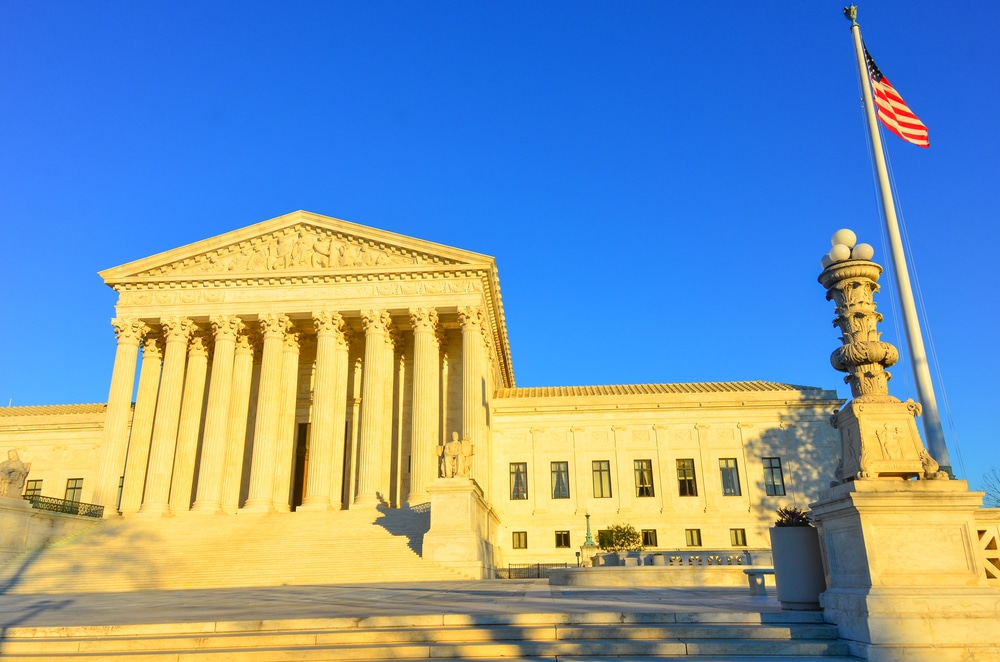
Almost immediately, both civil rights organizations and Democratic officials challenged the new map in federal court. They argued that lawmakers relied too heavily on racial data when designing districts, crossing lines previously established by the Supreme Court. While states may consider race in a limited capacity, it cannot be the predominant factor in how districts are drawn.
In November 2025, a panel of three state judges ruled that portions of the revised map likely violated federal law. Republican lawmakers appealed this decision to the Supreme Court, and in December, the Supreme Court ruled 6-3 to allow the revised map to be used for the 2026 election cycle while legal challenges continue.
The gamble
These redrawn districts were built on a theory: that the rightward movement among Latino voters in 2024 represents a long-term shift, rather than a temporary response to inflation, border policies, and other talking points around the election year.
Particularly in working-class communities, Republicans made massive gains, and party leaders saw this as a potential opportunity. If Latino voters were permanently realigning themselves, even modestly, then redrawing districts now could convert short-term momentum into advantages beyond 2026 and to the end of the decade. But electoral coalitions are rarely static.
Early polling and special elections in some of the newly drawn districts have sent mixed signals, with Republican candidates struggling to replicate 2024 margins. Debates on immigration enforcement, and renewed tensions globally have left many discontent with not just the Republican party, but the Democratic.

Redistricting works when political trends are stable. Texas lawmakers are, however, trying to draw lines at what may have been a moment rather than a movement. That is the gamble.
The Houston example
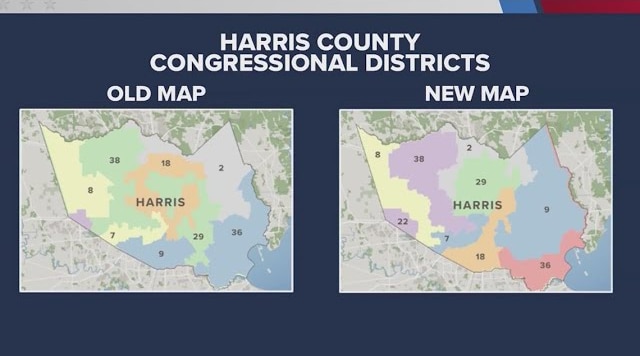
The effects of this gamble can be best seen in the Houston area, where the redrawn map has significantly altered several districts in and around Harris County, causing voter confusion. One of these affected districts includes one represented by Representative Sylvia Garcia.
“Congresswoman Sylvia Garcia was one of their top targets. Her 29th Congressional District was redrawn in a fashion that raised the real prospect that Houston’s only Latina U.S. representative could be defeated in next month’s Democratic primary”. ~ Houston Public Media
Traditionally urban Democratic districts were combined with suburban areas that leaned more Republican in 2024. The intent was clear: to see whether recent shifts in Latino voting patterns could hold under new boundaries. Yet despite those changes, Garcia has remained competitive in the Democratic primary, with both her fundraising and turnout not collapsing under the redrawn map.
Garcia’s tenacity does not invalidate the broader Republican strategy, but it also highlights a critical limitation: the inability to dictate voter behavior. If either Latino voters revert even slightly to prior voting patterns, or if suburban voters shift in response to national politics, then the carefully engineered advantage could not only narrow, but potentially backfire.
A national arms race on redistricting
Texas’s mid-decade redrawing has implications beyond its borders.
The effort was not simply about expanding Republican influence, but protecting it. With control of the U.S House of Representatives at risk in 2026, Republican leaders have explored whether redistricting could offset unfavorable national trends or protect vulnerable incumbents. Texas became the most visible test case for this strategy: redraw congressional lines mid-decade to secure advantages before the political environment deteriorates any further.
In California, Democratic leaders have signaled their readiness to defend their congressional positions if Republican-led states aggressively redraw their maps. Although California’s independent redistricting commission was designed to insulate district lines from partisan manipulation, that structure has increasingly been viewed not as a safeguard, but a disadvantage in what many now describe as a national redistricting “arms race”. As states like Texas continue to pursue an advantage in the House, pressure has mounted within California to reconsider whether neutrality remains viable when other states have all but abandoned it.
Proposition 50
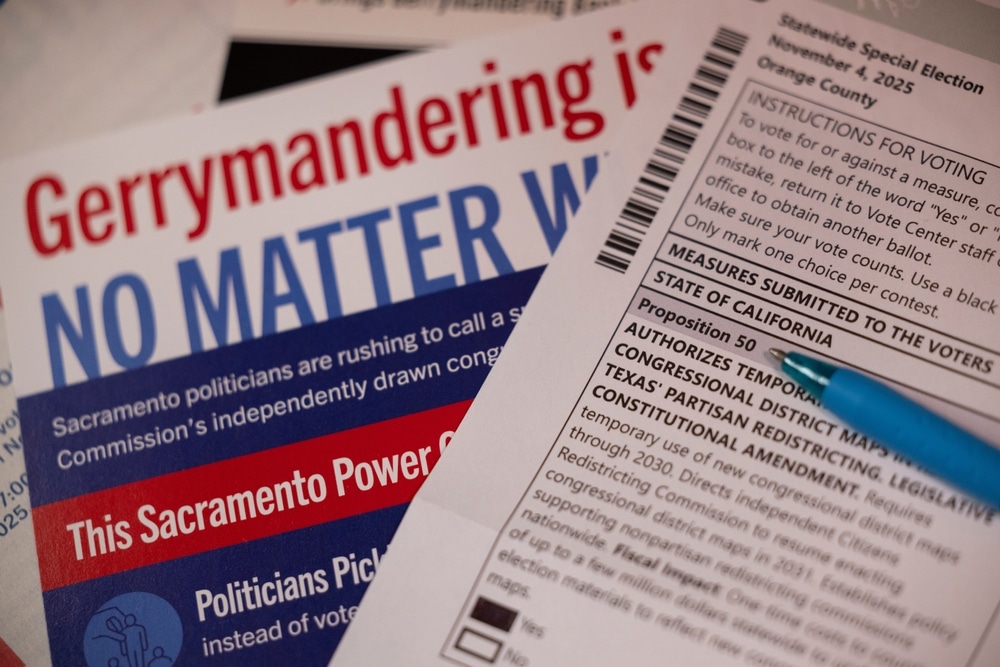
This tension came to the forefront with Proposition 50, which passed with overwhelming approval (64.4%). Rather than simply transferring power back to lawmakers, Proposition 50 represents an attempt to recalibrate the balance of authority while grounding changes in voter consent. This measure does not dismantle the commission, but signals that Democratic states do not intend on remaining bystanders. Proposition 50 underscores a broader reality: California’s approach to redistricting is no longer insulated from interstate partisan conflicts.
If courts ultimately affirm that mid-decade redrawing is permissible in competitive states, the traditionally ten-year redistricting cycle may give way to something far more reactive. The result is the normalization of a national redistricting arms race.
If one state redraws its district boundaries to gain seats in the House, opposing states may feel compelled to respond in kind. Escalation would become the routine rather than the exception. What was once an administrative duty tied to the census could escalate into continuous contests, where both parties fight for every seat in the House of Representatives.
What does this mean?

Ultimately, Texas’s redistricting effort reflects a familiar political impulse: turning short-term success into long-term structural power. In simpler terms, lawmakers are attempting to freeze a moment in time.
After 2024, Republican leaders interpreted the Latino voter movement as evidence of an enduring political shift. Redrawing district lines was a way to convert that shift into an advantage in the House, while also acting as a buffer against the uncertainties of the 2026 election cycle.
As the 2026 midterm approaches, the central question in Texas is no longer simply whether the map will survive judicial review, but whether lawmakers drew lines around an electorate that is already shifting again. If so, the carefully engineered map may prove less durable than the voters it was designed to contain, as while political maps can be engineered, political behavior cannot.