

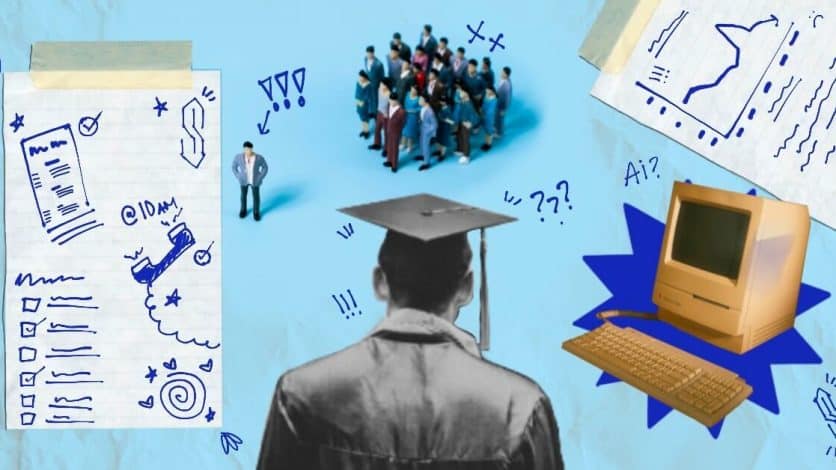
My ten-year undergraduate career was nothing short of a hot mess, but it’s finally over. Rather than celebrate the loss of super senior status like I thought I would, I’m currently in a state of perpetual freeze and uncertainty over what I’ll do next.
As I lie on the living room couch and stare at the light fixture that’s ever so slightly off-center, an overwhelming sense of dread consumes me at my core. I wonder if any of this even matters. Don’t we all just die anyway? Why am I crying over the simple notion of getting (or not getting) a job?
Rather than allow myself to marinate in couch leather and hopelessness, I decided to use my research and interview skills to ask some people (who know more than I do) what I should do to achieve the coveted paid position. My intentions through this process are to hopefully make the uncertainty of the future a little less horrifying while receiving some useful information that may help others in a similar (i.e. terrified and jobless) situation.
What’s The Big Deal With Finding a Job?
The job market, especially for recent graduates, is chilling to say the least. According to an article written by the Associated Press via Fast Company, besides what they were during the COVID-19 pandemic, unemployment rates for recent graduates ages 22-27 are the highest they’ve been in 12 years. Between the economic uncertainty created by the Trump administration and the widespread use of AI as a cheating tool in colleges and universities, employers are reluctant to take a risk and bring on up-and-coming talent.
Anecdotally, all you have to do is a quick Google search to find pages upon pages of disgruntled would-be workers. The subreddit r/recruitinghell, a space to vent about the nightmare that is the 2025 job hunt, has 1.1 million members and counting.
“The job outlook right now is full of uncertainty. Employers are unsure of funding and changes in their budgets and are being cautious with hiring,” says Larissa Allen, Associate Director of the Career and Personal Development Center at Frostburg State University.
So, Now What?
If you’re feeling a bit dejected, worry not! Luckily for all of us, according to Allen, there is hope.
“There are jobs out there, but it will take more than a great resume to get them. Think about upskilling: building on skills that are needed in that industry or adding certifications and experiences.”

Networking, or “the cultivation of productive relationships for employment or business,” is also something Allen stresses.
“Finding a job requires networking and building connections. More than 80% of the jobs are in the hidden job market,” says Allen.
Some examples of networking include attending happy hour networking meetups, higher education lectures, seminars and conferences, and roundtable events specific to your field of interest.
It’s very important to actually communicate with people when networking. Going to the events is all well and good, but if you don’t talk to anyone, how will they know who you are? Make sure to dress well, introduce yourself, and make a good first impression. With luck, you could meet your future employer!

Applicant Tracking Systems (ATS)
According to Allen, one of the biggest mistakes she sees recent graduates making during the job search process is not tailoring their resumes to Applicant Tracking Systems, or ATS.
“ATS…is [a] computer software used by employers to manage and track resumes and job applications. When someone submits a resume online it is typically scanned by an ATS before it gets to an actual person. The software ‘reviews’ the resumes for the best fits for the job description and matching qualifications.”
Allen recommends skipping things like resume templates, fancy graphics, and tables since ATS has trouble “reading” them and may unduly reject your resume. Instead, Allen recommends starting with a blank Word document.
“[I]t’s so important to start with an easy-to-read resume that is tailored to the specific job using key words from the description.”
Dreading the Future
There’s a general malaise that surrounds me as I lie in bed and draft this article. Life isn’t as scary in bed. Maybe it’s the pillows or the knowledge that sleep is never too far away.
As I draft, I imagine the writing process from idea to execution to finished piece. I recall painstakingly choosing each word to best convey my message and ensure my thoughts are coherent. And I see snack-fueled nights in front of my PC, tapping away at my keyboard and trying not to turn my back into the letter C from poor posture. I remember battling my SEO checker over sentence length or a stylistic choice I refuse to change.
I picture all of these things, and then I remember that a robot can generate thousands of words in seconds. And that all the job listings I’ve seen for freelance writing positions require a minimum of 25 articles a month.
Will AI Replace Me?
And, for companies refusing AI-generated writing, will I have to work like a machine to survive? These are questions that a lot of creatives grapple with, especially since the widespread implementation of generative AI tools. Still, I won’t answer these questions by becoming one with my mattress.
Instead, I talked to journalist, magazine editor, and freelance writer Glenn Hansen of Hansen House Communication to find out what the writing landscape is like.
And, more importantly in my case, has AI destroyed the writing profession? To my surprise, according to Hansen, the widespread implementation of AI has “changed my work in very small ways.”
“The clients who often were the lowest paying, they don’t contact me anymore. I assume they are using generative AI tools.”
Hansen also believes this work could return as people begin to realize the limitations of generative AI. In any case, the loss doesn’t seem to be affecting Hansen or his business.
The other good news is that AI probably won’t steal my job. Hansen, who has been experimenting with top AI tools like OpenAI’s ChatGPT and Google’s Gemini, doesn’t trust the technology fully.
“I do not believe AI will completely replace humans in creative fields. It might harm the work and business of artists and writers who are less committed or those not in the work as a full-time business endeavor. I’ve asked these tools to write things, and have found disappointing results. I spend so much time editing and rewriting that I don’t see the value.”
Despite AI’s limitations and potential downsides, Hansen has found it to be helpful for more mundane tasks like starting research and editing long-form content.
“Yes, it [information gathered through generative AI] all needs fact checking, but it’s a good start.”
And The Workload?
One thing that continues to haunt me is the 25 article minimum per month, so I asked Hansen for his take.
“There are some insane standards for quantity of work, and that is a new standard, in my experience.”
Hansen doesn’t believe these expectations are sustainable as a long-term strategy for publications.
“Publishers test that and then continue doing it as long as they can. And they burn through writers, whether staff or freelance.”
Advice for Writers
Hansen had a lot of really helpful advice for new graduates, especially writers, in the age of AI.
“First, develop your voice and style as a writer. You, personally. AI can’t do that.”
Like Allen, Hansen also recommends networking.
“[C]onnect and network with writers and designers and agency owners. Be human, establish relationships and ask for work. People do still prefer to hire people, and that begins with relationships.”
Finally, like Allen, Hansen recommends upskilling.
“Have a tangible skill—photography or Photoshop skills or podcasting or sound/video editing. You need to hone your primary craft and also develop a skill. Often today, that is the efficient use of technology tools, maybe SEO or TikTok or Canva or all of the above.”
Maybe I Can
A few weeks ago, my dad brought over a box full of stuff from my early childhood. It had overly-detailed daycare records, endearingly sloppy craft projects, and even an old pair of teeny little pink sandals.
One thing in particular caught my eye as soon as I saw it: my 5th grade yearbook. I flipped to the last page and saw a signature from my teacher.
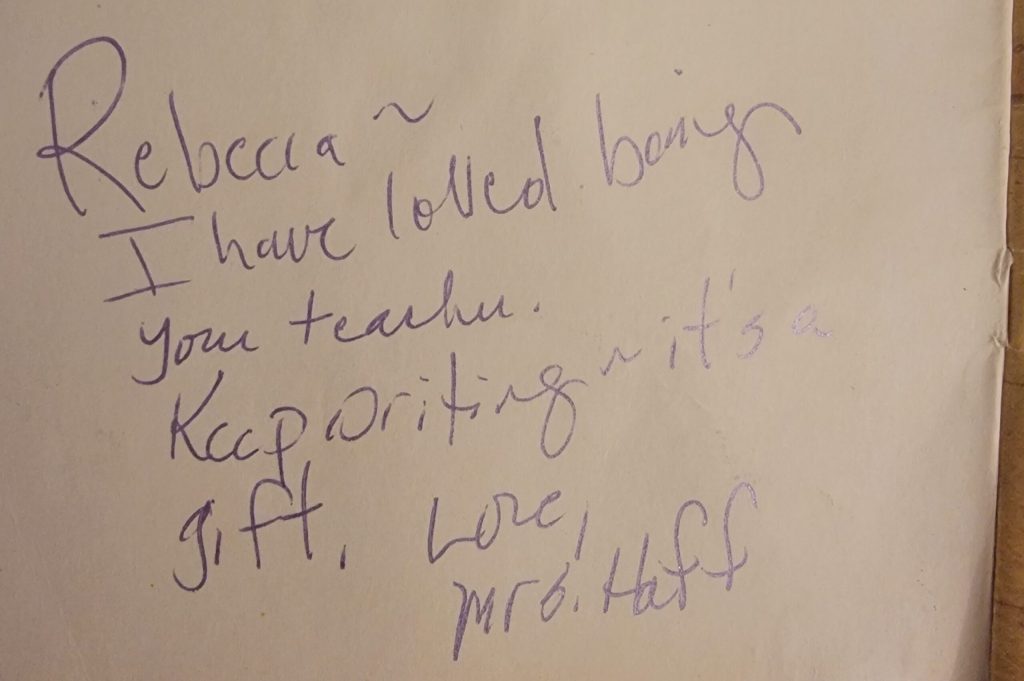
It might not be much, but for a moment, my mind wandered back to a time before SEO and AI and networking and ATS. I saw a little girl with frizzy pigtails writing stories about superheroes and talking potato chips that this same teacher read aloud to the whole class. I saw her, and I remembered why I chose to write in the first place.
Writing is the way I communicate best. It helps me convey my ideas and sort out my thoughts. More importantly, writing is about the human connection through storytelling. It’s something that AI can replicate in a shallow sense, but it can’t convey my voice, my style, or my lived experiences like I can.
One day, maybe AI will live. Maybe it will walk and talk and build connections and experience pain. Maybe AI will actually write rather than generate. Until then, I owe it to myself to keep trying to succeed as a writer. It’s a gift.









Judy
July 10, 2025 at 5:02 pm
It is a gift. Keep on writing.