
I vote, I’ve been to rallies, I’ve been to protests. But I want to resist President Trump as an individual, in my everyday life, instead of just as a part of a group. I recently learned how to do that by repairing a destroyed copy of an old novel.
On April 14th, I was walking to campus. I passed a man who was strolling along and tearing pages out of a book. I watched in horror. There were loose pieces of paper all over the sidewalk. I picked one up and scanned it.
Saving Everything Flows
As I picked the pages up from the sidewalk, I learned that the book was Everything Flows, by Vasily Grossman. Another student, Alex, was doing the same. When I asked, he handed me a bundle of pages that he was planning on recycling.

In a few minutes, I had 124 pieces of loose paper. The man willingly gave Alex what remained of the cover, and Alex gave it to me. Pages 1 to 43 were still in the book. I had pages 44 to 290 in my hands.
Everything Flows had been saved from a slow sidewalk death. But I didn’t feel like much a hero. On the contrary, I felt like I’d thrown one weak punch in a losing battle against a long list of book-banners and destroyers.
The disregard of books
I love books. I love writing them, and I love reading them. That was one of the reasons that I collected the torn pages of Everything Flows. But only one.
I’m Jewish on my father’s side, and proud to be. Watching the random, indifferent destruction of Everything Flows reminded me of what I’d learned about the burning of books that marked the beginning of the Holocaust.
This man was obviously not a Nazi. And I’m only half-Jewish. But it didn’t matter: I had to save the book he had tried to destroy. That need became intensified when I learned about Everything Flows itself.

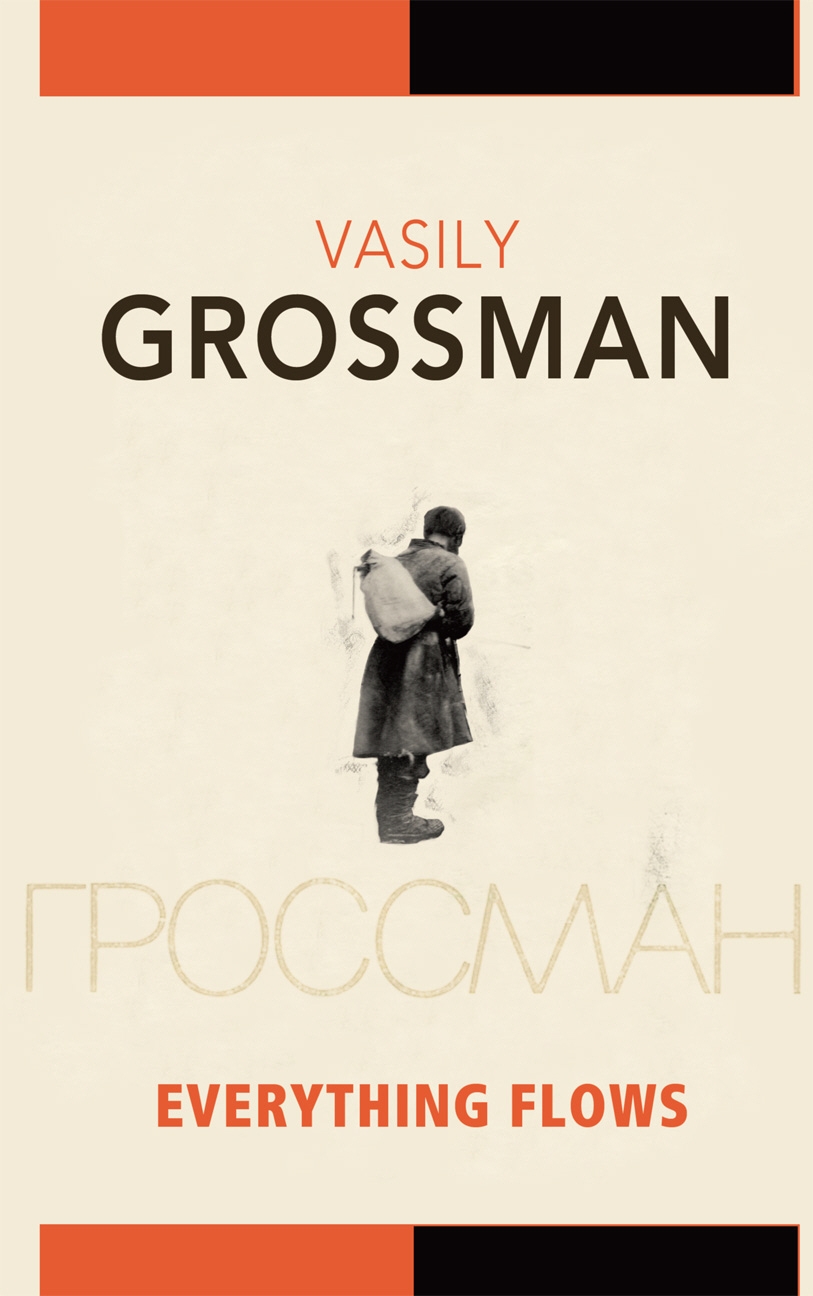
(Credit: Penguin Books Australia)
Everything Flows was Grossman’s final novel. It follows Ivan Grigoryevic after his release from the Gulag. After thirty years of imprisonment, Ivan returns to Moscow and rejoins a Soviet Union slightly thawed by the death of Stalin.
Grossman highlights the moral corruption of people living under a totalitarian government. He wrote it in the early sixties. But it wasn’t allowed to be published until 1989, twenty years after his death.
Stalin’s KGB also confiscated Grossman’s first novel, Life and Fate. He was told that it wouldn’t be read by anybody for at least two hundred years
Grossman was also a journalist. Most iconically, he was among the first to report the horrors of the concentration camps after their liberation. He was Ukranian-Jewish, like me. The Nazi army murdered his mother in the massacre of Berdychiv.

I had this man’s novel—destroyed, pages torn and stepped on—sitting in my room. It was safe now. But it certainly wasn’t readable.
All that I had learned about Grossman, about Stalin’s oppressive rule, about the Holocaust, about the disregard of books throughout history, mixed together. And I decided to repair the book.
Books have a right to exist
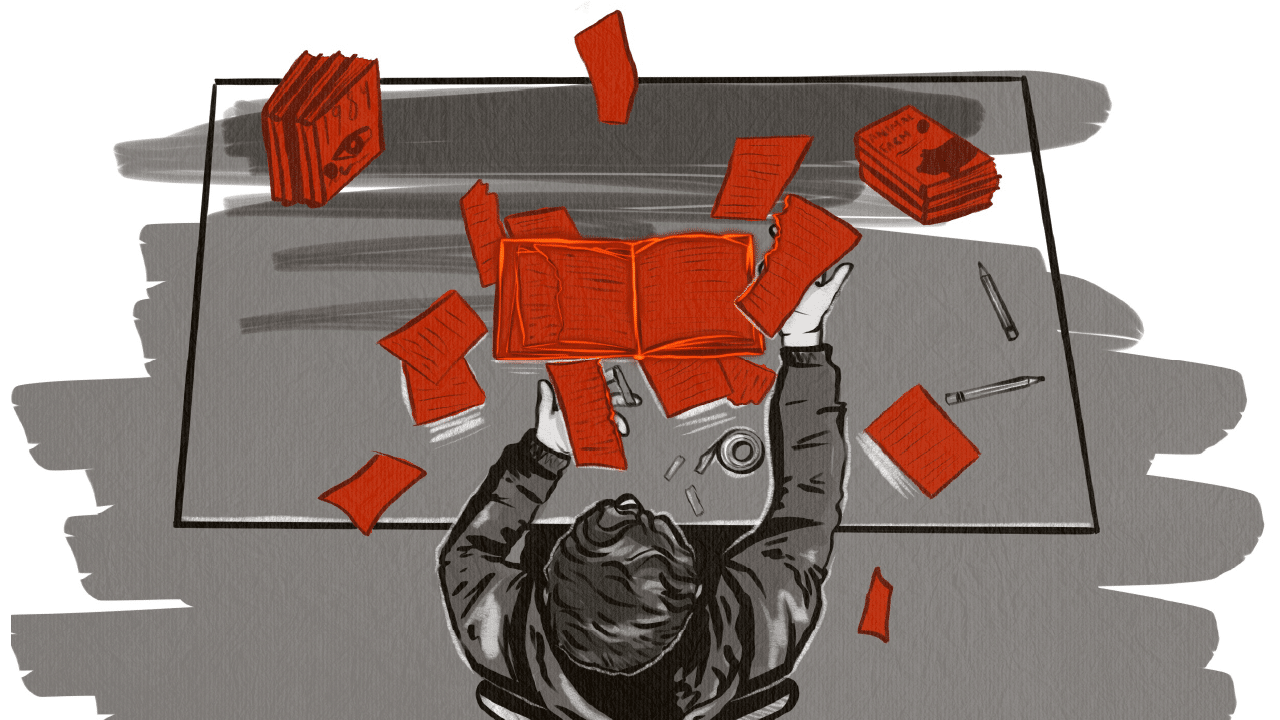
I bought tape, borrowed a pair of scissors from a friend, and cleared my desk. After sorting through the loose papers, I found that I wasn’t missing a single pages, though many were ripped.
It took hours to match the torn pieces with each other. It was like solving a puzzle. Once I found where each scrap belonged, I taped them back together.
As I repaired the book, I thought about Stalin and Grossman and the Holocaust. It reminded me of the state of the world today—specifically, of Donald Trump. As a Jew and as an American, it makes me very uneasy that Trump is my president.
In 2015, before Trump entered the political scene, the American Library Association reported that 233 books had been banned or censored in schools and public libraries. In 2024, that number was 5,813. Under his new administration, it’s easily to imagine that even more books will be banned.
Every book has the right to exist, even horrible books like Hitler’s Mein Kumpf. And that right needs to be defended by those in power. Trump is the figurehead of anti-wokeness. If he said that no book should be banned, book banning would slow down. But he won’t. And it won’t.
Trump doesn’t allow books to be banned out of malice, though. He lets it happen because he simply doesn’t care about any book, banned or not.
Defying indifference

“Indifference, to me, is the epitome of evil.”
— Elie Wiesel, US News & World Report, October 27th, 1986
Elie Wiesel was a Nobel Prize winner and Holocaust survivor. He died in 2016. When he said that indifference is evil, he meant that it is evil to not care. I agree. Trump’s indifference towards books is an evil which reminds me of Stalin’s KGB and the book-burners of the Holocaust. And I want to resist it.
Like many Americans, I vote. I’ve been to protests against Trump. I’ve signed things and sent money to people. And I’m proud to have done that, but I want to do more. I want to live my life, as an individual, in defiance of Trump’s indifference.
But I’m also a student of history. And I have learned that the average person only has the power to change things as a part of a group. The few who enact change as individuals get written into history books. And we can’t all be like them.
If I want to resist as an individual, I have to do it a different way. After repairing Everything Flows, I may know how.
The problem with historical narratives is that they leave out the feeling of a time and place. They have to. You can’t explain how the zeitgeist of 1790s Paris would shape a person, and in turn be shaped by its people, and so spark the French Revolution. It’s too complicated. But that’s how average people like me can resist as individuals—by reshaping the zeitgeist.
The best way to defy Trump’s indifference is to do the opposite: care. When I picked up the pages of Everything Flows and taped them back to life, I was caring for books. By doing that, I brought care into our cultural climate. One less destroyed book.
The more we become a culture of caring and not indifference, the more we will produce people who care, who will produce an even more caring zeitgeist. And eventually, we will create the people and the times which will refuse Trump’s indifference. And things will change.
You should absolutely vote. And you should go to rallies and protests. Resist as part of a group. But you can also resist as an individual, by caring: care for what Trump is indifferent towards, care furiously, care as defiance. Live your life caring.










AP
May 2, 2025 at 4:39 am
I’m happy that you care too.
-Alex
Cheryl Moi
May 7, 2025 at 6:26 pm
Book banning is a way to try and change history. By a man who is so intent on making white men appear heroes. I am white and ashamed to have this man the president of America.