With the playoff race nearing its end, the College Football Playoff Selection Committee is wrestling with decisions that carry major implications.
Before the College Football Playoffs became the norm, deciding on a national champion came with a complex process. Teams were subject to a point system to determine the quality of wins and the strength of their record. The two teams that ranked highest across three polls, combined with the lowest strength-of-schedule points, played for the National Championship. The main flaw in the Bowl Championship Series (BCS) system proved to be the common outcome of multiple teams sharing or claiming their own National Championship due to rankings generated by computer algorithms that relied on a point system. After some top-ranked teams played their bowl games, the computer ranked teams too close to each other to determine a true national champion. After the final season in 2013, the NCAA knew it was time for a change.
That’s where the College Football Playoff and the College Football Playoff Selection Committee came in. For the first time, college football teams that were cut got the chance to play two more weeks. This fresh new look gave teams more of a reason to play hard until the end of the season. Two semi-final games at the sites of major bowl games set the table for the College Football Playoff National Championship. However, with every new system comes criticism, and the playoffs’ criticism spread like wildfire. Teams getting snubbed out, game dates and times, and National Championship locations riled up plenty of fans. No matter how many changes are made, not everyone can be pleased.
Adapt and Survive
The College Football Playoff began in 2014 as a four-team, tournament-style bracket to determine a National Champion. 12 members make up the College Football Playoff Selection Committee, most of them being athletic directors from power four programs. The committee’s job entails nothing more than selecting the teams best suited to be national champions, with emphasis on the regular season where “every game counts”.
Criteria for evaluating teams consists of three major categories: strength of schedule, head-to-head matchups, and common opponents. Strength of record takes the sum of the winning percentages and averages them out. If two teams played head-to-head earlier in the season, the team that won that matchup would get the benefit of the doubt. A team that lost to an opponent who lost a team ranked similarly to them, the other team is rewarded.
In the inaugural College Football Playoff, three teams fought for the fourth and final spot in the bracket: Ohio State, Baylor, and TCU. TCU and Baylor entered the final week of rankings at 11-1 each, with a combined seven wins against ranked opponents. The only problem arose when people realized that the Big 12 conference would not host a conference championship that season. So, when Ohio State won the Big 10 Championship game 59-0, that put them above TCU and Baylor, causing chaos. Former TCU head coach Gary Patterson stated after being snubbed from the 2014 College Football Playoffs, “I thought it was about a committee just looking at tape and seeing the four best teams that are playing the best at the end of the season and choosing them.”
Go Big or Go Home
In the 10 years of the four-team College Football Playoffs, seven different teams representing three conferences won a National Championship. Fans and analysts alike agreed that the constant controversy over the final rankings showed everyone that more teams should be in the mix. ESPN College Gameday analyst Kirk Herbstreit spoke for many when he called out the College Football Playoff Selection Committee, “I thought it was about a committee just looking at tape and seeing the four best teams that are playing the best at the end of the season and choosing them.”
Years of bashing and criticism forced the committee’s hand, so they agreed to expand to a 12-team College Football Playoff in 2024. The decision ultimately came down to a necessity for conference champions to be recognized. The highest-ranked group-of-five conference champion has also reserved a spot thanks to the College Football Playoff. Regular-season matchups carried more weight to them as more playoff spots opened up.

Reaction
After five difficult weeks, the College Football Playoff Selection Committee finally picked its participants. Here’s a look at the bracket, followed by some analysis.
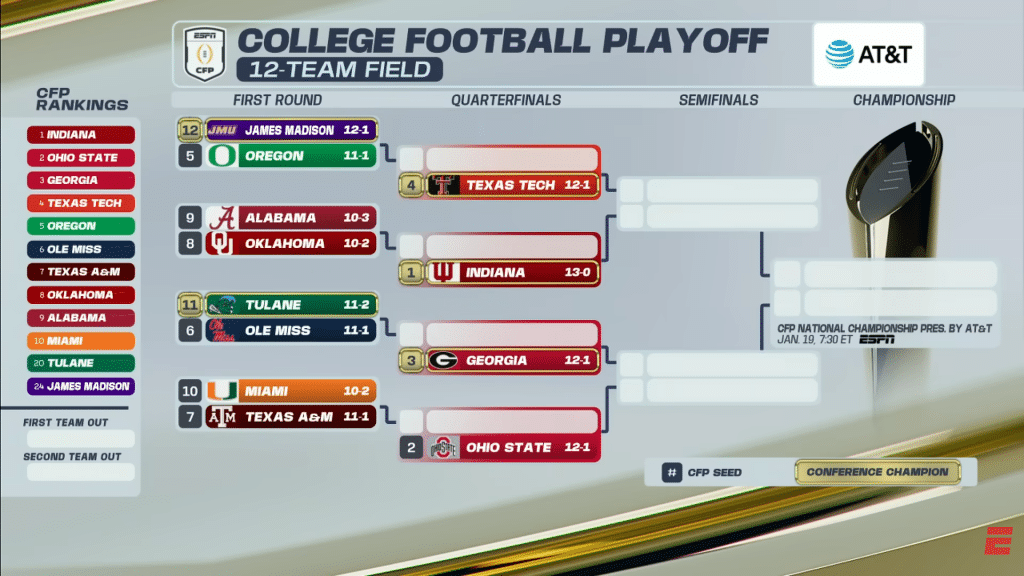
No. 10 Miami (10-2) Jumps No.11 Notre Dame (10-2) in the Rankings
On August 31, Miami defeated Notre Dame by a score of 27-24. After losing their first two games of the season, Notre Dame won 10 straight convincingly. Miami lost two in weeks six and eight to drop below Notre Dame, who continued to roll.
Leading up to the final College Football Playoff Rankings, Notre Dame led Miami as it kept winning. As it came time to make a decision, the Committee took the BYU loss to Texas Tech as an opportunity to move a team up. Ranked behind BYU at the time, Miami moved to the rank right behind Notre Dame. In a demoralizing fashion, the Committee left out Notre Dame for the final non-conference champion spot, giving it to Miami.
Notre Dame fans have the right to be upset, especially with the fact that two group of five teams are in. The Committee also allowed an Alabama (10-3) team that got run over by Georgia (12-1) in the SEC Championship to retain its ranking. Teams should not be punished for losing their conference title, but to lose so greatly is hard to justify. That being said, if Notre Dame joined a conference, their chances of making the playoffs would significantly increase.
No. 24 James Madison University (JMU) Overtakes ACC Champion Duke
Duke (8-5) defeated No. 17 Virginia (10-3), knocking them out of the playoff race. With 7 power four wins and a ranked win on their schedule, Duke confidently stood by their resume. JMU (12-1) won the Sunbelt conference and finished the season ranked No. 24, significantly ahead of Duke. Inherently, JMU got into the playoffs over Duke, despite losing to the only power four team they played, Louisville.
While Duke has a better win-loss record than JMU, a five-loss team does not deserve a spot in the playoffs. They even lost to Tulane, ranked No. 11 in the playoff bracket, earlier this season at home. Sure, JMU may not give Oregon the best game, but they fought hard all year to earn their 12-1 record and a No. 24 ranking in the polls.
Maybe the system is flawed, but teams need to recognize that having “better wins” than another team does not make them more deserving of a spot. There’s a high possibility that the College Football Playoff Committee parts ways with the automatic bids for conference champions. Even if they kept a few automatic bids, this would open up the floor for the teams that always end up on the bubble.