NIL: Name, image, and likeness, the transfer portal, the college football playoffs; What has become of an American pastime?
College football has gone through many significant changes in the last few years, affecting every team. Many years ago, student-athletes were forced to put in hard work to climb the depth chart to earn a starting position. Players were not paid a cent, so everybody had little to live off of in order to get by. To win a National Championship, teams had to convince a board of voters they were the best team. These concepts are far gone, and fans around the country have their gripes about the way things are run. The NCAA and the College Football Playoff committee have made college football into a business rather than a passion.
“I don’t feel appreciated by this coaching staff, and I won’t receive playing time here.” They can use the transfer portal to go to a school where he will be in the starting lineup. “I’m the best player in the country, and I want to be paid for my talent and abilities.” Name, Image, and Likeness deals have made it so that outside organizations can sponsor players with huge deals. “My team finished 10-2, and I believe that we can compete with any team ranked above us.” The College Football Playoff Committee, with help from the NCAA, made the postseason playoff for 12 teams.
How NIL changed college football forever
In 2014, former UCLA basketball player Ed O’Bannon took a stand against the NCAA for violating antitrust laws. The concern came from the use of the student-athlete’s name, image, and likeness in the video game NCAA Football 14. The antitrust laws in place would’ve allowed for compensation for former and current student-athletes. The NCAA clearly violated the law by prohibiting compensation to these players, and they were forced to settle. Seven years after the settlement, providing limited compensation, the NCAA changed its policy to allow compensation to players for their name, image, and likeness (NIL).
Since the birth of NIL, organizations founded or owned by alumni or supporters of a university are becoming beneficiaries. These organizations are known as collectives, and along with other donors, they create many opportunities for student-athletes. Big-name schools can pull together millions of dollars for their student-athletes just from their name, image, and likeness. Endorsements, sponsorships, autographs, and appearances are all on the table for student-athletes to be paid. Some athletes, especially in college football, are able to earn over eight figures due to these endorsements.
During these years of triumph and success for athletes and universities, controversies arose with collectives. The overstepping came when collectives were accused of influencing transfer prospects and high school prospects to commit to their school. Collectives and their ability to offer players money leveled the playing field, as every team was now able to pay for a player, not just the top programs. While the playing field may be more even, the top programs still have the largest system of donors, who are willing to spend more money. It shouldn’t be that the program with the wealthiest alumni or supporters should be able to create the best roster by throwing money around. Most college football players deserve to be paid, but it can’t turn into free agency where players hold out for more money.
Current James Madison University backup QB Matthew Sluka turned the NIL conversation on its head when he was at UNLV last year. Sluka had confirmation that he would receive $100,000 in NIL benefits before the season started, and those benefits never showed. So, in retaliation, Sluka decided he would sit out the remainder of the season until he received the benefits.
This is not a professional sport, so stop giving the impression that student-athletes can act as professionals.

The transfer portal carousel
Around the same time as the NIL sanctions came into the picture, the transfer portal evolved. The transfer portal used to be a place where young players went to try their luck at a smaller school for playing time. Their coach had to sign a release, and the player sat for a season, counting as a year of eligibility they gave up. Players went out of their way to explore options, not receiving giant offers from other schools. Education played an important role in a player transferring, as they graduated more often due to the one-year-off rule. In 2021, that rule went out the window, and players transferred freely, without having to sit for a season and lose a year of eligibility.
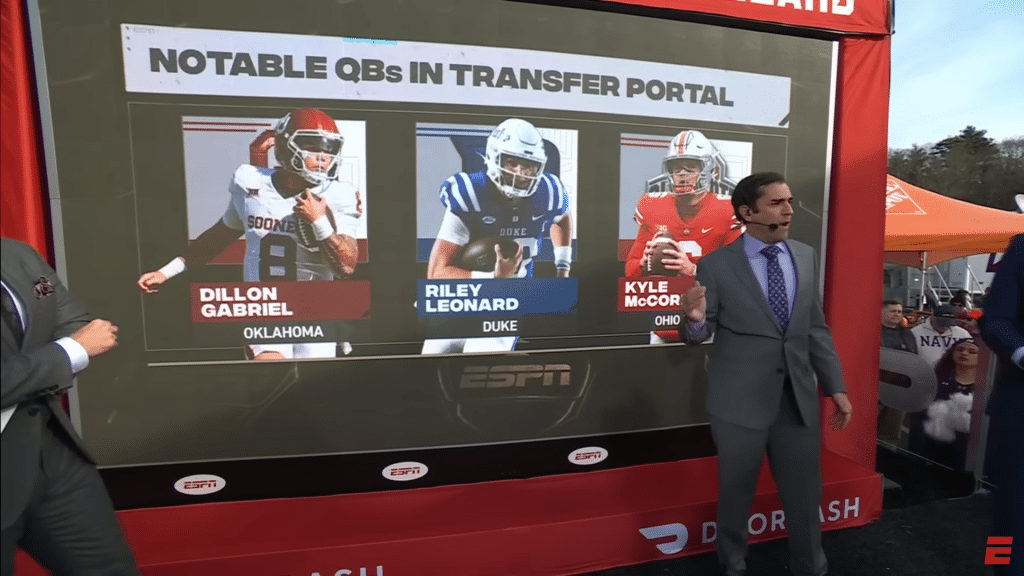
The transfer portal exploded with the news of the “one-time transfer” rule set in stone. Since then, there were two transfer windows for players, allowing them to go through the process to their next institution. Just recently, the NCAA eliminated the second transfer window in the spring, so that players couldn’t leave during spring practice and struggle to get acclimated at another school. The realization that programs will have to manage the portal along with high school recruits inflicted internal change. Programs across the country began hiring for general managers and transfer portal recruiters to adapt. General managers run the program’s NIL finances and determine how they distribute that money to players. Portal recruiters perform the same job as high school recruiters, but officials monitor them more closely for tampering.
Georgia State QB TJ Finley is the perfect example of a player using the transfer portal to his advantage. Finley is currently in his sixth year as a Division I QB at his sixth different school. After starting five games at LSU freshman year, the two years he spent at Auburn qualified him for two more years of eligibility. Finley showed that he could play QB at the highest level, but the more he transferred, the less of a spotlight he earned. He battled injuries later in his career, but when he came back with high expectations, he failed to deliver. Overuse of the transfer portal is a curse because it is harder to gain trust from coaches and other players. Advertisement of the transfer portal is unrealistic because it gives players false hope of starting over.
The college football playoff
The 2014 BCS National Championship game was the last edition of this postseason format before everything changed. Before the 2014 season, the NCAA collaborated with college football executives to instate a new playoff format, a four-team bracket.
Alongside the bracket, the College Football Playoff Committee arose so that voters could decide who plays for a National Championship. The 13-member committee surveyed and broke down film for every championship-caliber team in the hunt. College football higher-ups felt that a system of evaluation not based on polls or computer rankings would draw more attention.
From 2014 to 2023, the College Football Playoffs gave four teams a shot, based on record and strength of schedule, to participate in two of the New Year’s Six Bowl Games (Peach Bowl, Sugar Bowl, Cotton Bowl, Rose Bowl, Fiesta Bowl, and Orange Bowl) to play for a National Title.
In 2024, the NCAA and the College Football Playoff Committee introduced a new format for the postseason. This format included 12 teams, with four first-round matchups and four first-round byes for the highest ranking conference champions. It’s what the people asked for: more opportunities for teams that lose too many games to win a National Championship. Programs and fans complained immensely for years when only four teams could make the postseason, when they felt as if their team could compete with those teams. An interesting anecdote that the committee included is that the highest-ranked group-of-five conference champion received an automatic bid to the playoffs. This helped many group-of-five teams by motivating them to push for the playoffs, where much more money for their program lay.
With the change in playoff format, the main difference is that the regular season does not matter as much for blue-chip programs. If they could get into the playoffs with two, maybe three losses, those losses wouldn’t deter them from continuing their season. While players and coaches get relief from this, it takes away from the passion and intensity of college football. When two rivals meet at the end of the season with fewer than two losses, losing hurts less. That’s not how it should be. Rivalry games should always matter and must never lose their importance. As for the playoff, first-round byes give too much time off for the recipients, at nearly a month. Teams that win their conference and get a bye have a disadvantage against first-round teams because of their schedules.
What’s next for NIL, the transfer portal, and the college football playoff?
College football clealry requires changes, but how much change is too much?
- NIL deals need regulation due to threats of outside influence on players’ decision-making
- The transfer portal should return to its original state, forcing transfers to sit out for one season before playing
- The College Football Playoff should consider an incentive for a rivalry win, like more points towards a higher seed

The landscape of college football looks more and more like the NFL every week, and that’s not good for the sport. College Football is a sanctuary where student-athletes play for their school, in front of thousands of fans, and they show their dedication, loyalty, and passion for the game in the way they play. Fans and alumni alike live and die for their team, and the current state of college football is taking that away. Sure, big games draw millions of viewers, but what is the players’ purpose anymore? Are they playing to show love to the students, alumni, and fans? Or, is it a major endorsement deal or transfer opportunity that they’re after?
College football back in the day wasn’t perfect, so changes came about. However, those changes have millions of fans wishing they could go back in time. Has college football become just a pathway to the pros? Where has the love for the game gone?