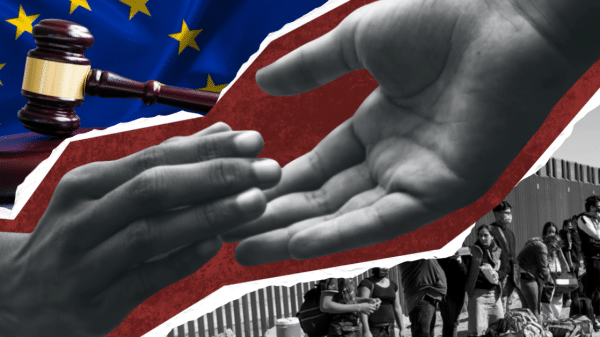


Many Americans grow up believing that if something is legal, it must be right. History, however, repeatedly shows how flawed that belief can be. The history of slave patrols and immigration enforcement, in particular, reveals how deeply that assumption fails.
This belief feels comforting because it suggests injustice happens only when laws are broken or when individual officials abuse their power. In reality, American history tells a different story. Some of the worst harms in this country were not accidents. Lawmakers authorized them. Governments organized them. The state enforced them.
For decades, hunting down escaped enslaved people was legal. Today, aggressive immigration enforcement is also legal. Yet legality does not equal morality. Across U.S. history, lawmakers have repeatedly used legality to give immoral systems the appearance of legitimacy.
Government organized slave catching
Historically, slave patrols were not spontaneous mobs or isolated vigilantes. They formed one of the earliest organized systems of policing in the American South.
Dr. Lucien Holness, an assistant professor of history at Penn State University, explains that slaveholders initially created early patrols themselves. As the enslaved population grew, colonial governments gradually converted those private efforts into official, state-sponsored forces.
South Carolina established a formal slave patrol in 1704. Virginia followed in 1727. North Carolina did so in 1753.
Local governments controlled daily operations. In some colonies, militia leaders supervised patrols. In others, county courts appointed patrol members. Regardless of structure, slave patrols functioned as part of the legal system.
Communities did not treat slave catching as criminal behavior. They treated it as a civic duty.

What slave patrols were designed for
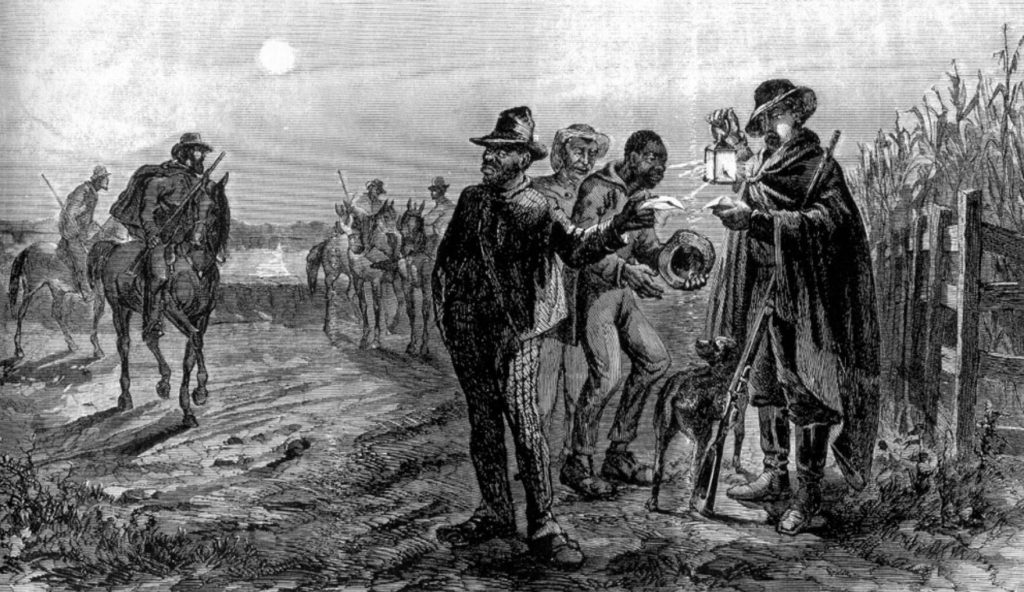
Slave patrols did not focus on solving crimes. They focused on monitoring and controlling enslaved people.
Patrollers enforced slave codes that regulated nearly every aspect of life: movement, gatherings, travel, and behavior. Enslaved people were required to carry passes. Free Black people were often subjected to the same scrutiny.
Patrollers stopped Black people, questioned them, and demanded proof of identity.
No crime was required. Mere presence triggered suspicion.
In effect, slave patrols targeted who people were and what they looked like, not what they had done.
That model did not disappear. It evolved into new legal forms, carrying the same underlying logic.
Immigration enforcement and slave patrols share a structural logic
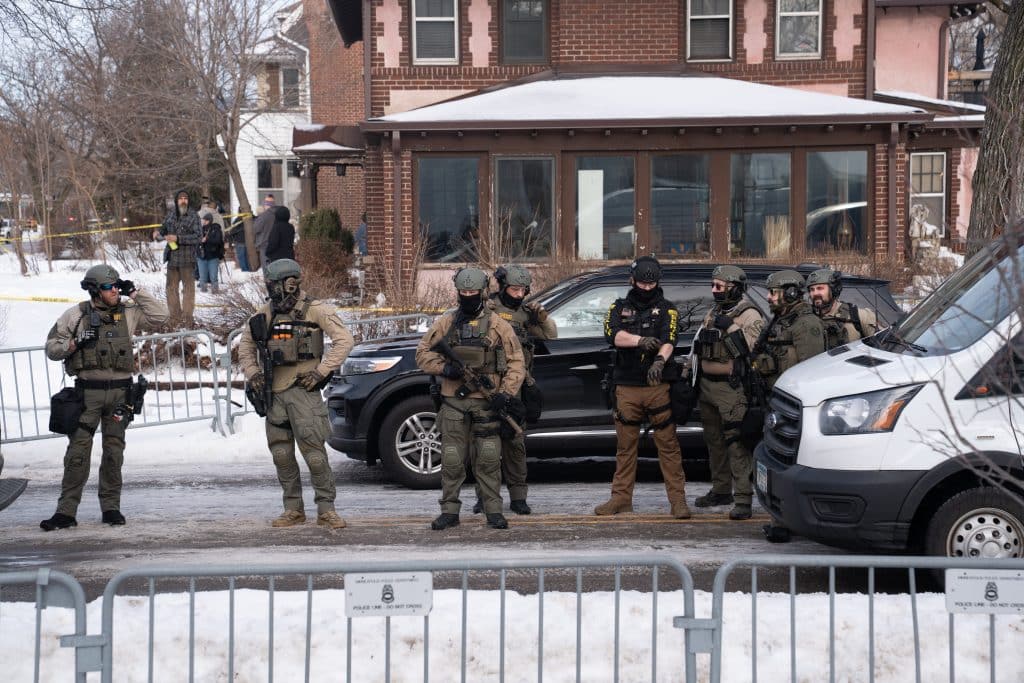
Some argue that immigration enforcement is simply about managing borders and enforcing administrative law, not controlling people based on identity. But in practice, the system does not operate neutrally. It operates through discretionary suspicion shaped by race, language, and appearance.
The comparison highlights something more specific: both systems rely on suspicion about identity rather than evidence of wrongdoing.
Today, Immigration and Customs Enforcement operates under federal law. Agents stop people, question them, and demand proof. Officers decide who belongs and who does not. And in practice, agents frequently exceed even these broad legal powers, further compounding the harm.
Like slave patrols, ICE does not begin by asking, “What crime did you commit?” Instead, officers ask, “Do you have the right papers?”
Even that standard proves unstable.
Agents stop immigrants with visas. They stop permanent residents. They stop people with valid documentation. They also stop U.S. citizens.
Investigative reporting by ProPublica found that more than 170 U.S. citizens were detained by immigration agents in a single year, often despite asserting their citizenship or presenting identification.
Legality does not prevent error; it simply legitimizes the process.
When policy becomes personal
The real meaning of this system becomes clearest when it shows up in ordinary people’s lives.
In Minnesota, Immigration and Customs Enforcement detained a five-year-old boy named Liam Ramos and his father as they arrived home from school. According to school district officials in Columbia Heights, the two were taken into custody in their driveway and later transported to a detention facility in Texas.
The boy’s father had an active asylum case and possessed documentation showing that he and his son entered the United States at an official port of entry. There was no standing order for their deportation, according to the family’s attorney.
Zena Stenvik, the district superintendent, said that when she arrived at the home, the father’s car was still running and both father and son had already been apprehended. She reported that an agent removed Liam from the car and instructed him to knock on his front door to see if anyone else was inside. Another adult present at the home begged to take responsibility for the child so he could avoid detention. Agents refused.
Roughly twenty minutes later, Liam’s older brother arrived home from school to find that his father and brother were gone.
As reported by The Guardian, the family’s attorney stated that they followed all legal procedures and were seeking asylum through the system. “They did everything they were supposed to,” he said. “They did not come here illegally. They are not criminals.”
This was not a response to violence.
It was not a response to danger.
It was enforcement.
It was enforcement based on who someone is and what papers they carry, not wrongdoing.
Who actually gets targeted
Supporters of aggressive immigration enforcement often claim that harsh policing is necessary to keep communities safe.
But research tells a different story.
A multi-year study published in the Proceedings of the National Academy of Sciences found that immigrants, including undocumented immigrants, are less likely to be arrested for felonies than people born in the United States. Undocumented immigrants, in particular, were about half as likely to be arrested for violent and property crimes.
In other words, the people most aggressively targeted by immigration enforcement are statistically less likely to commit serious crimes.
So enforcement is not driven by danger.
It is driven by perception.
Skin color. Accent. The way someone looks or sounds.
Agents often detain people first and sort out their legal status later.
Some are released. Others remain in detention. Many are deported.
This is not policing based on criminal behavior.
It is policing based on identity.
Policing identity creates a dangerous power
This kind of policing allows the state to detain people not for what they have done, but for who authorities believe they are.
Slave patrols possessed this power.
ICE possesses this power.
Agents do not need to witness harm. They do not need evidence of danger. Suspicion alone is enough.
Because race, language, and appearance shape suspicion, this power becomes deeply racialized.
Justice flips.
Instead of investigating wrongdoing, authorities begin with capture.
Instead of proving guilt, they assume illegitimacy.
When the law defines entire groups as potentially illegal, cruelty becomes easy.
When law criminalizes compassion
Under slavery, the law did more than allow cruelty. It punished compassion.
Helping enslaved people escape was illegal. Harboring fugitives was illegal. Providing food or shelter was illegal. The legal system framed mercy itself as a crime.
The Underground Railroad operated entirely outside the law. People who participated knew they were breaking it. They also knew they were doing the right thing.
The legal system did not malfunction.
It functioned exactly as designed.
Modern immigration law authorizes detention, family separation, and deportation. At the same time, it can punish those who help immigrants avoid enforcement.
Once again, the law protects a system that causes harm and casts resistance as wrongdoing.
Harriet Tubman is remembered as a hero. In her lifetime, the law called her a criminal.
That contradiction is not an exception.
It is a pattern.
What legality cannot decide
The question is not whether immigration enforcement is legal. It is whether legality should be treated as proof of justice.
History suggests otherwise.
Slave patrols were legal. Returning escaped enslaved people to bondage was legal. None of these systems was right. They were violent hierarchies protected and sustained by government authority.
Today’s immigration system operates through the same basic logic. It permits families to be separated. It allows children to be detained. It authorizes the removal and imprisonment of people who have committed no crime.
Calling these actions legal does not make them moral. It only means they have been given official permission.
Just as Americans do not excuse slave patrols today because they were legal, modern immigration enforcement cannot be excused simply because it operates under the law.
Legality did not make those systems moral. It does not make this one moral either.
The real question is not whether immigration enforcement is legal. The real question is whether Americans will continue to confuse legality with justice — or whether they will finally learn from history.