


Chicago is under pressure. National headlines are circling the city as President Trump ramps up federal enforcement: ICE agents are storming homes and businesses, and the Texas National Guard has crossed state lines and set up near Chicagoland. Armed agents have raided apartments, launched tear gas, and grabbed people off the street, all without warrants. It doesn’t feel theoretical anymore. It feels like escalation.
That’s why I called my grandmother.
She’s 79 now, but decades ago, she was a journalist in the Philippines during Ferdinand Marcos’s Martial Law regime. She knows what it’s like to watch an authoritarian government clamp down, slowly and then all at once. Her name is Melinda—and what she lived through is starting to feel familiar.
The city holds its breath
In just the last month, Donald Trump has publicly threatened to send the National Guard into Chicago, framing it as federal intervention to combat crime despite a decade low in violent crime rates. On September 6, he posted a “Chipocalypse Now” meme suggesting military-style crackdowns, and authorized sweeping ICE raids under Operation Midway Blitz.
By September 12, he backtracked, claiming troops would go to Memphis instead, but his administration has only increased its federal enforcement here, sparking protests. Meanwhile, ICE agents have terrorized the people of Chicago, snatching people off the streets, raiding homes, and entering schools and places of business without warrants. As a result, protesters have surged to the ICE facility in Broadview, clashing with authorities as tensions rise over reports of detainees held inside.
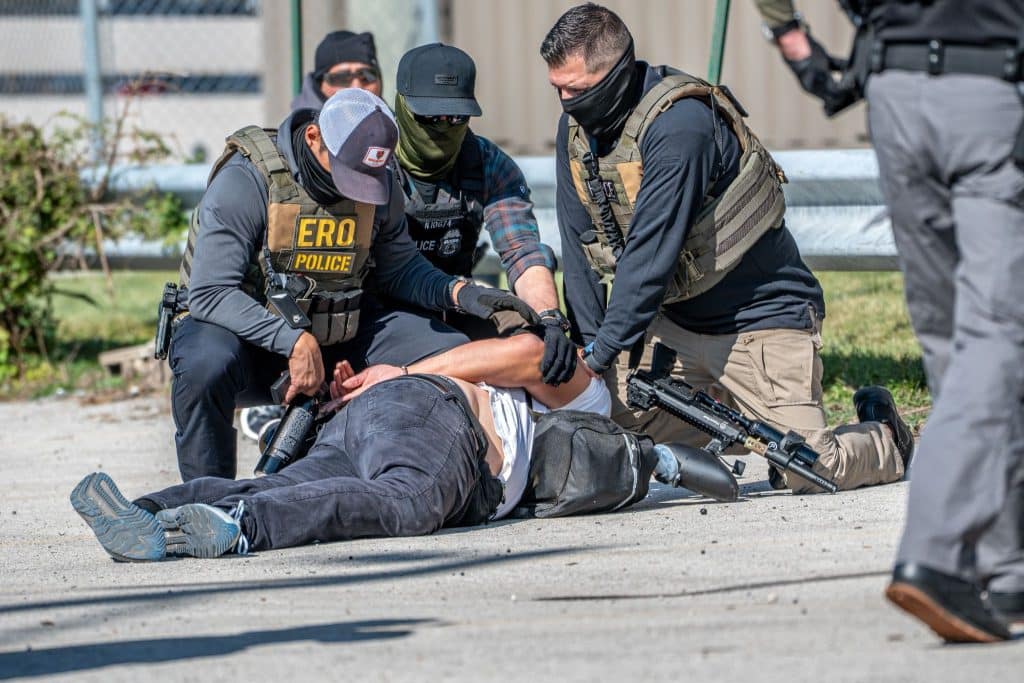
As of October, Texas National Guard troops have entered Illinois and established a presence near Chicagoland, defying state leaders who are now locked in legal battles to drive them out. ICE has escalated its tactics as well, storming an apartment complex in the South Shore with the use of Blackhawk helicopters, flashbangs, and tear gas against American citizens.
Meanwhile, citizens of Chicago are left in uncertainty: how long must we live in this state of suspended dread? The question remains: is the National Guard deployment just another flashpoint, or are we in the opening act of something deeper and more permanent?
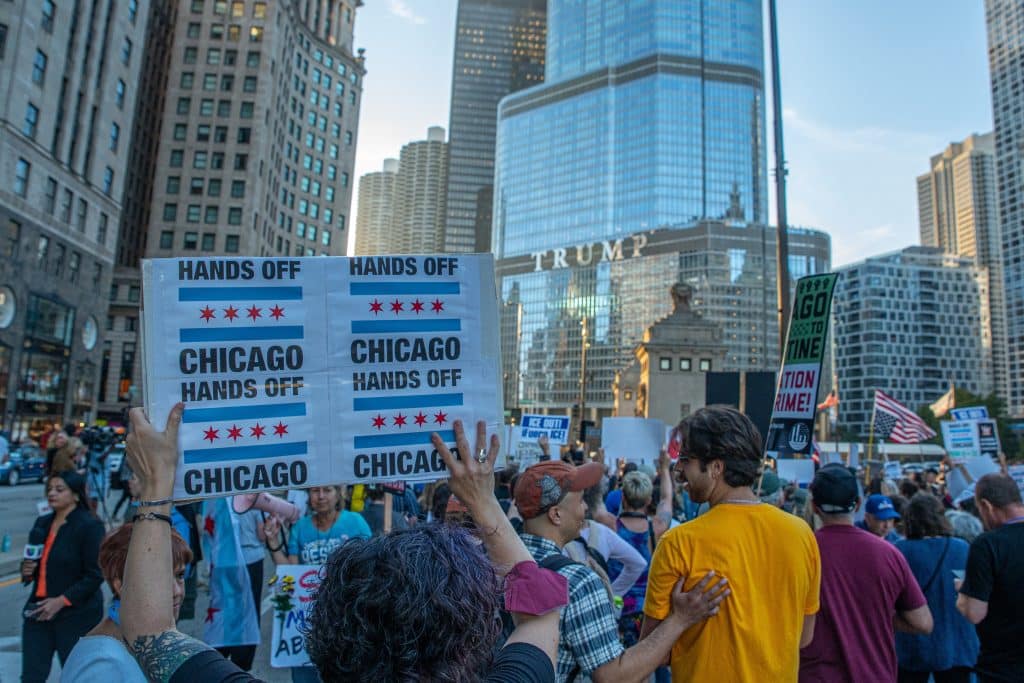
Also, I’ve been here the whole time.

Yeah, it’s weird. It’s weird to see your own city start to move differently. The broad shoulders feel tighter. Sirens feel louder, like they could be accompanied by the orders of masked soldiers demanding identification. It’s not just policy shifts and headlines, it’s the texture of our lives. The Charlie Kirk assassination still hangs in the air like the sharp, unmistakable sting of gasoline in your kitchen: an omen you can’t ignore. Trump followed it by lobbing a meme like a grenade, practically declaring war on the city, allowing ICE to terrify us, and the National Guard to effectively occupy us. Now, every new headline feels like a tripwire. Chicago isn’t wondering if we’ll cross the line—we’re bracing for when. The “what if” has already begun to blur into “what now.”
So what now?
My Lola, the martial law journalist
That’s what I asked Melinda. She’s 79, and she was a journalist during the Philippines’ period of Martial Law and the People Power Revolution in the Philippines. She’s also my Lola—my grandmother. In long overdue conversations between loved ones separated by distance and generation, I asked Melinda about her experiences reporting the news during that time of political turbulence and societal uncertainty.
In 1972, Philippine President Ferdinand Marcos declared Martial Law, citing growing political unrest and an encroaching communist threat. What followed was a full-scale authoritarian crackdown consisting of deployment of the National Guard, military presence, enforced curfews, and the suspension of civil liberties. Political opponents were jailed, and thousands were tortured, disappeared, or killed. Marcos had rewritten the Constitution to maintain his power indefinitely.
Primarily, the first casualty of Marcos’s reign was the freedom of the press. Upon declaration of Martial Law, military forces literally padlocked and seized control of the country’s major newspapers, radio stations, and TV networks. Entire publications vanished overnight, and only government-friendly outlets (run by Marcos allies and his cronies) were allowed to reopen. All news items had to go through the Department of Public Information (DPI) before publication or broadcast. Marcos’s Proclamation 1081 gave him legal cover to “sequester” or “regulate” the press for “national security.”
Melinda started her career as a reporter and editor for a politically oriented magazine during these times. She had never intended to become a political writer when she started her career. She made a conscious choice early in her career to steer clear of anything that might brand her, in the Marcos regime’s eyes, as a radical or anti-government writer.
As the corruption and brutality of Martial Law escalated, Melinda stepped up. She and three other women used their op-eds in Bulletin Today to challenge the regime directly—“teasing” and “tweaking” its hypocrisy in print, even as fellow journalists were being silenced, arrested, or disappeared.
Suddenly, Melinda and her fellow writers at Bulletin Today stood out as some of the only journalists in the country willing to, in her words, “have the balls to criticize the government.” The irony? They were all women. Four liberal columnists—raised in conservative households, shaped by religious schooling—were defying the regime from inside the margins. To many, they seemed like a novelty: unlikely rebels hiding sharp critique beneath polished, proper exteriors.
The government’s crackdown on press freedoms
The Marcos regime tried to preserve the illusion of democratic normalcy by allowing them to keep writing. Their presence became a talking point—proof, supposedly, that press freedom still existed. After all, if four liberal women could criticize the government in print, how could it be a dictatorship? But it was. They were “safe” critics: educated, Catholic, non-radical, not communist, not subversive. Just respectable women from respectable families, using their columns to raise uncomfortable questions.
However, that didn’t stop the inquisitions from the government. The death threats. The surveillance. The regime didn’t just tolerate their criticism; it tracked it. Melinda and the other women knew the government had their names, knew where they worked, and knew exactly where they lived.
One day, Melinda’s publisher called the women into the office and told them that the President himself had approached the publication in an attempt to suppress the news, inquiring about information on these four women. To protect the writers, Melinda and her cohort were “eased out” of their positions as columnists. The window of permissible dissent had shrunk. The Marcos regime could only tolerate so much truth before it began to lose its grip on the narrative.
That’s when the alternative press emerged. A grassroots, church-backed effort to publish the truth manifested in the forming of Veritas, a Catholic newsweekly standing at the forefront of free press. Backed by its ties to the Catholic Church, Veritas operated with more freedom than other alt-press outlets. The regime hesitated to openly target clergy, knowing the Church mirrored the people—devout, diverse, and not inherently rebellious. While rival editors were arrested or vanished, Veritas kept printing. Melinda joined the newsroom, rose to associate editor, and used her platform to speak truth to power.
When democracy disappears
Life under Martial Law, as Melinda described, was eerily calm. At the beginning, the National Guard had already locked up, shut down, or killed any open opposition to the regime. What followed next was a decade of strict control, as life changed overnight for the average Filipino. Curfews weren’t just enforced—they loomed. Melinda told me about the nerves of staying too late at a party with my grandfather, knowing that missing curfew didn’t just risk a warning or fine. It could mean getting picked up by soldiers and disappearing into the regime’s grasp.
Checkpoints dotted the city, and at any moment, you could be stopped, questioned, or arrested. The suspension of habeas corpus meant there was no need for a warrant, no charges necessary. You could simply vanish. It is at this point in the article I ask the reader to examine our current political climate, as well as the current situation developing in Chicago.
At first, many Filipinos downplayed the severity of what was going on before their eyes. “The regime justified its crackdown on civil liberties by claiming every measure was necessary to defeat the communists.” That narrative, propagated by the regime itself, permitted people to look away. Marcos sold Martial Law as discipline and necessary order. Some even called it “martial law with a smile.”
However, in rural provinces and poor communities, the smiling mask slipped. Activists were abducted. Ordinary people were killed without due process. Living outside the regime’s favor meant living in fear. And for my Lola, who dared to poke the bear itself and associate with these free-speaking journalists targeted by the state, it often felt like that fear never left.
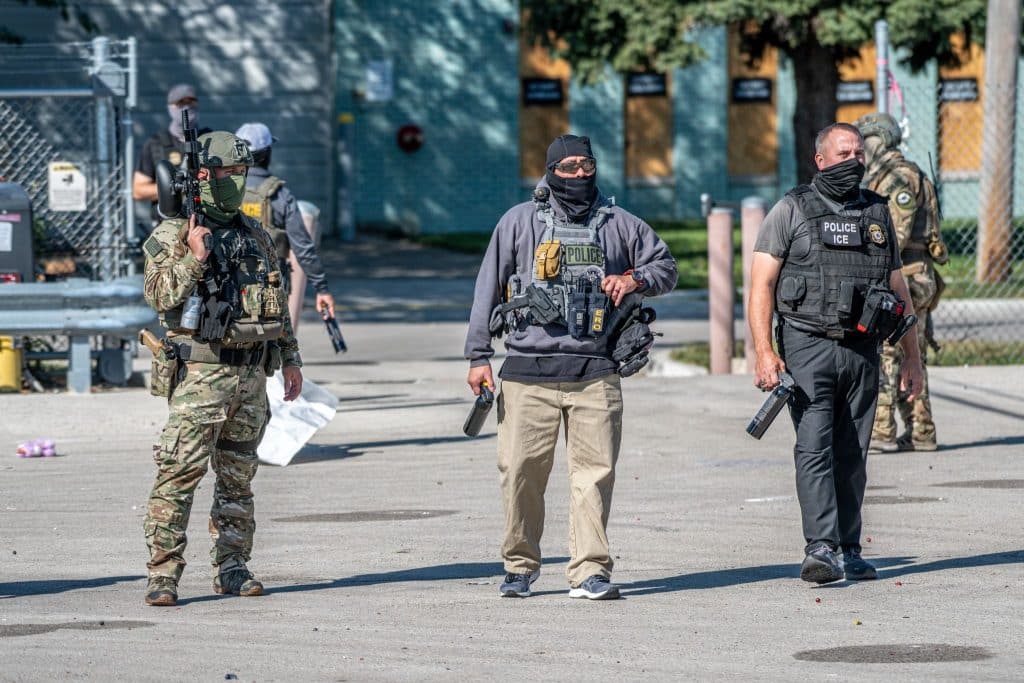
When democracy disappears, so does your right to meaningfully object. Joining a student organization, hosting a discussion group, or even reading the wrong article can all become dangerous acts. For many in a period of danger, silence was the safest option. Though the regime staged the illusion of democracy with rigged elections, handpicked parliaments, and carefully tolerated critics like Melinda, it wielded unchecked power behind the scenes, silencing dissent and stripping people of their civil liberties, using agencies like the National Guard or ICE equivalents to enforce their power.
Our President, Donald Trump, has officially designated Antifa (short for “anti-fascist”) as a terrorist organization, despite it not being a formal organization in any traditional sense. Trump purports to make an enemy of a specter with no central leadership, no official membership, and no clear hierarchy, just a loose ideology adopted by various left-leaning protesters who oppose fascist, racist, and authoritarian movements, sometimes through direct action. And now, they have made Chicago it’s enemy.
Civil advocates—including my grandmother—worry this label rests on murky legal ground. U.S. law doesn’t allow the government to ban movements outright (and hopefully never will). But Trump’s rhetoric has blurred the line between protest and terrorism, giving cover for targeting people based on appearance, beliefs, or vague association. It also allowed him to paint Chicago and its citizens as targets.
This is not a new tactic.
Under Marcos’s martial law, vague labels like “communist” or “destabilizer” justified arrests, torture, and indefinite detention. The regime used ambiguity—much like Trump officials labeling Antifa—to crush dissent and centralize power. Today, branding protest as terrorism lays the same groundwork. History shows this rhetoric paves the road for repression.
How do we move forward?
You and I stay awake in the small hours, wondering why our generation has to watch history repeat itself in real time.
But that’s why I called my Lola.
To ask: what did you do then?
To ask: what do we do now?
Did the fear ever let up? Did it ever make sense? I wanted to know if the dread my generation carries—the doomscrolling, the grief, the creeping sense of dread because we’re all just waiting for the next push notification to tell us something irreversible is about to happen—if any of that was familiar to her. If the ache we feel today has merit, or if it is a symptom of being too online, too informed, and too overwhelmed to function. Because sometimes, it’s hard to tell the difference between foresight and fatalism. So I asked her: Did you ever feel doomed?
And she said no.
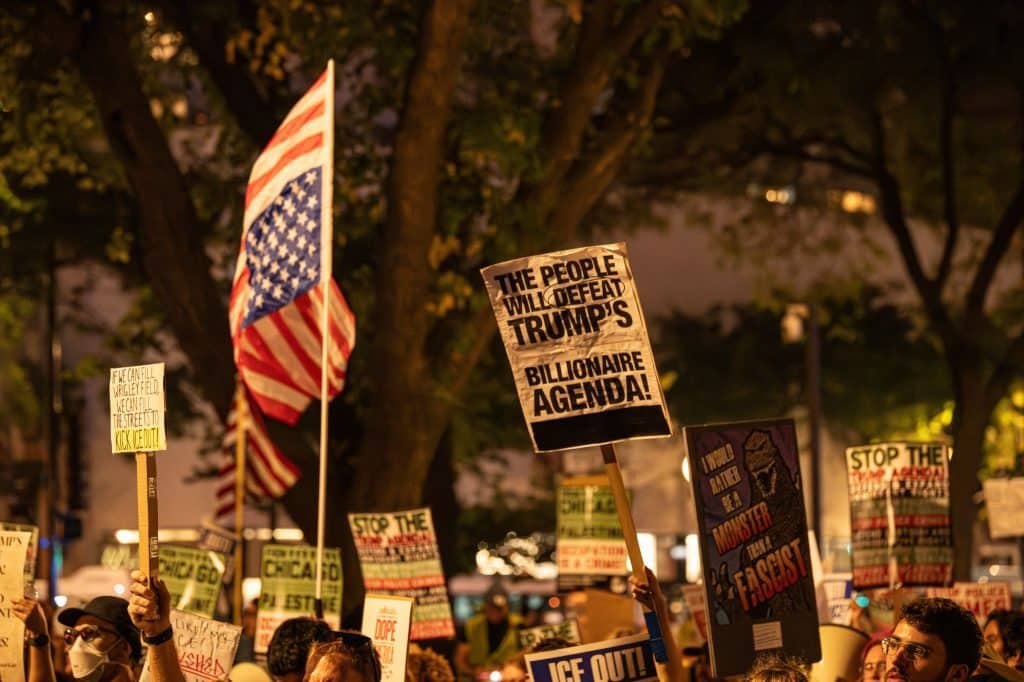
She told me that change doesn’t happen by accident.
What keeps people going? For her, it was prayer, but not just in the religious sense. Prayer as an expression. As conviction. As belief that a better world is still possible. Elections, she reminded me, aren’t just about casting a vote. They’re about the building of movements, of political communities, of meaningful conversations between people who may disagree but still share a vision worth fighting for.
It’s easy to feel like the system is broken beyond repair. But when something’s broken, you fix it. You don’t abandon the idea of fixing altogether.
So, for Americans, and the people of Chicago especially, we must find leaders or become them. We link arms with one another—journalists, organizers, artists, kindred spirits, or anyone willing to signal, to voice, to imagine. Movements begin in dialogue. In courage to stand up against the abuses of ICE and the National Guard. In the refusal to let fear dictate the future.
That’s what she did, back then. That’s what we can still do, now.








Ed C. de Jesus
November 30, 2025 at 9:00 am
Instructive piece, CJ. You retrieved useful information from your Grandma. Keep writing. EDJ